

Mount Vesuvius Tours and Crater Tickets
1,281 metres, silent since March 1944, and sold 26 times out of 28 as the second half of somebody else's day.
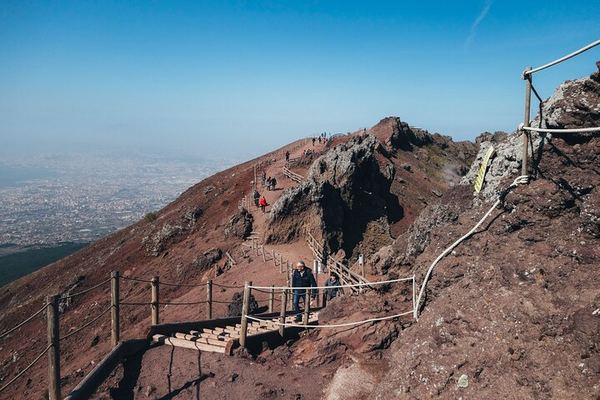
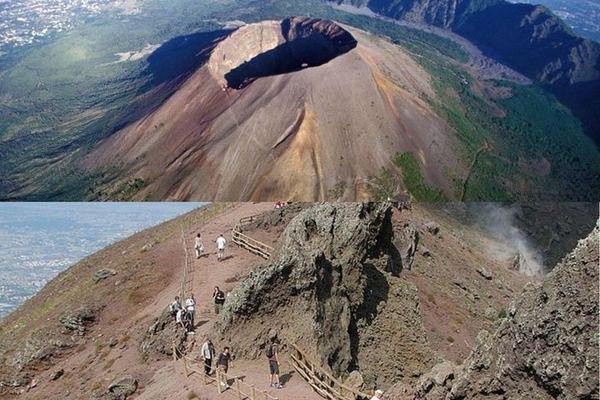
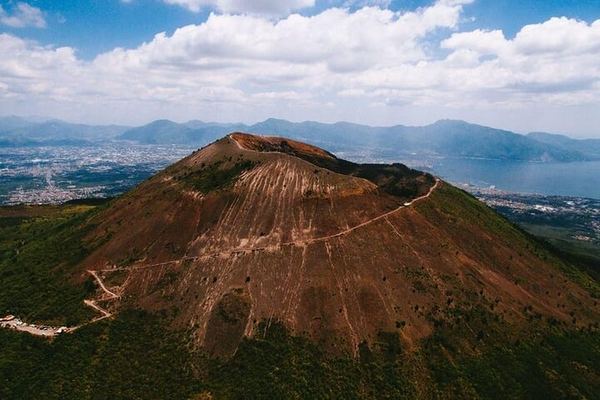
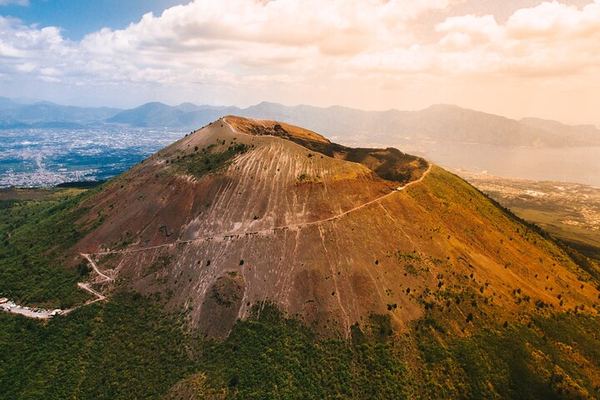
Vesuvius is 1,281 metres of volcano standing inside the wreck of an older and larger one, a dozen kilometres from the middle of a metropolitan area of three million people. It has not erupted since March 1944, when lava took the village of San Sebastiano and the ash falling on the plain below wrecked dozens of American bombers parked on the airfields there. The whole mountain became a national park in 1995. What you go up for today is path no. 5, the Gran Cono: four kilometres there and back from San Vito, which the park rates as low difficulty and allows two and a half hours for, walked in the company of one of its own volcanological guides, whose service is inside the ten euro ticket.
This page is about the mountain. The four pages under it are the four ways the market sells it, and they are not variations on one product. A combined Pompeii day runs seven to ten hours and puts several kilometres of Roman paving under your feet. A winery visit is lunch with a view. A crater ticket is a bus and an entrance. The distinction matters because the crater itself is a couple of hours of your life at most. Everything else in a Vesuvius listing is what the operator has attached to it, and that attachment is what you are really choosing between.
Choose a destination in Mount Vesuvius
-
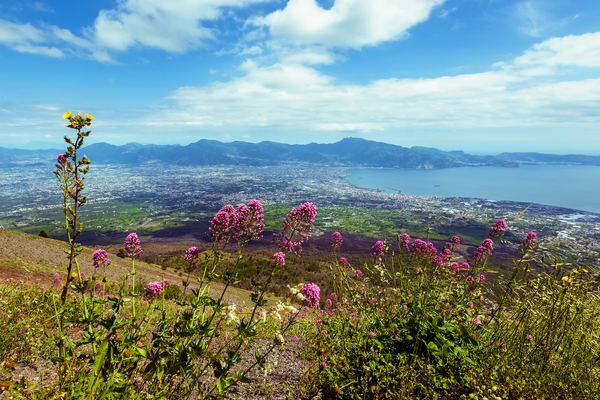
Vesuvius & Pompeii
Vesuvius and Pompeii in one day: the crater rim and the city the AD 79 eruption buried.
12 experiences -
Herculaneum
Herculaneum with Vesuvius: the smaller site, buried under 20 metres of pyroclastic flow and better preserved than Pompeii.
5 experiences -
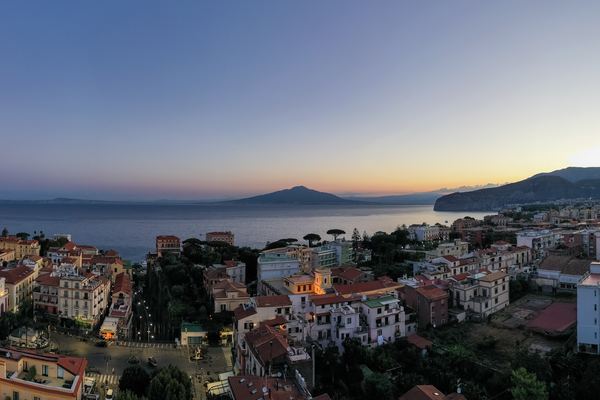
Wine Tours
Wineries on the slopes of Vesuvius: Lacryma Christi grown on volcanic soil, with a view over the Bay of Naples.
6 experiences -
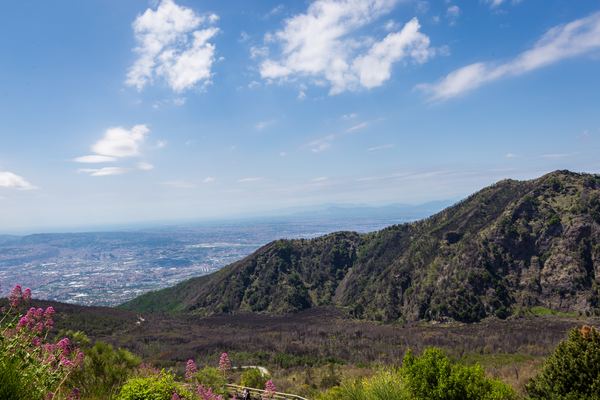
Crater Tickets & Entry
Entry tickets to the Vesuvius crater path. Ratings on these run lower than the rest of the area: check which ticket, and from where.
2 experiences


Volcano Travel Experiences in Mount Vesuvius
Herculaneum's Boat, Pompeii and Trail No. 5 up Vesuvius
A private day with a driver and licensed guides at both gates, the restored boat at Herculaneum, and trail no. 5 up Vesuvius from the Piazzale at 1,000 m.
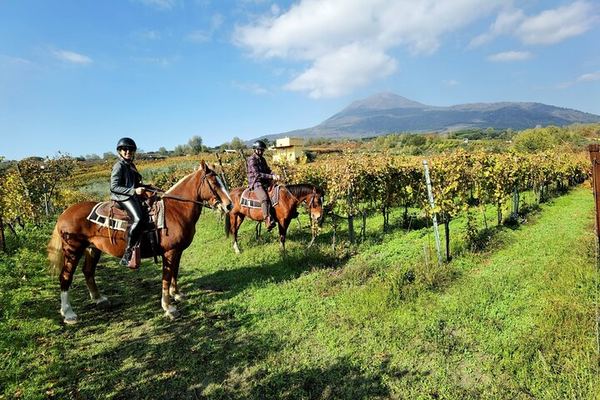
Horses on Vesuvius at 500 m, at a Walking Pace
The horses go to 500 metres and no further, because local law keeps them off the crater, and the pace stays slow the whole way. Not a ride for galloping.
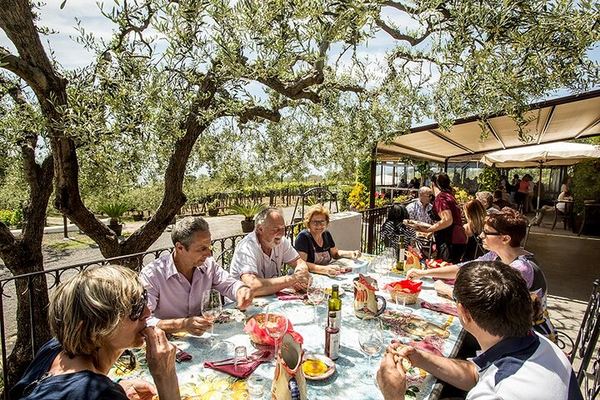
Lacryma Christi on the Slopes of Vesuvius, Four Hours
A walk through the vineyards on the slopes of Vesuvius, then a Mediterranean lunch with Falanghina, Lacryma Christi and Aglianico. Four hours, pick-up at 11.
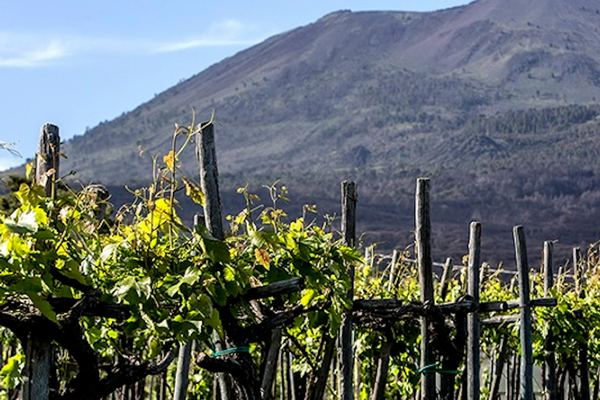
Lacryma Christi, with Salami, Cheese and Ricotta Dessert
Lacryma Christi with a full sit-down lunch behind it: local salami and cheeses, organic tomato pasta, and sweetened ricotta for dessert. Vineyard walk first.
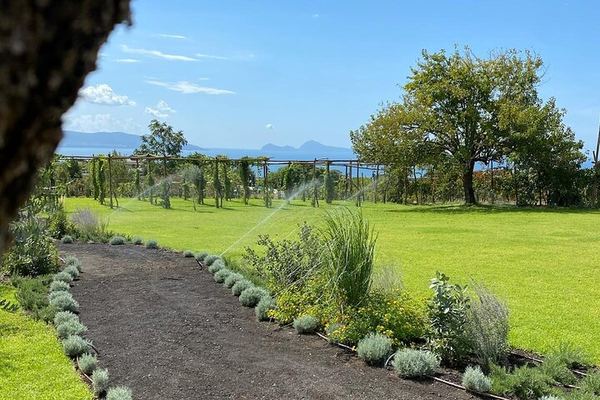
Lunch at an Organic Farm on Vesuvius, Shuttle from Pompeii
An organic farm inside the national park, with cheeses, cured meats and local wines, and a free return shuttle from Pompeii. Capri is on the horizon.
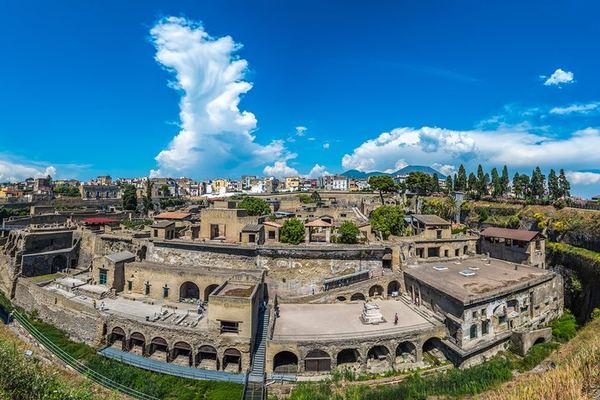
Pompeii and Herculaneum with an Archaeologist, and Lacryma Christi
An archaeologist with 31 years of guiding, both sites at your own pace, and a family winery on Vesuvius in between. Lunch there is at your own expense.

Pompeii and Vesuvius from Naples: Choose the Crater Trail or the Valley of Hell
On Vesuvius you pick the trail: the summit crater, or the 1944 lava flows and their small cave. Pompeii comes first, with an archaeologist and a wine lunch.
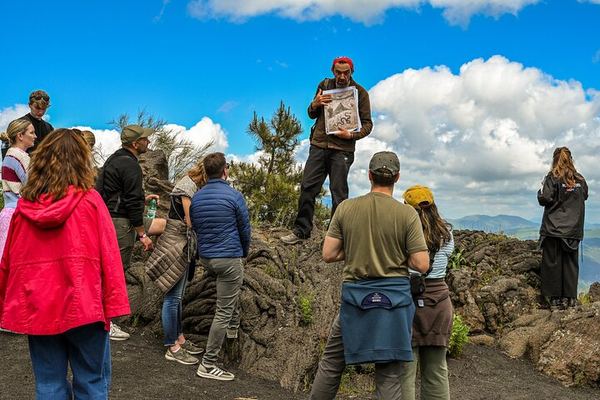
Pompeii and Vesuvius from Naples with an Archaeologist, a Mountain Guide and Lunch
An archaeologist leads the two hours inside Pompeii and a mountain guide takes the crater, with skip-the-line entry at both gates and lunch in between.
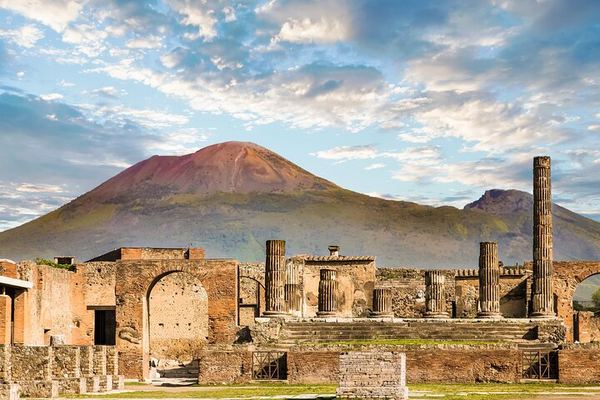
Pompeii from Rome with City Wonders: Vesuvius Crater or a Geologist's Walk
City Wonders runs it from Piazza del Popolo, and Vesuvius splits two ways: a hike to the crater rim, or a naturalistic walk with a professional geologist.
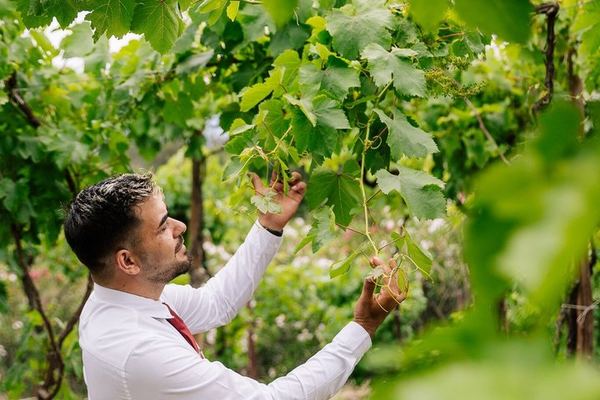
Pompeii Guided Tour & Horse Riding on Vesuvius with Lunch
Skip-the-line Pompeii with an archaeologist, lunch and Vesuvian wine at a ranch, then a guided ride at 500 metres. The horses go at a walk, not a gallop.
Pompeii, Herculaneum and Vesuvius Day Trip from Naples with Hotel or Cruise Pick-Up
Di Sarno collects from a Naples hotel or the cruise terminal and waits 15 minutes, with commentary at all three sites and free time at each of them.

Pompeii, Herculaneum and Vesuvius Private, Guide Optional
Book it with a driver and the tickets, or with a private guide as well. Herculaneum still has its wooden doors and upper floors; Pompeii has the scale.
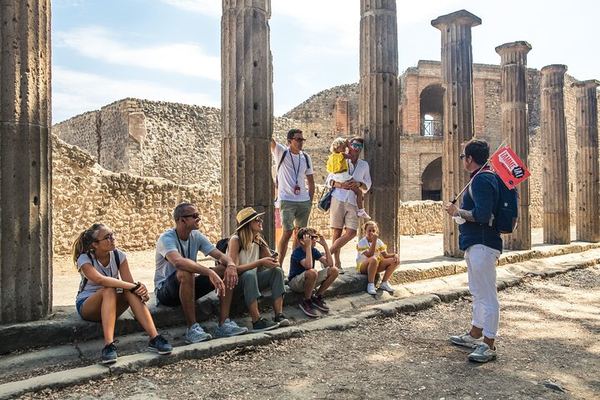
Pompeii in Two and a Half Hours, then Vesuvius at 1,280 m
An early departure to beat the queues, two and a half guided hours inside Pompeii, and the last 200 metres of Vesuvius on foot to the crater rim at 1,280 m.
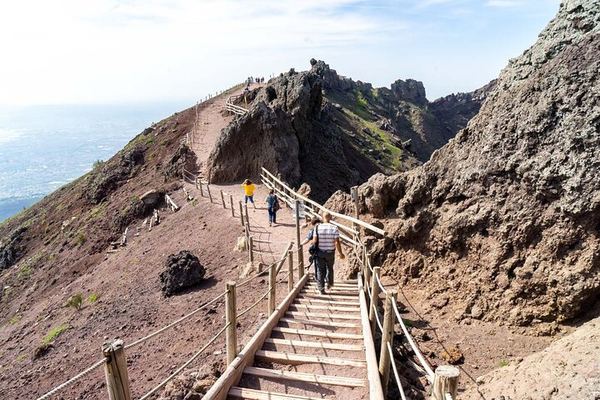
Pompeii Tickets, Lunch, and a Mountain Guide at the Crater
Entrance tickets and a light lunch are in the price, and a mountain guide meets the group at the crater rim of Vesuvius, 1,280 metres up. Sorrento or Naples.
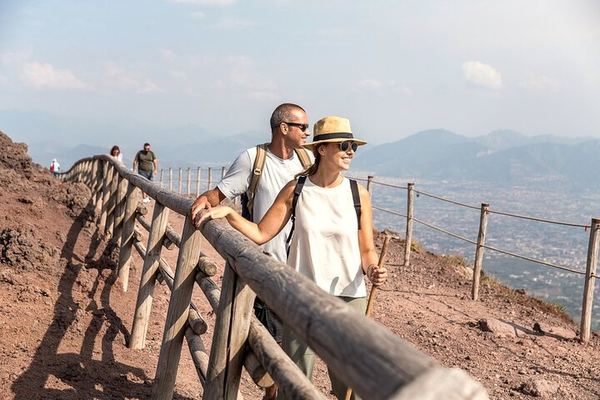
Pompeii with a Guide for 2h30, Then the Last 200 m up Vesuvius
Two and a half hours in Pompeii with a guide and skip-the-line entry, then the coach to 1,000 metres on Vesuvius and the last 200 on foot to the crater.
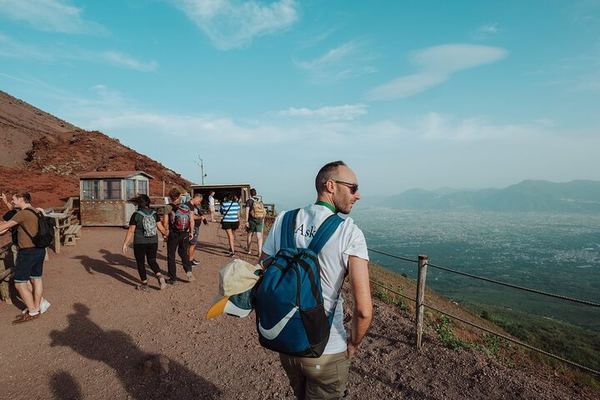
Pompeii with an Archaeologist, Vesuvius with a Hiking Guide
An archaeologist at Pompeii and a hiking guide on the volcano, with a minibus for up to 14 in between. The crater still smokes; closed shoes are essential.
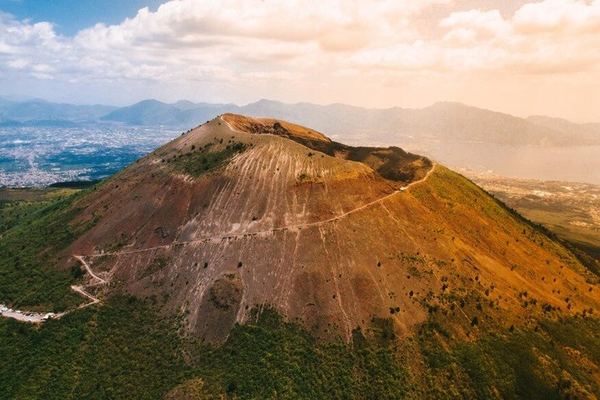
Private Car Tour from Naples: Herculaneum, Vesuvius Crater and Pompeii in One Day
A private car with an English-speaking driver from Di Sarno, so the three sites run at your pace and the Vesuvius climb sits in the middle of the day.
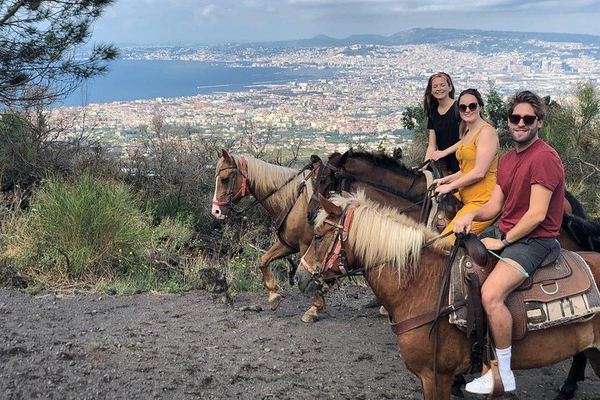
Riding Inside the Vesuvius Park, with the Family's Own Wine
Permission to ride inside the national park rather than take the bus, an hour and a half to two hours in the saddle, and the family's own wine afterwards.
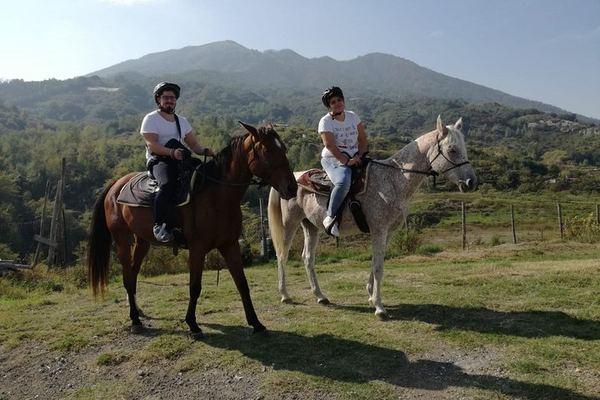
Riding on Vesuvius the Parelli Way, from Pollena Trocchia Station
Horses handled by ethological methods on the ground and in the saddle, inside the Vesuvius National Park. The meeting point is the Circumvesuviana stop.
Two Hours in West Pompeii, Then the Gran Cono Path
Two hours in the western half of Pompeii with an archaeological guide, then the Gran Cono path to the crater from the square at 1,000 metres. Hotel pick-up.
Vesuvius First, Then Pizza, Then Pompeii
Vesuvius to the crater at 1,281 metres with an alpine guide, a Margherita or Marinara on the slopes, then two hours in Pompeii with an authorised guide.
Vesuvius First, then Pompeii, with a Margherita or Marinara in Between
Vesuvius comes first, then pizza on its slopes, Margherita or Marinara, and Pompeii with an authorised guide in the afternoon. Sorrento or Vico Equense.
Vesuvius from Naples Central: Bus, Crater Ticket and an Audio Guide on Your Phone
Everything is collected at one desk inside Napoli Centrale, and the crater admission is skip-the-line, so the walk up runs at whatever pace you want.
Vesuvius from the Gates of Pompeii, Bus and Crater Ticket Included
Departure from Porta Marina Superiore at the Pompeii gate, with the crater ticket, the return bus and a guide all in one booking. The Gulf of Naples below.
Ratings collected by Viator, Tripadvisor and Tiqets
What is actually up there
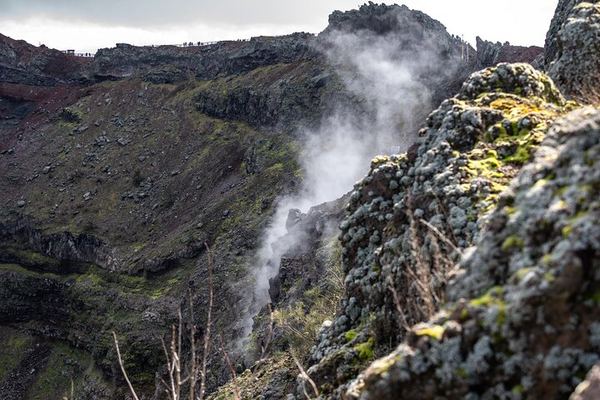
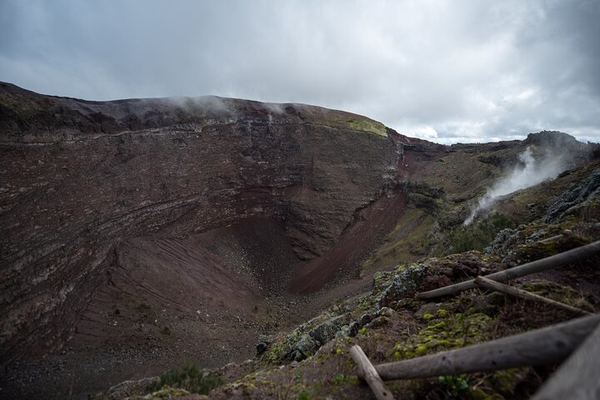
The summit is a crater a few hundred metres across and a couple of hundred deep, with a floor of rubble and a handful of vents that let out steam and a faint sulphur smell when the air is still. That is the whole show. Nothing glows, nothing moves, and no lava has been visible on this mountain in over eighty years. If a listing puts a picture of orange rock next to the word Vesuvius, that picture was taken on Etna or Stromboli.
What Vesuvius has instead is position. From the rim you look down on Naples, along the coast to Sorrento, out to Capri on a clear morning, and on the far side onto the excavated grid of Pompeii, which from up here reads as a street plan rather than a ruin. You are also standing on the most closely watched volcano on earth. The Osservatorio Vesuviano, founded in 1841 on the slope below you, was the first volcano observatory anywhere, and the civil protection plan for the red zone beneath it covers two dozen municipalities and several hundred thousand residents. The alert level today is green, the lowest of the four.

The mountain you see from Naples is two mountains
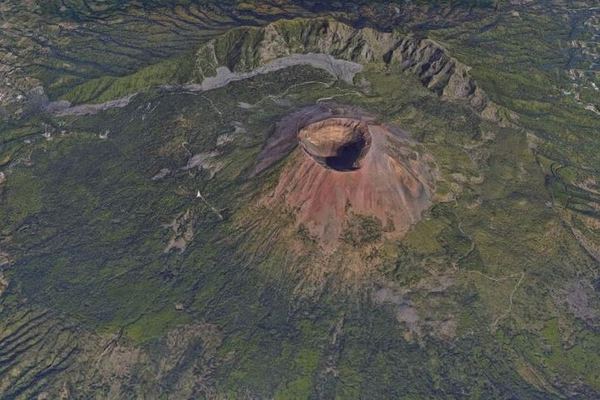
From the waterfront the profile has two summits, and that is not perspective. The northern ridge is Monte Somma, the surviving wall of a much older cone that destroyed itself; Vesuvius proper is the younger cone that grew inside the ruin. The trench between them, the Valle del Gigante, is where the 1944 lava ran.
That eruption is unusually well documented, because the Allies were sitting underneath it. The Twelfth Air Force had squadrons parked on airfields in the Campanian plain, and the hot ash that fell in March 1944 burned through fabric control surfaces and cracked the perspex of dozens of B-25s, which were written off where they stood. There are aerial photographs of the column taken from the cockpit, which is not something anyone can say about 1631 or 1906. Nothing has come out of the mountain since, and that silence is now the longest since the one that ended in 1631.
| What you buy | Listings | Price | Time | Choose it if |
|---|---|---|---|---|
| Vesuvius with Pompeii | 12 | 65 to 169 EUR | 7 to 10 hours | You have one day near Naples and want both |
| Vesuvius with Herculaneum | 5 | 120 to 890 EUR | 6 to 9 hours | You want the better preserved site, and can live with four of five being private |
| A winery on the slopes | 6 | 49 to 130 EUR | 3 to 6 hours | You want lunch and a view rather than a crater |
| Crater ticket and transport only | 2 | 29.70 to 55 EUR | 3 to 5 hours | The rest of your day is already planned |
| On the mountain itself | 3 | 65 to 129 EUR | 2 to 4 hours | Riding the lava paths, or a volcanologist to yourself |
Getting up there, and what the ten euro ticket already covers
There is one road. It climbs from Ercolano and Torre del Greco through chestnut woods and old lava flows to San Vito, at roughly a thousand metres, which is where every vehicle stops. From there path no. 5 zigzags up compacted ash and loose lapilli to a high point of 1,175 metres. The park measures the walk at 4.010 kilometres, rates it low difficulty and allows two and a half hours. It ends at the crater rim, not at the 1,281 metre summit, which is a distinction no listing anywhere bothers to make.
The ticket costs 10 EUR, or 8 for under-25s and residents of the park's municipalities, and the park sells it online only, in timed slots. Its own volcanological service supplies a guide, that guide is compulsory, and the cost is already inside the ticket. So when an operator advertises a guided tour of Vesuvius, the guiding on the cone was arriving with or without them. What their money buys is the ride, and on a road with nowhere to park at the end of it that is a genuine service, just not the one on the label. The ticket page has the slot rules, the seasonal hours and the entry window in full.
Where you start from changes the day more than the price does. Naples is the short transfer and leaves time for something else. Sorrento adds an hour each way and turns the crater into a fixed point in a long loop. Pompeii itself is the closest base and the only one from which the volcano is a genuine half day. Rome is the outlier: one listing here runs from Rome and carries 6,427 reviews, more than any other product in the area, and it is a very long day in a coach in which Vesuvius is an optional upgrade rather than part of the price.

Seven eruptions that made the mountain you are booking
The origins
AD 79
Pompeii, Herculaneum, Oplontis and Stabiae
The eruption that buried four towns in a day and a night. The traditional date of 24 August is disputed, and the argument is worth reading on the Pompeii page.
472
The Pollena eruption
Ash from Vesuvius was recorded falling as far away as Constantinople. The mountain was not a monument yet, it was a working volcano in a Roman province.
The growth
1631
The deadliest since AD 79
After roughly five centuries of quiet the mountain reopened and killed several thousand people. Everything Vesuvius has done since belongs to the cycle that began here.
1906
Rome gives up the Olympics
The eruption did so much damage that Italy withdrew from hosting the 1908 Games and London took them instead. The summit lost a large part of its height.
March 1944
The last eruption
Lava destroyed San Sebastiano and Massa di Somma. Ash falling on the plain wrote off dozens of Allied bombers. Nothing has erupted here since.
Today
1995
Parco Nazionale del Vesuvio
The mountain becomes a national park, which is why access, paths, numbers and guiding are now managed rather than open.
Today
Path no. 5 open to the crater, alert green
The Gran Cono path runs to the rim again after a period of restrictions. Tickets are online only, the park's guide comes with them, and civil protection holds the volcano at its lowest alert level.
What only this mountain sells
Five of the twenty-eight listings here put you on a horse. That is a Vesuvian speciality and it exists for a reason: the lower slopes are laced with old cart tracks and lava paths through broom and pine that are too rough to drive and too long to walk, and stables on the Torre del Greco side have been working them for years. Two of those five are on this page. It is the one thing on Vesuvius that Etna does not also sell, and the ratings are the highest in the area, a clean 5.0 across 149 and 92 reviews on the two here.
The second speciality is the wine, which has its own page. The third needs care, because it is easy to oversell. One listing on this page charges 129 EUR for a volcanologist, and it is worth being precise about what that buys. It does not buy access, and it does not buy expertise you would otherwise be denied, because the park sends one of its own volcanological guides up the cone with everybody. What it buys is that person to yourself, or nearly, and the time to ask them why the wall on your left is grey and the one on your right is red. On a mountain that has stopped doing anything visible, that is more of the experience than people expect, and it is a fair thing to charge for. It is simply not the thing the title implies.
Vesuvius has the world's oldest volcano observatory watching it, a national park drawn around it, and an evacuation plan for two dozen towns beneath it. What it does not have is anything coming out of the top.
When to go, and what to put on your feet
The park is open every day of the year and the month you pick does not change what you see. It changes how much you enjoy seeing it, and it changes the hours: the path runs 9.00 to 15.00 from November to February and stays open until 18.00 in July and August, with the shoulder months in between. In high summer the cone is a shadeless zigzag of dark gravel that stores heat all morning, and the first slot after opening is worth setting an alarm for. In winter the path stays open but cloud sits on the summit for days at a time, and a ticket bought for a Tuesday is a ticket for whatever that Tuesday turns out to be. April, May, September and early October are the compromise everybody recommends, and for once everybody is right.
Two things people learn the expensive way. The path closes when there is thunder around, because there is nowhere on it to shelter, and getting a park ticket refunded is not a five-minute job. And wear closed shoes with some grip. The surface is loose lapilli over compacted ash, there is a drop on the outer side of the path in places, and it is the descent rather than the climb that puts people on the ground. Trainers are fine. Sandals are not, and the number of people who arrive in them is remarkable.
Questions people actually ask
How long does it take to walk up Mount Vesuvius?
The park allows two and a half hours for path no. 5, which measures 4.010 kilometres there and back from San Vito at about a thousand metres up to 1,175. It rates the difficulty as low. Fit walkers get up the steep section in half an hour, but the ticket is timed around the full allowance, and the guide who walks it with you sets the pace.
Do you need a guide, and does it cost extra?
You need one and it costs nothing extra. The park's Presidio Permanente Vulcanologico provides the guide on the cone, the service is compulsory, and it is included in the 10 EUR ticket. This is the single most misread thing about Vesuvius: an operator selling a guided Vesuvius tour is selling you transport, because the guiding was coming anyway.
Can you see lava on Vesuvius?
No. The last eruption was in March 1944 and there has been nothing since, which is the longest quiet spell the mountain has had since the seventeenth century. Italian civil protection holds it at the green alert level. What is visible today is a rubble-floored crater with a few fumaroles giving off steam. For molten rock in Italy you need Etna during an eruptive episode, or Stromboli after dark.
Do you reach the summit?
Not quite, and nobody says so. Path no. 5 tops out at 1,175 metres and the summit is 1,281. You walk to the crater rim and along a stretch of it, which is where the view is anyway. The phrase reach the summit turns up in a great deal of marketing about this mountain and it is not accurate.
Do I need to book Vesuvius tickets in advance?
Yes. The national park sells entry exclusively online, in timed slots, so there is no ticket office at the gate to fall back on. Book before you travel, or book a tour that includes the entrance and let the operator deal with it. Turning up without one is the most common way a Vesuvius morning goes wrong.
Is Vesuvius worth doing on its own?
Only if getting there is already solved. The crater is a couple of hours of your day and the road up is not somewhere to improvise transport. Twenty-six of the twenty-eight listings here bundle the volcano with something else, and that is the market telling you something rather than upselling you: on its own, the mountain is a short, hot, memorable walk with a very good view, and not a day out.
How much does a Vesuvius tour cost?
The park ticket itself is 10 EUR, or 8 reduced. The cheapest package here is 29.70 EUR, which adds a return bus from Naples and an audio guide. A day pairing the crater with Pompeii runs 65 to 169 EUR depending on transfers, guide and lunch. A winery on the slopes is 49 to 130. Above 250 EUR you are buying a private vehicle and a private guide, and the top of the range here is 890 EUR for a full day with an archaeologist.
Data verified on. Prices and counts from the 28 Vesuvius products on this site. Path length, ticket, hours and the compulsory park guide from the Parco Nazionale del Vesuvio; alert level from Italian civil protection.