

There are three volcano glossaries of any size on the internet and all of them descend from the same geological dictionary. They are accurate and they are written for geologists, which means they will tell you the silica content of andesite and not tell you that andesite is why the mountain is too steep to climb.
This one is written the other way round. Every entry answers a second question: what does knowing this change for you.
Entries marked with a bracket are terms that get used wrongly in tourist material often enough to cause problems. Those are the ones worth reading even if you skip the rest.
Magma, lava and rock
| Term | What it is | Why it matters to you |
|---|---|---|
| Magma and lava [!] | The same molten rock before and after it reaches the surface. Magma is underground; lava is out | The two words tell you which side of the vent you are on. A river of magma is always wrong, and a tour promising lava is promising something at the surface |
| Basalt | The most common volcanic rock: low in silica, dark, fluid, erupting at 1,100 to 1,200 C | This is the rock that makes long flows and walkable volcanoes. Where there is basalt there are hexagonal columns, lava tubes and black beaches |
| Andesite | Intermediate composition, more silica than basalt, erupting at 850 to 1,100 C and far more viscous | The rock of the steep photogenic cones and of explosive eruptions. The postcard volcanoes of the Pacific are andesitic: admire them from a distance |
| Rhyolite | The most silica-rich and most viscous. Can erupt below 800 C and often piles up rather than flowing | Where there is rhyolite there are domes, obsidian and calderas. Rhyolitic landscapes are coloured, yellow and pink and green, not black |
| Obsidian | Volcanic glass: silica-rich lava chilled too fast to form crystals | Found on Lipari, in Iceland, at Yellowstone. The edges genuinely cut, and collecting it is prohibited in many parks |
| Pumice | Solidified lava foam, with so many voids that it is less dense than water | The only rock that floats. After a submarine eruption, rafts of it drift for kilometres. Lipari's quarries are a UNESCO site |
| Scoria | Like pumice but basaltic: darker, heavier, bigger bubbles, and it does not float | This is what the walkable cones are made of. The stuff that slides underfoot and fills your shoes is scoria, which is the argument for boots and gaiters |
| Tephra | Umbrella term for everything thrown into the air by an eruption, at any size | The word you will meet on signs and in bulletins. Tephra layers in a road cutting are the eruption history, read from the bottom up |
| Lapilli | Fragments between 2 and 64 mm. In the Canaries they are called picon or rofe | On Lanzarote they are the entire agriculture: spread over the fields, they catch the night dew and grow vines where 100 mm of rain falls a year |
| Volcanic bomb | A fragment over 64 mm ejected while still molten, taking an aerodynamic shape in flight | The reason exclusion radii are wide. These are ballistic, so they do not follow the wind, and a helmet is no use against a half-metre rock |
| Pahoehoe | A flow with a smooth, ropy, folded surface. Less viscous and less disturbed than a'a | The lava you can walk on. The rope forms are the most photographed surfaces in Hawai'i and Iceland |
| A'a | A flow with a surface of sharp broken blocks, more viscous, advancing like a bulldozer track | Crossing an a'a field destroys shoes and hands. A pahoehoe flow can turn into a'a, but never the reverse: the change runs one way only |
| Pele's hair | Threads of golden basaltic glass, 5 to 15 cm long and as fine as a human hair, stretched by wind from airborne lava droplets | The wind carries them for kilometres. They are sharp glass: they lodge in skin, need gloves to handle, and contaminate rainwater tanks downwind |
| Pele's tears | Droplets of black glass frozen in flight, often at the end of a strand of Pele's hair | Found downwind of vents. Like Pele's hair, collecting them in a US national park is illegal |
| Limu o Pele | Paper-thin sheets of volcanic glass, like dark flakes of mica: burst and flattened lava bubbles | The signature of an ocean entry. If you find them on a beach, that is where lava met the sea |
| Lava field | An expanse of overlapping flows. In Icelandic, hraun, a word buried in dozens of place names | The moss covering Icelandic fields takes decades to grow and one footstep to destroy. That is why the barriers exist |
| Volcanic soil [!] | Soils formed from weathered tephra: porous, mineral-rich, good at holding water | Why Etna, Santorini and Lanzarote make wine. But fresh lava is sterile: the fertility arrives after centuries, not seasons |
| Black sand beach | Sand of basaltic fragments, formed slowly by erosion or instantly when lava enters the sea and shatters | Instant black beaches are temporary and have been buried again. And black sand gets hot: at midday it can be unwalkable barefoot |
Shapes in the landscape
| Term | What it is | Why it matters to you |
|---|---|---|
| Crater | A depression at a vent, excavated by explosions or by collapse of the conduit. Usually under 2 km across | Where the summit tours take you. Gas is heavier than air and collects in it, which is why the floor is almost always off limits |
| Caldera [!] | A depression kilometres wide, formed when the roof of the magma chamber collapses. The opposite process to a crater: subsidence, not excavation | These are landscapes rather than mountains, and you often live inside one without noticing. If there are villages in it, it is a caldera, not a crater |
| Cinder cone | A cone of scoria around a vent, usually low and usually monogenetic: it erupts once and stops | The cones you climb in an hour. The slope sits at the angle of repose, so you slide back going up and take long strides coming down |
| Stratovolcano | Alternating layers of lava and pyroclastics building a steep, tall cone: Fuji, Vesuvius, Cotopaxi, Mayon | Beautiful shape, difficult character. These are the volcanoes of explosive eruptions, pyroclastic flows and lahars |
| Shield volcano | Enormous but very low, with slopes of a few degrees built from fluid basaltic flows | Mauna Loa is the largest volume on the planet and does not look like a mountain from the ground. Visitors are often disappointed by the scale |
| Lava dome | A mound of lava too viscous to flow, piling up over the vent and growing from within | Unstable by definition. Domes collapse and generate pyroclastic flows without warning, which is why dome volcanoes have permanent exclusion zones |
| Fissure eruption | An eruption from a linear crack rather than a point vent: a curtain of fire, sometimes kilometres long | The classic Icelandic form. There is no summit to reach, and the best viewpoint moves as the fissure does |
| Lava tube | A natural conduit: the flow surface roofs over, lava runs underneath, and the tunnel finally drains | The visitable volcanic caves. The longest and deepest in the world is Kazumura in Hawai'i, at 65.5 km with 1,101 m of vertical range |
| Lava bench | A terrace of new land where lava enters the sea, resting on loose unstable debris | The most dangerous place on an apparently calm volcano. Bench collapses give no warning and take hectares into the sea in seconds |
| Ocean entry | Where a flow reaches the sea, producing steam, littoral explosions and laze | The most sold spectacle in Hawai'i, and it is watched from the sea or the air. Permitted boats keep to fixed distances |
| Lava lake | A persistent pool of molten lava in a crater. Rare, and the membership list changes | This is the lava that most people are looking for, and the list is short and unstable. Verify before building a trip on one |
| Crater lake | A lake in a crater or caldera, either fresh water or hyper-acidic brine | The colour tells you the chemistry: milky turquoise means acidic and sulphur-rich, deep blue means fresh water. You do not swim in the first kind |
| Maar | A wide, low crater from a steam-driven explosion, with its floor below the original ground level | They appear as unexpected round lakes in ordinary countryside. Germany's Eifel has around seventy. They do not look like volcanoes, which is the point |
| Tuff ring | A low ring of consolidated ash around a wet explosive crater, with gentler walls than a cinder cone | Pu'u Mahana, the tuff ring that feeds the green sand at Papakolea, is the classic case: its ash is what releases the olivine |
| Kipuka | An island of older ground surrounded by a newer flow that went round it | Patches of mature forest in the middle of black rock, visible from Hawaiian roads. Ecologically they are refuges from which life recolonises the lava |
| Seamount | An underwater volcano that does not reach the surface. There are tens of thousands | They concentrate marine life by deflecting currents upwards, which is why they are the best dive and fishing sites in half the Pacific |
Eruption styles and scales
| Term | What it is | Why it matters to you |
|---|---|---|
| Hawaiian | The least explosive style: lava fountains and fluid flows from gas-poor basaltic magma | The only style that can be watched from relatively close with permission. When the media say tourist eruption, they mean this |
| Strombolian | Short rhythmic explosions, minutes to hours apart, throwing lava fragments tens to hundreds of metres | The most reliably watchable style because it repeats. But regular is not predictable: the same volcano produces far more violent paroxysms |
| Vulcanian | Single violent explosions that clear a solidified plug from the conduit, with dense columns and ballistics | The style that catches out hikers, because it arrives out of a clear sky after weeks of apparent calm |
| Plinian | A sustained eruption column tens of kilometres high which, on collapsing, generates pyroclastic flows. Named after Pliny the Younger | The word on the museum boards at Pompeii, and the only eruption style named after a witness rather than a place |
| Phreatic | A steam explosion: groundwater meets hot rock and flashes, with no new magma involved | The most treacherous for tourism, because it lacks the precursors of rising magma. It killed 22 at Whakaari in 2019 and 63 on Ontake in 2014 |
| Phreatomagmatic | Magma and water together: the water shatters the magma and multiplies the explosivity | The process that built maars, tuff rings and Surtsey. It explains why volcanoes surrounded by water are violent out of proportion to their size |
| VEI [!] | A 0 to 8 scale based on erupted volume and column height, logarithmic from 2 upwards | Useful for reading museum boards and useless as a measure of impact. Laki in 1783 was a VEI 4 and changed Europe's climate |
Hazards
| Term | What it is | Why it matters to you |
|---|---|---|
| Pyroclastic flow | An avalanche of gas and incandescent fragments descending at hundreds of km/h and hundreds of degrees | The number one killer. You cannot outrun it, outdrive it, or shelter behind a hill, because they run uphill. The only defence is not being there |
| Lahar | A volcanic mudflow with the consistency of wet concrete and the speed of a flooding river | The hazard that needs no eruption: heavy rain on old ash deposits is enough. Hence lahar route signs and sirens in quiet valleys |
| Jokulhlaup | A glacial outburst flood: an eruption under ice melts water that is then released all at once | Why Iceland's ring road has deliberately sacrificial bridges and why some floodplains are empty |
| Ash fall | The fallout of erupted material: pulverised rock, abrasive and sharp | A few millimetres closes airports and makes roads slippery. Wet, it weighs far more and collapses roofs, which is how most ash-fall deaths happen |
| Ash cloud | The airborne plume, monitored by nine volcanic ash advisory centres worldwide | Ash is invisible to weather radar and from an aircraft window, which is why airspace closures feel arbitrary under a clear sky |
| Laze | The plume where lava boils seawater: hydrochloric acid, steam and glass particles, with acid rain at pH 1.5 to 3.5 | It irritates eyes and airways and has killed. The reason boats are held at a minimum distance from ocean entries |
| Vog | Haze from sulphur dioxide reacting to form sulphuric acid aerosols, largely fine particulate | It cuts visibility for hundreds of kilometres and aggravates asthma. If you have a respiratory condition, factor it into a Hawai'i trip |
Hydrothermal features and gas
| Term | What it is | Why it matters to you |
|---|---|---|
| Fumarole | A vent emitting gas and vapour with no liquid or solid. Mostly steam, from about 100 to 1,000 C | The ground around one is altered, fragile and hollow, and the crust gives way. The boardwalks are not there for convenience |
| Solfatara | A fumarole dominated by sulphur compounds, depositing yellow crystals around the vent | The kind of vent that makes Ijen's blue fire possible. The word is Italian, from the Solfatara at Pozzuoli, and it went international |
| Mofette [!] | A cold emission dominated by carbon dioxide, typical of the late stage of volcanic activity | The most insidious feature there is: no heat, no smell, no plume. CO2 is heavier than air and pools in hollows. Guides often call these fumaroles; the difference is what comes out, and this one kills silently |
| Geyser [!] | A hot spring that erupts intermittently because of boiling under pressure in a constricted conduit. Genuinely rare | The original Geysir in Iceland, which named all the others, is now largely inactive: the one you watch is Strokkur. Throwing objects or soap into geysers has permanently destroyed several |
| Hot spring | A spring where water emerges warmer than the mean air temperature, heated at depth | Not all are bathable. Surface temperature tells you nothing about 30 cm down, and boiling water at Yellowstone and Rotorua has killed people |
| Mud pot | A pool of boiling mud where acidic steam has broken the rock down to clay. The bubbling is gas, not boiling water | The pools that go blop. The rotten-egg smell is hydrogen sulphide, and the crust around them is the most treacherous ground in a geothermal field |
| Mud volcano [!] | A cone built by mud and gas pushed up by pressure in sediments. In most cases the mud is cold | Azerbaijan, Sicily, Trinidad, Romania. They are sold as volcanoes and often have no relationship to magma at all |
| Sulphur | An element melting at 115 C and burning with a blue flame. At Ijen it is mined by hand from an active solfatara | The miners carry 70 to 90 kg twice a day. Visitors enter the same environment, and measured sulphur dioxide risk at the tourist viewpoints exceeds the safety threshold |
| Blue fire [!] | Not blue lava: sulphurous gases igniting on contact with air, plus molten sulphur burning as it runs. Flames up to 5 m | Visible only in darkness, which is why departures are at one in the morning. Blue lava is false and it is everywhere |
Tectonics
| Term | What it is | Why it matters to you |
|---|---|---|
| Hotspot | A deep, relatively fixed magma source. The plate slides over it, leaving a chain of progressively older volcanoes | Explains the Hawaiian archipelago in one sentence: the further northwest, the older and more eroded. Big Island is still over the source |
| Subduction zone | A margin where oceanic plate descends beneath another. The water it carries lowers the melting point above, generating silica-rich, gas-rich magma | The physical reason Pacific volcanoes are explosive and Hawaiian and Icelandic ones are not. Same word, opposite holiday |
| Rift zone | A belt where the crust is pulling apart. On a plate scale it makes ridges; on a volcano scale, the flanks that fissures open along | At Thingvellir you can walk inside the boundary between the North American and Eurasian plates, and at Silfra you can dive in it |
| Ring of Fire [!] | A belt of about 40,000 km around the Pacific with 750 to 915 active or dormant volcanoes and around 90 per cent of the world's earthquakes | Contains most of the icon volcanoes. The often-quoted 75 per cent of the world's volcanoes is too high: the standard catalogue puts it closer to two thirds |
Monitoring and access
| Term | What it is | Why it matters to you |
|---|---|---|
| Active, dormant, extinct [!] | Active means showing signs of subsurface activity; dormant means no signs but capable of waking; extinct means no remaining magma supply | The US Geological Survey warns that activity sits on a graded spectrum and does not fit neatly into one category. Dormant is not a safety rating, and treating extinct as a synonym is the most dangerous error in the tourist vocabulary |
| Aviation Colour Code | A four-colour ICAO code about ash risk to aircraft: green, yellow, orange, red | This is the code that determines whether your flight leaves. Watch this one, not the ground alert level, if you are worried about the plane |
| Volcano Alert Level [!] | A separate scale about hazard on the ground: Normal, Advisory, Watch, Warning | Not the same scale as the aviation code, and confusing the two is the commonest mistake. An effusive flow can be Warning on the ground and only Orange in the air |
| Exclusion zone | A perimeter of prohibited access around a vent, set by the local authority and changing over time | Since Whakaari in 2019 this is not merely a moral question: New Zealand prosecuted operators, agencies and landowners. A tour that enters a closed zone exposes you too |
| Decade Volcano [!] | A list of sixteen volcanoes selected in the 1990s for intensive study during a United Nations disaster reduction decade | Not a danger ranking. One of the selection criteria was that the volcano be politically and physically accessible to study. It is a research priority list |
The five that cause the most trouble
If you read nothing else on this page, these are the five where the wrong definition leads somewhere unpleasant.
Dormant does not mean safe. Pinatubo had been quiet for around five hundred years before it produced one of the largest eruptions of the twentieth century.
The aviation colour code is not the alert level. They are assigned separately and answer different questions.
Blue fire is not lava. It is burning sulphur, and it is invisible in daylight.
A mofette has no smell, no heat and no plume, and carbon dioxide pools in hollows on still days. It is the feature most likely to be mistaken for nothing at all.
If the smell of sulphur suddenly stops, that is bad news, not good. Hydrogen sulphide deadens the sense of smell as its concentration rises. Move away, uphill and upwind.
Now go and use some of it
Thirty-five destinations, with what you would actually be looking at in each one.
One word worth travelling for
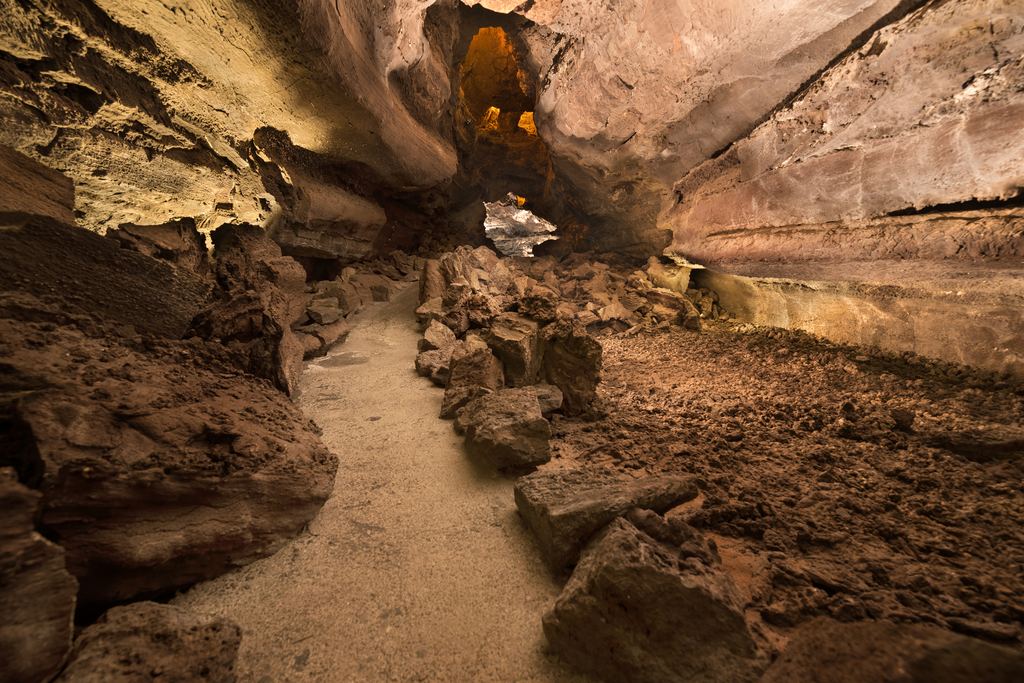
Lava tube
If you learn a single term from this page, make it this one, because it describes the most underrated volcanic experience there is and almost nobody books it deliberately.
A fluid lava flow crusts over on the surface while the inside keeps running. When the eruption stops, the liquid drains away and leaves a tunnel behind, sometimes for kilometres, with a glazed ceiling and the tide marks of the last flow still on the walls.
What that gives you is the inside of a lava flow, which no active eruption will ever show you. It also gives you something no other volcanic attraction can: certainty. A lava tube does not depend on the alert level, the weather, the season or the volcano's mood. It is there, it is identical every day, and you can book it four months ahead with complete confidence.
Lanzarote's are the most developed, Hawai'i has the longest in the world at 65 kilometres, and Iceland, the Azores and Etna all have them.

Data verified on. Definitions follow standard volcanological usage. Terms we could not verify against a primary source were left out rather than guessed at. Editorial Policy