
New Zealand Volcano and Geothermal Tours
41 experiences across two North Island areas. The country has plenty of magma and no reachable lava, which is why the whole market is built on heat that stays underground.
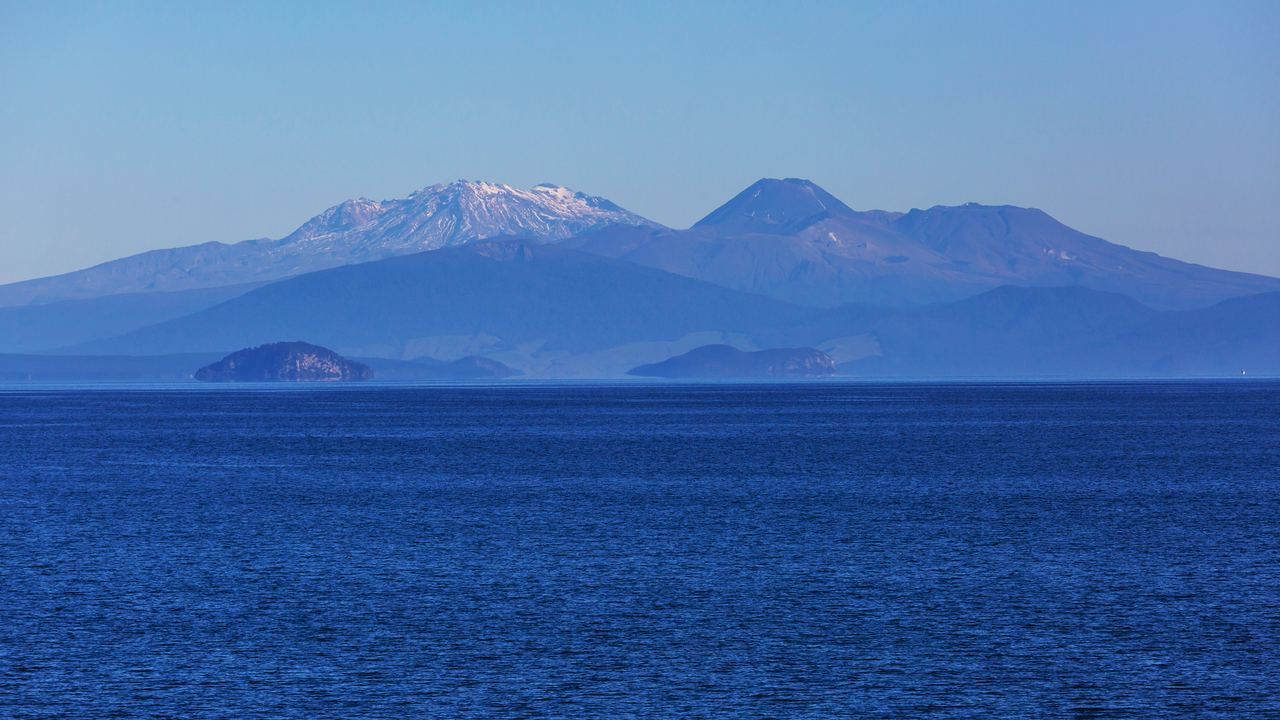
New Zealand's largest lake is a volcano. Lake Taupō sits in the hole left when the ground collapsed into an emptied magma chamber, and GeoNet still monitors it as an active centre, currently at alert level 0 with no unrest. That one fact explains the shape of the market here. The North Island runs on heat that stays underground: geysers, mud pools, silica terraces, water hot enough to cook in. There are 41 experiences in this catalogue across the whole country, and not one of them takes you to flowing lava, because there is none to take you to. Anyone selling New Zealand as a lava destination is selling Hawai'i or Iceland with the wrong photograph.
This page is the comparison. The two destination pages below deal with how each place is organised, what the tickets cost and where the tours leave from. Here the question is which of the two you want, how far apart they are, and what the country will not sell you. That last part matters more in New Zealand than anywhere else in this catalogue, because the one volcano that did put visitors on an erupting cone killed twenty-two of them, and the industry that replaced it is deliberately, carefully, not that.
Choose a destination in New Zealand
-
Rotorua Geothermal
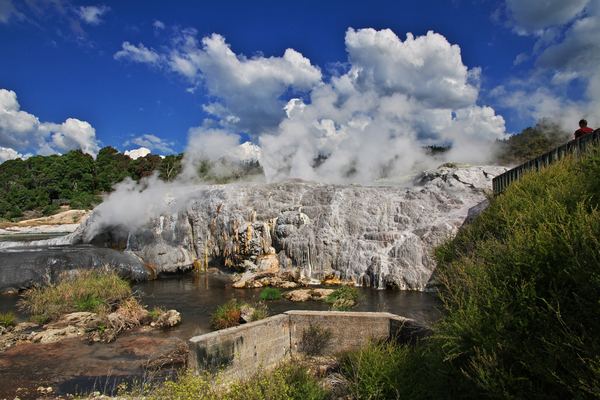
Geothermal tours in Rotorua: the Wai-O-Tapu springs, the Pōhutu geyser at Te Puia, Mount Tarawera and the Māori villages.
35 experiences in 3 destinations -
Tongariro Alpine Crossing
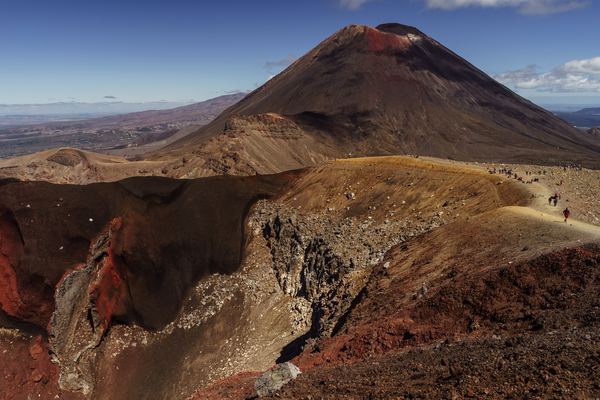
The Tongariro Alpine Crossing: guided walks past the Emerald Lakes and Mount Ngauruhoe, and the shuttle the one-way route makes compulsory.
6 experiences in 1 destination


Volcano Travel Experiences in New Zealand
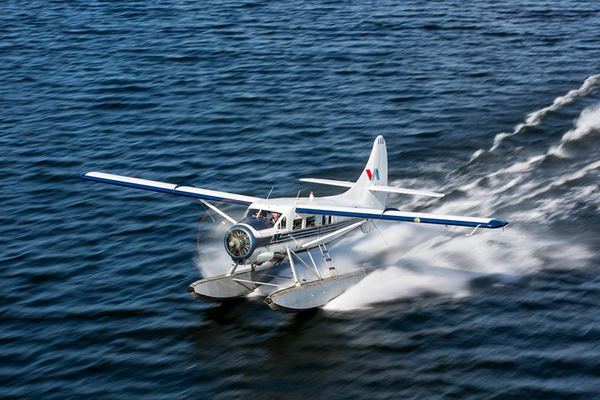
30 Minutes by Floatplane over Tarawera, Waimangu and Whakarewarewa
The seaplane lifts off the lake in front of town and covers in half an hour the crater lakes, Tarawera, Waimangu and Whakarewarewa, with flight times to suit.
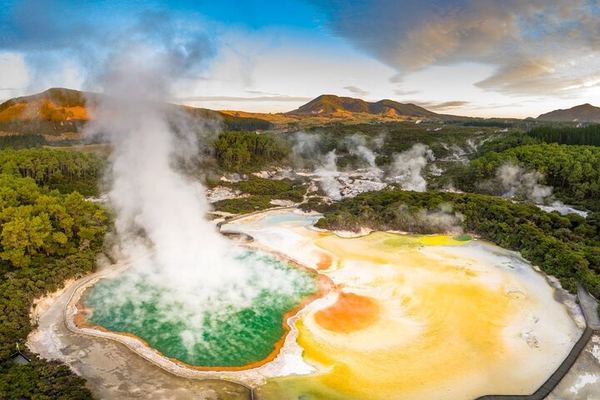
Auckland to Rotorua: Wai-O-Tapu, a Private Cedar Hot Tub, and Tirau's Corrugated Iron
The afternoon is a private cedar tub in native forest rather than another walk, and the road passes Tirau, the corrugated iron capital of the world.
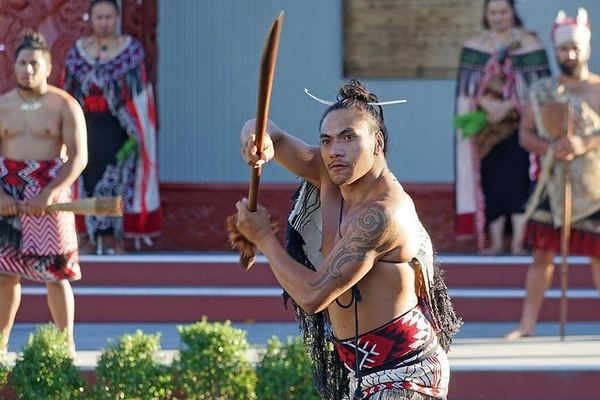
A Whole Day at Te Puia: Hāngī Buffet, Haka and Time to Actually Stay
One destination instead of two, so the hāngī buffet, the haka and the guided geothermal walk all fit without anyone hurrying you back to the minibus.
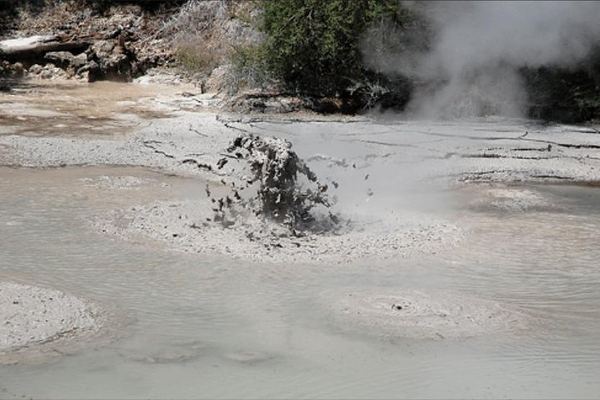
Boutique Rotorua Day from Tauranga: the Native Bush Walk That Beats the Redwoods
The operator surveys every group, and the stop they name most is the Tikitapu bush walk, not the Redwoods. Ohinemutu, Te Puke orchards and a foot soak too.
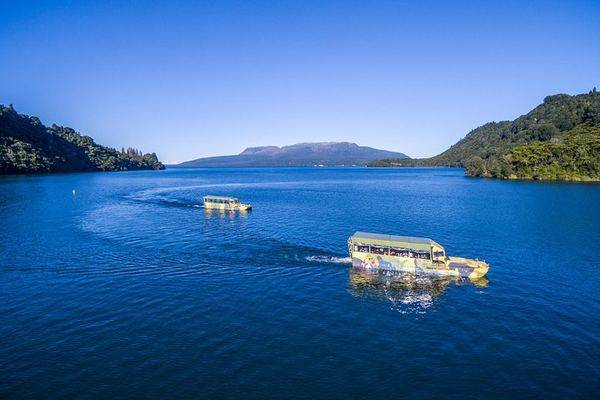
Four Rotorua Lakes in a WWII Amphibious Duck: Three of Them Entered by Water
The vehicle drives into three of the four lakes rather than stopping at them, and the Tarawera commentary is given from the water at the mountain's foot.
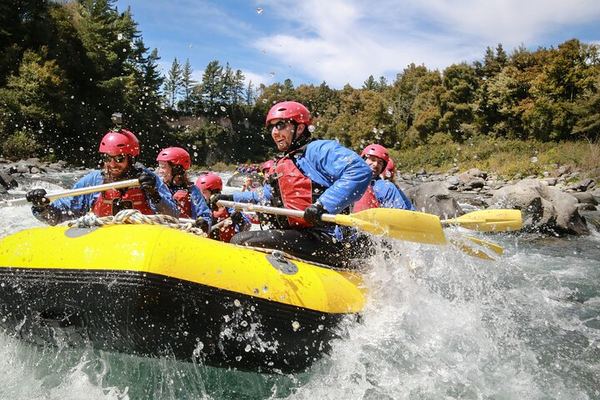
Grade 3 Rafting on the Tongariro: Blue Ducks, Volcanic Cliffs and Enormous Trout
Grade 3 rapids that take complete beginners, on a river where endangered blue ducks nest on the banks and the trout are big enough to eat a mouse.
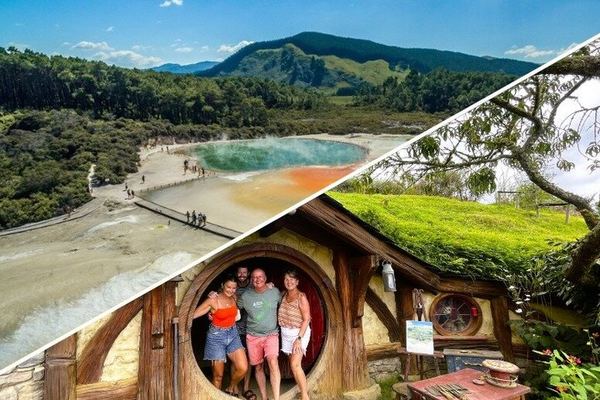
Green Hills to Devil's Bath: Hobbiton and Wai-O-Tapu in One Day from Auckland
Farmland and 44 hobbit holes in the morning, the Devil's Bath and boiling mud in the afternoon, with no hire car and no route to plan yourself.
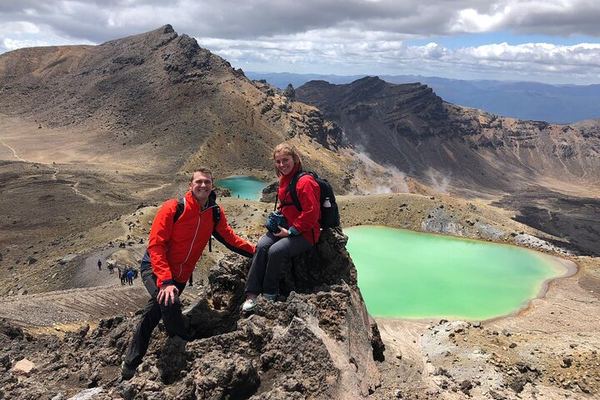
Guided Tongariro Crossing: 19 km, 8 Hours, Past the Mountain That Played Mount Doom
The guide reads the weather and track conditions as the day goes and times the pick-up to when the group actually gets down, not to a fixed schedule.
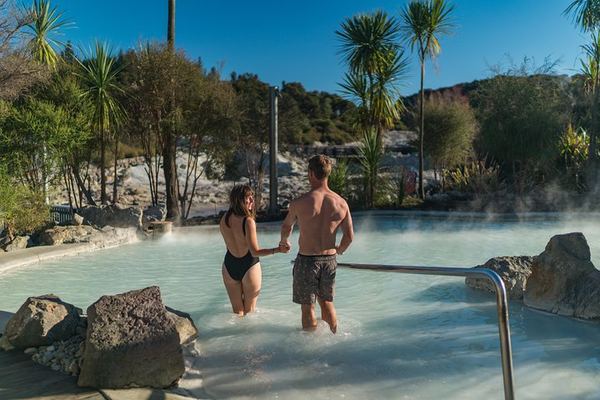
Hell's Gate, All Three Parts: the Walk, the Carving House, the Mud and Sulphur Baths
The combined ticket, so the geothermal walk and the carving house are followed by the mud baths and the sulphur spas rather than ending at the gate.
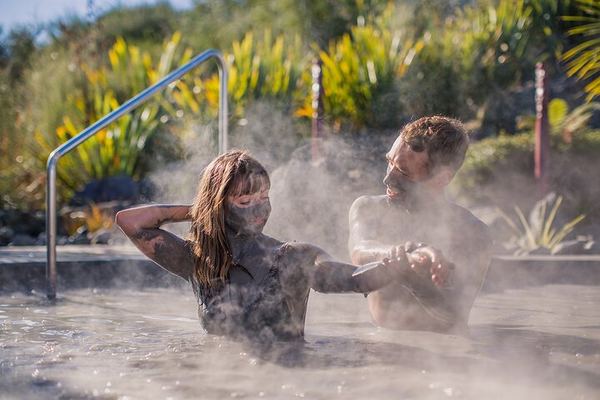
Hell's Gate from the Tauranga Cruise Dock: Largest Hot Waterfall South of the Equator
Timed to the ship's arrival and refunded in full if it never docks, with three hours at Hell's Gate and the biggest hot waterfall in the Southern Hemisphere.
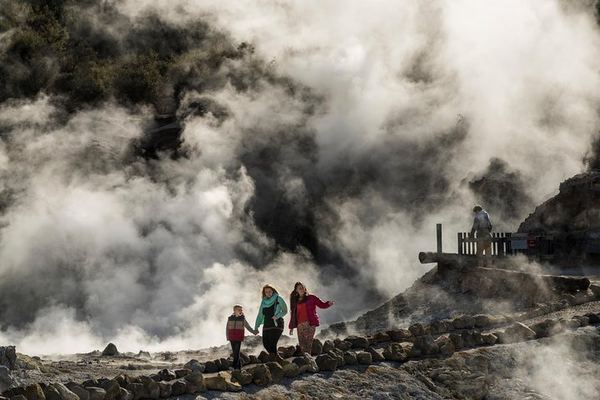
Hell's Gate Geothermal Walk: the Reserve on Foot, with the Free Guided Tour
The walking ticket for the reserve, with the daily guided tour included at no extra cost, plus the healing mud foot pool and a go at Māori carving on site.
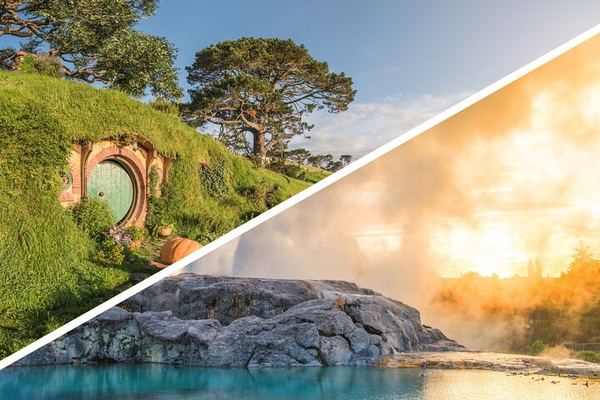
Hobbiton and Te Puia from Auckland: Small Group, Two Attractions
Cheeky Kiwi Travel runs this one in a small group: two and a half hours inside Hobbiton with a Green Dragon drink, then Te Puia guided in the afternoon.
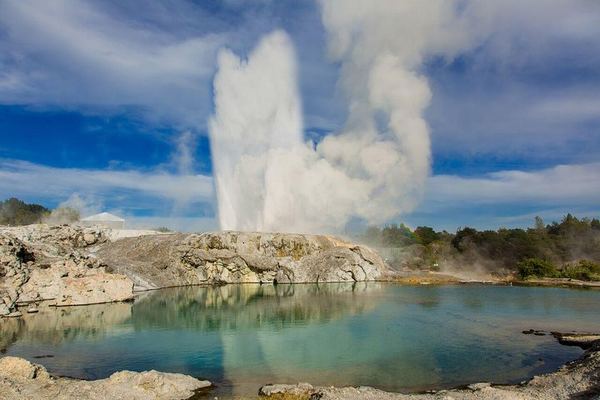
Hobbiton and Te Puia in a Day: 2.5 Hours in the Shire, a Drink at the Green Dragon
Two and a half guided hours at Hobbiton with a Green Dragon drink included, then Te Puia's geyser, a kiwi house and the wood and stone carving schools.
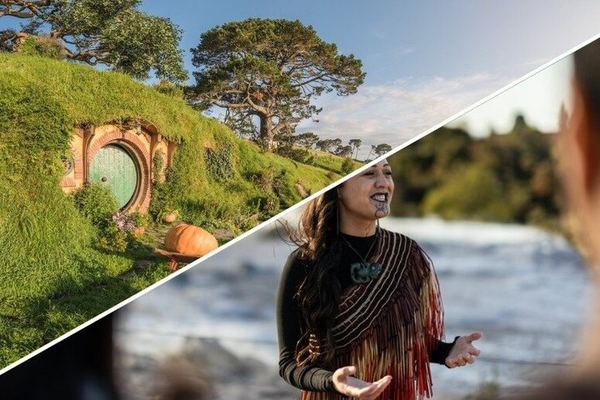
Hobbiton's 44 Hobbit Holes and Te Puia: a 12-Acre Film Set and a Geyser in One Day
Two and a half hours inside the 12-acre set with its 44 hobbit holes and a drink at the Green Dragon, then Te Puia's geyser and the Māori arts school.
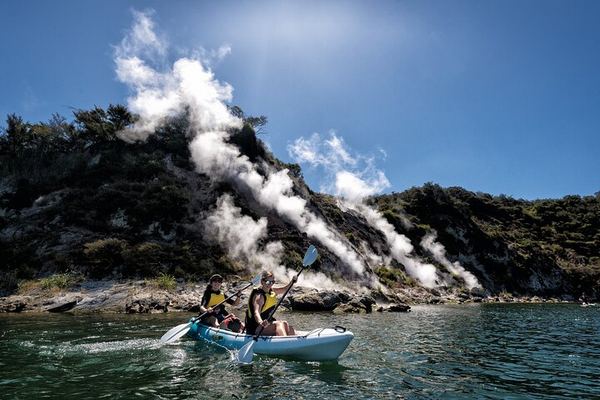
Kayaking Lake Rotomahana's Steaming Cliffs: the Only Operator Allowed on the Water
Taiao Adventures holds the only kayak access to Lake Rotomahana, so the steaming cliffs along its shore can be reached at water level on no other trip.
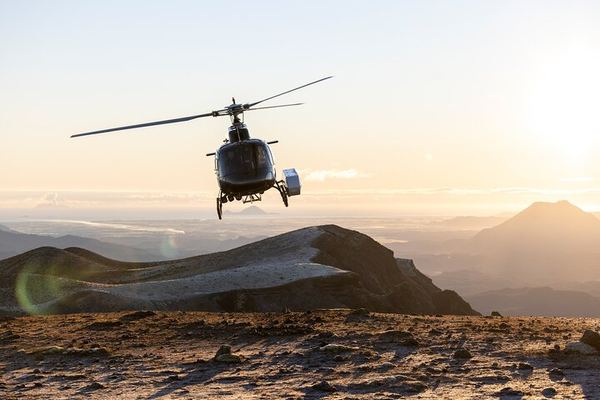
Landing on Mount Tarawera by Helicopter, with 20 Minutes on the Volcano
The pilot doubles as the guide, and the flight ends with a landing on the volcano and twenty minutes of walking up there rather than a pass overhead.
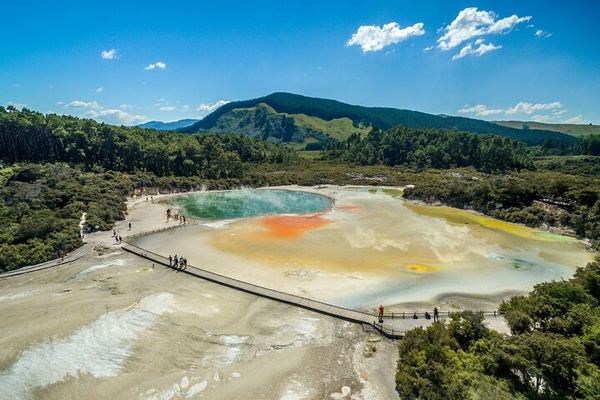
One Geothermal Morning, Five Afternoons: Wai-O-Tapu and a Rotorua Choice
The geothermal morning and lunch are fixed; the afternoon is a treewalk, a spa, hot tubs, Te Puia or a zipline, and you pick it when you book.
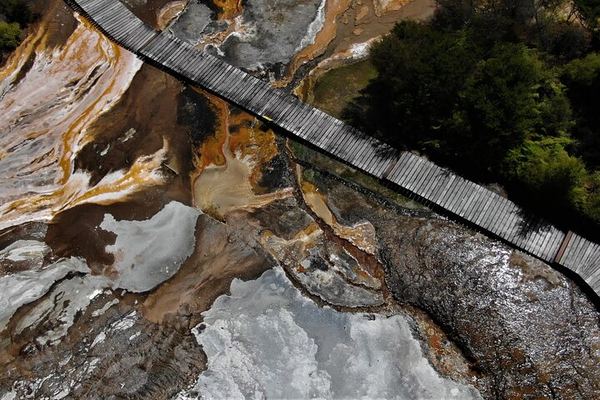
Orakei Korako: 23 Geysers, a Rare Thermal Cave, and a Ferry to Reach Them
Up to 23 geysers, silica terraces and a rare thermal cave on a 2.5 km self-guided loop, reached by a short ferry that runs on demand, not to a timetable.
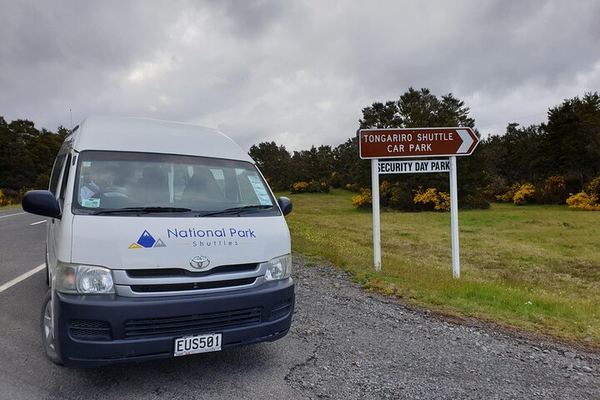
Park at the Finish: Ketetahi Carpark and a One-Way Lift to the Tongariro Start
You leave the car at the finish and get driven round to Mangatepopo, so there is no shuttle to catch at the end whether you walk it fast or slowly.
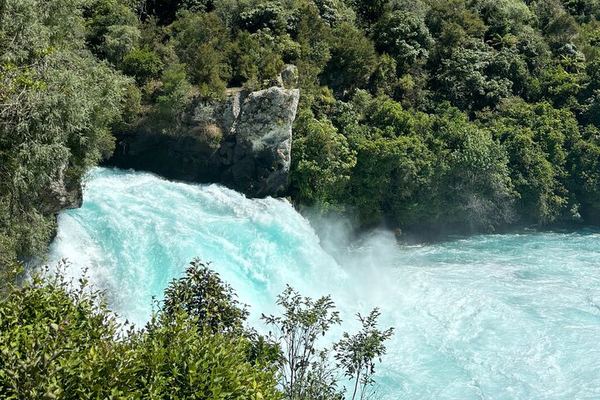
Private Day to Wai-O-Tapu, Huka Falls and Lake Taupo: 220 Cubic Metres a Second
Your vehicle only, from two people up, with the running order adjustable and Huka Falls pushing 220 cubic metres a second at the viewing point.
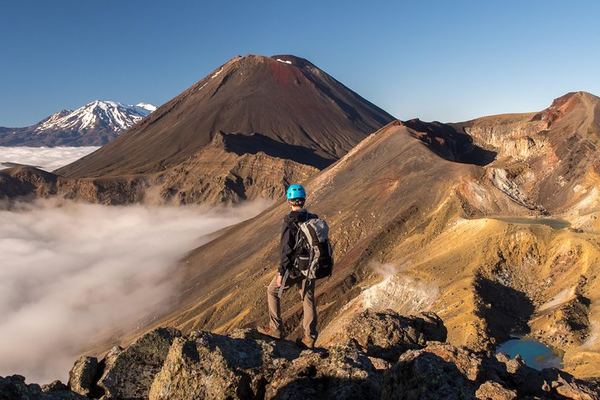
Private Tongariro Crossing with Adrift: Crampons and Ice Axes Supplied in Winter
Adrift supplies crampons and ice axes for the winter route and teaches their use on the day, and lunch and NZ$40 of gear hire come with the private guide.
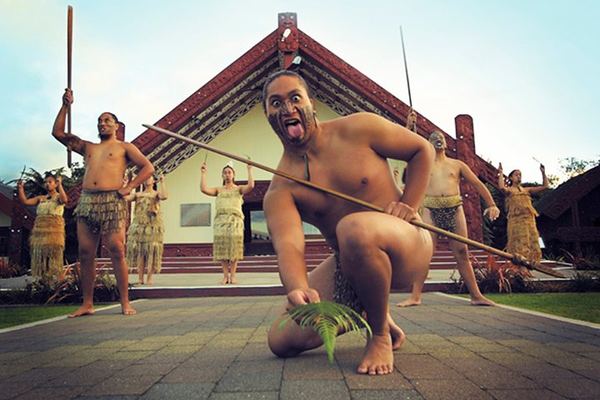
Rotorua and Te Puia in a Day: the Small-Vehicle Route the Big Coaches Miss
A small-vehicle day that reaches roads the coaches skip, with Te Puia's valley, a marae performance, a kiwi awake, and Rachel's Spring in the gardens.
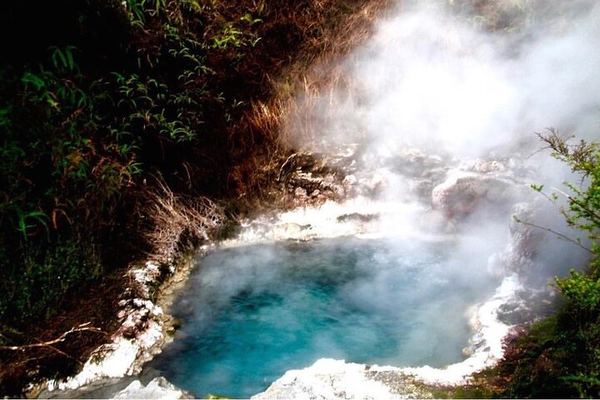
Taupo in a Day from Rotorua: Choose Waiotapu or Orakei Korako, Eleven Seats
The day fits Waiotapu or Orakei Korako, not both, and the entry to whichever you pick is in the price. Eleven passengers maximum, lunch at Taupo on you.
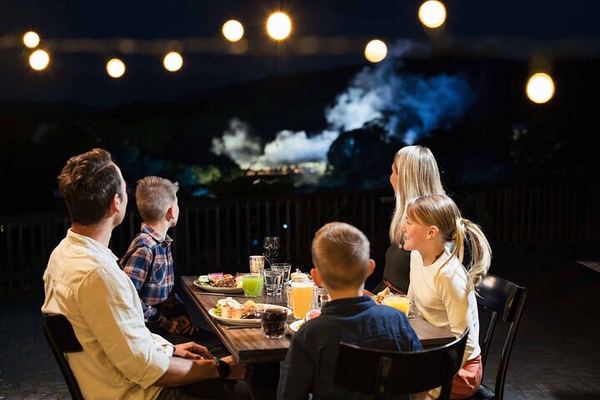
Te Pō at Te Puia: Hāngī Lifted from the Pit, then Pōhutu Under Lights
The evening opens with the hāngī being lifted out of the earth oven and closes with hot chocolate beside Pōhutu, with the thermal valley lit around it.
Ratings collected by Viator and Tripadvisor
Why the country sells steam and not lava
Everything in this catalogue sits inside one strip of ground. The Taupō Volcanic Zone runs from the Bay of Plenty coast, through Rotorua and Lake Taupō, and ends at Ruapehu in the middle of the island. The crust there is stretched thin, hot water circulates close to the surface, and that is why you get a town where the drains steam.
Two consequences follow, and they point in opposite directions. The heat is reliable, which is why Rotorua has been selling this since the 1800s and why the geysers, mud pools and hot springs run to a timetable you can book against. And the eruptions are rare and enormous rather than frequent and small, which is why nothing here is producing lava you can stand next to. Etna puts out something most years. Taupō's last significant eruption was around 1,800 years ago, and GeoNet describes it as the most violent eruption anywhere in the world in the last 5,000 years. Those are two different businesses, and only one of them can be sold as a Tuesday afternoon.
The lake is the volcano
Lake Taupō is not a lake near a volcano. It is the volcano: the water sits in the collapsed roof of the magma system that made it. The eruption that dug the basin, the Ōruanui, happened around 26,500 years ago and remains the largest known anywhere on earth in the last 70,000 years. The one that shaped the modern shoreline came far later, around 232 AD by the usual dating, and sent a pyroclastic flow across roughly 20,000 square kilometres of the North Island.
None of that is on sale, and it should not be. The alert level has been sitting at 0, and the practical effect on a visitor is a lake with trout in it, a river with Huka Falls in it, and geothermal fields at both ends. What you are looking at when you look at Lake Taupō is the crater. Most people drive round it without ever being told.
North Island or South Island
There is no volcano holiday in the South Island. The Southern Alps are a collision range, thrown up where two plates meet rather than built out of erupted rock, and the volcanic centres that do exist down there, Banks Peninsula behind Christchurch and the hills around Dunedin, stopped erupting millions of years ago and are now farmland and suburbs. Queenstown sells a great deal of adrenaline and none of it is volcanic.
So a volcano trip to New Zealand is a North Island trip, and in practice it is a triangle. Auckland is where you land. Rotorua is about three hours south of it by road. Tongariro National Park is another two and a half hours on from Rotorua, or four to five hours direct from Auckland. The most common mistake is trying to do either of them as a day trip from Auckland, and this catalogue shows exactly how that goes: the Auckland departures run 11 to 12 hours door to door, with pickups from 5:45 in the morning, and a good half of that is the coach.
| Rotorua Geothermal | Tongariro Alpine Crossing | |
|---|---|---|
| Listings here | 35 | 6 |
| What you do | Walk between geysers, mud pools and coloured springs on boardwalks | Walk 19.4 km across an active volcano, one way |
| Physical demand | None to moderate, most of it flat and paved | High: about 765 m of climbing, 6 to 9 hours, alpine exposure |
| Highest point | About 280 m, the height of the lake shore | 1,886 m at the Red Crater |
| Season | All year, nothing closes for weather | Effectively November to April without alpine skills |
| Usual price | 23 to 106 EUR at the gate | 31 to 42 EUR for the shuttle, 235 to 704 EUR guided |
| You start from | Rotorua, or a long day out of Auckland or Tauranga | National Park Village, Tūrangi, Taupō or Ohakune |
| Best for | Colour, culture, hot water, and doing it with children | One hard day and the best alpine ground on the island |
What you cannot book, and why these pages say geothermal
In New Zealand the phrase volcano tour carries something specific, and it is better said plainly than worked around.
Whakaari, also called White Island, is an active cone 48 kilometres off the Bay of Plenty coast. It is privately owned and has been a private scenic reserve since 1953, and for decades boats and helicopters took visitors into the crater. At 2:11 in the afternoon on Monday 9 December 2019 it erupted with people inside it. Twenty-two of them died.
Nobody lands on Whakaari now. There is no tour to book, no operator running one, and anything claiming otherwise is not what it says it is.
That is why the Rotorua destination on this site is called Rotorua Geothermal and not Rotorua Volcano. It is not squeamishness about a word. What New Zealand actually sells is geothermal: hot ground you walk over with a boardwalk between you and it. Calling that something else would describe a different and considerably more dangerous product than the one on offer.
One smaller restriction, on the other side of the island. Mount Ngauruhoe, the cone the Lord of the Rings films used for Mount Doom, is sacred to the iwi whose land the park sits on, and both they and the Department of Conservation ask people not to climb it. The Tongariro Alpine Crossing passes round its base rather than up it, and no legitimate guided walk offers the summit.
What it costs
The spread is wide, and it is not the spread most people expect. The cheapest thing in the New Zealand catalogue is a geothermal park at 23 EUR and the most expensive is a private guide on a walk at 704. Between those two, price is decided almost entirely by transport: how far the vehicle drives, and whether you are sharing it.
The pattern worth watching is the Auckland premium. Entry to a geothermal park costs a fraction of what a day trip from Auckland costs, and the difference is a coach and eleven hours. That is a reasonable thing to buy if you have one free day and no car. It is a poor thing to buy if you are sleeping in Rotorua that night, and a fair number of people book it without noticing which of those two they are.
| Type of day | Where | Price | How long |
|---|---|---|---|
| Geothermal park, on your own | Rotorua or Taupō | 23 to 60 EUR | 1 to 3 hours |
| Guided Māori village | Whakarewarewa | 29 EUR | 1 hour |
| Geyser terrace and the carving school | Te Puia, Rotorua | 55 EUR | 90 minutes |
| Shuttle to the Tongariro Crossing | Tongariro National Park | 31 to 42 EUR | the walk is 6 to 9 hours |
| Two geothermal parks in one morning | Rotorua | 96 EUR | half a day |
| Guided crater walk with a 4WD | Mount Tarawera | 102 EUR | 4.5 hours |
| Evening with hāngī dinner and performance | Te Puia, Rotorua | 106 EUR | about 4 hours |
| Day trip from Auckland | Rotorua and back | 170 to 224 EUR | 11 to 12 hours |
| Guided Tongariro Crossing | National Park Village | 235 EUR | 8 hours |
| Helicopter with a summit landing | Mount Tarawera | 352 EUR | 40 minutes |
| Private guide on the Crossing | National Park Village | 704 EUR | 8 hours |
When to go
The two areas have opposite calendars, and this is the rare case where the season changes what you can actually do rather than just how crowded it is.
Rotorua works every day of the year. The parks are open, the pools are hot regardless of the air temperature, and Wai-O-Tapu closes only on Christmas Day. Winter is arguably the better half: steam is visible against cold air, which is the photograph everyone wants and almost nobody gets in February.
Tongariro has a real season. From May to late October the Department of Conservation reclassifies the Crossing from a track to a route and states that alpine skills are essential, with crampons, an ice axe and a helmet on the equipment list. It is walkable in winter and it is a different, more serious day. The rest of the year it is a long hike.
| Month | 1 | 2 | 3 | 4 | 5 | 6 | 7 | 8 | 9 | 10 | 11 | 12 |
|---|---|---|---|---|---|---|---|---|---|---|---|---|
| Rotorua GeothermalOpen every day; steam reads better against cold air, and Wai-O-Tapu shuts only at Christmas | 1 | 2 | 3 | 4 | 5 | 6 | 7 | 8 | 9 | 10 | 11 | 12 |
| Tongariro Alpine CrossingMay to late October it is a route, not a track: crampons, ice axe and helmet, and about 9 hours of walking | 1 | 2 | 3 | 4 | 5 | 6 | 7 | 8 | 9 | 10 | 11 | 12 |
Months are shown as numbers. Tongariro's winter classification and equipment list are from the Department of Conservation; Rotorua's opening hours from the parks themselves. Checked August 2026.
Respect the sanctity of the maunga tapu by not touching or entering any of the waterways.
Getting between the two, and where to sleep
Rotorua and Tongariro are about two and a half hours apart by road, which makes them a natural pair over four or five days and an awkward one over two. On a long weekend, pick one.
Rotorua is the easier base by some distance. Everything in that branch, the geothermal parks, the village, the geyser, the lake trips, the helicopter, leaves from inside the town or within forty minutes of it, several operators collect you from your hotel, and you can fill three days without driving anywhere. It also holds the most concentrated Māori tourism in the country, and that is not a bolt-on: two of the destinations in this section sit on land the local iwi own and run.
Tongariro is the opposite. There is no town, only villages: National Park Village, Whakapapa, Tūrangi, Ohakune. The shuttles leave between about 5:45 and 9:45 in the morning, and if the weather shuts the track you have lost the day. Book the Crossing for your first full day in the area rather than your last, so that a closure leaves you a second attempt.
Questions people actually ask
Can you see lava in New Zealand?
Not on any bookable tour. Nothing in the country is producing surface lava you can reach. What you can see is the other half of volcanism: geysers, boiling mud, silica terraces, hot springs and the craters of eruptions that are recent in geological terms and not in human ones. If a listing implies lava, it is describing the rock rather than the state it is in.
Can you visit White Island or Whakaari?
No. It is privately owned, 48 kilometres offshore, and closed to visitors since the eruption of 9 December 2019, in which twenty-two people died. Scenic flights pass over it and nobody lands. Any listing offering a landing is not describing something that exists.
Rotorua or Tongariro?
Rotorua if you want colour, culture, hot water and no physical demand, and if you are travelling with children or with anyone who does not walk for eight hours. Tongariro if you want one serious alpine day and the best volcanic ground in the country, and if 19.4 kilometres with 765 metres of climbing is within reach. They are not substitutes for each other and both are worth the time.
Is Rotorua worth it if I only have one day?
Yes, but preferably not from Auckland. The day trips out of Auckland in this catalogue run 11 to 12 hours with pickups before six in the morning, and about six of those hours are in the vehicle. Staying in Rotorua turns the same content into a relaxed morning and costs a fraction of it. If Auckland is genuinely your only base, the trips are well rated and they work, but understand what you are buying.
Is the South Island volcanic?
Not in any way you can visit. The Southern Alps are a collision range rather than a volcanic one, and the old volcanic centres at Banks Peninsula and around Dunedin last erupted millions of years ago. Every volcanic and geothermal experience in this catalogue is on the North Island, and the two areas are within three hours of each other.
Do I need a guide?
Not for the geothermal parks, which are boardwalks with signs on them. For the Tongariro Alpine Crossing you are not legally required to have one and most people walk it independently in summer, but you do need transport at both ends because there is nowhere to leave a car for the length of the walk. Between May and late October the Department of Conservation calls it a route and says alpine skills are essential, and at that point a guide is the sensible answer rather than an upsell.
How many days do I need for the volcanic North Island?
Four to five for both areas without rushing: two full days in Rotorua, one to drive south and settle in, one for the Crossing, and one spare in case the weather takes your first attempt. Three days does one area properly. Two days does one area badly, and the two-day version is usually the one people regret.
Data verified on. Prices and listing counts from the New Zealand products on this site. Volcanic data from GeoNet. Track rules, quotes and classifications from the Department of Conservation.