
The Volcanic Explosivity Index is the closest thing volcanology has to the Richter scale, and it comes with the same problem: a single number that people take to mean how bad was it, when it actually means something much narrower.
It runs from 0 to 8. It is logarithmic, so each step up is roughly ten times more erupted material than the one below. And it is built almost entirely from two things: how much came out, and how high the column went. Nothing else.
The scale
| VEI | Description | Erupted volume | Plume height | Example |
|---|---|---|---|---|
| 0 | Effusive | under 10,000 m3 | under 100 m | Kilauea's lava flows, most Icelandic fissure eruptions |
| 1 | Gentle | over 10,000 m3 | 100 m to 1 km | Stromboli's routine explosions |
| 2 | Explosive | over 1 million m3 | 1 to 5 km | Fuego's frequent activity, most Etna paroxysms |
| 3 | Severe | over 10 million m3 | 3 to 15 km | Fuego 2018, Nevado del Ruiz 1985 |
| 4 | Cataclysmic | over 0.1 km3 | 10 to 25 km | Mont Pelee 1902, Eyjafjallajokull 2010, Merapi 2010 |
| 5 | Paroxysmal | over 1 km3 | over 25 km | Vesuvius AD 79, Mount St. Helens 1980 |
| 6 | Colossal | over 10 km3 | over 25 km | Krakatoa 1883, Pinatubo 1991 |
| 7 | Super-colossal | over 100 km3 | over 25 km | Tambora 1815, Samalas 1257, Thera about 1600 BC |
| 8 | Mega-colossal | over 1,000 km3 | over 25 km | Nothing in recorded history. Yellowstone, Toba |
Two things are worth pausing on. Nothing in recorded human history is an 8, and the last one was tens of thousands of years ago. And the jump between adjacent numbers is enormous: a VEI 5 and a VEI 6 differ by a factor of ten, so Krakatoa was not slightly bigger than Mount St. Helens, it was an order of magnitude bigger.
The three things it deliberately ignores
It does not measure deaths. This is the big one. Mont Pelee in 1902 was a VEI 4 and killed around 28,000 people in minutes, because a pyroclastic flow reached a town. Pinatubo in 1991 was a VEI 6, a hundred times larger, and killed a few hundred, because it was monitored and people were evacuated. The scale describes the volcano's output, not the human outcome, and the human outcome depends overwhelmingly on where the people were and whether anyone warned them.
It does not measure effusive eruptions well. The index is explicitly about explosivity, so a huge outpouring of lava that does not go bang scores near zero. Laki in 1783 produced the largest lava flow of the last thousand years and caused a famine that killed roughly one Icelander in six, and it does not stand out on this scale at all. Nyiragongo's lava flows have destroyed large parts of a city more than once with very modest VEI numbers.
It does not measure climate impact. That depends on sulphur content and on whether the plume reaches the stratosphere, neither of which the index tracks directly. Two eruptions of identical VEI can have completely different global effects depending on how much sulphur they carried and how high it went.
The one that broke the model
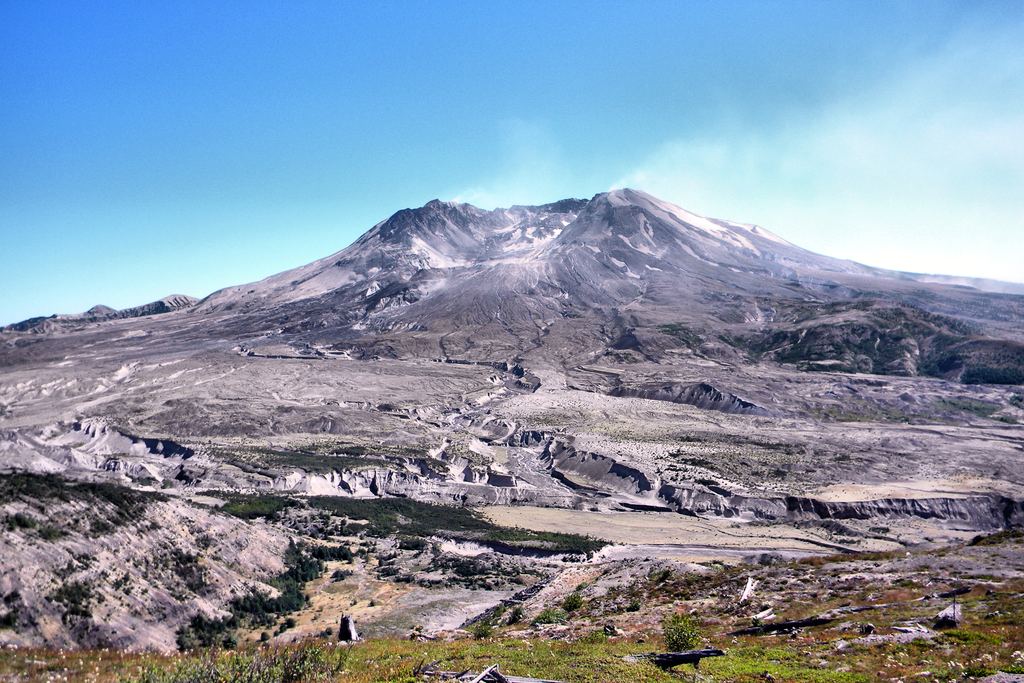
Mount St. Helens is a 5, and that number hides the interesting part
By volume, the 1980 eruption was unremarkable for a stratovolcano. What made it one of the most studied eruptions in history is something the index has no way to record.
The north flank of the mountain had been bulging for weeks as magma pushed into it. When an earthquake triggered its collapse, the resulting landslide was the largest in recorded history, and it did something nobody had planned for: it removed the confining weight from a pressurised system, which then erupted sideways.
The lateral blast flattened forest across some 600 square kilometres in minutes. Fifty-seven people died, several of them well outside what had been considered the danger zone, including a volcanologist who was monitoring the mountain from what everyone believed was a safe distance.
The mountain lost about 400 metres of height and gained the enormous open crater you can see today. It remains climbable, by permit, and the route up Monitor Ridge is one of the more sobering walks in this catalogue.
What actually predicts danger
If VEI is the wrong number to worry about, here is a better set.
How close people live. The single strongest predictor of a volcanic catastrophe is population within a few kilometres of a stratovolcano. Vesuvius has the largest at-risk population of any volcano in the world; that, not its eruptive history, is why it is watched so closely.
Whether it makes pyroclastic flows. These are what kill people: avalanches of hot gas and rock moving at speeds nothing can outrun, at temperatures nothing survives. Sticky-magma volcanoes make them, runny-magma ones do not.
Whether there is loose ash and heavy rain. Lahars, volcanic mudflows, can occur years after an eruption whenever rainfall mobilises deposited ash, and they travel far down river valleys. Nevado del Ruiz in 1985 was a modest eruption that produced a lahar which killed over 20,000 people in a town 50 kilometres away.
Whether it is monitored, and whether anyone acts on it. Pinatubo is the case that proves this. Tens of thousands of people were evacuated before the largest eruption in most people's lifetimes, on the basis of monitoring data, and it worked.
How the number gets assigned
Mostly afterwards, and mostly by measuring the deposits.
For a historical eruption, geologists map how thick the ash layer is at different distances from the vent, integrate that to get a volume, and work back to a column height. It is painstaking fieldwork, and it is why the VEI of ancient eruptions gets revised as the mapping improves: an older book and a recent paper disagreeing about Thera or Samalas is usually not an error in either of them, it is twenty years of additional trenches.
For a modern eruption, satellite measurement of the plume and direct sampling of the fallout do the same job in days rather than decades.
But the index remains fundamentally retrospective. You cannot assign a VEI to an eruption that has not finished, because the volume is not yet known, and you certainly cannot assign one to an eruption that has not started. This matters more than it sounds, because it is the reason no observatory will tell you how big the next eruption will be. They can tell you what the volcano has done before, which is the best available guide and is not the same thing.
Which is worth remembering when you see a page forecasting the VEI of a future eruption. That is not what the scale is for, and nobody who works with it would write such a sentence.
Quick answers
What VEI is dangerous?
The wrong question, and asking it is the most common misuse of the scale. A VEI 2 at a volcano with a village on its flank is more dangerous than a VEI 5 in an empty part of Alaska. Proximity, pyroclastic flows and warning matter far more than the number.
Has there ever been a VEI 8?
Several, and none in recorded history. The Toba eruption in Sumatra around 74,000 years ago and several Yellowstone eruptions are in that category. They are known from deposits rather than from any account, for the obvious reason.
What VEI was the 2010 Iceland eruption?
A 4, which is modest by historical standards, and it grounded European aviation for days. It is the clearest illustration that consequences depend on where the ash goes rather than on how much of it there is. A slightly different wind and almost nobody outside Iceland would remember it.
Do lava flows have a VEI?
Technically 0 or 1, since the index measures explosivity and a lava flow does not explode. This is a genuine limitation. Laki in 1783 produced the largest lava flow of the last thousand years and led to the death of about one Icelander in six, and it barely registers on the scale that is supposed to measure eruption size.
Why do different sources give different VEI numbers for the same eruption?
Because the value is calculated from deposits, and deposits get re-mapped. As fieldwork improves, volume estimates change and the assigned number moves with them. An older book and a recent paper disagreeing about a historical eruption is usually not an error in either of them.
The range that holds both of them
St. Helens lost 400 metres of summit in 1980. Sixty kilometres away in the same chain stands Rainier, which is the one volcanologists actually worry about, and the one you can walk on.

Data verified on. The index follows the standard Newhall and Self formulation used by volcano observatories. Assigned values for historical eruptions are revised as fieldwork improves. Editorial Policy