

Terceira: Inside Algar do Carvão and the Lava Tubes
338 steps down a volcanic chimney to a rainwater lake, and an opening timetable that decides whether you get in at all.
On Terceira the volcano is not a mountain you look at. It is a hole you climb down into. Algar do Carvão is a vertical chimney left by a lava column that drained away, ninety metres deep, with a mouth roughly fifteen metres by twenty in a field of hydrangeas and cattle. There are 338 steps to the bottom, where a lake of rainwater collects to fifteen metres in a wet year and disappears entirely in a dry summer. Very few volcanic chimneys anywhere are open to walk into, and almost nobody outside Portugal has heard of this one.
This page is about Terceira and its cavities, and about two things that will change your trip if you read them in the right order: the winter timetable, and the fact that two of the four listings on this site still say the main cave is shut. The archipelago as a whole and the flights between the islands are on the Portugal page.
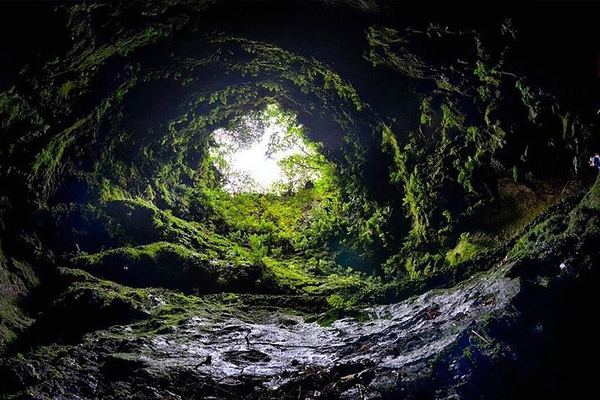
Terceira's Lava Caves, Including One That Is Not Open to Tourism
A lava tube that is not open to tourism, the Christmas cave and the sulphur fumaroles at Furnas do Enxofre. Algar do Carvão is closed with no reopening date.
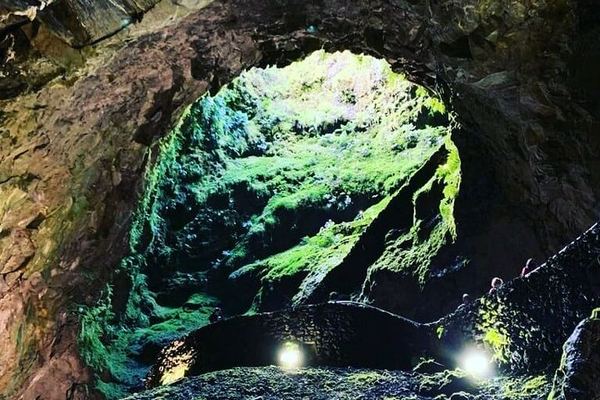
Terceira Underground: a Lava Tube and the Inside of a Volcano
A lava tube and a volcano interior in one half-day, with the sulphur vents at Furnas do Enxofre and the stream and ducks at the Lagoa das Patas. By van.
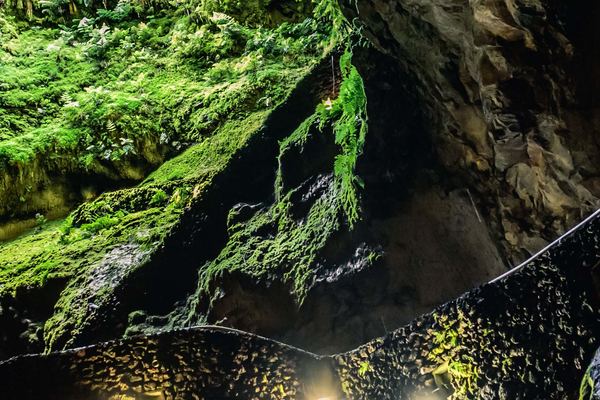
The Volcanic Caves of Terceira and the Furnas do Enxofre
Terceira's two volcanic caves plus the fumaroles of the Furnas do Enxofre, on an off-road run from Angra do Heroísmo with a guide and hotel pick-up.
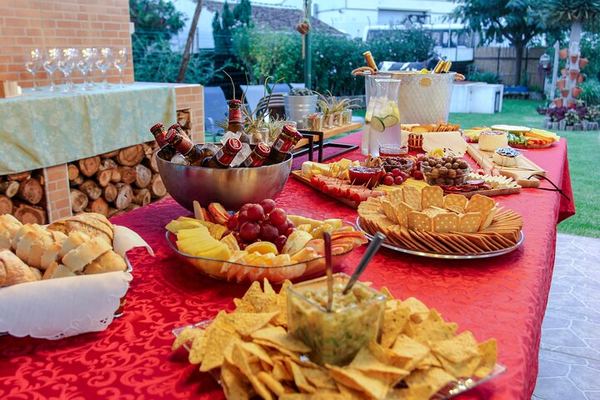
Volcanic Wine on Terceira: Biscoitos and Full Bottles on the Table
Vines grown in basalt less than 50 metres from the Atlantic, the wine museum at Biscoitos, and a tasting of at least three wines in a family's garden.
Ratings collected by Viator, Tripadvisor and Civitatis
Three cavities, and they are not the same thing
Every cave tour on Terceira visits some combination of the same three places, and the marketing tends to blur them into "the caves". They are structurally different and worth telling apart before you book.
Algar do Carvão is the chimney. A column of lava drained back down its own vent and left the pipe standing, and the pipe is what you descend. Radiocarbon work puts it at 2,148 years old give or take 115, which is more precise and more defensible than the "about 3,200 years" that circulates in guidebooks. Inside it is 12 to 13 °C all year, the walls carry silica stalactites that are unusual enough to be the reason it is a Regional Natural Monument, and a lake of rainwater sits at the bottom. Entry is 10 EUR, visits last about half an hour, and 150 people may be inside at once.
Gruta do Natal is a lava tube: a horizontal tunnel where a flow crusted over and kept running underneath. Furnas do Enxofre is neither, an open fumarole field near Porto Judeu where volcanic gas comes out of the ground at a range of temperatures, some of them high enough to be fenced.
| Algar do Carvão | Gruta do Natal | Furnas do Enxofre | |
|---|---|---|---|
| What it is | A 90 m volcanic chimney | A lava tube you walk along | An open fumarole field |
| Getting in | 338 steps down and back up | Level walking, low ceiling | A boardwalk, no descent |
| Entry | 10 EUR | Charged separately, 8 to 15 EUR | Free |
| Temperature | 12 to 13 °C | Cool and damp | Whatever the weather is |
| Time inside | About 30 minutes | About 30 minutes | 20 minutes on the walkway |
| Limit | 150 people at once | Group bookings out of season | None |
The opening hours are what decide the trip
This is the fact that every other page about Terceira puts last, and it should be first.
From October to March, Algar do Carvão opens on four days a week only: Tuesday, Wednesday, Friday and Saturday, from 14:30 to 17:00. Two and a half hours, four days. If you land on a Sunday in November for three nights, there is a real chance you never get inside the thing you came for, and no amount of paying will change it, because there is no online booking. Tickets are sold at the door, and the ticket desk does not take American Express.
Gruta do Natal is stricter still out of season. Outside the summer opening it is available only by prior arrangement, with 48 hours' notice and a charge of 300 EUR for the group. That matters because the combined cave tours sold at 45 to 50 EUR are priced on the assumption of ordinary summer opening. A December booking for a combined trip is buying something that does not exist in that form at that price, and the substitution is a different lava tube rather than a refund.
In summer the problem disappears. From April the site runs daily hours and the caves are the easiest thing on the island to arrange.
| 1 | 2 | 3 | 4 | 5 | 6 | 7 | 8 | 9 | 10 | 11 | 12 |
Two of the four listings still say the cave is closed
This is uncomfortable and it is better said than hidden. Of the four Terceira products on this site, two carry a notice in their own text saying Algar do Carvão is not accessible and that a substitute lava tube will be shown instead. One of the two dates its notice to 19 October 2024 and describes the reopening date as unknown. The other says the site is temporarily closed for maintenance and adjusts its itinerary accordingly.
The other two sell Algar do Carvão without any caveat at all.
Both cannot be current. A closure notice left in a listing for two years is a listing nobody has read since, and the far more likely reading is that the site reopened and the text was never updated. But that is a deduction, not a booking condition, and the amount you are risking is the entire reason you chose this island. Message the operator before you book and ask one question: is Algar do Carvão open on the day of my tour. A straight answer takes them thirty seconds and it is the single most useful thing you can do about Terceira.
ATT: Algar do Carvão will be closed from Oct 19th 2024 to unkown date as of now, during this period we will be showing a hidden lava tube instead.
Four volcanoes, one eruption anybody watched
Terceira is four overlapping stratovolcanoes on the Terceira Rift, and they are in age order across the island. Cinco Picos is the oldest at roughly 370,000 years and is now worn down to low ground. Guilherme Moniz follows at around 270,000, and its crater rim at 640 metres is where the road to the caves runs. Pico Alto is much younger, active between about 9,000 and 1,000 years ago, and Algar do Carvão belongs to its system. Santa Bárbara is the youngest and the highest, 1,023 metres, and it is the only one that has erupted since people arrived.
That eruption was in 1761, on Santa Bárbara's eastern flank, and it is the only one on land in the island's written history. The most recent activity anywhere near Terceira was underwater: a submarine eruption off Serreta, at the western tip, which ran from 1998 into 2001 and produced floating lava balloons that fishermen scooped out of the sea. Nothing about it was visible from a viewpoint.
Angra do Heroísmo was rebuilt, and then listed
Angra was founded in 1534 and is the oldest city in the Azores. It was a compulsory stop for the fleets coming back from the Indies and the Americas, which is why a town of its size has that many churches, that much fortification and a volcanic cone with a fortress on it. Monte Brasil, the cone above the harbour, is a tuff ring built by an eruption in the sea, and the walk to the top is free and takes about an hour.
On 1 January 1980 an earthquake of magnitude 6.9 struck fifty kilometres west of the town. It killed more than sixty people, injured over four hundred, left around twenty thousand homeless, and destroyed roughly seventy per cent of the houses on Terceira, the historic centre included.
UNESCO inscribed Angra do Heroísmo on the World Heritage list in 1983, three years later, while the reconstruction was still going on. So the sixteenth-century town you walk through is genuinely sixteenth-century in plan, in facade line and in a great deal of its stone, and it was also put back together within living memory by people who had just lost their houses. Nobody selling you a tour will mention this and it is the most interesting thing about the place.
The wine, and one claim to treat carefully
The fourth product on this page is not a cave at all. It is a five-hour wine tour at 110 EUR that runs to Biscoitos on the north coast, where vines grow in black lava inside the same kind of walled enclosures used on Pico, and finishes with a tasting in the garden of an Azorean family at Praia da Vitória. Three wines minimum, full bottles on the table, plus fortified wines and homemade liqueurs, and a rating of 5.0 from everyone who has left one.
The listing opens with a claim worth handling at arm's length: that only eight places in the world produce volcanic wines. That is a marketing figure rather than a viticultural one, and there are considerably more than eight. The supporting statement in the same paragraph is the sound one, and it is the interesting part anyway: volcanic soils cover roughly one per cent of the world's land surface and account for a much larger share of the wine anybody argues about.
Note the museum's closing days. The Biscoitos wine museum shuts on Sundays and Mondays, and the operator substitutes another producer when it does.
The things that are not in the listing
Four Terceira specifics, three of which cost money and one of which costs you the trip.
Cave entrances are not in the tour price. One operator states 8 to 15 EUR per person for the caves; another excludes the Gruta do Natal ticket by name. On a 45 EUR half day that is a quarter again.
There is no online booking for Algar do Carvão. Tickets are sold on site, and American Express is not accepted. Carry another card, or cash.
338 steps is 338 steps in both directions. Two of the listings mark the tour as not recommended for travellers with poor cardiovascular health and ask for a moderate level of fitness, which is a fair description. There is no lift and there is no alternative route out.
Check the timetable before you book the flights, not before you book the tour. Winter opening is four days a week for two and a half hours. If Algar do Carvão is the reason you chose Terceira over another island, that calendar should be choosing your dates.
Questions people actually ask
What is Algar do Carvão?
A volcanic chimney: the vertical pipe left behind when a column of lava drained back down its own vent, roughly 2,148 years ago. It is ninety metres deep, you go down 338 steps to reach the bottom, and a lake of rainwater collects there to about fifteen metres in a wet year. The walls carry silica stalactites, which is unusual enough to have made it a Regional Natural Monument. Entry is 10 EUR and the visit takes about half an hour.
Is Algar do Carvão open all year?
Not on the same terms. From April onwards it keeps daily hours. From October to March it opens on Tuesday, Wednesday, Friday and Saturday only, between 14:30 and 17:00, which is four days a week and two and a half hours a day. There is no online booking, so you cannot secure a slot in advance. If it is the reason you are coming to Terceira, plan the flights around the timetable.
Why do some tours say the cave is closed?
Two of the four Terceira listings on this site carry a closure notice in their own text and offer a substitute lava tube instead. One of those notices is dated 19 October 2024 and gives no reopening date. The other two operators sell the same site with no caveat at all. The likeliest explanation is a stale listing rather than a current closure, but that is inference. Message the operator and ask whether Algar do Carvão is open on your date before you pay.
Is Terceira a good island if the weather is bad?
Better than most of the Azores, and that is its real argument. The main sites are underground and they do not care about cloud, unlike the crater-lake viewpoints on São Miguel that sit at 650 to 950 metres and vanish for months at a time. The catch is the opposite one: the caves are governed by an opening timetable rather than by weather, and in winter that timetable is tighter than the sky.
How much does a Terceira cave tour cost?
45 to 50 EUR for a three to four hour trip covering Algar do Carvão, Gruta do Natal and the Furnas do Enxofre fumarole field, with hotel pickup. Add 8 to 15 EUR per person for the cave entrances, which are excluded almost everywhere. The only other product on the island is a volcanic wine tour at 110 EUR for five hours, which goes to Biscoitos and Praia da Vitória instead.
Has anything erupted on Terceira recently?
Not on land since 1761, on the eastern flank of Santa Bárbara. The most recent activity was underwater, off Serreta at the western tip, between 1998 and 2001, and it produced floating lava balloons rather than anything visible from shore. The island sits on the Terceira Rift and is monitored continuously, but what you can visit is old rock, a fumarole field and the inside of a chimney.
Is Angra do Heroísmo worth time as well as the caves?
Yes, and for a reason nobody puts in a brochure. Angra has been a UNESCO World Heritage site since 1983, three years after an earthquake of magnitude 6.9 destroyed around seventy per cent of the houses on the island, the historic centre included. The town was rebuilt to its own plan and then listed. Monte Brasil, the volcanic cone above the harbour, is a free walk of about an hour and gives you the whole bay.
Data verified on. Prices and inclusions read from the four Terceira products here. Cave depth, fees, limits and opening days as published on site; 1761 and 1998–2001 eruptions from the record.