

Mount Ijen Tours: Blue Fire, the Acid Lake and the Sulphur Miners
The blue fire is burning gas, not lava. One operator here states in its own terms that it is not available, and the crater descent was unresolved on 13 August 2026. Ask before you pay.
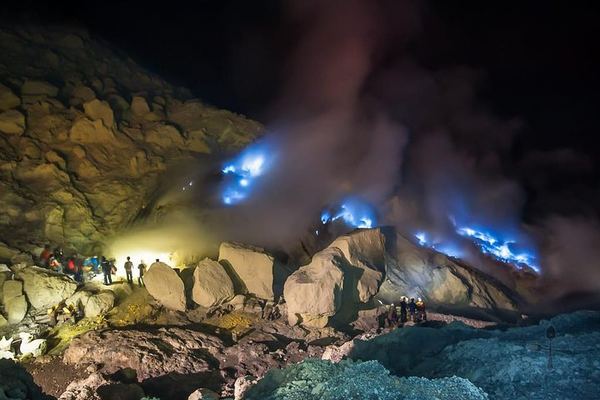
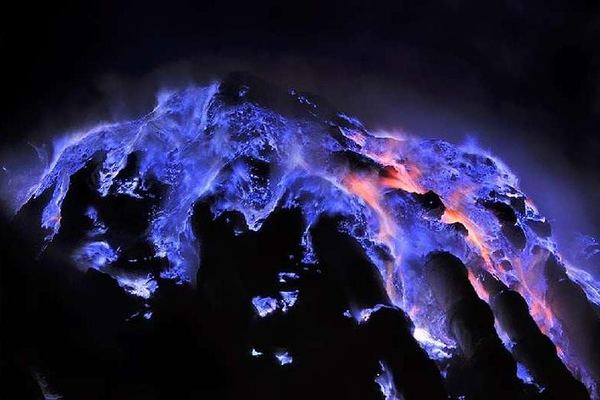
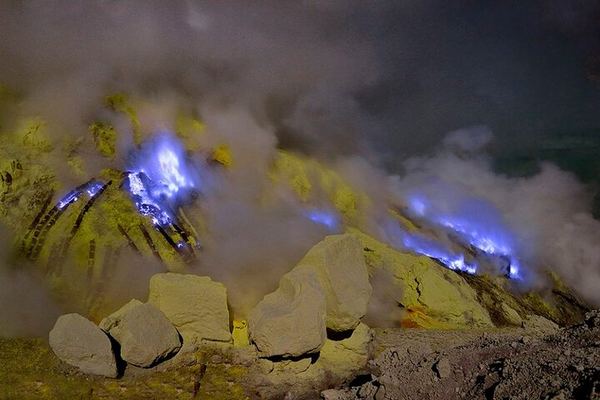
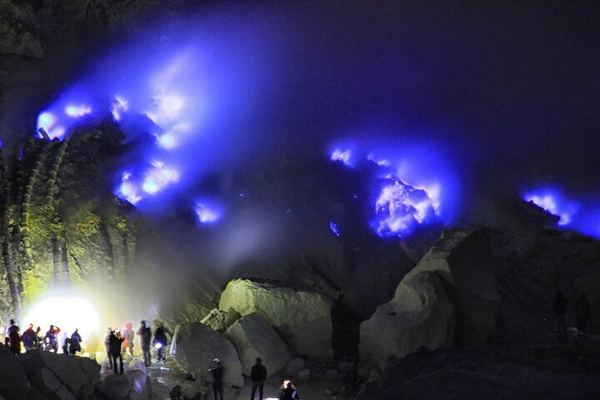
The blue fire at Ijen is not lava. It is sulphurous gas escaping from vents on the crater floor at temperatures that let it ignite in air, burning at up to 600 degrees in flames that can reach five metres, and it is only visible in the dark. That is the whole reason a trip here starts at one in the morning instead of at dawn. It also means the sight depends on being allowed to walk down into the crater, which is a separate permission from being allowed to walk up the mountain, and that permission has been on and off.
Two things separate this page from every other Ijen page you will read. The first is that the blue fire is treated here as a question rather than a promise. The second is the monthly closure, which is published by the park and by almost nobody else, and which sends people who left Bali at seven the previous evening to a locked gate after six hours in a car.
From Banyuwangi or Bali Sunrise Ijen Vulcano Hiking All Inclusive
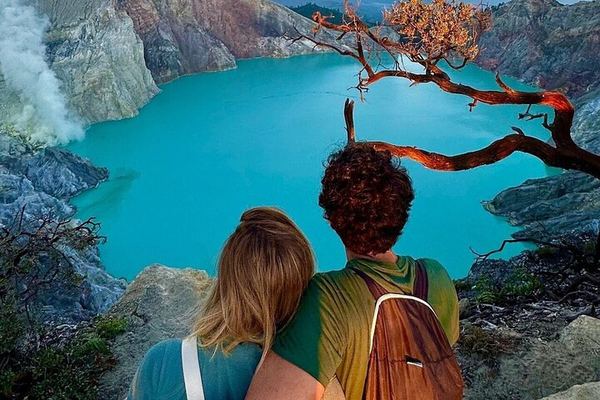
A 1 hour 30 transfer to Paltuding, the climb to the blue flames before dawn, then the summit at sunrise over the largest acidic crater lake in the world.
Ijen at Midnight, with a Coffee Plantation on the Way Back
Ninety minutes through rainforest to the car park, an hour up and thirty down into the crater, and a coffee plantation and a waterfall on the drive home.
Ijen at Night, Past the Miners Carrying 80 to 100 Kilos
The miners you pass on the way up are carrying 80 to 100 kilos of sulphur in bamboo baskets, one way, and the route ends at the sunrise spot above the lake.
Ijen Blue Fire, and the Sunrise Window from May to September
The acid lake inside the crater covers a square kilometre, the largest on Java, and the operator puts the best sunrises of the year between May and September.
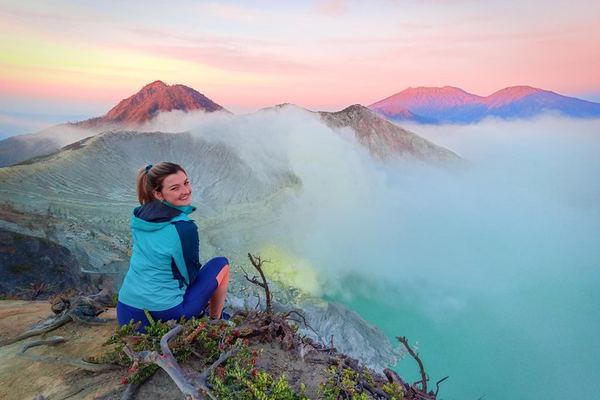
Ijen Blue Fire from Bali in 24 Hours, No Overnight Stay
Blue fire burns in only two places on earth, here and at the Dallol volcano in Ethiopia, and this crossing from Bali runs 24 hours with no overnight stop.
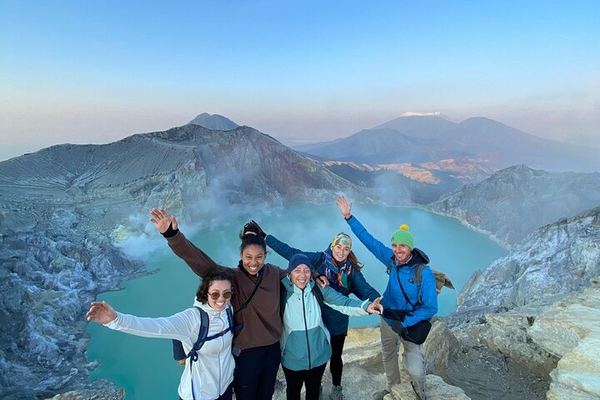
Ijen Blue Fire from Banyuwangi, Health Check and Gas Masks
Pick-up runs from 11 pm, a health check is required by local government rules before anyone climbs, and the gas mask and headlamp are handed out at Paltuding.
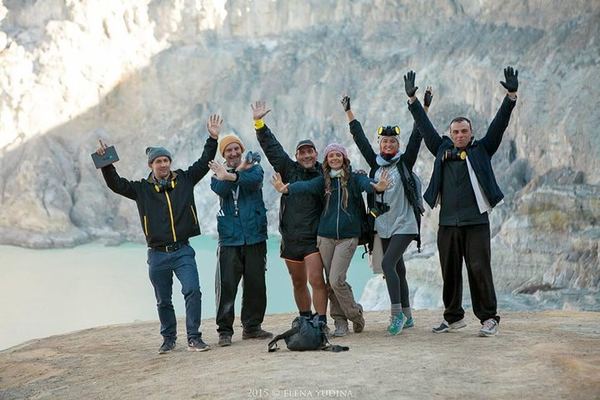
Ijen in 24 Hours from Bali: Afternoon Departure, a Room, and the 2,370 m Rim
The car leaves at 1 PM, dinner comes in vegetarian and halal versions, and there is a room to sleep in before the night climb to the rim at 2,370 m.
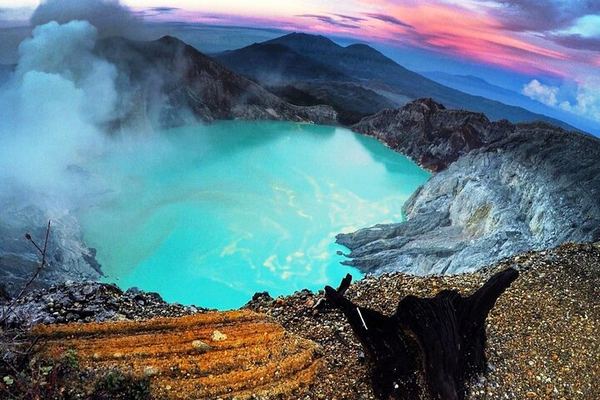
Mount Ijen Blue Fire from Ubud: Overnight Drive, Ferry and the Acid Lake
The pick-up is at 19:00 and the crater is on Java: a ferry crossing, then a climb of about an hour and three quarters down to a lake at 40 °C and pH 0.5.
Overnight Ijen from Bali: North Coast Stops, a Homestay and the 2 am Climb
The drive north stops at Ulun Danu, the twin lakes and Lovina, the night is spent in a homestay on the Java side, and the climb to the blue fire starts at 2 am.
Overnight Ijen from Bali via Banyumala Falls, Munduk and the Licin Rainforest
The crossing day takes in Wanagiri, the Banyumala falls you can stand under and the Munduk terraces, then the fern rainforest at Licin and a night climb.
Ratings collected by Viator and Tripadvisor
Whether you will see the blue fire
Every listing on this page sells the blue fire in its title or its first line. One of them, a 25 EUR departure from Banyuwangi with a 4.9 rating, also says this in its own terms and conditions, where nobody reads it: that the phenomenon is not available, and that the operator provides a visual illustration designed to closely resemble it for documentation and educational purposes. Those were its published terms on 13 August 2026, and the same product was bookable for the following day.
That sentence is worth sitting with. It is not a scam and it is not hidden fine print in the legal sense, since it is written on the product page. It is a company that has decided to keep selling a named phenomenon it cannot deliver, and to hand you a picture of it instead. Nobody else selling Ijen says anything about this at all, which is the more troubling fact of the two.
The reason for the uncertainty is that reaching the flames means descending about 150 metres from the rim onto the crater floor, and that descent is governed by gas readings rather than by the volcano's alert level. Reports from the year to August 2026 contradict each other: one account has the descent shut for maintenance of the sulphur pipes, another has it shut as too dangerous, and a third operator's own website says on one page that it is allowed subject to daily gas readings and on another that it takes thirty minutes. No official document settles it. Treat the descent as unresolved, ask the operator directly for the position on your date, and do not pay a premium for the flames as a guaranteed item.

What it looks like when it is running
The flames follow the gas. Where a fracture or a pipe vents sulphur vapour hot enough to catch, the burn traces the ground in sheets rather than jets, blue because burning sulphur is blue, and it goes out and relights as the flow shifts. Photographs make it look like a wall of neon; in person, on a good night, it is closer to a moving pool of blue at your feet with people standing in the smoke around it.
You need genuine darkness. By around five in the morning the sky has taken the colour out of it and there is nothing left to see, which is why the hike starts when it does. The volcano being quiet is not the same as the crater floor being open, and the two get conflated in almost every article written about this place.
The lake you are standing above
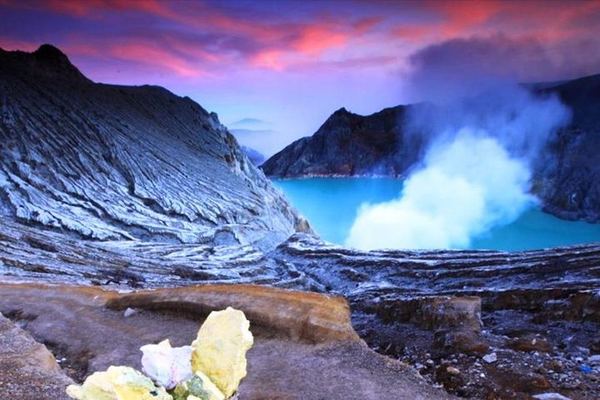
What daylight reveals when the flames fade is the reason to be here even if the descent is shut. The Ijen crater holds a lake about 722 metres across and around 200 metres deep, turquoise in a way that looks retouched, and it is the largest body of acid water on earth. The pH is roughly 0.5 at the shore and has been measured nearer 0.13 towards the middle. That is not a lake with unusually acidic water. That is dilute sulphuric and hydrochloric acid with a lake's worth of it.
Nothing lives in it. Metal objects dropped in it do not come back. The colour comes from dissolved iron and aluminium sulphates, and it changes with the weather and with what the vents underneath are doing. From the rim in the first proper light the whole bowl reads as a single flat sheet of blue-green, with yellow crusts of sulphur down one side and steam coming off the water at the far end.

The miners, without the sentiment
Ijen is a working sulphur mine and has been since the 1960s. Ceramic pipes are run into a vent to condense the vapour, the sulphur solidifies as it cools, men break it out with iron bars and carry it up. The loads are between 75 and 90 kilograms in two baskets on a shoulder pole. The route out of the crater climbs roughly 300 metres on gradients between 45 and 60 degrees, and then there is a walk of about three kilometres down the outside of the mountain to the weighing station. Many of them do it twice a night.
Visitors meet this on the trail in the dark, and the honest description of the encounter is that it is uncomfortable. You are going up for pleasure and they are going down for a wage, on the same path, and they step aside for you because you are the customer. Buying a moulded sulphur turtle for a few thousand rupiah is not an act of solidarity; it is a small purchase from a side business. What it does do is put money in the right hand directly, which is more than most of what happens up there.

The wheelbarrow economy
The most visible change on this mountain in the last decade is that a good number of miners now push tourists instead of carrying sulphur. The service is a converted barrow with a seat, worked by two men, one pulling and one braking, and it is called the trolley taxi. It costs between 800,000 and 1,200,000 rupiah for the ride up and back.
Set that against a basket of sulphur and the economics explain themselves without anyone needing to be pitied. If you cannot make the climb, the barrow is a legitimate option and the money goes to the people who used to carry rock. If you can make the climb, walk. The one thing worth avoiding is haggling hard over the barrow, which is where the transaction stops being a fair trade.
Where you are picked up decides what you pay
Ten listings sit under this page and they split exactly in half. Five leave from Banyuwangi, the town at the eastern tip of Java about ninety minutes from the trailhead, and cost 22 to 61 EUR. Five leave from Bali, cost 106 to 175 EUR, and go to the same crater.
The extra money buys a car to the Gilimanuk ferry, a crossing of the Bali Strait, a drive up the Java coast, and all of that again in reverse the next day. It is roughly six to seven hours in each direction. A trip sold as a day trip from Bali is a 20 to 24 hour day, most of it seated, with a mountain in the middle of it at two in the morning. Several of the Bali listings on this site are honest about the structure in their itineraries, giving pick-up times of seven in the evening and a ferry crossing at midnight. The word in the title is still day trip.
If Ijen is the reason you are in this part of Indonesia, sleep in Banyuwangi. If Ijen is a detour from a Bali holiday and you have one free night, the Bali departures work, and the cheapest of them is a third of the price of the dearest for a materially similar programme.
| Leaves from | Listings | Price | Door to door | What the price adds |
|---|---|---|---|---|
| Banyuwangi | 5 | 22 to 61 EUR | 9 to 10 hours | Transfer, guide, entry, gas mask, headlamp |
| Bali (Ubud, Kuta, Seminyak) | 5 | 106 to 175 EUR | 20 to 24 hours | Two ferry crossings and about 13 hours of road |
| Combined with Bromo | See Mount Bromo | 175 to 441 EUR | 2 to 4 days | A second volcano eight hours west |
The paperwork and the costs that sit outside the ticket
Four things that decide your night and appear in almost no listing.
A medical certificate is required. Participants are checked before the hike under local rules, and the certificate costs between 30,000 and 100,000 rupiah at a post that operates from two in the afternoon until seven the next morning. One operator here includes it. Another lists it explicitly as not included, which means you are buying it yourself, in the dark, in a queue, before you start walking. This requirement appears on a small minority of the pages that rank for Ijen.
The gas mask is not optional and not all masks are equal. A proper cartridge respirator rents for around 45,000 rupiah at the trailhead. The paper surgical masks that some groups hand out do nothing against sulphur dioxide. Both of the Banyuwangi products on this site that itemise their inclusions list a gas mask and a headlamp; the ones that do not itemise, do not itemise. Ask, and if the answer is vague, rent your own at Paltuding.
The gate opens at two in the morning and the site works to a ceiling of about 2,000 visitors a day. In practice the ceiling bites in the high season and on weekends rather than on a wet Tuesday.
Pick-up outside the Banyuwangi city centre costs extra. One operator states 150,000 rupiah per booking rather than per person for anywhere beyond the centre, which includes the Ijen resort area and Licin village. That is the sort of clause that turns the cheapest listing into the third cheapest.
Two questions, asked before you pay: is the crater descent permitted on your date, and is a cartridge gas mask included? Everything else about an Ijen night is negotiable. Those two are the night.
The first Friday of every month
Ijen closes to visitors on the first Friday of each month for a cleaning and maintenance day known locally as Ijen Rijig. It is not weather, it is not volcanic, and it is not negotiable. In 2026 the dates are 2 January, 6 February, 6 March, 3 April, 1 May, 5 June, 3 July, 7 August, 4 September, 2 October, 6 November and 4 December.
Nothing about this is secret and almost nothing on the open web mentions it. If your Ijen night falls on one of those dates and you are travelling from Bali, you will spend six or seven hours getting to a barrier. Check the date against that list before you check anything else.
| 1 | 2 | 3 | 4 | 5 | 6 | 7 | 8 | 9 | 10 | 11 | 12 |
The walk, in numbers
From Paltuding at about 1,865 metres it is roughly three kilometres to the rim at about 2,300, so 435 metres of ascent over a wide track of volcanic gravel. Most people take between ninety minutes and two hours. It is not technical and it is not exposed. It is relentlessly uphill, in the dark, at an hour when your body expects to be asleep, and the last stretch is steep enough that the trolley taxis do good business on it.
If the descent into the crater is open, add 150 metres down on a rough path of loose rock and steps cut by the miners, about 45 minutes each way, in gas. Operators put the total at nine to ten hours door to door from Banyuwangi. Take a jacket: the rim before dawn is cold, and you will have sweated on the way up.
Questions people actually ask
Is the blue fire lava?
No. It is sulphurous gas venting from the crater floor at a temperature high enough to ignite when it meets air, burning blue because that is the colour sulphur burns. Some of it condenses back into molten sulphur that runs downhill and glows, which is where the confusion comes from. There is no magma anywhere near the surface here.
Can you actually see it?
Uncertain, and anyone giving you a confident yes or no is going beyond what is documented. Seeing it requires descending about 150 metres into the crater, which is managed on gas readings and was closed at various points in the year to August 2026. One operator selling Ijen tours on this site states in its own conditions that the phenomenon is not available. Ask your operator directly about your own date, and treat a guarantee as a warning sign.
Do you need a gas mask?
Yes, and a real one. A cartridge respirator, hired at the trailhead for around 45,000 rupiah if it is not included, filters sulphur dioxide. A surgical or cloth mask does not. On the rim in a favourable wind you may barely need it; on the crater floor, or when the wind turns, it is the difference between an uncomfortable few minutes and being unable to breathe.
Is it better to go from Bali or Banyuwangi?
Banyuwangi, on every measure except convenience. It is 90 minutes from the trailhead, the listings run 22 to 61 EUR, and the whole thing takes nine or ten hours. From Bali it is six to seven hours each way including a ferry, the listings run 106 to 175 EUR, and the trip lasts 20 to 24 hours. Going from Bali is a reasonable choice if Bali is where you are. It is not a day trip.
How hard is the climb?
About three kilometres and 435 metres of ascent to the rim, on a wide gravel track, taking most people 90 minutes to two hours. The difficulty is the hour and the dark rather than the terrain. The descent into the crater, if it is open, is a different matter: loose rock, steps cut by miners, and gas. Operators list Ijen as unsuitable for people with respiratory or cardiovascular problems, and they mean it.
What is the acid lake like?
About 722 metres across, roughly 200 metres deep, and the largest acid lake in the world, with a pH near 0.5 at the shore. Nothing lives in it. You look at it from the rim after sunrise, when the water reads turquoise against the yellow sulphur crusts on the far side. You do not go near the water and no tour offers to.
Is Ijen ever closed?
Yes, on the first Friday of every month for maintenance, and at other times when gas readings or volcanic activity require it. The 2026 monthly closures fall on 2 January, 6 February, 6 March, 3 April, 1 May, 5 June, 3 July, 7 August, 4 September, 2 October, 6 November and 4 December. Badan Geologi had the volcano at alert Level I of four when this page was checked on 13 August 2026, which is the lowest of the four.
Should I buy a sulphur souvenir from a miner?
If you want one, yes, and pay the asking price. The moulded figures cost a few thousand rupiah and the money goes straight to the person who carried the material out. It does not offset anything and it is not charity. It is a small transaction between two people, which on this mountain is the most straightforward form the exchange takes.
Data verified on. Alert level from Badan Geologi (PVMBG). Closure dates and access rules from park announcements. Prices, durations, inclusions and the blue fire disclaimer read from the products on this site.