

It is the first question anyone asks about a volcano holiday, and almost nobody answers it straight. The honest answer has two halves. The first half is encouraging: at any moment there are around forty volcanoes in a state of ongoing eruption, and roughly twenty of them are doing something on any given day. The second half is the one that gets left out. Most of those volcanoes sit on islands with no airport, in war zones, in Antarctica, or behind an exclusion zone that a government drew for good reasons.
Count the places where persistent activity, legal access and a realistic chance of seeing something all overlap, and you are down to about four. That is not a sales pitch. It is the number, and knowing it is worth more than a list of thirty destinations that mostly cannot deliver.
Three probabilities, not one
Whether you see lava is not one question. It is three, multiplied together, and they behave nothing like each other.
Is the volcano active? This changes on the scale of decades. Stromboli has been erupting since February 1934. Yasur has been going, by the best estimate, since around 1270.
Will they let you near it? This changes in days. An exclusion radius is drawn by a government agency after a monitoring reading, and it moves without warning. Kīlauea's recent activity has been happening inside a closed area of its own national park.
Will you see anything when you get there? This changes in hours. Cloud, rain, and above all daylight.
A volcano can be superb on the first count and hopeless on the second. That combination is more common than the encouraging one, and it explains most of the disappointment in this field.
The constraint nobody mentions
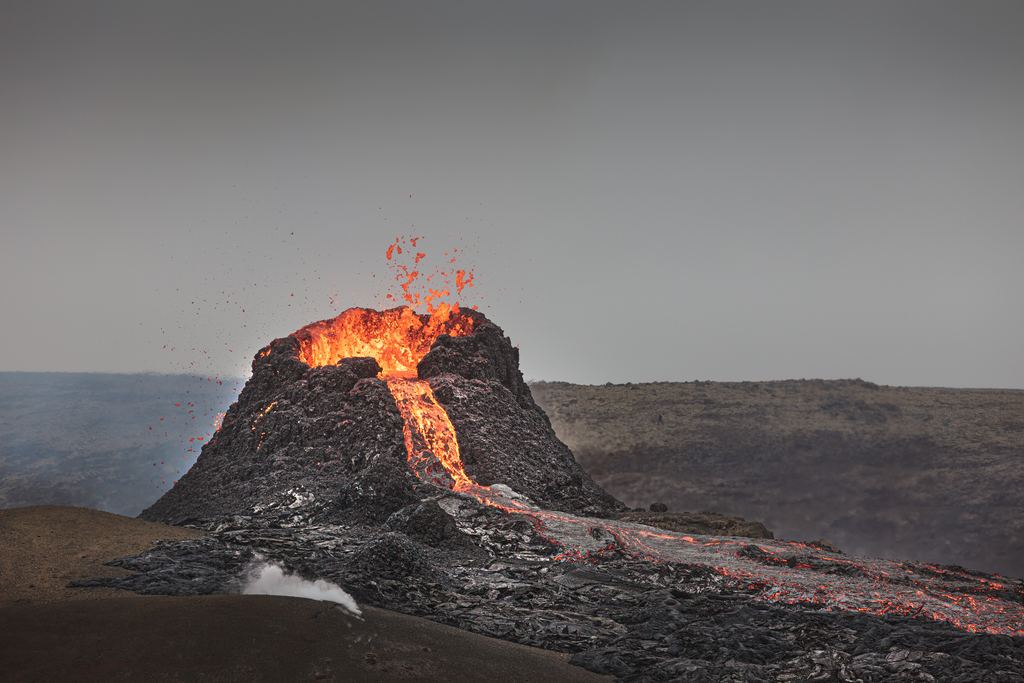
Every photograph of red lava you have ever seen was taken at night
Basaltic lava sits somewhere between 1,000 and 1,150 °C. That sounds enormous, and for a rock it is, but as a light source it is feeble. Most of what it radiates comes out in the near infrared, around 2,100 nanometres, where your eyes register nothing at all. The visible red is only the tail end of the emission.
Now put that against daylight, which runs from roughly 10,000 lux under heavy cloud to 100,000 lux in full sun. In the middle of the day, moving lava looks grey, or a dull rust colour, with a shimmer of heat above it. The vivid orange that sold you the trip only exists once the sun is down.
This is why the good tours are awkward. Acatenango is an overnight because the show starts after dark. Stromboli departures climb in the late afternoon and come down by torchlight. It is not adventure styling, it is the only window in which the product exists.
What "continuously erupting" actually means
The phrase does a lot of quiet work, and it does not mean what most people assume. In the standard global catalogue, an eruption is counted as continuing as long as there is no break of three months or more. Not daily lava. Not weekly lava. Just no quarter-year of complete silence.
Which produces a useful trap. A volcano can be listed as continuously erupting for twenty years and still have given visitors nothing for the last five months of it.
An eruption marked as continuing does not always mean persistent daily activity, but indicates at least intermittent eruptive events without a break of three months or more.
There is a second consequence, and it is the one that catches out anyone writing about this. The clock resets after every pause. Sangay in Ecuador has been restless since the 1930s, but the eruption officially in progress began in March 2019. Popocatépetl woke up in December 1994; the current episode dates from January 2005. Both framings are true, and only one of them is safe to write down, because only one of them survives the next quiet spell.
So when you read that a volcano has been erupting since some impressive date, check which clock is being quoted.
The four or five places where the odds are genuinely good
These are the destinations where long-running activity and usable access overlap. None of them is a guarantee, and anyone offering you one is selling something.
| Place | Active since | What you would be looking at | The catch |
|---|---|---|---|
| Stromboli, Italy | February 1934 | Explosions from the summit craters every few minutes, seen from the Sciara del Fuoco or from a boat | Access above a set altitude is regulated and periodically restricted after violent episodes |
| Yasur, Vanuatu | around 1270 | One of the few craters on earth you can stand on the rim of and look down into | Getting to Tanna is the hard part; the alert level closes the rim when it rises |
| Masaya, Nicaragua | lava lake formed December 2015 | A lava lake you drive to. There is a car park at the crater rim | Lava lakes drain. This one has been fading since 2017 |
| Fuego, from Acatenango, Guatemala | January 2002 | Explosions on the neighbouring cone, watched across a saddle from a high camp | You do not climb Fuego. You climb its neighbour, and it is a hard climb |
| Santiaguito, Guatemala | June 1922 | A lava dome that has been growing for a century, viewed from marked overlooks | Dome collapses are the hazard; distance is not optional |
The most reliable volcanoes on earth are ones you will never see
Dukono, in the Halmahera islands of Indonesia, has been erupting without a recorded pause since 13 August 1933. Bagana, in Bougainville, since 2000. Erebus, on Ross Island in Antarctica, has held a lava lake since 1972. Between them they represent the most dependable volcanic activity on the planet, and not one of them is a place you can visit.
I find this the most clarifying fact in the whole subject. It separates two things that get muddled constantly: how active a volcano is, and how much use that is to you. They are unrelated. The volcano does not know you are coming.
Where the odds are worse than the marketing suggests
Kīlauea is the clearest case. It is one of the most famous volcanoes in the world and it does erupt, but in episodes of lava fountaining that generally last under twelve hours, separated by pauses of two weeks or more. If you book a week in Hawai'i hoping to catch one, you are buying a lottery ticket with reasonable odds and no refund. Go for the park, which is extraordinary on any day. Treat lava as a bonus.
Etna works the same way. It is Europe's most productive volcano and it spends most of the year doing nothing you could photograph. When it goes, it goes properly, with lava fountains that close the airport at Catania. Between those episodes you get a superb mountain, a summit crater field, steam, and no incandescence at all.
Iceland is a special case, because the region has entered a phase that will probably outlast all of us, and still has an unhelpful habit of erupting in places nobody is allowed to stand.

How to read a tour that promises lava
We look at a lot of these listings. The pattern is consistent enough to be useful: the title evokes, the description declares, and almost nobody puts a date on anything. Six checks, in the order worth doing them.
Read the description, not the title
Titles are marketing and are written loosely. Descriptions are usually written by someone worried about complaints, and they tend to be accurate.
Look for the word that is missing
If molten, glowing, incandescent or flowing never appears, there is no liquid rock in this tour. Lava field, lava cave and lava tube all mean cold stone.
Check the timing against the physics
A tour that promises lava, leaves at nine and returns at three cannot deliver it. Honest ones run at dawn, at dusk, or overnight.
Look for a date
A description that mentions lava without saying when that lava was last seen is quoting a fact with no expiry printed on it.
Check the volcano against the list
If it is not among the few dozen currently in eruption, there is no eruption. Not a small one. None.
Distrust the undated photograph
All lava photography is nocturnal. A daytime tour illustrated with glowing orange rock is showing you somebody else's night.
The great lava attractions all ended
This is the part that should make you book sooner rather than later, and also the part that should make you distrust any page that has not been updated in three years. Every one of the famous ones stopped, and most of them stopped abruptly.
How the classics ended
Five decades of the world's best-known lava viewing, and what closed each one.
The origins
July 1968
Arenal wakes up
A Costa Rican farmland cone that had been quiet for centuries erupted without warning, destroying two villages and killing 78 people. It then settled into 42 years of nightly incandescence and built a town around itself.
1983
Puʻu ʻŌʻō opens on Kīlauea
The vent that made Hawai'i synonymous with lava viewing. For 35 years it fed flows that reached the sea, and the ocean entry became one of the most photographed places in volcanology.
The growth
October 2010
Arenal goes quiet
The activity had been fading for a decade. Then it stopped. La Fortuna, the town built on lava viewing, rebuilt itself around hot springs, waterfalls and hanging bridges, and did it well enough that most visitors today never learn what they missed.
May 2018
Kīlauea collapses
In three months the volcano erupted about 0.8 cubic kilometres of lava through fissures in a residential subdivision while its summit caldera collapsed in stages. Puʻu ʻŌʻō drained and died. The ocean entry ended.
December 2018
Ambrym drains in a night
Two of the planet's handful of permanent lava lakes sat at Benbow and Marum in Vanuatu. A dyke of roughly 0.7 cubic kilometres propagated more than 20 kilometres along the rift and emptied the system beneath them. Both lakes vanished.
Today
December 2019
Whakaari
An eruption on an actively visited island in New Zealand killed 22 people and injured dozens. Tourism on the island ended that day, and the case reshaped how volcano access is regulated well beyond New Zealand.
March 2021
Iceland starts over
After 781 years of silence, the Reykjanes peninsula erupted again. The first eruption was in an uninhabited valley half an hour from Reykjavík and 356,000 people walked out to see it. The ones that followed were beside a town, and nobody was allowed near.
May 2021
Nyiragongo
The largest lava lake on earth sat above the city of Goma. The eruption killed 32 people and destroyed 17 villages. The lake has since reformed, but the region's security situation is what keeps visitors away now.
The only place where lava is guaranteed has no volcano
There is exactly one venue on earth where you can book a time slot and be certain of seeing molten rock. It is an indoor theatre, with two locations in Iceland, and what they do is melt real basalt quarried from the 1918 Katla eruption, heat it past 1,100 °C, and pour it into the room in front of you.
Purists will object that this is not an eruption, and they are right. It is also honest about being what it is, it happens on schedule, and it is the only lava in the world with a probability of 1.00. For a traveller who wants to feel the heat of molten rock from a couple of metres away and cannot spend a week gambling on a mountain, that is not a consolation prize.
Quick answers
Can I see lava in Hawai'i right now?
Sometimes, and never predictably. Kīlauea erupts in fountaining episodes that usually last less than twelve hours, with pauses of two weeks or more between them, and recent activity has been inside a closed section of the national park. Check the Hawaiian Volcano Observatory before you build a trip around it, and go for the park regardless.
Which volcano gives me the best chance in Europe?
Stromboli, without much competition. It has been erupting since 1934 and produces explosions from the summit craters at intervals of minutes. Etna is more dramatic when it performs but performs on its own schedule. Access on Stromboli is regulated above a certain height and the rules tighten after violent episodes, so check what is currently permitted before travelling.
Is a lava tour dangerous?
The regulated ones are managed risk, not adventure. The danger is concentrated in three things: going beyond a boundary, going without a guide where one is legally required, and volcanic gas, which is heavier than air and pools in hollows. The Whakaari disaster in 2019 killed 22 people who were standing where a permit said they could stand, which is worth knowing before you assume that permitted means safe.
Why does every tour photo show orange lava at night?
Because that is the only time it looks like that. Molten rock emits most of its energy in the infrared; the visible red is a fraction of the output, and daylight overwhelms it completely. If the tour runs in daylight and the photo glows, the photo was taken on somebody else's night.
What is the difference between a lava field and lava?
About a thousand degrees. A lava field is cooled rock, sometimes only a few years old, and it can be a spectacular landscape. It is not molten and it does not glow. Most products sold as lava tours are field tours, and the good ones say so.
Start with the places where it is close to reliable
Stromboli erupts every few minutes and has done for ninety years. It is the shortest distance between a European airport and molten rock.
The most reliable lava in Europe
Stromboli has been erupting since February 1934 and you reach it on a scheduled ferry.
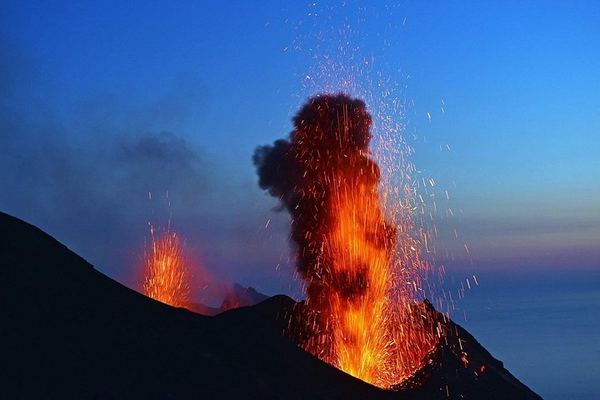
Panarea and Stromboli Boat Trip from Lipari, Sunset at Strombolicchio
Regina Eolie boats from Marina Corta, time ashore at San Pietro on Panarea and at Scari on Stromboli, then sunset off Strombolicchio and the Sciara del Fuoco.
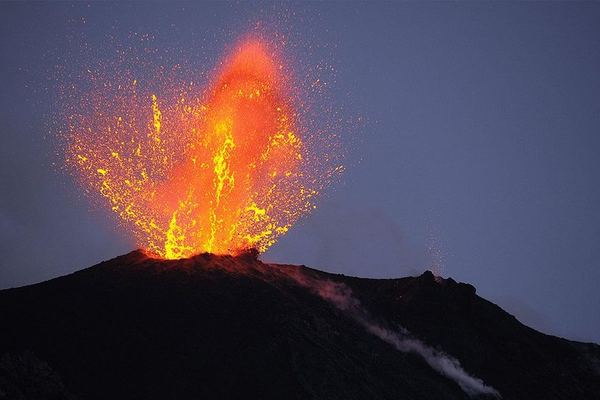
Stromboli at Sunset to 400 m, the Highest a Guide May Take You
The walk stops at 400 metres because that is the highest a volcanology guide may go, and the way down is in the dark with torches. Two hours before sunset.
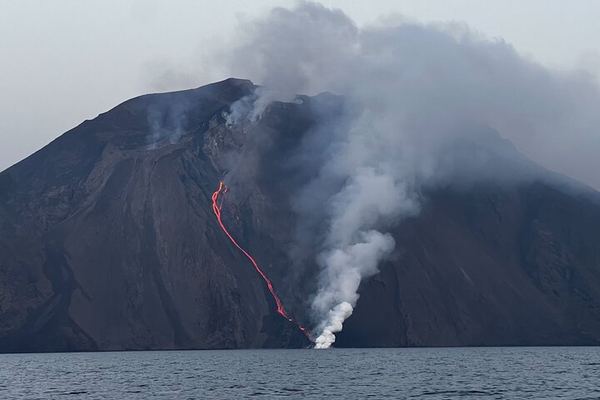
Stromboli by Night: Thirty Minutes Under the Sciara del Fuoco
The time ashore moves with the daylight so the boat is under the Sciara del Fuoco at dusk, and the stop there lasts about half an hour. Tropea by 22:30.
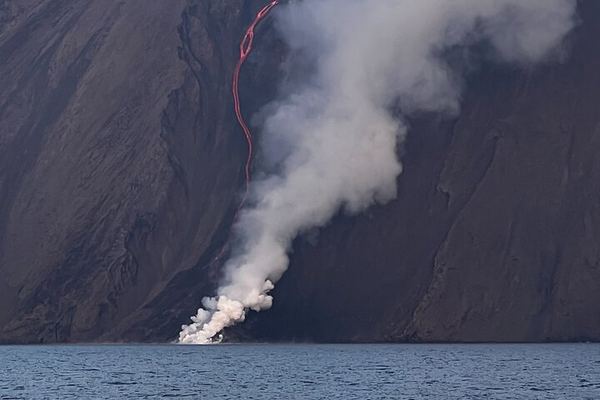
Vulcano, Lipari and Stromboli from Tropea: the Sciara del Fuoco by Day
Savadori's fast boat leaves from Calabria rather than Sicily, and the speed buys longer stops: fumaroles on Vulcano, the Sciara del Fuoco in daylight.
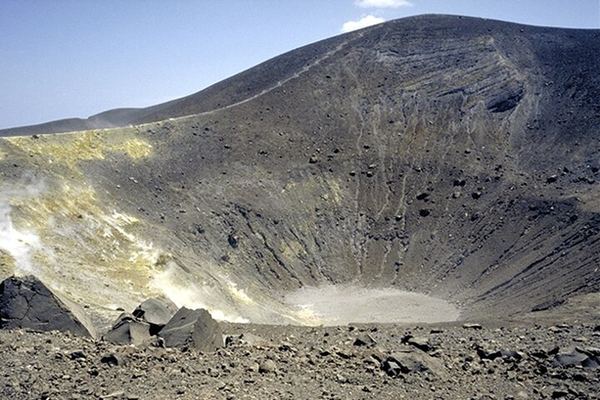
Vulcano, Lipari and Stromboli in One Day by Fast Boat
Stops of 1h15 at Vulcano, 2h20 at Lipari and 1h15 at Stromboli. Commentary is in Italian, and Lipari charges a cash fee to disembark. The boat is a fast one.
Ratings collected by Viator and Tripadvisor
The rest of this section
Four pages that go further into the one question everybody asks first.
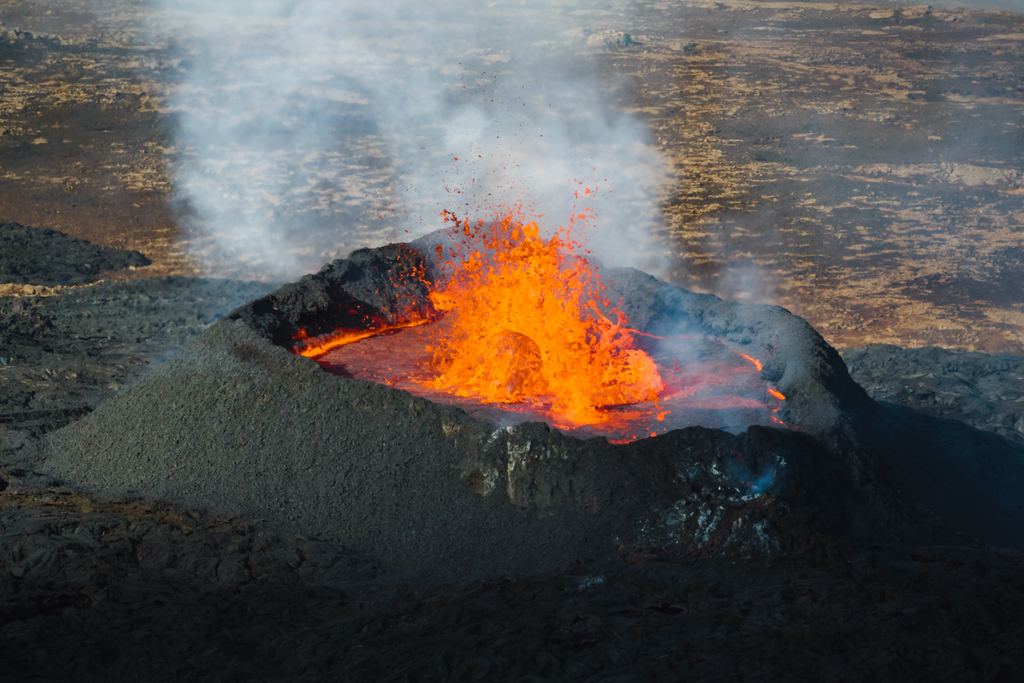
The volcanoes that never stop
Stromboli since 1934, Dukono since 1933, Yasur since about 1270. What geologists mean by an open-vent volcano, and which of them you can actually reach.

Lava, lava fields and lava shows
Six things get sold under the word lava and they are about a thousand degrees apart. How to read the vocabulary before you pay for it.
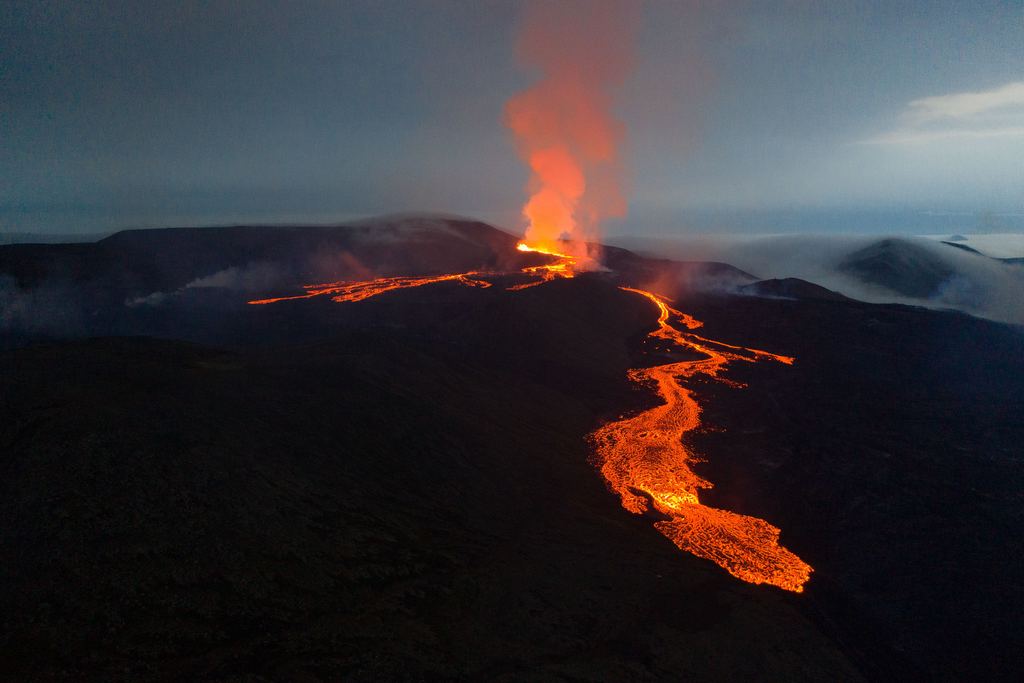
Iceland's new volcanic era
After 781 years of silence, Reykjanes entered its fourth eruptive period in 4,000 years. Why the scientists called it Fires, and what that implies.

How to check whether it is erupting
Every country runs its own alert scale and the same number means opposite things. Which observatory to read, and how.
Data verified on. Alert levels and exclusion zones change without notice, so this page points you to the observatories rather than quoting numbers that expire. Editorial Policy