
Gobustan Mud Volcanoes: Tours from Baku
Twelve day trips from 10 EUR. Two separate places sold as one line, and the last few kilometres are a dirt track.
Gobustan sits about 70 kilometres south-west of Baku, and a Gobustan day is really two visits with a gap between them. One is a reserve with a paved approach, a modern museum and over 6,000 prehistoric carvings on the rocks. The other is a field of grey cones a few kilometres away, reached down an unsurfaced track, where cold mud bubbles out of the ground and there is nothing built at all. Twelve products on this page sell both, plus the Absheron peninsula fire sites, as a single day out of the capital.
Three practical things decide how this day goes, and none of them is the price. Whether the off-road transfer to the mud field is inside your booking. Whether you go in the morning, before the coach groups and the afternoon heat. And whether it has rained, because the track is dirt and one operator states in its own description that the mud volcanoes are visited in good weather conditions, which is the polite version of sometimes not at all.
300 of the World's 700 Mud Volcanoes, an Ezraider Ride and Yanardag's Café
Roughly 300 of the world's 700 mud volcanoes sit here, the off-road stretch is ridden on an Ezraider, and the entrance tickets are already paid for.
Baku's Two Sides in Eight Hours: Gobustan West, the Fires East
The sites sit on opposite sides of Baku and the buses do not reach them all, so the day is built round the driving. The Aliyev Center is a photo stop only.
Fires Attila and Marco Polo Wrote Down, Dated 4,000 to 5,000 Years Old
Attila's annals and Marco Polo both record these flames, and science dates the hearth at four to five thousand years. Two museums at Gobustan first.
Four Absheron Treasures: the Fire Worshippers' Cells and Today's Pilgrims
The fire worshippers' cells still hold the cookware and inscribed slabs the digs found, and pilgrims from Iran and India still climb to the burning hill.
Four Hours to Gobustan and the Cold Mud Volcanoes, Chauvet's Equals
The mud in these craters is cold, not hot, and in wet weather the track closes, so the volcanoes are swapped for the Bibi-Heybat mosque instead.
Gobustan and Absheron: the 1846 Oil Well, the Mud Volcanoes and Dumas's Guest House
The day opens at the first oil well ever drilled, in 1846, and takes in the mud volcanoes, the petroglyphs and the guest house where Dumas stayed.
Gobustan by Soviet Lada: the 1966 Reserve, the Mud Craters and Yanardag
The track to the craters is done in a Soviet Lada, and the reserve has been protected since 1966. Without the ticket option, bring cash for the entrances.
Gobustan's 100,000 Finds, the Yalli Petroglyphs and Ateshgah's Five Sides
The museum reopened in 2011 with over 100,000 finds, and Ateshgah turns out to be five-sided, with the altar standing in the middle of its courtyard.
Gobustan's 20,000-Year Carvings, Mud to Take Home, and Zaha Hadid's Building
Bring an empty bottle for the mineral mud, and the day adds Deniz Mall and Zaha Hadid's building to the carvings and the fire temple. Lunch included.
Gobustan's 6,000 Engravings, and the Flames Marco Polo Wrote About
The site carries 6,000 engravings across 40,000 years of rock art, and the flames at Yanardag are the ones Marco Polo wrote about on his way through.
Gobustan's Blue Clay Craters, Bibi-Heybat Mosque and the Last Fire of Absheron
The mud here is blue clay, the 13th-century Bibi-Heybat mosque is on the way back, and Yanardag is the last of Absheron's fires still burning.
Gobustan, the Mud Volcanoes and a Free Heydar Aliyev Ticket
Nine stops in a day, with the Heydar Aliyev Center ticket included, and an empty bottle worth carrying for the mud at the volcanoes, which is free to take.
Ratings collected by Viator and Tripadvisor
The last four kilometres are the whole problem
The road from Baku to Gobustan is a normal highway and the reserve has a car park. Then the mud field, which is what most people came for, sits away from the paved network at the end of a rough, rutted track across open ground. Ordinary cars do not reliably make it, and after rain they do not make it at all.
The arrangement everyone uses is the same: local drivers wait at the turn-off with old Soviet-era vehicles and run visitors up and back for a fee agreed on the spot. Several of the twelve products state that this transfer is included, and one describes it explicitly as a special taxi with the fee inside the price. If your listing does not mention it, assume it is extra and ask.
The cost of that transfer is the single most useful number in this destination and no public source publishes it. It is negotiated, it varies with the number of people and with the day, and every travel page that covers Gobustan skips over it. The honest advice is to carry manat in small notes, to agree the price and the waiting time before you get in, and, if you are travelling alone, to accept that a group tour with the transfer included is usually cheaper than doing it yourself.
There is now a second option that most guidance has not caught up with. Since June 2024 there has been an official mud volcano tourism complex about 80 kilometres from Baku, built with a proper approach that an ordinary car can use. It is a different site from the classic Dashgil field where the local-vehicle arrangement applies. If you are self-driving and do not want the track, that is the answer, and almost nobody will tell you it exists.
What the mud field is actually like
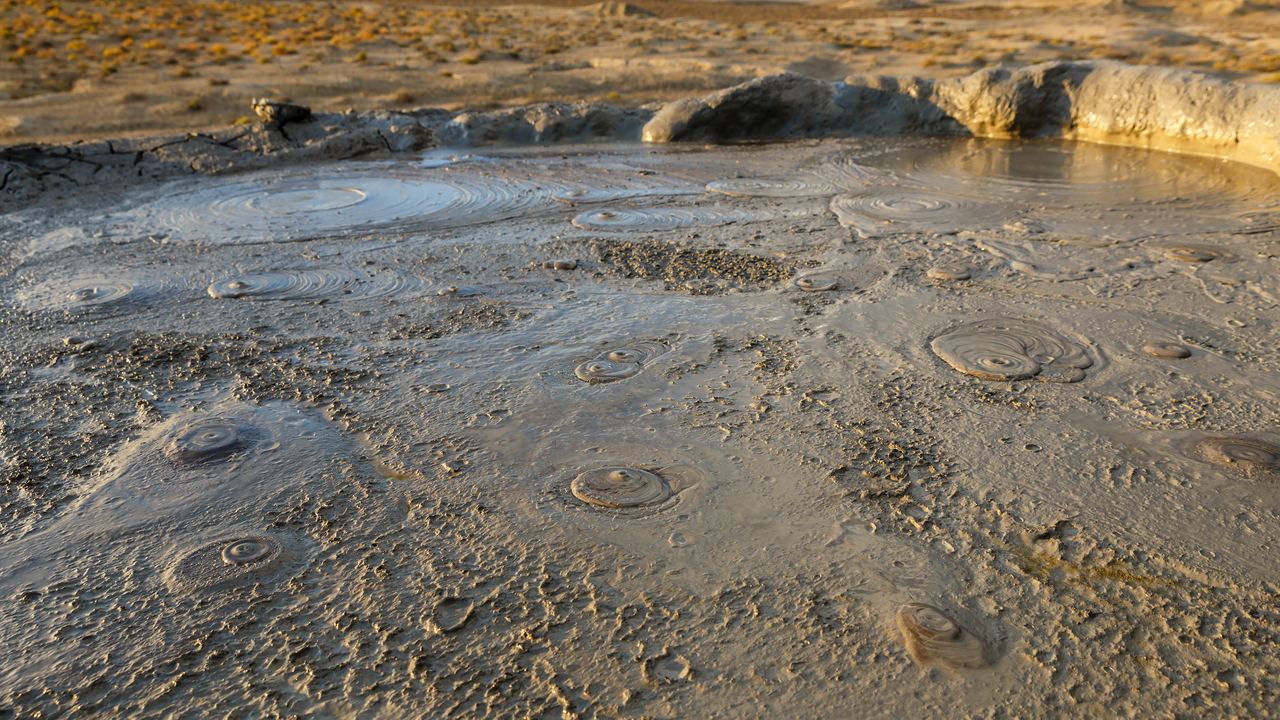
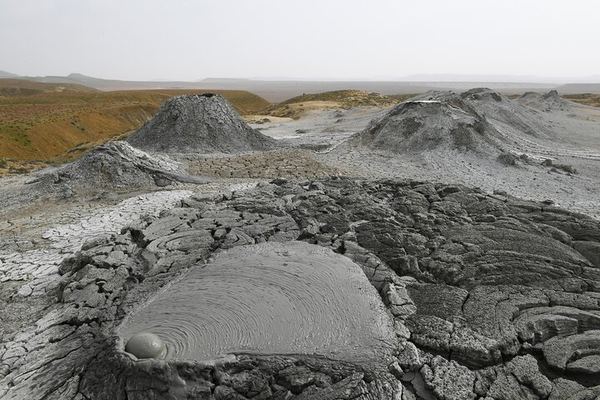
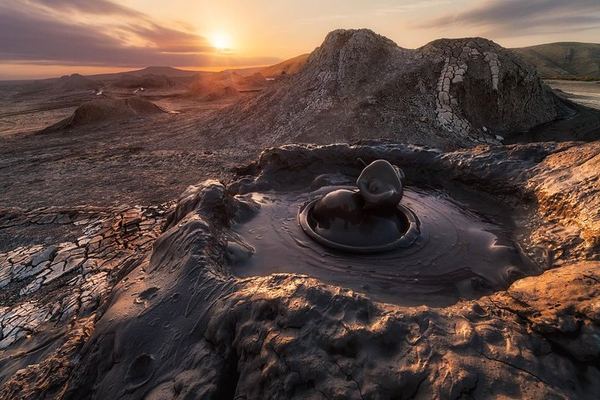
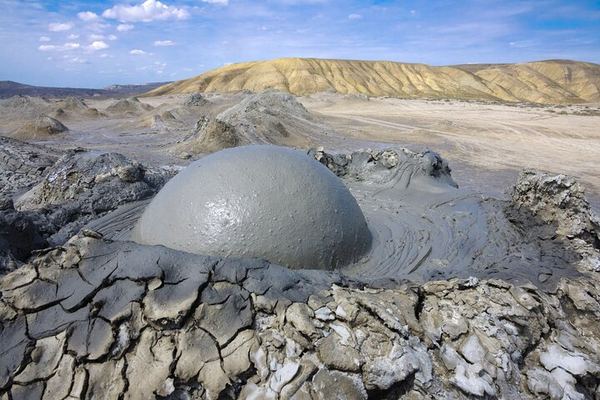
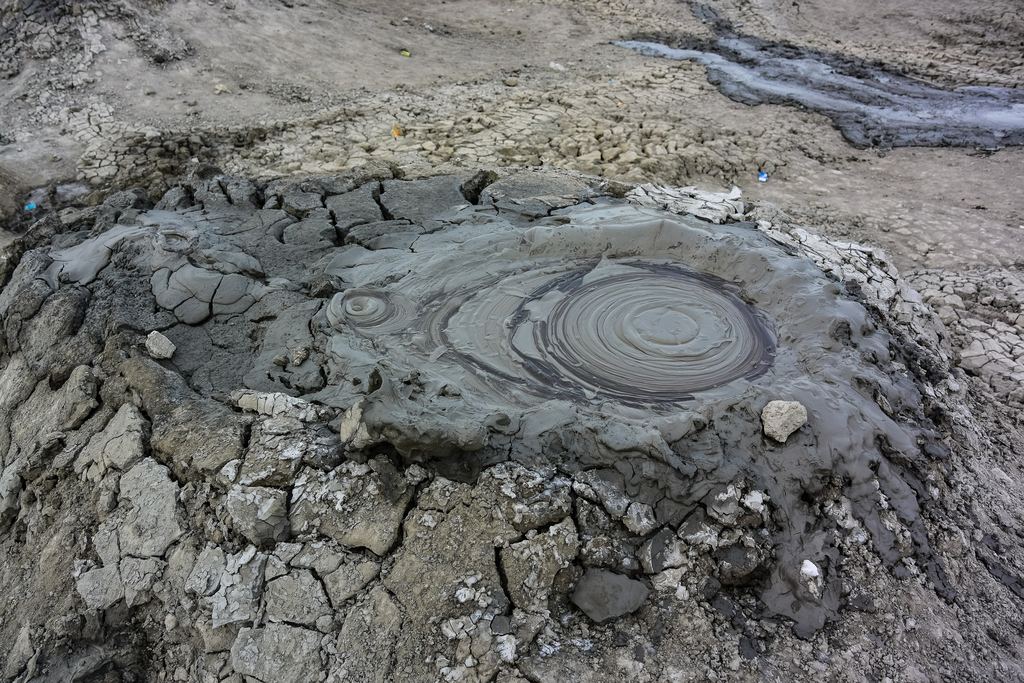
Open, dry, treeless ground with grey and buff cones on it, some a metre high and some considerably larger, each with a pool of thick mud at the top. The mud moves. Gas pushes through it in slow irregular pulses, lifting a dome that holds for a second and collapses with a wet plop, and the sound carries further than you expect across empty ground. Some cones are quiet and crusted; the guides know which ones are performing this month.
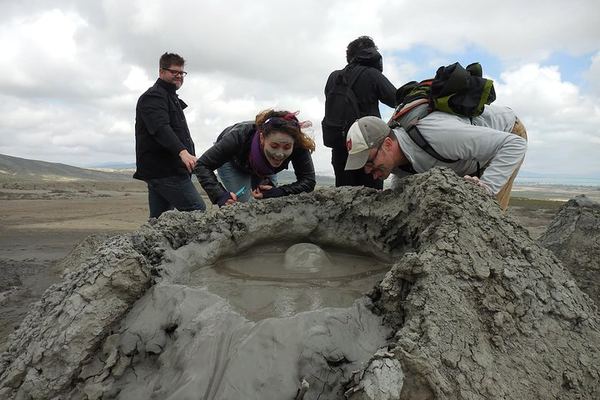
It is cold. All of it: the mud sits at roughly ground temperature, and there is no steam, no glow and no smell of sulphur. People put a finger in, and touching it is fine. Getting into it is not, both because the pools are deeper than they look and because this is a geological site rather than a spa. Allow about forty-five minutes here on a group tour. There is no shade, no shelter, no facilities and no fence.
The rock art is the UNESCO site, and it is worth the hour
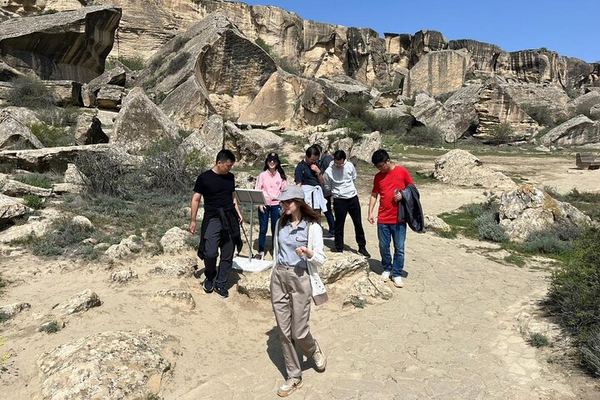
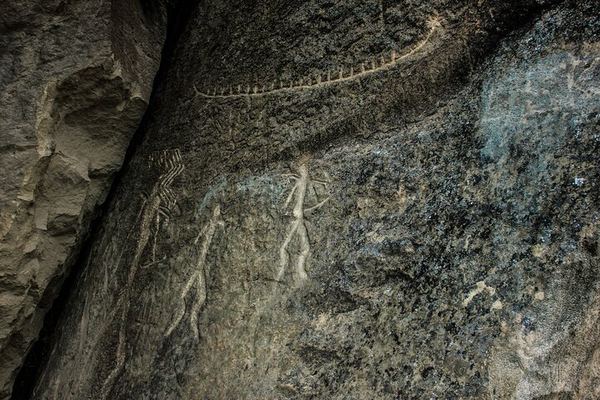
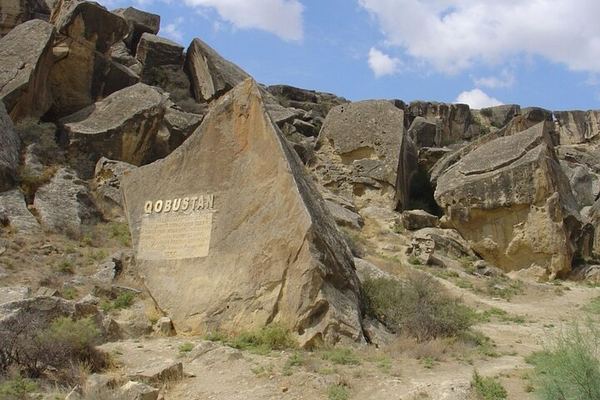
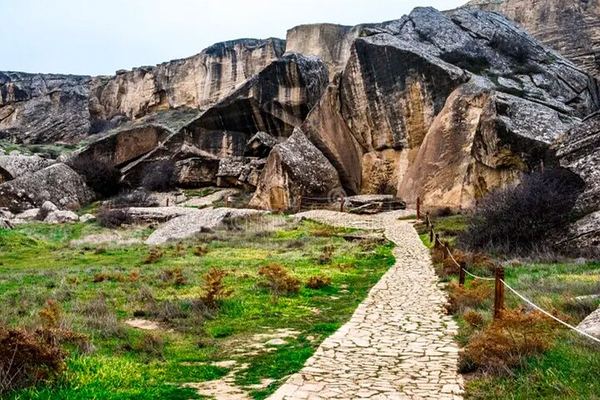
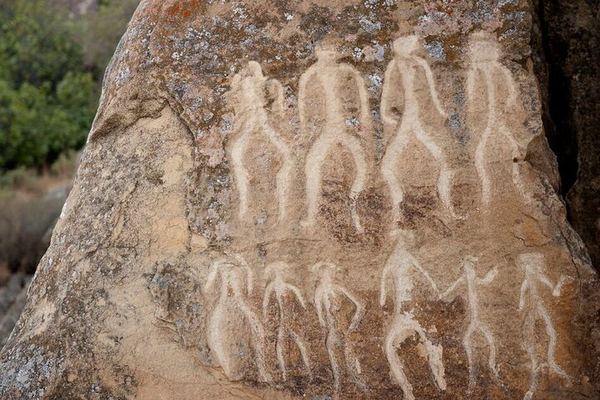
The Gobustan Rock Art Cultural Landscape was inscribed in 2007: over 6,000 petroglyphs on more than 1,000 rock surfaces spread across 537 hectares of boulder field, with images ranging over many thousands of years. Boats with rowers, aurochs, hunting scenes, lines of dancing figures. There is also a Roman inscription, left by a centurion of the Legio XII Fulminata, which is the furthest east such a carving has been found.
The mud volcanoes are not part of that inscription, and the number of pages describing UNESCO mud volcanoes is remarkable. The listing is the carvings. Knowing this changes what you do with your time: the reserve has a museum that is genuinely good, and the ticket at 10 manat includes a guide, so the hour there is better spent than most people expect from an itinerary line that reads petroglyphs.
Several listings advertise carvings 20,000 or even 40,000 years old. The published range for the site is broad and the older end of those claims is at the very edge of what is supported. The site is very old and the exact figure in the marketing is not the point.
| Stop | What it is | Entry | Time |
|---|---|---|---|
| Gobustan rock art reserve | Over 6,000 petroglyphs, museum, UNESCO listed 2007 | 10 AZN, guide included | 1 to 1.5 hours |
| Mud volcano field | Cold mud cones; off-road transfer needed | Transfer fee, not published | about 45 minutes |
| Ateshgah fire temple, Surakhani | 17th to 18th century complex; flame on mains gas since 1969 | 9 AZN, or 11 AZN combined | 45 minutes |
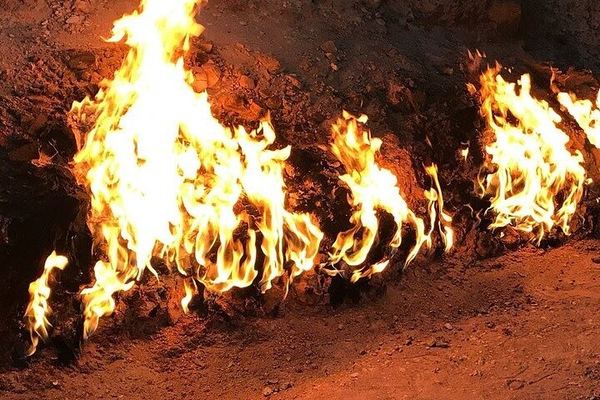
| Yanar Dag | Genuine gas seep burning at the base of a scarp | 9 AZN, or 11 AZN combined | 30 minutes |

Prices: the ones online are three years out of date
Entry to Gobustan reserve is 10 manat and includes a guide. Yanar Dag and Ateshgah are 9 manat each for foreign visitors, 2 for residents and 1 for students, and there is a combined ticket at 11 manat valid for 72 hours which covers both and is the obvious buy if you are doing them on the same day or across two.
A large number of travel pages still quote 2 and 3 manat for these sites. Those figures are old and wrong by a factor of three to four and a half. The absolute amounts are small either way, but the pattern is worth noticing: this destination is described online mostly by pages that have not been back.
On the tours themselves, twelve products run from 10.58 to 96.99 EUR. The floor is a shared coach with a guide and nothing else included. Around 25 EUR you get lunch and, usually, the off-road fee. Above 90 you are buying a private car. The 25.57 EUR product with 2,059 reviews at 4.9 is where this market has settled, and the gap between it and the 10 EUR listings is almost entirely the things that would otherwise be extras.
| 1 | 2 | 3 | 4 | 5 | 6 | 7 | 8 | 9 | 10 | 11 | 12 |
How the day is put together
Almost every product follows the same shape, and knowing it lets you read the listings quickly. Hotel pick-up in Baku between 09:00 and 10:00. South along the coast, often with a short stop at Bibi-Heybat where the world's first industrially drilled oil well was sunk, which is ten unglamorous minutes that explains everything else you will see. Gobustan reserve and museum. The mud field. Lunch. Then north to the Absheron peninsula for Ateshgah and Yanar Dag, and back to the city between 17:00 and 18:00.
Some versions add the Heydar Aliyev Center, the Zaha Hadid building on the way back into town, and one includes its ticket. Others add the old city gates at the start. These are city sightseeing rather than part of the geology, and they lengthen a day that is already seven to nine hours.
Two things to check before booking. Whether entrance fees are included, since the cheapest listings usually exclude them and the total difference is about 20 manat. And whether the mud field transfer is inside the price, which is the item most likely to appear as an unexpected cash payment in the middle of nowhere.
Local drivers wait at the turn-off in old Soviet vehicles and take you the last few kilometres for a price agreed on the spot. Every guide to Gobustan mentions the ride. None of them tells you what it costs.
Questions people actually ask
Do you need a 4x4 to reach the mud volcanoes?
For the classic field, effectively yes. The last few kilometres are an unsurfaced track that ordinary cars struggle with and cannot manage after rain, and the standard arrangement is a local driver waiting at the turn-off. Several tours include that transfer; check yours. Since June 2024 there is also an official mud volcano complex about 80 km from Baku with a proper approach road, which an ordinary car can reach.
How much does the off-road transfer cost?
Nobody publishes it, and that is the honest answer rather than an evasion. It is negotiated on the spot with the drivers at the turn-off and varies with group size and day. Carry manat in small notes and agree both the price and the waiting time before you get in. For a solo traveller, a group tour with the transfer included usually works out cheaper than arranging it alone.
Is Gobustan a UNESCO World Heritage Site?
The rock art is, inscribed in 2007 as the Gobustan Rock Art Cultural Landscape: over 6,000 petroglyphs on more than 1,000 rock surfaces across 537 hectares. The mud volcanoes are a separate site a few kilometres away and are not part of the listing, although a great many pages say they are.
Can you bathe in the mud?
No. This is a geological reserve, not a spa: the pools are deeper than they look, the ground around them is unstable, and there are no facilities of any kind. Touching the mud is fine and everyone does. If a mud bath is what you want, that is a different destination entirely.
Is the mud hot?
No, and this surprises almost everyone. Mud volcanoes are driven by gas pressure from petroleum deposits rather than by magma, so the material comes out cold, at roughly ground temperature. There is no steam and no glow. No public source publishes a measured temperature for the Gobustan field, so treat any confident figure you read with suspicion.
How long does a Gobustan tour take?
Seven to nine hours from Baku, including both Gobustan and the Absheron fire sites. Pick-up is usually between 09:00 and 10:00 and you are back in the city around 17:00 to 18:00. The shorter option is a private four-hour trip covering Gobustan alone, at around 93 EUR, which skips Yanar Dag and Ateshgah.
How much are the entrance tickets?
Gobustan reserve is 10 manat with a guide included. Yanar Dag and Ateshgah are 9 manat each for foreign visitors, or 11 manat for a combined ticket valid 72 hours. Residents pay 2 and students 1. Many travel pages still quote 2 and 3 manat, which are old figures. Check whether your tour includes entry: the cheapest listings usually do not.
Is it worth it if there is no lava?
It is, provided you booked knowing there is none. What you get is the largest concentration of mud volcanoes on earth, a first-rank prehistoric rock art site with a good museum, a hillside that has been burning on its own gas for as long as anyone can remember, and a temple built on a vent that industry later drained. As a day out of a capital city for around 25 EUR, very little competes with it. As a substitute for a volcano, nothing about it will work.
Data verified on. Prices, timings and inclusions read from the 12 Azerbaijani products on this site. Ticket prices, the UNESCO inscription and the 2024 mud volcano complex from public sources.