
Santa Ana Volcano Hike: the Ilamatepec Crater Lake
6.9 km and 471 m of ascent from Cerro Verde to an acid lake at 2,381 m. Eight guided departures, and the trail goes down before it goes up.
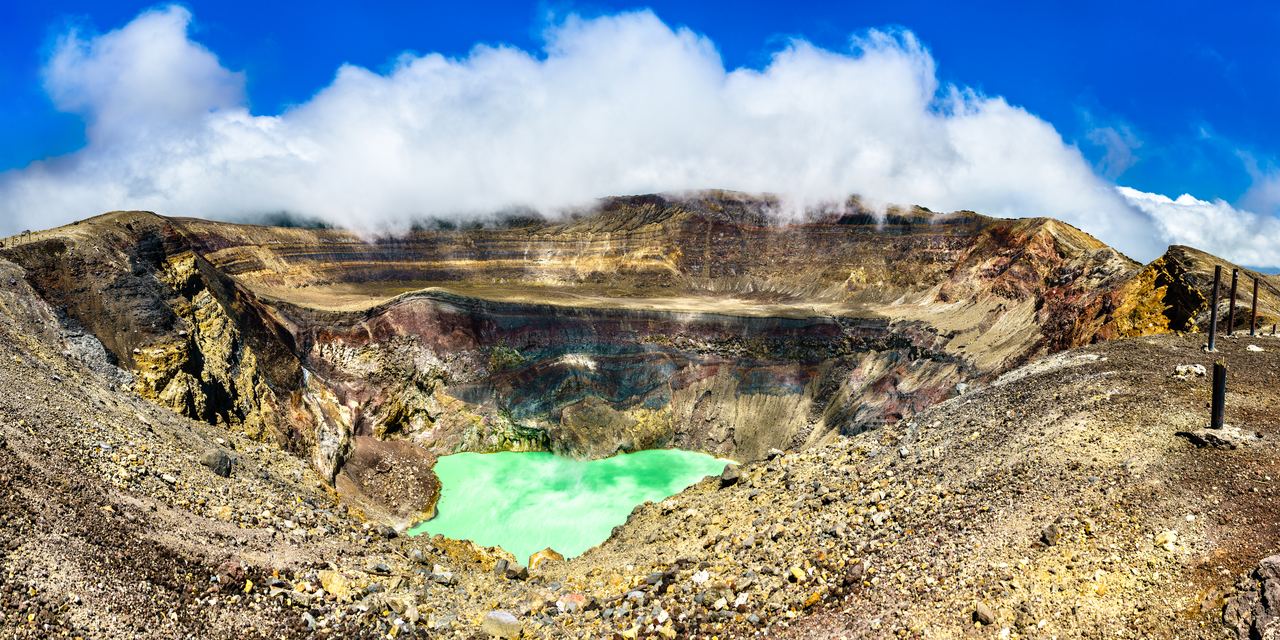
Santa Ana is 2,381 metres, the highest point in El Salvador, and the reason people climb it is a hole in the top with a turquoise lake at the bottom. The colour is not a filter and it is not swimmable water. It is an acid pond sitting on a vent, tinted by dissolved sulphur and iron, and it steams. Local usage calls the mountain Ilamatepec. The eight products on this page all do the same thing with it: collect you before dawn on the coast or in the capital, drive to Cerro Verde, walk for about two hours, look in, walk back, and finish at a different volcano's lake.
What separates the eight is not the route, because there is one route. It is what time you leave, how many people share the van, whether lunch at the lake is inside the price and whether the operator has arranged to be on the trail before the general opening. One of the private products says so in the plainest terms available in its own description: it requests a special permit to enter the volcano early. That single line explains the thirty-five euro gap better than any of the adjectives in the listings.
Early Santa Ana Hike for Birdsong and Forest, plus Coatepeque Lake
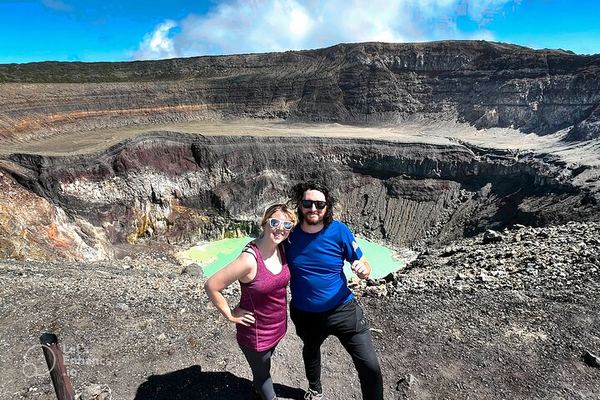
The early departure buys the forest at its loudest, and the guiding runs to what lives in the Apaneca-Ilamatepec corridor rather than only the summit.
Private Santa Ana Hike: Izalco, Cerro Verde and the Pacific from the Top
The operator takes only a limited number of guests a day, the guide is certified and bilingual, and lunch is at a local restaurant on Lake Coatepeque.
Private Santa Ana on an Early Permit, with a Day Pass at Cardedeu
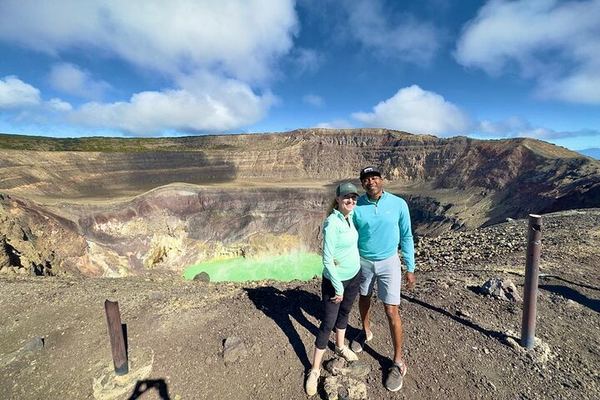
A special permit gets the group onto the volcano in the early hours, and the afternoon runs on a day pass at Cardedeu, on the Coatepeque shore. Private.
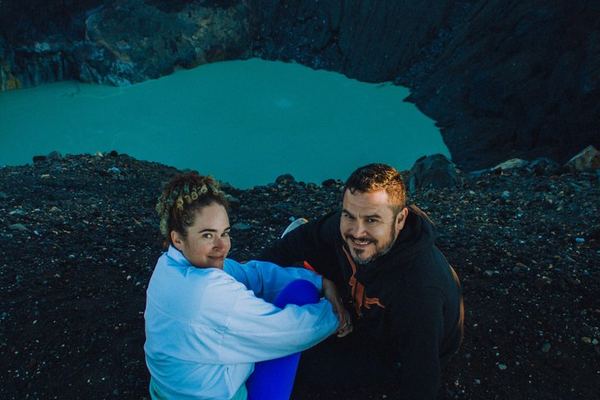
Santa Ana and Coatepeque, Private, Leaving from Santa Ana City
Two hours up, two down inside Los Volcanes National Park, then two hours at Lake Coatepeque. The boat ride and lunch are not included in the price. Private.
Santa Ana Early Hike with Tunco Life, Four Hours Round Trip
Leaving early puts the group on the mountain before the heat and the crowd, and the guides are easy enough to spot: they always wear a Tunco Life T-shirt.
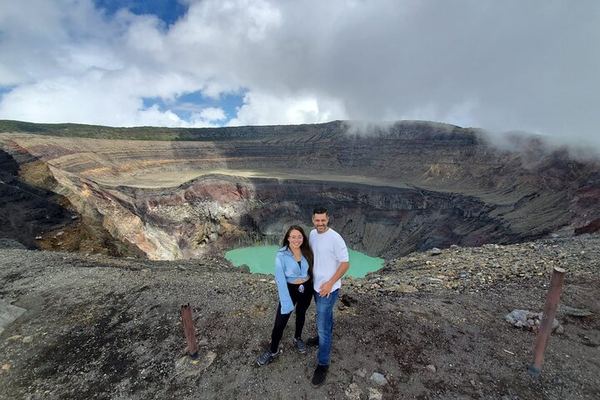
Santa Ana in the Apaneca-Ilamatepec Corridor, Two Hours Up, Two Down
Two hours up and two down, with the group capped at twenty people, and lunch by Lake Coatepeque at your own expense. Departures from 5:00 on the coast.
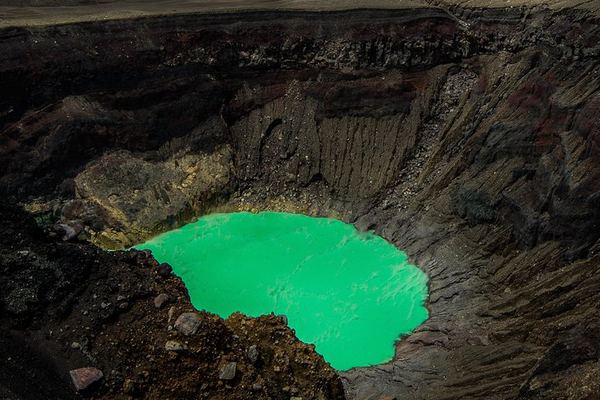
Santa Ana Volcano with Pick-Up from El Tunco and El Zonte
Pick-up runs from El Tunco and El Zonte as well as three points in San Salvador, and the swim at Lake Coatepeque comes after the summit and its lagoon.
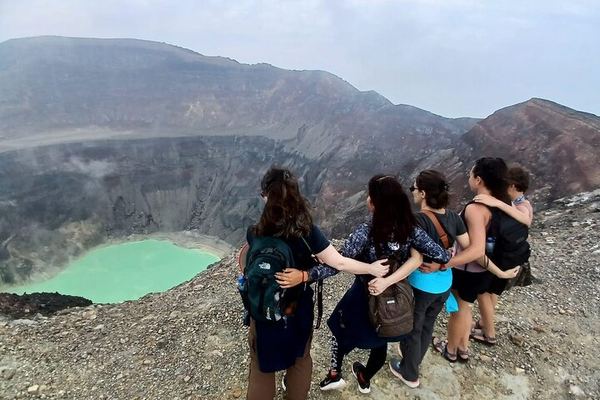
The Turquoise Lagoon of Ilamatepeq and a Late Lunch at Coatepeque
The crater at the top of Ilamatepeq holds a turquoise sulphur lagoon, and the day closes with a late lunch at Coatepeque and a swim for anyone who wants one.
Ratings collected by Viator and Tripadvisor
The profile is backwards, and almost nobody says so
The trailhead sits inside Cerro Verde National Park at roughly 2,000 metres, and the summit is 2,381. That looks like 380 metres of climbing. It is not how the walk works. You start by going down several hundred steps through cloud forest, cross the saddle between Cerro Verde and Santa Ana, and only then start the real ascent up the cone, which is steep, loose and completely without shade. The published figures for the round trip are 6.9 kilometres and 471 metres of ascent, and the extra is the descent you have to reclaim.
The sting is at the end. Having come off the summit, tired, in the middle of the day, you climb those forest steps again to get back to the car park. People who paced themselves for a two-hour descent find the last twenty minutes the hardest part of the day. It is not a hard mountain. It is a mountain with the difficulty in an unexpected place.
Operator times are consistent: about two hours up, about two hours down, varying with the group. One listing states four hours for the round trip and adds that it depends on the physical condition of the party, which is the honest version.
What is actually at the top
The summit is not a single crater but a nest of them, with the youngest and innermost holding the lake. From the rim you look down a sulphur-stained wall at water that shifts between green and a milky turquoise depending on the light and on what the vent below is doing. There is no path to the water and there should not be one: it is acid, it is warm in places, and the walls are loose.
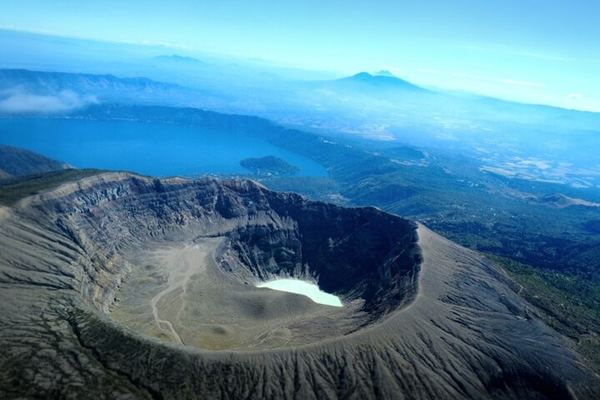
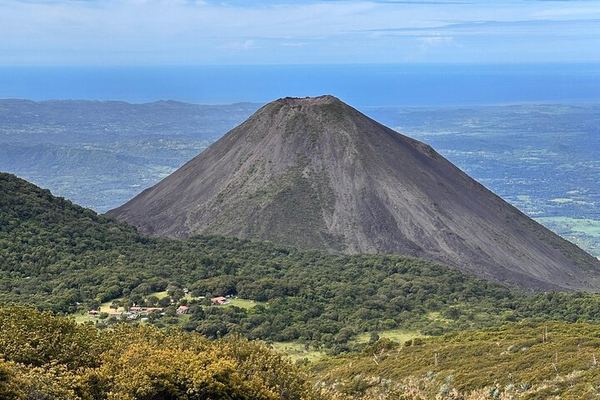
The other half of the view is behind you. On a clear morning the rim gives you Izalco's black cone below to the south, Cerro Verde's forested dome between the two, Lake Coatepeque to the east and, on the best days, the Pacific. By late morning the cloud has usually closed the summit, which is the entire reason every operator on this page leaves before six.
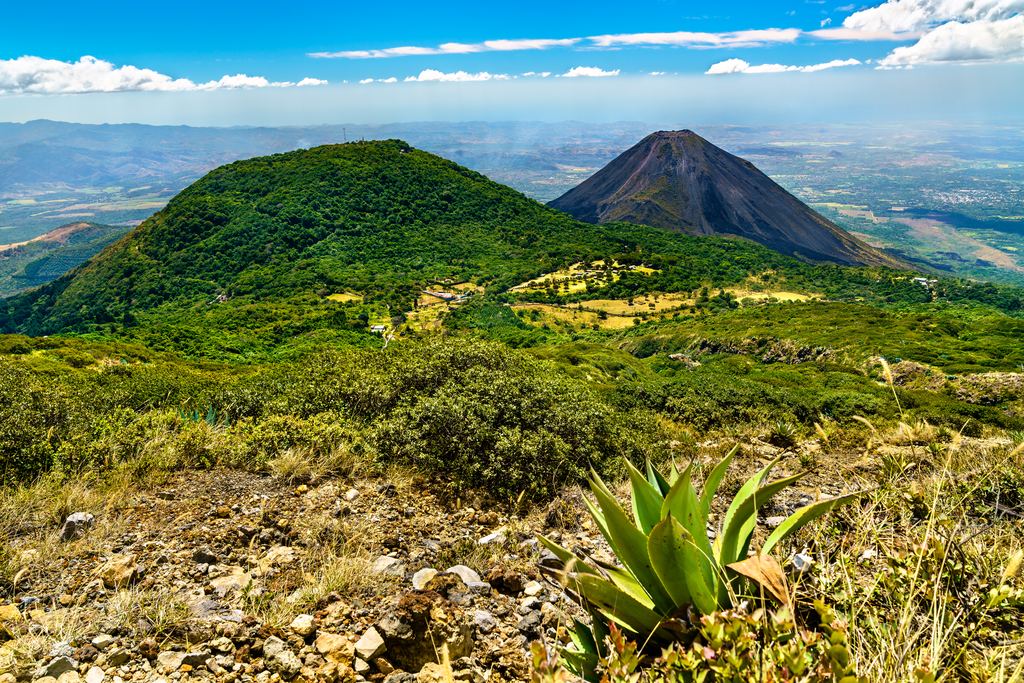
The cone in your photographs is the dormant one
Izalco is the bare dark cone below you to the south, and it is the thing most people photograph from the Santa Ana rim. Several listings on this page describe it as an active volcano. It last erupted in October and November 1966 and has been quiet ever since. The active volcano is the one you are standing on.
It is worth a moment anyway, because the cone did not exist in 1769. It grew out of a vent that opened in a field in 1770 and then erupted almost continuously for 188 years, which is why sailors in the eastern Pacific called it the Lighthouse of the Pacific. The car park you started from is roughly where a mountain hotel was built in the 1950s so that guests could watch that eruption from their rooms. The volcano went quiet just before the hotel was finished.
The fees at the gate: four sources, four different schemes
This is the part of the Santa Ana hike that no page gets right, and it is worth being explicit about why. The entrance and guiding charges are collected in cash on the mountain, and the four most visible English-language accounts of them do not agree with each other. One describes a 3 dollar park fee plus 4 dollars for the guide. One splits it into 3 for Cerro Verde, 6 for the volcano and 1 for the guide. One lists 1 for the area, 6 for the park and a 1 dollar tip. One gives an itemised total of 13.80. They cannot all be current, and we have not been able to establish which is.
So here is the honest instruction rather than a number we cannot stand behind. Assume you need somewhere between 10 and 15 US dollars per person in small cash notes, and ask your operator the night before what is included in your price. Several of the eight listings here state that admission is included, and if yours does, that is the answer. If it does not, the gate takes cash and there is no machine.
Four competing published fee schemes for the same mountain is not a detail. It is the reason people arrive at a national park gate in Central America with a card and no notes.
| What you get | Price | Collected from | Group | Worth knowing |
|---|---|---|---|---|
| Shared group, standard morning departure | 66 to 75 EUR | San Salvador | up to 12 to 20 | The 74.95 EUR product carries 874 reviews at 4.9 |
| Early departure, small group | 72 to 75 EUR | San Salvador, La Libertad, El Tunco, El Zonte | up to 15 | Buys the clear window before the cloud closes the rim |
| Private, early crater access | 110 EUR | San Salvador, flexible | your party only | The operator states it requests a permit for early entry |
| Private with lunch at Coatepeque | 141 EUR | San Salvador, flexible | your party only | Lunch inside the price rather than a restaurant stop |
What time you actually leave
Two different clocks matter and people confuse them. The first is your pick-up, which the products state clearly: 05:00 to 05:30 from El Tunco and El Zonte on the surf coast, 06:00 to 06:30 from San Salvador, and around 06:00 at the Hilton meeting point if you are in an apartment rather than a hotel. From the capital it is roughly ninety minutes to Cerro Verde.
The second is the departure from the trailhead itself, which is the fixed group start with the guide and escort, and here the published information is as contradictory as the fees. Four sources give four times: 09:00, 09:30, 10:00 and 11:00. That is not a rounding difference, it is the difference between making the walk and missing it, and it is the single most consequential number on this page. Treat the trailhead departure as a fixed morning slot that has to be confirmed with your operator for the day you are going, and if you are going independently, arrive early rather than on the hour you read somewhere.
The rule that is not in dispute: a guide is compulsory, groups climb together with a police escort, and the ascent does not go ahead in rain. That last one ends more Santa Ana attempts than fitness does.
| 1 | 2 | 3 | 4 | 5 | 6 | 7 | 8 | 9 | 10 | 11 | 12 |
The mountain is monitored, and that changes the trip
Santa Ana erupted on 1 October 2005. The eruption was phreatomagmatic, it put ash to around 14 kilometres, it killed two people, and eleven days later lahars ran down towards Lake Coatepeque. The previous eruption was in 1904. That gap of a century is worth holding in mind: this is not a mountain that does something every year, and it is also not a mountain that has finished.
What came out of 2005 is the arrangement you now book into. Access is controlled inside a national park, groups climb together rather than as a stream of individuals, guiding is compulsory, and the volcano is watched by the national environmental authority, which publishes activity bulletins and an alert level. None of the pages competing for this search mention that the alert level exists. On a volcano with an acid crater lake and two deaths in living memory, checking the current bulletin before you travel is a five-minute job that nobody is telling you to do.
What to bring, and who should not go
Shoes with grip, because the upper cone is loose volcanic gravel and the forest steps are wet. Two litres of water, since there is nothing on the mountain. Sun cover, because above the treeline there is no shade at all. And a layer, which is the one people leave behind: the rim is cold and windy while the coast you left at five in the morning is heading for thirty degrees.
All eight listings carry the same operator warnings, and they are worth reading as a set rather than as boilerplate. Not recommended for pregnant travellers, for anyone with a spinal injury, or for anyone with poor cardiovascular health, and a moderate level of fitness is expected. The groups are capped, typically at twelve to twenty depending on the product. Infants sit on an adult's lap and specialised infant seats are available in the vehicles, which tells you the drive is the family-friendly part and the walk is not.
Coatepeque, the second volcano nobody calls a volcano
The afternoon stop on all eight products is Lake Coatepeque, ten minutes from the base of Santa Ana, and it is a caldera roughly six kilometres across, formed by a sequence of large eruptions rather than the single tidy explosion the round shape suggests. Its Nahuat name means hill of snakes. Every so often the water turns a bright turquoise for a few weeks; this is a bloom and a shift in water chemistry rather than a volcanic event, and it is worth knowing because most of the photographs that sell the lake were taken during one.
In practice the stop is a restaurant terrace with a view, and it is a good hour. It is not swimming. Unless your listing says so explicitly, there is no lake time built into the day, and six of the eight exclude lunch even though the itinerary parks you in front of it.

Questions people actually ask
How hard is the Santa Ana hike?
Moderate, with the difficulty in an odd place. The round trip is 6.9 km with 471 metres of ascent, about two hours up and two down. What catches people is the shape: you descend several hundred forest steps first, climb the cone, and then have to reclaim those steps at the end of the day when you are tired. The upper cone is loose gravel with no shade. Anyone who walks regularly will manage it; nobody should treat it as a stroll because the summit is only 2,381 metres.
Can you swim in the crater lake?
No, and you cannot reach it. The lake is acid water sitting on an active vent, warm in places, inside walls of loose rock with no path down. You look at it from the rim. The swimming, if any, happens later at Lake Coatepeque, and even there most products only stop at a restaurant terrace rather than at the water.
Do you need a guide to climb Santa Ana?
Yes. A guide is compulsory and groups go up together with a police escort at a fixed morning departure from the trailhead. This is not an operator upsell, it is how access to the volcano has been organised since the 2005 eruption. Independent walkers join the same group departure.
What time do the tours leave?
Pick-up is 05:00 to 05:30 from the surf towns of El Tunco and El Zonte and 06:00 to 06:30 from San Salvador, with about ninety minutes of driving to Cerro Verde. The group departure from the trailhead itself is a fixed morning slot, but published times for it disagree, ranging from 09:00 to 11:00 across four sources. Confirm it with your operator for your date rather than trusting a figure you read online, and if you are going independently arrive early.
How much are the entrance fees?
Nobody can tell you reliably, which is the useful answer. Four published schemes give four different breakdowns, from a 3 dollar park fee plus 4 for the guide up to an itemised total of 13.80. Carry 10 to 15 US dollars per person in small notes and check whether your booking already includes admission, since several of these products state that it does. There is no card machine at the gate.
Is Santa Ana safe to climb?
Under the current arrangement, yes, and the arrangement exists for a reason: the 2005 eruption killed two people. The volcano is monitored by the national environmental authority, which publishes bulletins and an alert level, and access is controlled inside a national park with compulsory guiding. Check the current bulletin before you travel, which no competing page suggests. The routine risks are more ordinary: loose ground, sun, and cold on the rim.
What should I bring?
Grippy shoes, two litres of water, sun protection and a warm layer for the rim. Small US dollar notes for the gate fees. Lunch money, because six of the eight products exclude it while stopping at a restaurant on Lake Coatepeque. Leave anything you do not want covered in fine volcanic dust in the van.
Is the Lake Coatepeque stop worth it?
Yes, and not for the reason it is sold. It is a caldera about six kilometres across, which makes it the second volcano of the day rather than a scenic add-on. The stop is normally an hour on a restaurant terrace ten minutes from the base of Santa Ana. Do not expect swimming unless the listing promises it.
Data verified on. Prices, pick-up times and inclusions read from the 8 Santa Ana products on this site. Trail distance, height and eruption data from the published volcanological record.