
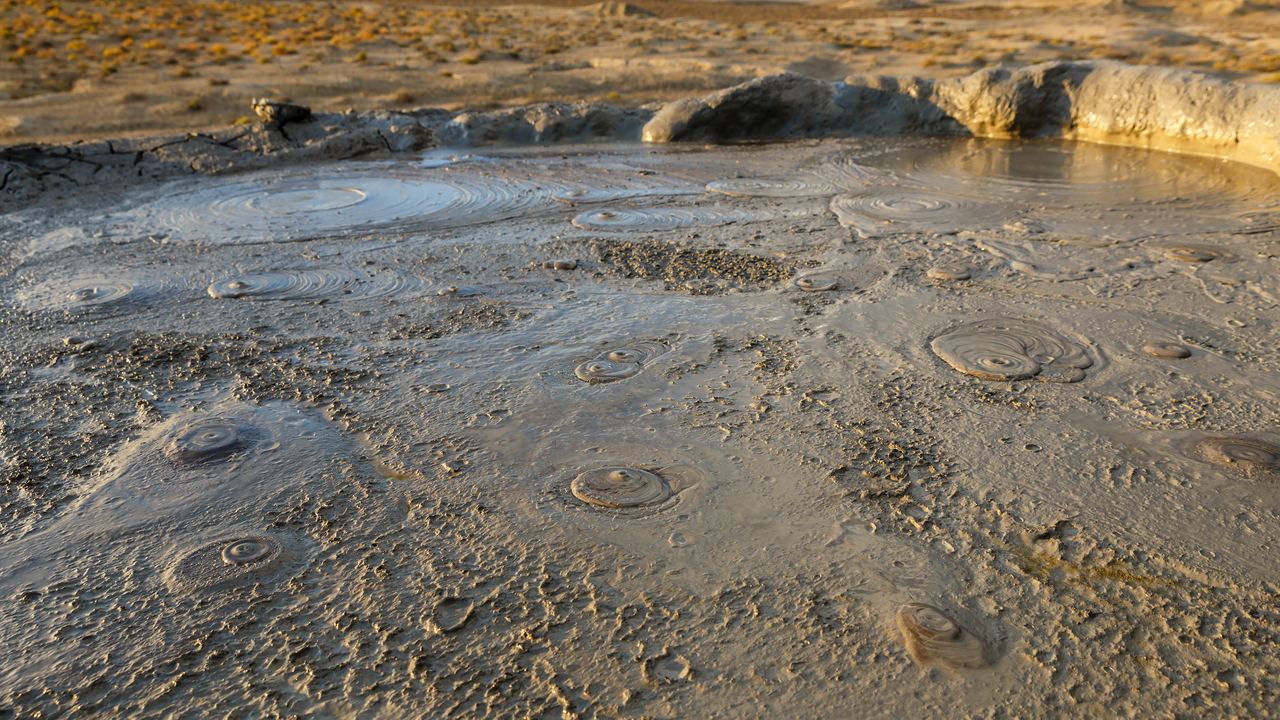
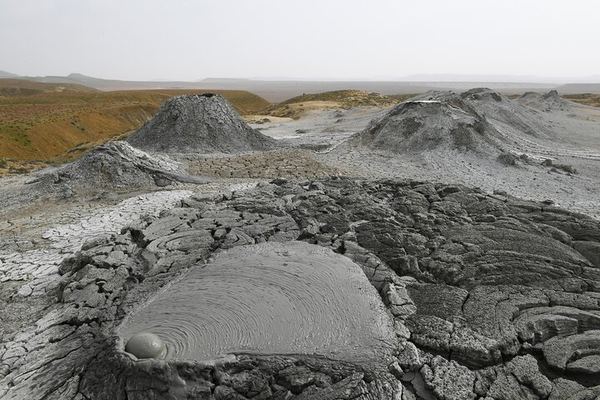
A mud volcano looks like a volcano that has been left in the rain. Small grey cones, sometimes a few metres high and sometimes a few hundred, with a crater at the top full of something the consistency of thick soup, which bubbles, occasionally belches, and periodically overflows.
The word volcano is doing something misleading here. There is no magma involved, no lava, and no heat in the volcanic sense: the mud arriving at the surface is usually somewhere between cool and mildly warm. What they share with actual volcanoes is a mechanism for getting something pressurised from underground to the surface, and a habit of building a cone out of whatever comes up.
The confusion is common enough that we have given the subject a page, and there is a second reason: two of the destinations on this site are mud volcanoes, and travellers arrive at both expecting something else.
How they actually work
Start with a thick pile of sediment, usually in a basin where a river has been dumping mud for millions of years. Bury it, and the layers at the bottom get compressed and heated. Organic material in them breaks down and produces gas, mostly methane.
Now the problem: the fine clay above is close to impermeable, so the gas cannot escape. Pressure builds until it exceeds the weight of the rock above, and the system fails. Gas forces its way up through any weakness it can find, carrying water and clay with it, and arrives at the surface as a mud slurry.
That is the whole mechanism. It is a petroleum-geology phenomenon rather than a volcanic one, which is why mud volcanoes and oil fields are found in the same places. Azerbaijan is not coincidentally both the mud volcano capital of the world and one of the oldest oil regions on earth.
| Volcano | Mud volcano | |
|---|---|---|
| What comes out | Molten rock, ash, gas | Cold clay slurry, water, methane |
| Temperature | 700 to 1,200 C | Ambient to mildly warm |
| Driven by | Magma buoyancy and dissolved gas | Pressurised sediment and hydrocarbon gas |
| Depth of source | Kilometres to tens of kilometres | Hundreds of metres to a few kilometres |
| Can it catch fire? | Not applicable | Yes. The gas is flammable |
| Can you get in it? | No | At El Totumo, that is the point |
Azerbaijan has most of them
Estimates of the global total run to around seven hundred, and something like three hundred of those are in Azerbaijan and the adjacent Caspian, which makes it far and away the densest concentration on earth.
The reason is geological luck. The South Caspian basin is one of the thickest sedimentary accumulations anywhere, over twenty kilometres in places, laid down fast and buried deep, generating enormous quantities of gas beneath layers that will not let it out. The mud volcanoes are the pressure relief.
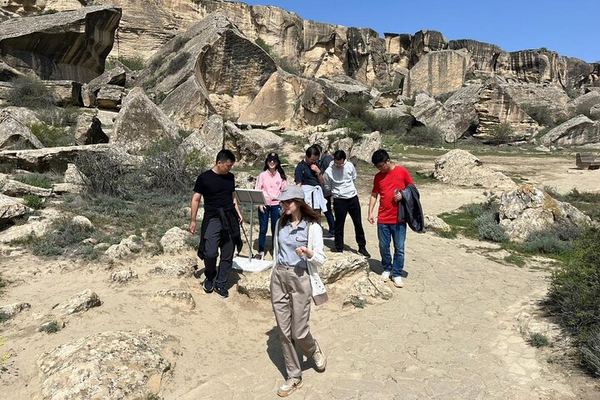
They are also large. The biggest Azerbaijani examples are hundreds of metres high and kilometres across, which puts them in a different category from the metre-high cones people usually picture, and the field at Gobustan sits alongside a UNESCO-listed collection of thousands of prehistoric petroglyphs, so the visit is archaeological as well as geological.
The other Azerbaijani speciality is fire. Because the gas is methane, a mud volcano can ignite, and when a large one does it produces flames reported at hundreds of metres. Nearby Yanardag, the burning hillside, is a related phenomenon: natural gas seeping from the ground and alight, apparently continuously, for a very long time.

What the visit is actually like
A landscape with no scale and no sound
Gobustan is a semi-desert plateau about an hour from Baku, and the first thing that strikes people is that it is impossible to judge size. The cones are grey, the ground is grey, there is nothing green and nothing vertical to measure against, so a hill that turns out to be a hundred metres high reads as knee-high until you start walking towards it.
The second thing is the sound, which is almost none. Every so often a crater burps, and the noise is closer to a kitchen than a volcano.
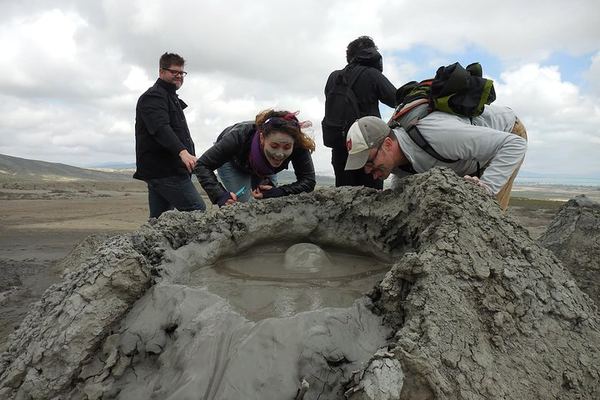
You can walk up to the craters and look in, which is not something the other kind of volcano permits. The mud moves slowly and continuously, forming and popping bubbles across a surface that looks like something on a stove.
Practically: it is exposed, there is no shade, summer temperatures on the plateau exceed 30 degrees, and the winter version involves wind and a track that turns to the same clay you came to look at. Spring and autumn are the sensible months. Since 2024 a sealed road has reached the site, which has changed the trip considerably from the four-wheel-drive expedition it used to be.
El Totumo, which you climb into
Colombia's contribution is a cone about fifteen metres high near Cartagena, with a crater at the top that holds ten to fifteen people at a time, and the tradition is that you get in.
The mud is dense enough that you float regardless of body composition, which people find genuinely disconcerting: you cannot sink, and you cannot easily stand up either, because there is nothing solid to push against. The usual description is somewhere between warm porridge and wet cement. There are attendants who will move you around the crater and offer a massage, generally for a tip, and then you climb down and rinse off in the lagoon at the bottom.
Two practical notes that nobody mentions until you are standing there in your swimming costume. The mud does not come off easily, particularly out of hair and swimwear, and the rinsing is done in the lagoon by local women who also expect a tip: bring small notes and something you do not mind staining. And leave the camera, or hand it to someone dry, because the combination of fine clay and a phone is permanent.
It is one of the odder things in this catalogue, and it has essentially no dependence on season, weather, altitude or volcanic activity. The only real seasonal factor is that the access track and the rinsing are more pleasant when it is not raining, and Cartagena's dry season runs from December to April.
What it is not is a volcano in any sense that would interest a volcanologist. It is a hole full of cold clay, and it is enormously good fun.
When they go wrong
Two things are worth knowing, because they explain why the sites are managed the way they are.
They can erupt violently. A large mud volcano releasing pressure can throw material and, if the gas ignites, produce a flame column visible for tens of kilometres. This is rare and it happens in the large Azerbaijani and Caspian systems rather than in the small ones tourists visit.
They can be triggered by drilling, and the consequences can be permanent. The case that defines this is in East Java, where a mud eruption began in May 2006 beside a gas exploration well and never really stopped. It has buried villages under metres of mud across several square kilometres, displaced tens of thousands of people, and required embankments to be built and raised continuously for years to keep the flow from spreading further. The vent has been reported discharging on a scale that makes it one of the largest mud eruptions ever documented.
Whether it was triggered by the drilling or by an earthquake two days earlier has been argued in the scientific literature ever since, with reputable groups on both sides and a good deal of money resting on the answer. Either way it demonstrates the thing worth carrying away: these systems are pressurised, the pressure is deep, and disturbing them has consequences that outlast everyone involved.
For a visitor at a managed site, neither of these is a practical concern. They are the reason the managed sites are managed.
Quick answers
Is the mud hot?
No, and that surprises almost everyone. It arrives at roughly ground temperature, sometimes slightly warm. There is no magma involved and nothing to heat it. If you are looking for warm mud you want a geothermal mud pot, which is a different thing entirely and is genuinely hot enough to injure you.
Is the mud good for your skin?
It is widely held to be, and mud from these fields has been used medicinally in Azerbaijan for a long time. Whether it does more than any other fine mineral clay is not something we can verify. It is certainly rich in minerals and it certainly makes a memorable photograph.
Can mud volcanoes really catch fire?
Yes. The gas is mostly methane, and large Azerbaijani mud volcanoes have ignited during eruptions, producing flames reported at hundreds of metres. It is spectacular, rare, and not something scheduled for visitors.
Are they related to real volcanoes?
Only by analogy. They occur in sedimentary basins with hydrocarbons, not at plate boundaries or hotspots, and the two often do not coexist. Azerbaijan has hundreds of mud volcanoes and no active magmatic volcanoes at all.
Three hundred cones and ten thousand years of rock carvings
Gobustan combines the world's densest mud volcano field with a UNESCO petroglyph site, an hour from Baku.
Gobustan tours
The mud volcano field and the petroglyphs, an hour from Baku.
300 of the World's 700 Mud Volcanoes, an Ezraider Ride and Yanardag's Café
Roughly 300 of the world's 700 mud volcanoes sit here, the off-road stretch is ridden on an Ezraider, and the entrance tickets are already paid for.
Baku's Two Sides in Eight Hours: Gobustan West, the Fires East
The sites sit on opposite sides of Baku and the buses do not reach them all, so the day is built round the driving. The Aliyev Center is a photo stop only.
Fires Attila and Marco Polo Wrote Down, Dated 4,000 to 5,000 Years Old
Attila's annals and Marco Polo both record these flames, and science dates the hearth at four to five thousand years. Two museums at Gobustan first.
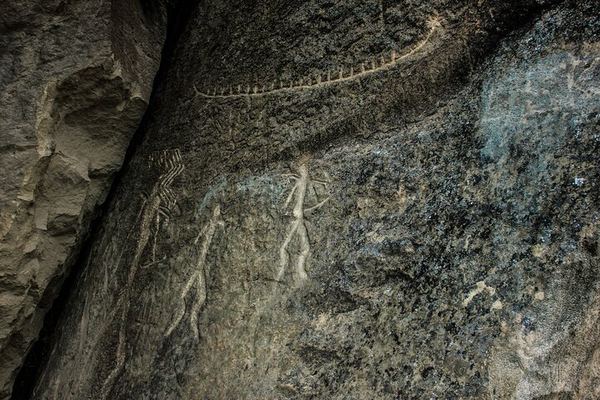
Four Absheron Treasures: the Fire Worshippers' Cells and Today's Pilgrims
The fire worshippers' cells still hold the cookware and inscribed slabs the digs found, and pilgrims from Iran and India still climb to the burning hill.
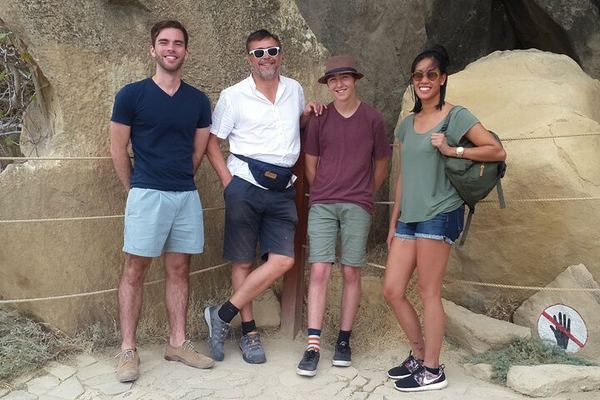
Four Hours to Gobustan and the Cold Mud Volcanoes, Chauvet's Equals
The mud in these craters is cold, not hot, and in wet weather the track closes, so the volcanoes are swapped for the Bibi-Heybat mosque instead.
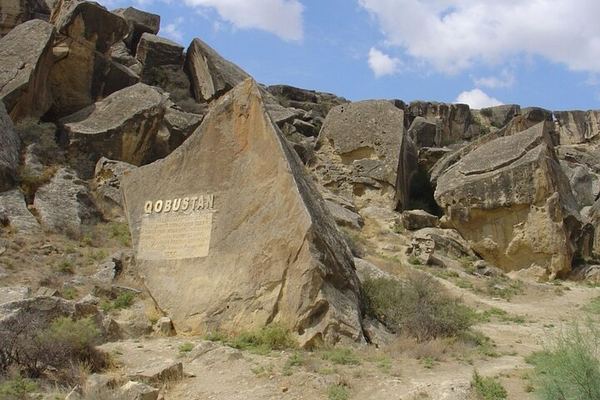
Gobustan and Absheron: the 1846 Oil Well, the Mud Volcanoes and Dumas's Guest House
The day opens at the first oil well ever drilled, in 1846, and takes in the mud volcanoes, the petroglyphs and the guest house where Dumas stayed.
Ratings collected by Viator and Tripadvisor

Data verified on. Global counts of mud volcanoes vary between sources depending on what is counted as a distinct feature. The Azerbaijani share is consistently reported as around half. Editorial Policy