
These are the questions that come up most often, and we have tried to answer them the way we would answer a friend rather than the way a booking page would. Where the honest answer is it depends, we have said what it depends on.
A few of them are questions that get mocked when people ask them in public. Those are usually the best ones, because the mockery is a sign that nobody has bothered to answer.
Safety
Is it safe to visit a volcano?
For the regulated, monitored destinations in this catalogue, yes, and the risk is comparable to other outdoor activities rather than to anything exotic. Millions of people visit volcanoes every year without incident.
The risk concentrates in specific, avoidable behaviours: crossing a boundary, going without a guide where one is legally required, and underestimating gas in enclosed hollows. It also concentrates on a small number of volcanoes that are genuinely dangerous and are managed accordingly.
The uncomfortable qualifier is Whakaari in New Zealand in 2019, where 22 people died on a permitted tour at a volcano that was being monitored. Permitted does not mean risk-free, and the honest framing is managed risk rather than no risk.
What actually kills people at volcanoes?
Historically, and by a wide margin: pyroclastic flows, which are avalanches of hot gas and rock that nothing outruns. Then lahars, which are volcanic mudflows that can arrive years after an eruption when rain mobilises loose ash, and which travel a long way down valleys.
For individual visitors rather than populations, the pattern is different: falls on unstable ground, gas in depressions, burns from thin crust over hot ground, and being where they had been told not to be.
Lava, notably, is not high on the list. It is generally slow enough to walk away from.
Do I need a gas mask?
No, and this is worth stating clearly because a lot of advice says otherwise. The international guidance on volcanic health hazards specifically does not recommend gas masks for the general public: a cartridge respirator protects you only if the cartridge suits the gas, the mask has been fit-tested to your face and you have been trained to use it, and without those it substitutes confidence for protection.
Particulate masks, N95 included, filter ash and no gas at all. Nothing filters carbon dioxide. And wetting a cloth does not help, despite advice to the contrary that circulated for years before being corrected.
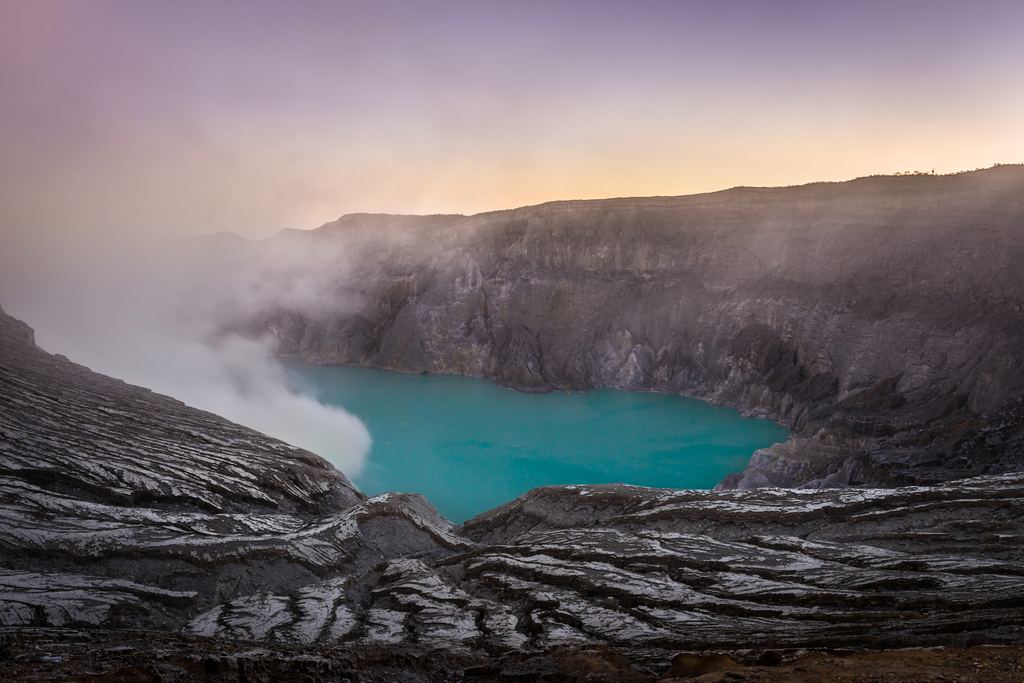
For a visitor the protection is distance, height and time. Stay upwind, stay out of hollows, keep it short. The one place this genuinely arises is the descent into the Ijen crater, and there the honest answer is that it is a decision about whether to go down, not a problem a mask solves.
How do I know if the gas is getting worse?
By smell, with one crucial reversal. Hydrogen sulphide, the rotten-egg smell of geothermal ground, changes character as it concentrates: around 30 parts per million it turns sweetish, and somewhere between 100 and 150 it stops registering at all, because it deadens the olfactory nerve. That upper figure is essentially the same concentration health authorities designate as immediately dangerous.
So a smell that fades or turns sweet is a reason to leave, moving uphill and upwind. It is the opposite of what instinct suggests.
Is the alert level a good guide to safety?
It tells you what the volcano is doing, not whether where you are standing is safe, and the scales are not comparable between countries. Level 3 means an eruption is under way in New Zealand and no eruption at all in the Philippines. Even at the lowest level, agencies are explicit that hydrothermal ground, gas, landslides and lahars remain hazards.
Lava
Where can I actually see lava?
Reliably, at very few places: Stromboli in Italy, Yasur in Vanuatu, Masaya in Nicaragua, Fuego watched from the neighbouring Acatenango in Guatemala, and Santiaguito from a distance. Episodically and unpredictably: Kilauea, Etna, Iceland's Reykjanes peninsula. That is close to the whole list.
At any moment there are around forty volcanoes erupting worldwide, but most are unreachable, behind exclusion zones, or in places nobody visits.
Can I see lava at Etna, or at Vesuvius?
At Etna, sometimes, during an eruptive episode, and those are unpredictable and often close the summit while they happen. Between episodes there is no lava to see, and that is most of the time.
At Vesuvius, no. It last erupted in 1944. The crater is dramatic, the view over the bay is superb, and there is no molten rock.
Why is all lava photography at night?
Because that is the only time it looks like that. Molten rock radiates most of its energy in the infrared, and the visible red is a small fraction that daylight completely overwhelms. In sunshine, moving lava looks grey or dull rust-coloured with a shimmer above it. If a tour runs in daylight and its photographs glow, the photographs are from somebody else's night.
Should I hope for an eruption while I am there?
No, and this is the most useful counter-intuitive thing on this page. An eruption closes access rather than improving it: exclusion zones widen, summits shut, guides are obliged to bring clients down, and if there is ash in the air, flights stop. What you want is a volcano with routine, low-level activity that the authorities have built rules around, which is a completely different thing.
How hard is it
How fit do I need to be?
It depends entirely on which volcano, and the range is enormous. We scored around forty of the best-known itineraries on one scale and the spread was ninety points out of a hundred. Vesuvius is 175 metres of ascent on a made path. Rinjani's summit trek is three days and over 2,500 metres of cumulative climbing.
A rough test for the hard ones, from someone who had done Acatenango: if you can run for twenty to thirty minutes without stopping, you will finish. If you have not walked uphill for a few hours in the last year, start somewhere else.
What is the hardest part?
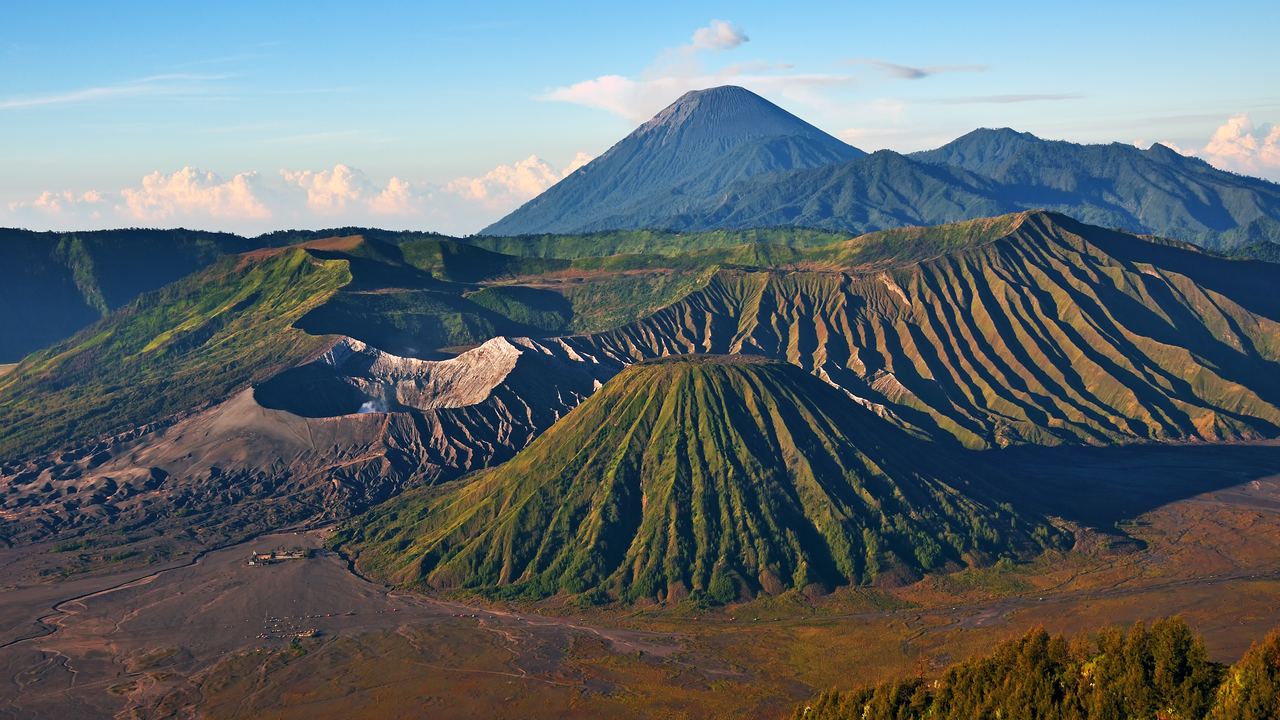
Rarely the thing people expect. On Acatenango it is not the climb, it is sleeping at 3,600 metres. On Bromo it is the fifteen minutes of walking through soft sand before the climb starts. On Quilotoa the descent takes thirty minutes and the return takes two hours at nearly 3,900 metres. And on almost all of the sunrise treks it is being awake at two in the morning.
Will I get altitude sickness?
Possibly, above about 2,500 metres, and fitness does not protect you. Mild symptoms feel like a hangover and are common. The rule is simple: do not go higher if you feel worse, and going down fixes it.
The trips that most deserve respect are the ones where you gain altitude without effort, because your body gets no warning. You can drive from sea level to 3,055 metres on Maui, and to 4,207 on Mauna Kea, in about two hours.
Guides, permits and booking
Do I need a guide?
It varies, and the rule is often not where you would look for it. On Etna it depends on which zone you are in and on the day's civil protection alert, not on an altitude. On Stromboli it is set by a mayoral ordinance with a fine attached. On Villarrica in Chile you need either a guide or documented mountaineering credentials. On Batur in Bali it is enforced by the local guides' association rather than by any law. On Fuji and the Tongariro Crossing, no guide is required at all.
What should I book furthest in advance?
Anything with a government cap. Haleakala's sunrise reservation opens sixty days ahead. Mount St. Helens climbing permits are released monthly and summer weekends go in minutes. The Teide summit path needs a timed permit with a cap of fifty people. Vesuvius and Bromo tickets must be bought online before you arrive.
Everything else can wait, and there is an argument for booking close to the date so you can choose your weather.
Is it better to book locally or online?
Local operators are usually cheaper and more responsive, and they answer the phone when conditions change. Platforms give you a cancellation policy, a disputable payment and enough reviews to judge an operator you know nothing about. Both are legitimate. The mistake is thinking you are doing one when you are doing the other.
What happens if the tour is cancelled for weather?
Only the operator knows their own policy, which is why it is worth asking before you pay. In practice the more useful question is how many attempts you can get: booking the volcano early in your trip rather than late means a cloudy morning can be repeated.
When to go
Do volcanoes erupt more in certain seasons?
No, and people asking this get mocked for it, which is unfair because the question underneath is reasonable. Eruptions do not follow a calendar. What does follow a pattern is disruption risk, which is a property of the individual volcano: some produce frequent small events with local effects, others go decades and then close airspace across a continent.
What you can do is build a trip that survives disruption. Spare days, no tight connection home, and refundable accommodation where it costs nothing to have it.
When is the best time to go?
There is no single answer because volcanic destinations span every climate zone. Java runs on rain, with a factor of twenty between wettest and driest month. Iceland runs on daylight, going from four hours to twenty-one. Sicily runs on altitude, with a summer at the summit and a winter at the same time lower down. New Zealand is inverted, and its coldest month is also its wettest.
Is the dry season always the best?
Usually, with one consistent catch: clear skies radiate heat away overnight, so the dry season is also the coldest at altitude. The best months for seeing Fuego from Acatenango are also the months with the coldest nights at base camp.
Practicalities
Can I take children?
To many volcanoes, easily. The obstacles are the two in the morning starts, the cold at the top, and loose ground, rather than the walking itself. Lanzarote, Vesuvius, lava tubes and geothermal parks all work at any age. Mauna Kea has official guidance against taking under-13s above the visitor centre.
Does travel insurance cover this?
Check the exclusions rather than assuming. Some policies exclude volcanic activity by name, and many limit trekking above a stated altitude. Several destinations here are above 3,000 metres and a few above 4,000. Also check whether mountain rescue is covered, because in several countries it is chargeable.
How much should I tip the guide?
It varies enormously by country and the question gets asked constantly, which suggests nobody is being told. Ask the operator when you book. It is a completely normal question and they would rather answer it than have you guess.
Can I take a piece of lava rock home?
Often prohibited, and in Hawai'i it is culturally offensive as well. The national park there receives a steady stream of rocks posted back by visitors who took one and then had a difficult year. Whatever you make of the folklore, the rule is real and the parks are serious about it.
Still deciding where to go?
Thirty-five destinations with the months that work, the difficulty scored on one scale, and an honest answer about the lava.
One more, because it comes up constantly
Is it worth it?
People almost never ask this in the abstract. They ask it about a specific mountain: is Acatenango worth it, is Vesuvius worth it, is the Etna cable car worth it. And the honest answer depends on something the question does not contain, which is what you were expecting.
Acatenango is worth it if you want to watch an active volcano throw rock into the sky all night from a ridge opposite. It is not worth it if you wanted a camping trip, because it is 1,500 metres of loose ash and a night at 3,600 metres.
Vesuvius is worth it for the crater and the bay and for standing on the thing that buried Pompeii. It is not worth it if you wanted lava.
The cable car on Etna is worth it if your alternative is not getting above 1,900 metres. It is poor value if you were happy to walk.
Which is the whole argument for the rest of this site: the question is never whether a volcano is good. It is whether this volcano matches what you actually want, and that is answerable in advance.

Data verified on. Answers drawn from official park and observatory guidance and from what travellers most often report going wrong. Rules change: verify anything you rely on. Editorial Policy