
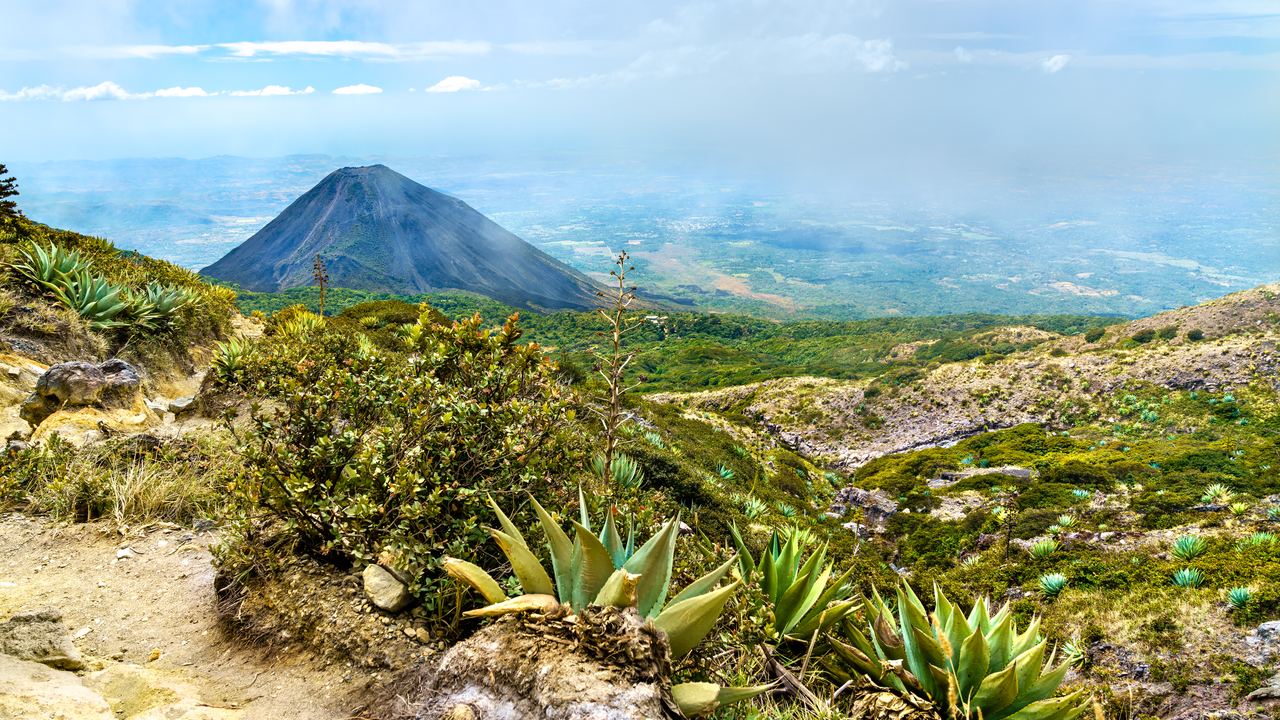
Volcano Tours in El Salvador
Twenty-three catalogued volcanoes in 21,041 square kilometres, and all 8 experiences here climb the same one.
El Salvador is 21,041 square kilometres, the smallest country on the Central American mainland, and the published record lists twenty-three volcanoes inside it. The density shows up in the ordinary furniture of the place: a crater forty minutes from the capital with a road to the rim, a caldera lake where people keep weekend houses, five cones on the coat of arms. It does not show up in the tour market. All eight experiences on this page climb the same mountain, and it is not the one that erupted most recently.
The concentration is commercial, not geological. Santa Ana has a national park, a road to about 2,000 metres, a marked trail, a guide requirement and a police escort. The other twenty-two have some of those things and never the combination. This page is the country: what is there, what is awake, and what you give up by spending your one volcano day on the mountain everybody sells. The climb itself, with its five in the morning pick-ups and its staircase that goes down before it goes up, is on the Santa Ana page below.
Choose a destination in El Salvador

Volcano Travel Experiences in El Salvador
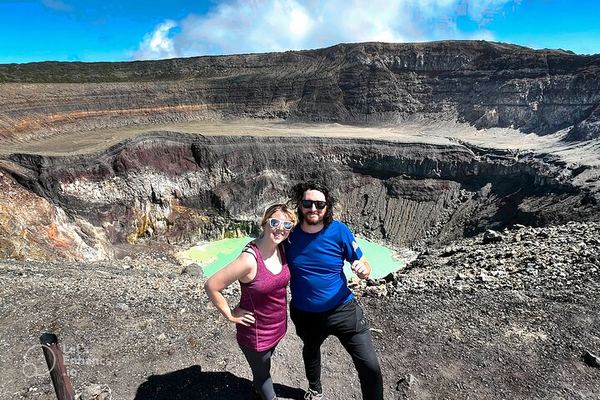
Early Santa Ana Hike for Birdsong and Forest, plus Coatepeque Lake
The early departure buys the forest at its loudest, and the guiding runs to what lives in the Apaneca-Ilamatepec corridor rather than only the summit.
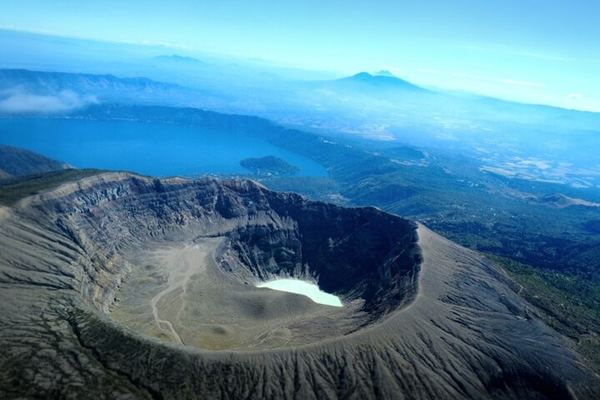
Private Santa Ana Hike: Izalco, Cerro Verde and the Pacific from the Top
The operator takes only a limited number of guests a day, the guide is certified and bilingual, and lunch is at a local restaurant on Lake Coatepeque.
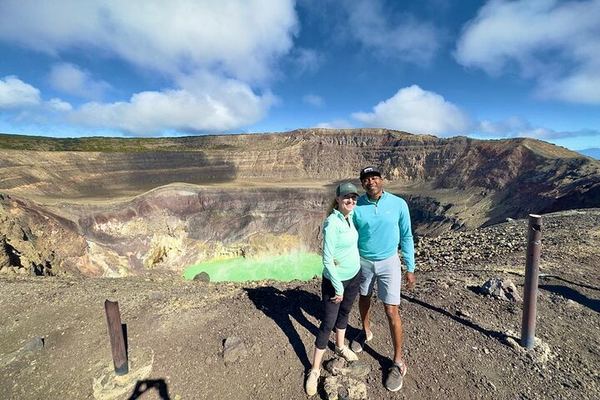
Private Santa Ana on an Early Permit, with a Day Pass at Cardedeu
A special permit gets the group onto the volcano in the early hours, and the afternoon runs on a day pass at Cardedeu, on the Coatepeque shore. Private.
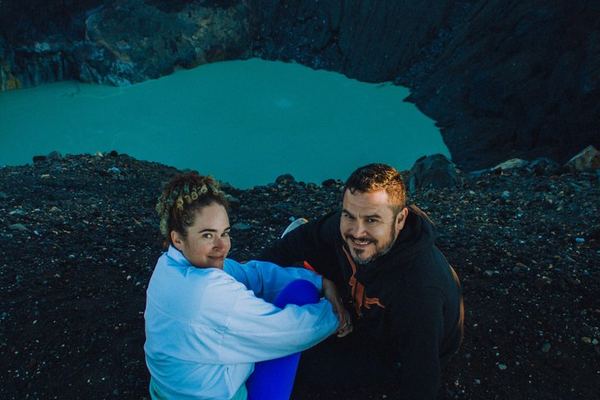
Santa Ana and Coatepeque, Private, Leaving from Santa Ana City
Two hours up, two down inside Los Volcanes National Park, then two hours at Lake Coatepeque. The boat ride and lunch are not included in the price. Private.
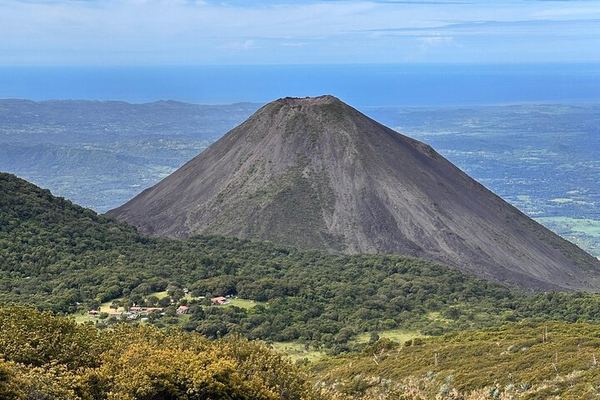
Santa Ana Early Hike with Tunco Life, Four Hours Round Trip
Leaving early puts the group on the mountain before the heat and the crowd, and the guides are easy enough to spot: they always wear a Tunco Life T-shirt.
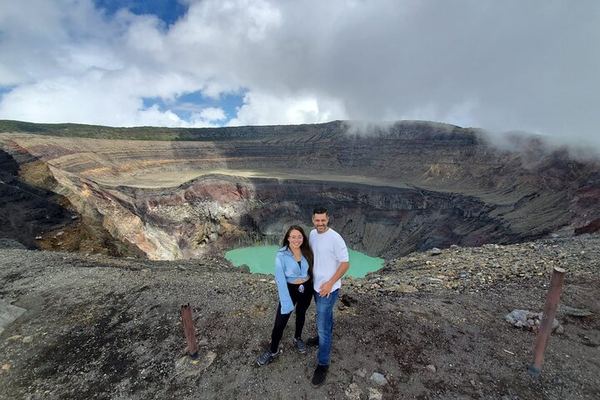
Santa Ana in the Apaneca-Ilamatepec Corridor, Two Hours Up, Two Down
Two hours up and two down, with the group capped at twenty people, and lunch by Lake Coatepeque at your own expense. Departures from 5:00 on the coast.
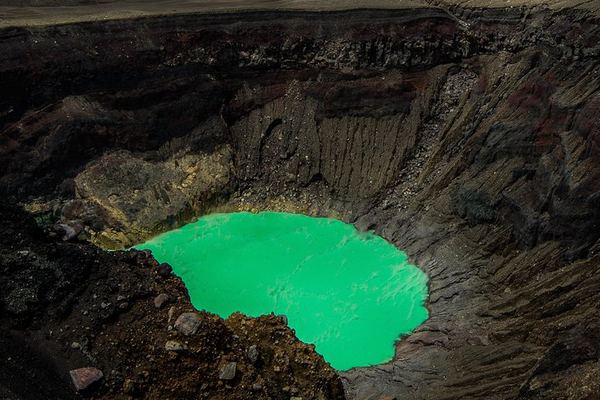
Santa Ana Volcano with Pick-Up from El Tunco and El Zonte
Pick-up runs from El Tunco and El Zonte as well as three points in San Salvador, and the swim at Lake Coatepeque comes after the summit and its lagoon.
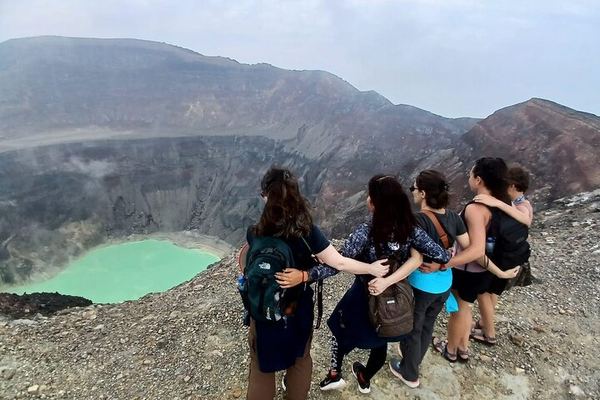
The Turquoise Lagoon of Ilamatepeq and a Late Lunch at Coatepeque
The crater at the top of Ilamatepeq holds a turquoise sulphur lagoon, and the day closes with a late lunch at Coatepeque and a swim for anyone who wants one.
Ratings collected by Viator and Tripadvisor
Twenty-three volcanoes, one of them on sale
The table below is not a ranking. It is a map of where the commercial supply is and is not, and two things in it are worth stopping on. The Salvadoran volcano with the most recent eruption is not the one you can book. And the caldera nearest the capital, which produced one of the largest eruptions anywhere on earth in the last seven thousand years, has no volcano product attached to it at all.
| Volcano | Height | Last eruption | Nearest base | Sold here |
|---|---|---|---|---|
| Santa Ana (Ilamatepec) | 2,381 m | 1 October 2005 | Cerro Verde, about 90 min from San Salvador | Yes, all 8 listings |
| San Miguel (Chaparrastique) | 2,130 m | 2022 | San Miguel city | No |
| San Vicente (Chichontepec) | 2,182 m | No eruption in recorded history | San Vicente | No |
| Izalco | 1,950 m | October to November 1966 | Cerro Verde | No, but you look straight at it from the trail |
| San Salvador (El Boqueron) | 1,893 m | 1917 | 40 minutes from the capital | No |
| Coatepeque caldera | 746 m | Holocene | Santa Ana | Only as the afternoon stop |
| Ilopango caldera | 450 m | December 1879 to March 1880 | San Salvador | No |
| Conchagua | 1,225 m | Not recorded | La Union | No |
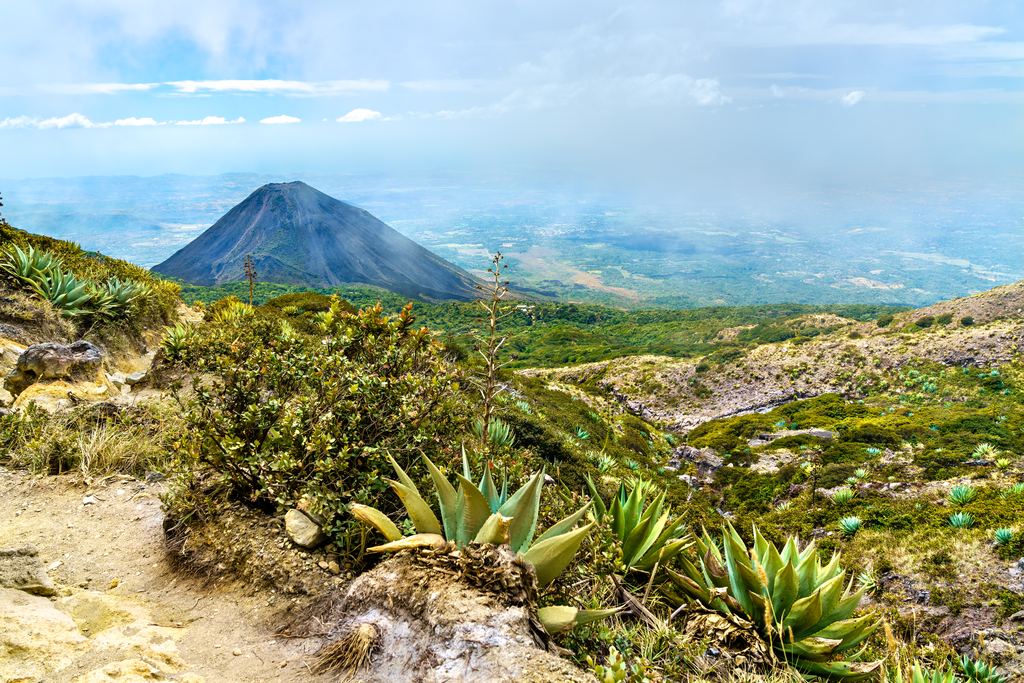
The lighthouse that went out
Izalco is the black cone you photograph from the Santa Ana trail, and it did not exist in 1769. A vent opened in a field on the southern flank of Santa Ana in 1770, and within a few years there was a cone where there had been grazing. It then erupted almost without pause for one hundred and eighty-eight years. Crews in the eastern Pacific used the glow to fix their position, which is where the name Lighthouse of the Pacific comes from, and it was not a metaphor.
Then the ending, which is the best thing in Salvadoran tourism and is almost never told. A mountain hotel went up at Cerro Verde in the 1950s, sited and angled so that guests could watch the eruption from their rooms. The volcano stopped erupting shortly before the hotel was finished. It has done nothing since except a short flank eruption in October and November 1966. The rooms are gone, the view is still there, and the car park where the Santa Ana hike now starts is roughly where the guests were meant to stand.
The Salvadoran record, in eight dates
The origins
431
Ilopango buries the valley
<p>The eruption known as Tierra Blanca Joven puts between 37 and 82 cubic kilometres of material into the air and covers at least 10,000 square kilometres in pumice and ash. Ice core work dates it to 431 CE give or take two years. The Maya settlements of the valley are emptied. What is left is the lake fifteen minutes east of San Salvador.</p>
1770
Izalco appears in a field
<p>A vent opens on the southern flank of Santa Ana. Within a few years there is a cone where there had been grazing land, and it begins an eruption that runs for 188 years. Ships in the eastern Pacific navigate by the glow and call it the Lighthouse of the Pacific.</p>
1880
Ilopango's last eruption ends
<p>Activity from December 1879 to March 1880 pushes a lava dome above the lake surface. The islets it left are called the Islas Quemadas, and they are the last thing Ilopango has done.</p>
1904
Santa Ana erupts
<p>The eruption before the modern one. It matters mainly as the measure of how rarely this mountain does anything: a century passes before the next.</p>
1917
San Salvador volcano erupts beside the capital
<p>The last activity at El Boqueron, whose summit crater is now a national park forty minutes from the city centre and carries no volcano tours at all.</p>
1958
The lighthouse goes out
<p>Izalco stops erupting, shortly before the mountain hotel built at Cerro Verde to show guests the eruption is completed.</p>
2005
Santa Ana, 1 October
<p>A phreatomagmatic eruption sends ash to around 14 kilometres and kills two people. Lahars reach towards Lake Coatepeque on 12 October. It is the event behind the guiding rules, the escort and the monitoring that govern the hike you can book today.</p>
2022
San Miguel, the most recent
<p>The country's most recently active volcano is not the one on sale. Chaparrastique stands over a city of a quarter of a million people and has no international tour distribution whatsoever.</p>
What a volcano day costs here
Eight products, a spread of just over two to one, and the whole difference is transport, group size and what time you leave. Nobody is selling a different mountain, a different route or a different summit. Read the pick-up point before you read the price: the cheap listings leave from San Salvador, and the surf towns on the Pacific coast, where a lot of visitors actually sleep, are either an hour further out or a surcharge.
One thing to budget for that no listing puts in the headline number. Most of these products exclude lunch even though every itinerary stops at a restaurant on Lake Coatepeque, and the park and guide fees on the mountain are collected in cash on the day. The published fee schemes do not agree with one another, which is dealt with on the Santa Ana page.
| Type of day | Leaves from | Price | How long |
|---|---|---|---|
| Shared group hike, lake viewpoint after | San Salvador | 66 to 75 EUR | about 7 hours |
| Early departure, small group | San Salvador, La Libertad, the surf towns | 72 to 75 EUR | about 7 hours |
| Private hike with early crater access | San Salvador | 110 EUR | 7 to 8 hours |
| Private hike with lunch at Coatepeque | San Salvador | 141 EUR | about 8 hours |
The volcanoes nobody is selling you
Three gaps worth naming, because eight products on one mountain is not a description of a country.
San Miguel, called Chaparrastique, is the one that has erupted most recently. It is 2,130 metres, it stands over a city of a quarter of a million people on the eastern plain, ash falls are in living memory, and an eruption is logged for 2022. It has no international tour distribution at all. If you want it, you arrange it locally in San Miguel.
El Boqueron is forty minutes from the capital and has a car park. San Salvador volcano is 1,893 metres, last erupted in 1917, and its summit crater is a national park you can walk the rim of in an afternoon. It is a city excursion rather than a volcano day, which is why nobody packages it, and why it is the sensible thing to do if your flight leaves in the evening.
Ilopango is the one that matters and the one you will not notice. The lake east of San Salvador sits in a caldera measuring 8 by 11 kilometres, 231 metres deep at its deepest point. The eruption that made it rated 6 on the explosivity index and is one of the largest anywhere on earth in the last seven thousand years. Today it is a lake with jet skis on it, and the only volcanic product attached to it is lunch.

For nearly two centuries ships in the eastern Pacific took their bearings from a volcano that had not existed in 1769 and would be dark by 1958. Izalco is the only landmark on this coast with both a birth date and a closing date.
How the trip actually assembles
You fly into San Salvador. From the airport it is roughly forty-five minutes to the capital and a little over an hour to the surf towns of the Pacific coast, El Tunco and El Zonte, where most independent travellers end up sleeping. Cerro Verde, where the Santa Ana trail starts, is about ninety minutes from San Salvador and rather more from the coast, which is why the coastal pick-ups on these products run from 05:00 and the capital pick-ups from 06:00.
The city of Santa Ana is closer to the trailhead than either, and almost nothing departs from it. One of the eight listings is based there; the rest treat the capital as the hub. If you are building your own itinerary rather than buying a package, a night in Santa Ana or at Lake Coatepeque takes an hour off the front of the day and is the single most useful change you can make.
On timing: the country has a dry season from roughly November to April and a wet one from May to October. It matters here for one reason rather than comfort. The Santa Ana summit gives you the crater lake, Izalco, Coatepeque and on the best mornings the Pacific, and in the wet months the rim is usually inside cloud by mid-morning. There is also a hard rule rather than a preference: the ascent does not run in rain. A country-wide season table would be padding when there is one sellable destination, so the month-by-month detail sits on the Santa Ana page, where the decision is actually made.
Questions people actually ask
How many volcanoes does El Salvador have?
Twenty-three are catalogued in the published record, which is the highest concentration in Central America for the land area. Very few of them are awake in any ordinary sense. Santa Ana last erupted in 2005, San Miguel in 2022, Izalco in 1966, San Salvador in 1917 and Ilopango in 1880. The rest range from long dormant to extinct.
Which volcano can you actually climb in El Salvador?
Santa Ana, and in practice only Santa Ana if you are booking rather than organising it yourself. It is the highest at 2,381 metres, it has a marked trail from Cerro Verde National Park, and it is the only one with a guide and escort arrangement that makes a daily commercial departure possible. All 8 products on this page go there. San Salvador volcano and San Vicente can be walked independently; nobody is selling them internationally.
Is Santa Ana still active?
Yes. Its last eruption was on 1 October 2005, a phreatomagmatic event that sent ash to around 14 kilometres, killed two people and produced lahars towards Lake Coatepeque eleven days later. The one before that was in 1904. The summit holds an acid crater lake and the mountain is monitored, which is why access is controlled and guided rather than open.
How much does a volcano tour in El Salvador cost?
From 66.13 to 141.08 EUR for the eight products here, with the middle of the market at about 75 EUR. The 74.95 EUR product is the one with 874 reviews at 4.9. Above 110 EUR you are buying a private vehicle and an earlier start rather than a different mountain. Park and guide fees on the day are usually cash and are not always inside the price.
Do tours leave from San Salvador or from the beach towns?
Both, and the difference is an hour of sleep. Capital pick-ups run from around 06:00, coastal pick-ups from El Tunco and El Zonte from around 05:00, and at least one operator charges a surcharge for the coastal collection unless you are booking as a group. If you are staying at Lake Coatepeque or in Santa Ana city you are closer than either, but far fewer products will collect you.
When is the best time of year?
November to April, and within that December to March. The reason is visibility rather than comfort: the whole point of the Santa Ana summit is the crater lake and the view across to Izalco and the Pacific, and from May to October the rim is usually in cloud by mid-morning. There is also a firm operational rule that the ascent does not go ahead in rain.
Is it safe to visit a volcano in El Salvador?
On Santa Ana, under the arrangement that exists, yes. Groups go up with a guide and a police escort rather than as a loose stream of individuals, the route is inside a national park, and the mountain is monitored by the national environmental authority. The risks that actually reach visitors are ordinary ones: loose volcanic gravel underfoot, no shade above the treeline, and a rim that is cold and windy when the coast is at thirty degrees.
Data verified on. Prices and counts read from the 8 Salvadoran products on this site. Heights, eruption dates and caldera dimensions from the published volcanological record.