
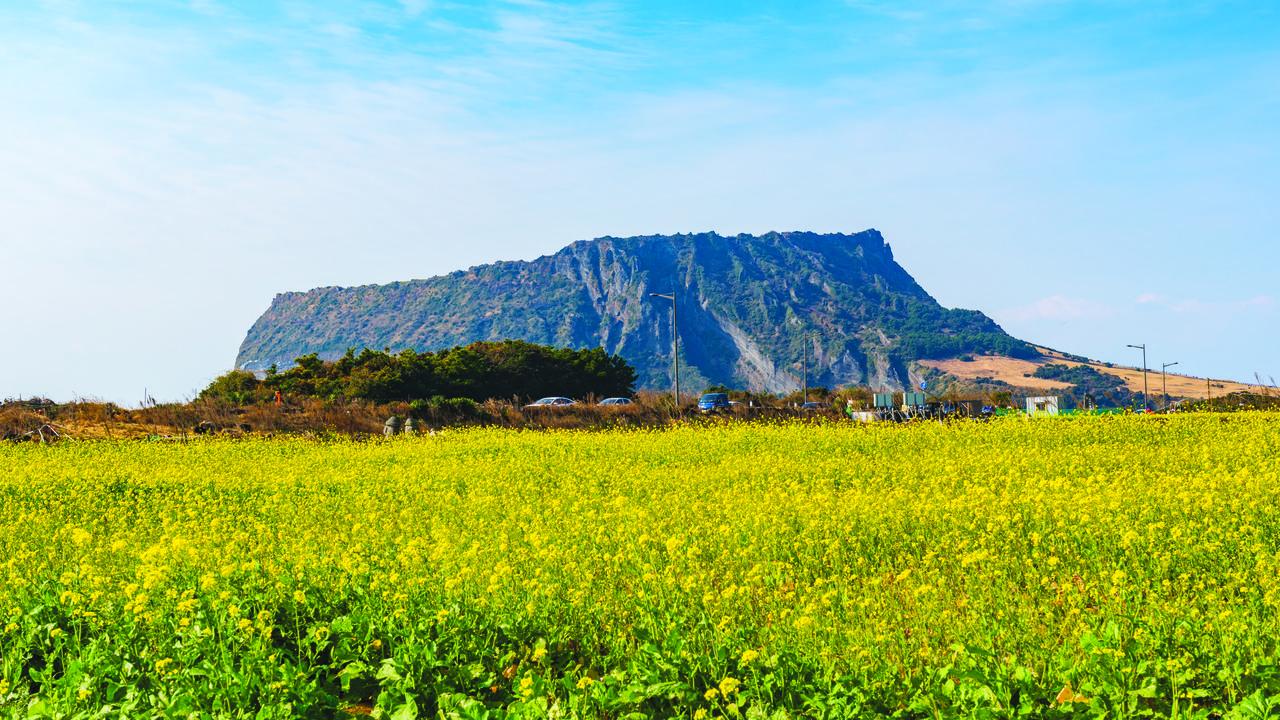
Jeju Island Volcano Tours: Hallasan, Seongsan & Manjanggul
Twelve day tours from 19 EUR across three UNESCO sites, plus the trailhead cut-off times that stop late starters on Hallasan.
Jeju is not an island with a volcano on it. It is a volcano with an island's worth of surface, and everything worth seeing here is a piece of that: a shield the size of the whole landmass, a tuff cone standing in the sea on the east coast, a lava tube running nine kilometres under the north-east farmland, and around 360 smaller cones scattered over the fields. The three headline sites were listed together by UNESCO in 2007, which is why almost every tour title on this page contains the word. The twelve products differ mainly in which half of the island they cover.
Two operational facts decide whether a Jeju trip works, and neither is easy to find in English. The first is that Hallasan's summit runs on timed gates with seasonal cut-offs, and a walker who starts at nine in the morning in winter will be turned back at the trailhead. The second is that Manjanggul spent two and a half years closed and only reopened at the end of May 2026, so a good deal of the advice still circulating says it is shut and some tour inventory is only now rebuilding around it. Both are below, with the hours.
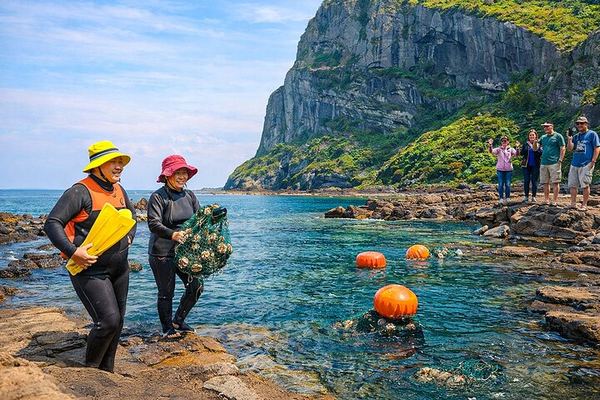
Eastern Jeju: a Live Haenyeo Dive Below Seongsan Ilchulbong and Manjanggul
The haenyeo dive live below Seongsan Ilchulbong, with the museum as the fallback, and the licensed guide works in both English and Chinese.
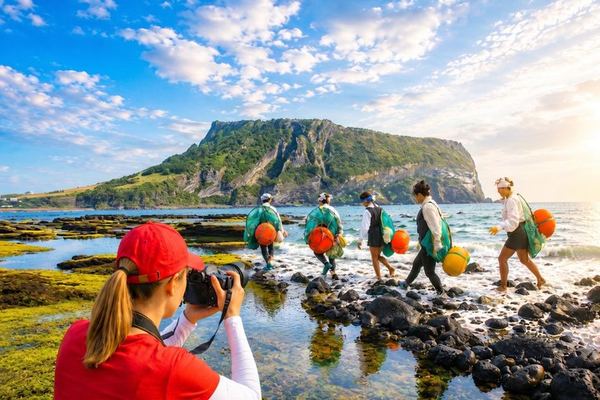
East Jeju: Seongsan in the Sun, Manjanggul's Cold Air to Finish
Manjanggul comes last on purpose, so the cave's cold air lands after the sun on Seongsan, and the haenyeo dive without tanks in between.

Jeju, East or Southwest: Two Routes, One Booking
The east route puts 50 guaranteed minutes on Seongsan and the haenyeo divers at 14:00; the south and west runs to Hallasan and the O'sulloc tea fields.
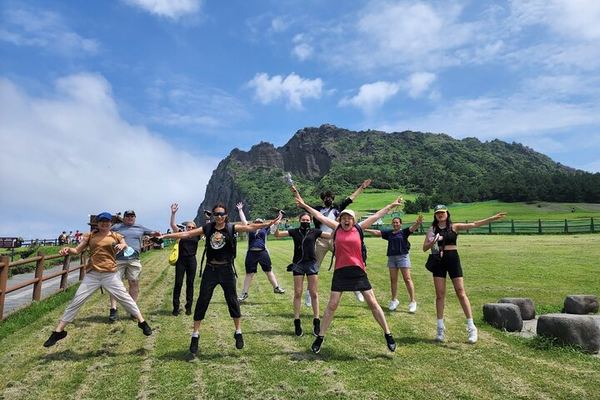
Jeju East UNESCO Day Tour: Manjanggul Cave, Seongsan Peak and the Haenyeo Divers
A 15-person group with an English-only guide, hotel pick-up in Jeju City, and the 2:00 PM haenyeo dive below Seongsan before the climb to the crater rim.
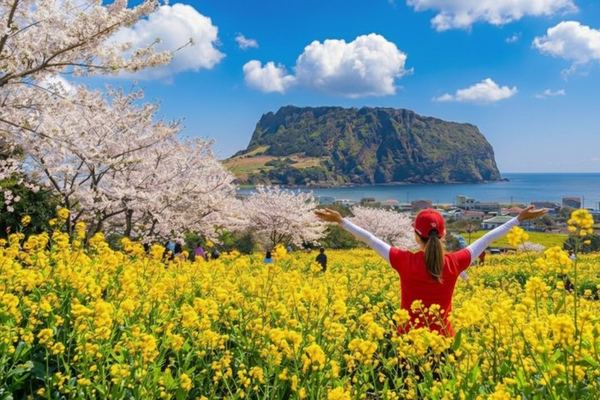
Jeju from Jungmun and Seogwipo: a 10.30 Start and No Shopping Stops
Picked up in Jungmun or Seogwipo rather than Jeju City, starting at 10.30 and back by five, with no shopping stops and no optional extras sold on board.
Premium Jeju South: English-Only Groups of 15, Everything Included
Core Travel does not mix English and Chinese-speaking groups the way budget tours do, and entrance fees, lunch and hotel transfers are all in the price.
Private Taxi Around Jeju: Your Own Itinerary Inside a 130 km Day
You set the route and can change it until departure, within a 130 km day; beyond that the driver charges 15,000 to 20,000 won per 10 km on the spot.
Southern Jeju: a 21-Metre Plunge Pool, a Temple Facing the Sea, Lunch at Songaksan
The first of Cheonjeyeon's three falls lands in a pool 21 metres deep, and lunch is your own at Songaksan with Hallasan on the horizon.
Southern Jeju in a Day: a Waterfall into the Sea, Hexagonal Cliffs and Hallasan
The operator never cancels for low numbers, and the route takes in the waterfall that drops straight into the sea and the hexagonal columns at Jusangjeolli.
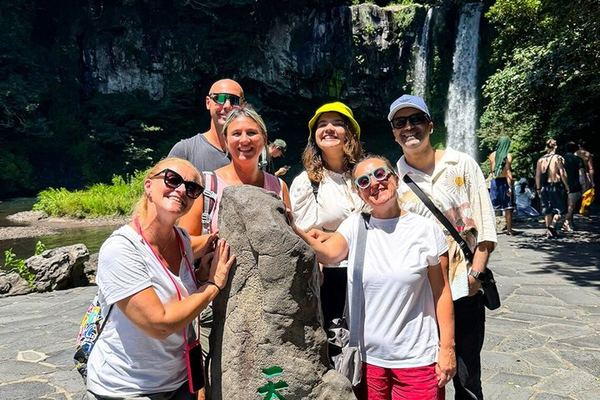
South Jeju with a Choice on Hallasan: Climb the Trail or Stay in the Gallery
The only waterfall in Asia that falls into the sea, and a Hallasan finish where climbing the trail or staying in the nature gallery both count as the tour.
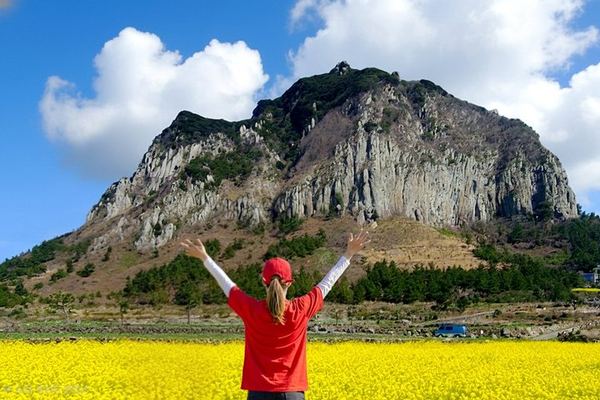
Southwest Jeju with No Shopping Stops: Four Sites and a Weather-Picked First Stop
The operator sells no add-ons and makes no shopping stops, and the first destination is chosen on the morning from three options by weather and traffic.
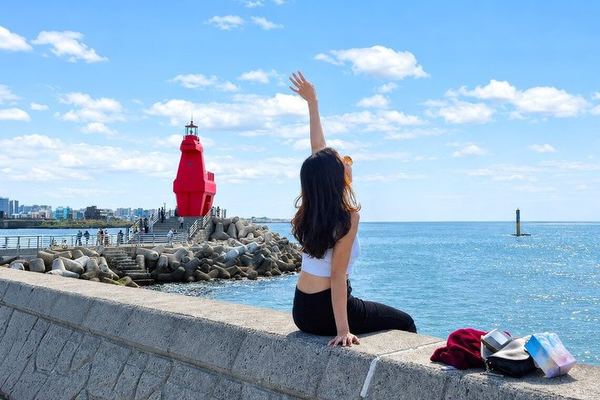
West Jeju: Korea's Highest Convenience Store, Two Horse Lighthouses, a Sunset Street
Korea's highest convenience store sits on the boardwalk at the 1100 Wetland, and the day ends at the two horse lighthouses from Welcome to Samdal-ri.
Ratings collected by Viator and Tripadvisor
Hallasan: the gate closes before you get there
Hallasan is 1,947 metres, and you will see 1,950 on signs and in older material. Both numbers are in circulation; the surveyed figure is 1,947 and the round one is what the mountain has been called for decades. At the top is Baengnokdam, a crater lake around two kilometres in circumference, and there is no cable car, no road and no shortcut.
Five trails go up the mountain. Only two of them reach the summit: Seongpanak, 9.6 km, and Gwaneumsa, 8.7 km. The other three, Eorimok, Yeongsil and Donnaeko, stop at Witse Oreum on the western shoulder at around 1,700 metres. They are beautiful walks and they are frequently sold, described and photographed as Hallasan hikes, which is true in the sense that they are on Hallasan and misleading in the sense that most people who book them are expecting the crater.
Then the part that ends days. Entry and turnaround are controlled by clock. The trailhead opens at 06:00 in winter, 05:30 in spring and autumn and 05:00 in summer, and the cut-off at the trail entrance is midday in winter, 12:30 in mid-season and 13:00 in summer. Arrive after the cut-off and you are not allowed to start. There are further turnaround points higher up on the same logic, which exist because the mountain has to be emptied before dark and the weather at the summit changes fast.
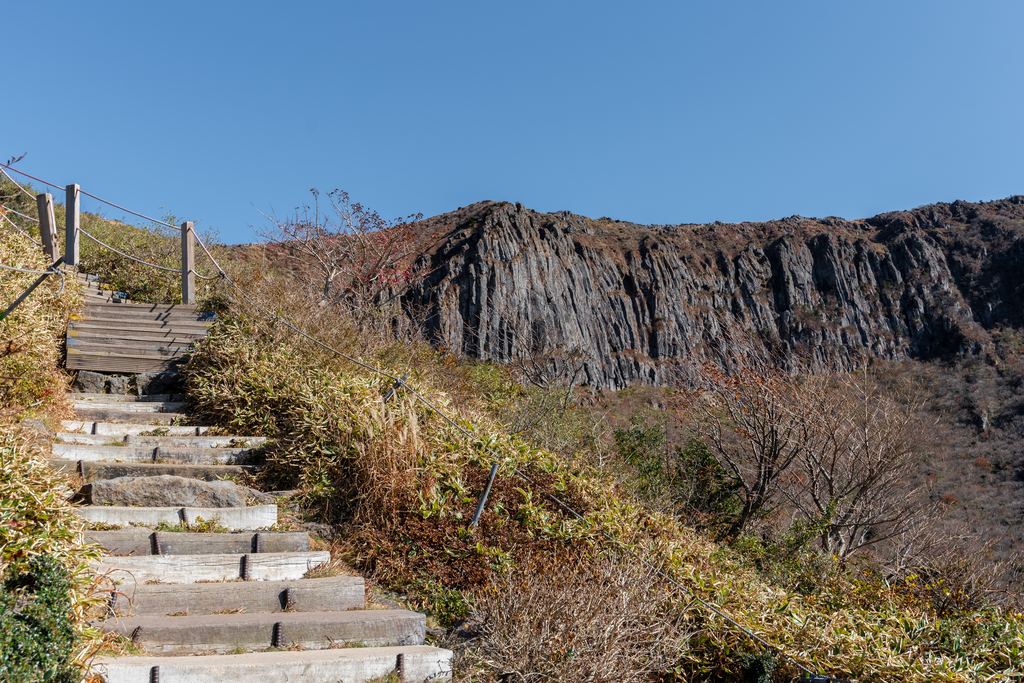
Booking on the wrong website is the commonest mistake
The two summit trails require a reservation, and this is where visitors go wrong most often. The booking sits on a Jeju provincial portal, not on the Korea National Park Service site that a search will usually surface first. People arrive holding a confirmation for something else.
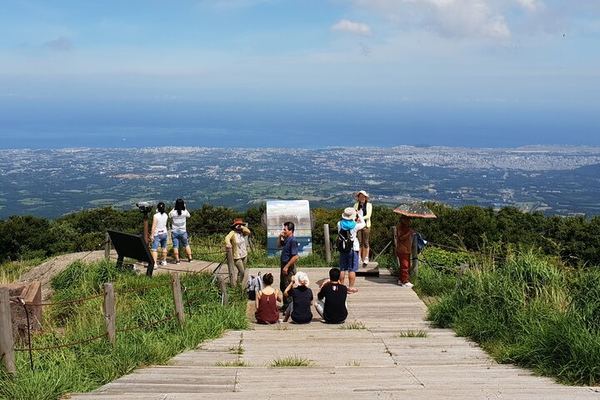
Reservations open at 09:00 on the first working day of the month, for the following month. And there is a penalty for booking and not turning up: three months blocked the first time, a year the second. That policy exists because no-shows were holding places on a capped mountain, and it is enforced. The trail in this photograph, Yeongsil, is one of the three that need no reservation, because they stop short of the crater.
| Trail | Length | Ends at | Summit? | Reservation |
|---|---|---|---|---|
| Seongpanak | 9.6 km | Baengnokdam crater, 1,947 m | Yes | Required |
| Gwaneumsa | 8.7 km | Baengnokdam crater, 1,947 m | Yes | Required |
| Eorimok | shorter | Witse Oreum, about 1,700 m | No | Not required |
| Yeongsil | shorter | Witse Oreum, about 1,700 m | No | Not required |
| Donnaeko | longer approach | Witse Oreum, about 1,700 m | No | Not required |
Seongsan Ilchulbong: half an hour of stairs, and a real explosion
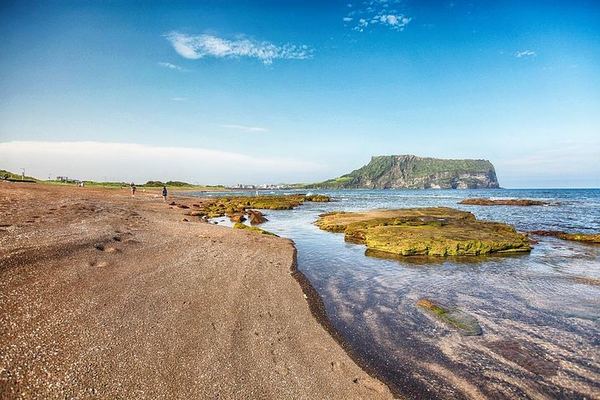
The cone at the eastern tip of Jeju is 182 metres high with a crater 600 metres across, and it is the one photograph everybody comes back with. What is worth knowing is how it was made. This is not a lava cone. Around 6,700 years ago a vent opened on a shallow seabed, seawater met rising magma, and the resulting steam explosions built a ring of soft ash and tuff instead of a mountain of rock. The technical name is a Surtseyan eruption, after the Icelandic island that did the same thing in 1963 while people watched. Seongsan was a separate island until sediment joined it to Jeju.
The visit is a wooden staircase, and the published figure is about thirty minutes to the top. It is steep and it is busy, particularly at sunrise, which is what the name means: sunrise peak. The tour groups arrive mid-morning. If you want the sunrise you go independently, and you go early enough to be climbing in the dark.
The other thing sold at Seongsan is a haenyeo demonstration, the free-diving women who harvest shellfish without air tanks and whose culture is on UNESCO's intangible heritage list. Several of the twelve products include it. It is a real tradition performed by real divers, and it is also, at this point, a scheduled performance rather than a chance encounter. Book it knowing which of the two you are getting.

Manjanggul: closed for two and a half years, open since May 2026
Manjanggul is 8.928 kilometres of lava tube, one of the longest and best-preserved anywhere, and about one kilometre of it is open to visitors. The tube reaches 23 metres wide and 30 metres high in places, which is larger than most people picture when they hear cave, and at the end of the open section stands a lava column 7.6 metres tall, formed where flowing lava from an upper tube poured into the lower one. It is the largest such column known in the world. The tube also holds a colony of some 30,000 bent-wing bats, the largest confirmed in Korea.
Two practical points. The air inside sits at roughly 11 to 14 degrees all year, which makes it the best hour of a Jeju August and a cold one in January: take a layer either way. The floor is wet, uneven lava and the lighting is deliberately low.
And the point that most published advice still gets wrong. Manjanggul closed in December 2023 after a collapse and did not reopen until 30 May 2026. That is nearly two and a half years, long enough that a large amount of guidance written in between says it is shut, and long enough that tour operators are still rebuilding the itineraries that include it. If a listing you are comparing does not mention Manjanggul, that may be why rather than because it chose the other cave.
East or south: the two days, and which one is the volcanic one
Jeju is 73 kilometres across and the sites are at opposite ends, so the tours split by course rather than by subject. Getting this right is the whole planning problem.
The east course is the volcanic day. Seongsan Ilchulbong, Manjanggul, the Seongeup folk village, Seopjikoji, usually a haenyeo stop. Everything on it exists because of an eruption and two of the stops cannot be seen anywhere else on earth.
The south and west course is the scenic day. The 1100 Altitude Wetland boardwalk in Hallasan National Park, the Jusangjeolli columnar basalt cliffs, Cheonjeyeon and Jeongbang waterfalls, a green tea museum, a temple. The Jusangjeolli cliffs are genuinely volcanic, hexagonal columns formed as a lava flow cooled against the sea, and they are the reason the day is not a write-off for someone here for the geology. But if you have one day and came for volcanoes, take the east.
| Course | Typical stops | Price | Notes |
|---|---|---|---|
| East | Seongsan Ilchulbong, Manjanggul, Seongeup folk village, haenyeo | 26 to 48 EUR | The volcanic day; four products, one at 27 EUR with 1,233 reviews at 4.9 |
| South and west | Hallasan National Park, Jusangjeolli cliffs, waterfalls, tea museum | 19 to 37 EUR | Does not climb Hallasan; cheapest listings on the island |
| Premium small group, east or south | As above, capped at 15 people | 88 EUR | No forced shopping stops, English guide |
| Private taxi tour | Your own itinerary anywhere on the island | 194 EUR | The only way to combine east and south in one day, and it will be rushed |
| Resort pick-up tour | Seongsan, a cave, haenyeo, from Jungmun and Seogwipo | 37 EUR | Later start around 10:30, back around 17:00 |
What actually goes wrong on a Jeju day
Four things, in the order they cost people their day.
Booking the wrong website for Hallasan. The summit reservation is on a Jeju provincial system, and the Korea National Park Service portal that ranks better in search does not cover these trails. People arrive with a confirmation for the wrong thing.
Starting too late. A nine o'clock start in winter does not get you to Baengnokdam; the trailhead cut-off is midday and the higher turnarounds are earlier still. In summer the gate opens at 05:00 for a reason.
Expecting a tour to climb the mountain. None of the twelve does. The park stops are at low altitude and are worth doing on their own terms.
Assuming one day covers the island. The two courses do not overlap, the drive between them is forty minutes each way, and the private taxi products that promise both spend a lot of the day in the car.
Book, then fail to turn up on Hallasan, and you are blocked for three months. Do it twice and it is a year. The mountain is capped, and the reservation is a place somebody else could have had.
Questions people actually ask
Can you climb to the top of Hallasan?
Yes, on foot and independently, but only by two of the five trails: Seongpanak at 9.6 km and Gwaneumsa at 8.7 km. Both require a reservation made on a Jeju provincial portal, not on the Korea National Park Service site. The other three trails stop at Witse Oreum on the western shoulder and never reach the crater, even though they are commonly described as Hallasan hikes.
What time do the Hallasan trails open and close?
The trailhead opens at 06:00 in winter, 05:30 in spring and autumn and 05:00 in summer. The cut-off for entering the trail is midday in winter, 12:30 in mid-season and 13:00 in summer, and there are further turnaround points higher up. If you arrive after the cut-off you will not be allowed to start. Confirm the current hours before you travel, since they change with the season.
Do the tours on this page climb Hallasan?
No. Several carry the mountain's name and what they visit is Hallasan National Park at lower altitude, typically the 1100 Altitude Wetland boardwalk. That is a real stop and it is not the summit. The crater at 1,947 metres is a full independent day hike with a reservation.
Is Manjanggul open?
Yes, since 30 May 2026. It closed in December 2023 after a collapse and stayed shut for nearly two and a half years, so a lot of advice written in that period still says otherwise and some tour itineraries are only now adding it back. About 1 km of the 8.928 km tube is walkable, ending at a 7.6 metre lava column, the largest known anywhere.
How long does Seongsan Ilchulbong take?
About 30 minutes up a wooden staircase to the rim of a 600 metre crater on a 182 metre cone, and about the same back down. Allow an hour to ninety minutes with photographs. For actual sunrise, which is what the name means, you have to go independently and start in the dark; the coach tours arrive mid-morning.
Which tour should I book if I only have one day?
The east course. It carries Seongsan Ilchulbong and Manjanggul, the two sites you cannot see anywhere else, and it runs from 26 to 48 EUR. The south and west course is waterfalls, the Jusangjeolli basalt cliffs and the lower slopes of Hallasan: a good day, but not the volcanic one. Two days lets you do both without hurrying.
How cold is it inside the lava tube?
Around 11 to 14 degrees, steady all year. In August that is a relief and the best hour of the day; in January it is colder inside than you expect after a walk in the sun. Take a layer regardless of the season, and wear something with grip: the floor is wet, uneven lava and the lighting is low on purpose.
Is Jeju worth it just for the volcanic sites?
For two days, yes. Three UNESCO components in one small island, a lava tube in the top rank worldwide, a tuff cone you can climb in half an hour and a shield volcano with a crater lake you can walk to if you plan for it. For one day it is thinner, and you will be choosing between halves of the island rather than seeing it.
Data verified on. Prices and stops read from the 12 Jeju products on this site. Trail lengths, gate hours, cave dimensions and reopening date from Jeju provincial and UNESCO sources.