

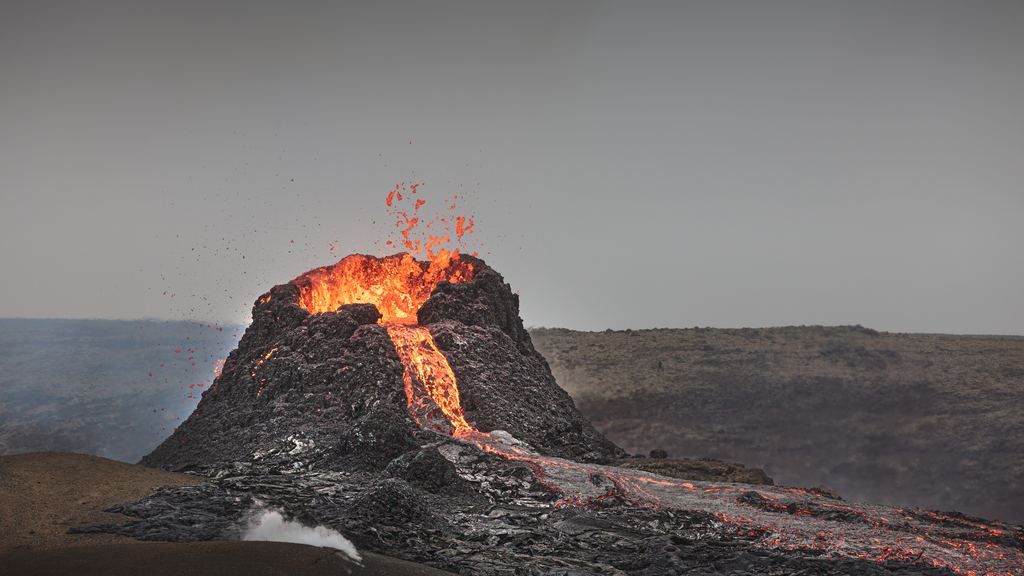
The word lava is doing a lot of work in the tourism industry, and most of it is being done quietly. A lava tour, a lava cave, a lava field, a lava show and a lava viewing platform are five different products. Two of them involve molten rock. The other three involve rock that cooled down, in one case several thousand years ago.
None of this is fraud. A lava field is a genuinely remarkable place and the tours that visit them are often excellent. The problem is that a traveller reading a listing at eleven at night, three weeks before a trip, has no way of knowing which of the five they are buying. So here they are, in order of temperature.
The six things people call lava
| What it is | Temperature | Where you realistically find it | Can you see it in daylight? |
|---|---|---|---|
| Molten lava, flowing or fountaining | 1,000-1,150 °C | Only during an eruption, at very few accessible volcanoes | It is there, but it looks grey. The glow needs darkness |
| A lava lake | around 1,100 °C | A handful of volcanoes worldwide. Masaya is the only one you drive to | Partly. Looking down into a crater, the shade helps |
| Incandescent avalanches from a dome | several hundred °C at the surface | Merapi, Santiaguito, Sheveluch, from a permitted distance | No. You see dust by day and glowing blocks by night |
| A fresh lava field, still cooling | warm to hot underfoot in places | Iceland's Reykjanes flows, recent Etna flows | Yes, and the steam is visible. No glow |
| An old lava field or lava tube | ambient | Lanzarote, Iceland, Hawai'i, Etna, the Azores | Yes. This is a landscape, not an event |
| A lava show | 1,100 °C, reheated | Two indoor venues in Iceland | Yes. It is indoors and they control the lighting |
The gap between row four and row five is the one that catches people out. Both are called lava fields. One of them is a black plain a few years old where the ground is warm through your boots and steam comes out of the cracks after rain. The other is a black plain a few thousand years old where lichen has started to grow. They photograph almost identically.

Two surfaces, two entirely different walks
Pahoehoe and a'a: the only two lava words worth memorising
Both are Hawaiian, both are used worldwide by geologists, and the difference between them decides what your day is like.
Pahoehoe is the smooth kind. It flows fast and hot, and its surface wrinkles into ropes and folds as the skin drags on the liquid underneath. Walking on it is easy. It is what people photograph, and it is what forms lava tubes, because the surface crusts over while the inside keeps running.
A'a is the other kind, and the name is worth saying out loud because it sounds like what walking on it feels like. Cooler, stickier lava that tears itself apart as it moves, leaving a surface of loose, angular, razor-edged clinker. It shreds trainers. It cuts hands. A field of it is slow, ankle-turning ground.
The same eruption often produces both, and a flow can change from one to the other as it travels and cools. If a tour description mentions walking on a lava field, this is the thing worth asking about.
Lava tubes are the best value in the whole category
A lava tube forms when a pahoehoe flow crusts over on top and keeps running underneath. When the eruption stops, the liquid drains out and leaves a tunnel, sometimes for kilometres, with a smooth glazed ceiling and the tide marks of the last flow still on the walls.
They are worth your time for two reasons. The first is that they show you something an active eruption never does, which is the inside of a lava flow. The second is that they are reliable. A lava tube does not depend on whether the volcano is doing anything this week. It is there, it is the same every day, and it is one of the few volcanic experiences you can book with confidence months ahead.
Lanzarote's are the most developed. Iceland has several open to visitors. Hawai'i's Nahuku is famous. The Azores and Etna both have them. Ask whether the tour includes lighting and helmets, and whether the floor is level, because in some tubes it very much is not.
What a lava show actually is
This deserves explaining properly, because on paper it sounds like a gimmick and it is not.
A furnace heats real basalt, quarried from a genuine eruption deposit, past 1,100 °C until it is liquid. The liquid is then poured down a chute into a room where you are sitting a few metres away. You feel the radiant heat on your face. You watch it crust over and slow down and stop, which is the part you would never see on a volcano because the good bits happen at night on a mountain with a two hour walk in each direction.
It is real lava and a fake eruption. Both halves of that sentence matter. If you want to understand how the stuff behaves, it is the clearest demonstration available anywhere. If you want the experience of standing in a wild place at three in the morning watching a mountain throw rocks, it is not that, and it does not pretend to be.
The vocabulary, translated
Words that appear in listings, and what they commit the operator to.
| The phrase | What it means | Molten rock included? |
|---|---|---|
| Lava viewing | Usually means viewing a volcano that has produced lava. Occasionally means the real thing | Only sometimes. Check the timing |
| Lava field | Cooled rock. Could be five years old or five thousand | No |
| Lava tube / lava cave | An underground tunnel left by a drained flow | No |
| Lava tour (Merapi and similar) | Usually a jeep circuit across deposits from a past eruption | No |
| Petrified lava | An unusually honest phrase. It means solid rock | No |
| Volcanic heat, geothermal | Ground heat, steam vents, hot springs | No |
| Glowing, incandescent, molten, flowing | These are the words that commit to something | Yes, if the tour also runs after dark |
| Lava show | Reheated basalt poured indoors | Yes, guaranteed |
So what should you actually book?
My honest advice, having looked at a great many of these listings: decide which of the six you want before you search, then search for that. Most disappointment in this field is not caused by bad tours. It is caused by someone booking row five while imagining row one.
If you want molten rock, you need an active volcano, a night departure, and tolerance for the possibility that cloud ruins it. If you want a landscape that will not let you down, a lava field or a tube on a clear day is one of the strangest places you can walk, and it will be exactly as advertised. If you want to understand lava rather than merely glimpse it, the indoor show beats both.
They are all worth doing. They are just not interchangeable.
Quick answers
Can you walk on a lava field safely?
On established routes, yes, and it is a normal activity in Iceland, Lanzarote and Hawai'i. Off route on young flows it is genuinely dangerous: the crust can be thin over voids, a'a surfaces cut deeply, and cracks are easy to miss. Park services warn about razor-sharp lava and hidden earth cracks for good reason.
How hot is the ground on a recent lava field?
It varies enormously across a few metres. Flows years old can still be hot enough to feel through boot soles at cracks and to make rainwater steam. Guides on young fields in Iceland routinely demonstrate this. It is not hot enough to be dangerous on marked routes, and very much is a few metres off them.
Is a lava tube claustrophobic?
The developed ones are large. Lanzarote's and Hawai'i's main tubes are several metres across with lighting and level walkways. Wild tubes are a different proposition and generally require a caving trip, a helmet and a guide.
Why is some lava rope-like and some like broken bricks?
Temperature and gas content when it flowed. Hotter, faster, more fluid lava wrinkles into pahoehoe ropes. Cooler, stiffer lava tears apart into the rubble called a'a. The same eruption often makes both, and one flow can turn into the other as it cools downhill.
Lava fields you can walk on any day of the year
Lanzarote is built on them. Timanfaya, the Cueva de los Verdes and the Jameos del Agua sit on flows from the 1730s eruptions, and none of it depends on what a volcano is doing this week.
Lava you can walk inside
Lava tubes do not depend on the alert level, the weather or the season. Lanzarote's are the most developed in Europe.
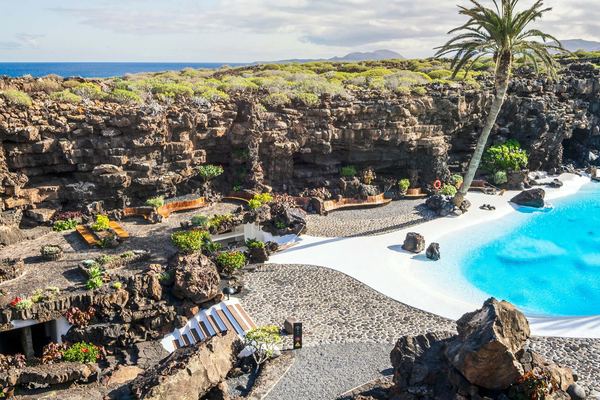
Charco de los Clicos, the Timanfaya Geysers and Jameos del Agua
The Green Lake at El Golfo takes its colour from algae and sulphur, Timanfaya runs its geyser demonstrations, and Jameos del Agua sits in a lava tunnel.
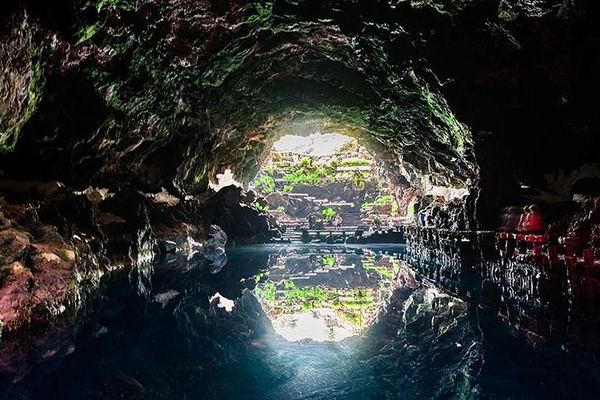
Cueva de los Verdes and Jameos del Agua, Mondays and Fridays
A four to five hour run through the north of Lanzarote on Mondays and Fridays, with a guided visit inside Cueva de los Verdes and free time at Jameos del Agua.
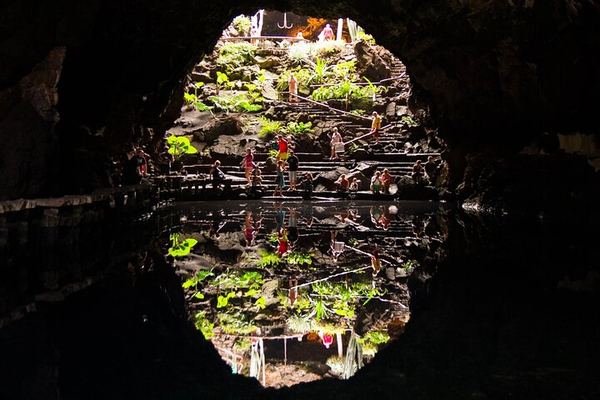
Jameos del Agua, Mirador del Río and the Manrique Foundation, Wednesdays
A Wednesday run through the north of Lanzarote: the Manrique Foundation, the Cactus Garden, Mirador del Río and the clicos crabs at Jameos del Agua.
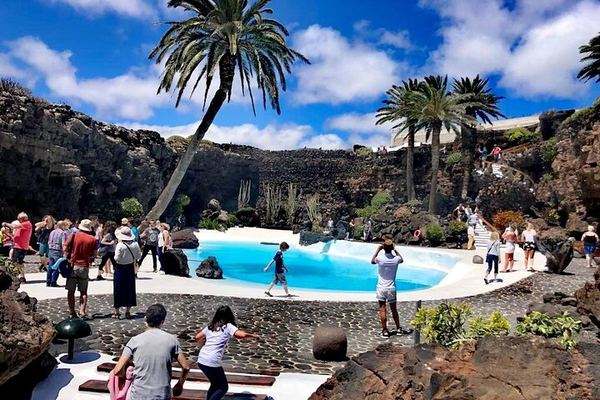
Lanzarote in a Day from the Cruise Port: Timanfaya, Jameos, Lago Verde
Seven stops between the port and Timanfaya, with no queues: Jameos del Agua, the cliff at Mirador del Río, a wine tasting in La Geria and the Lago Verde.
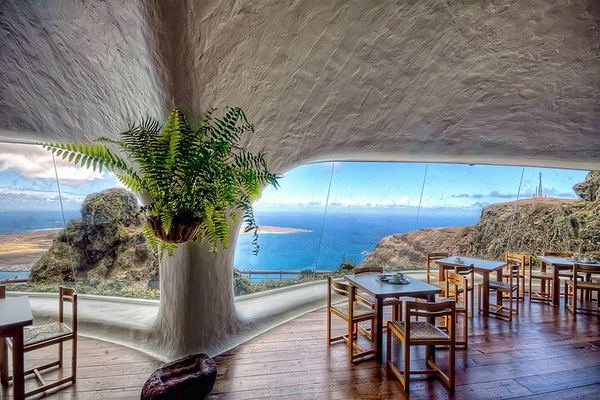
North Lanzarote: Cueva de los Verdes, Jameos, Mirador del Río
Three paid sites with no queueing, plus Haría's palm valley and the Monumento al Campesino. The Mirador del Río looks across at La Graciosa from 500 metres.
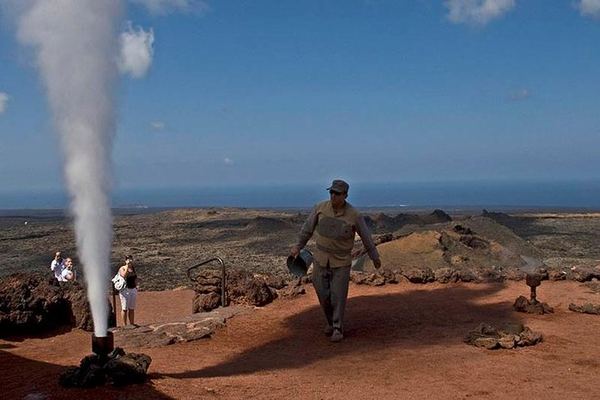
Ten Hours Across Lanzarote: El Golfo, Timanfaya, Jameos del Agua
Ten hours Monday to Friday, from the Green Lagoon at El Golfo up to free time at Jameos del Agua, with the Corona volcano above Haría. Lunch not included.
Ratings collected by Civitatis, Viator and Tripadvisor
Data verified on. Temperatures are typical values for basaltic lava. Surface conditions on any given field vary; follow local guidance on where walking is permitted. Editorial Policy