
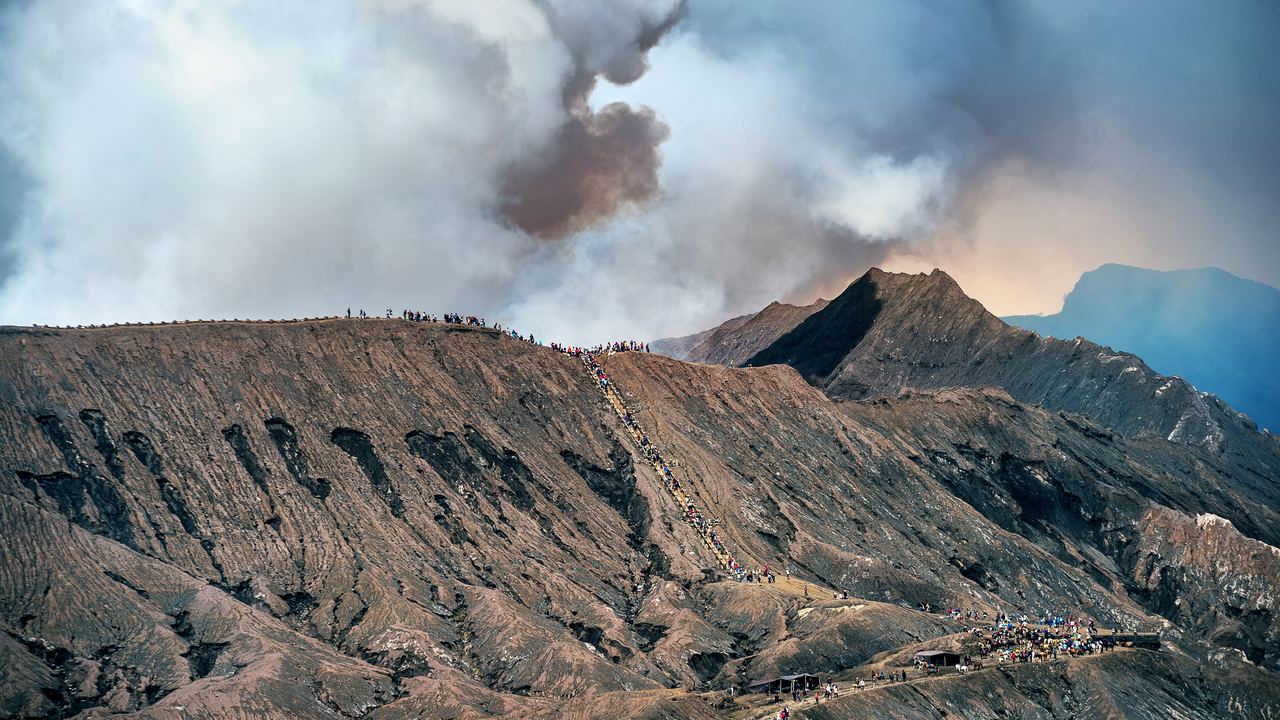
Volcano Tours in Indonesia
About 127 active volcanoes, five of them sold as trips: Batur, Bromo, Ijen, Rinjani, Merapi. Three of the five carried a raised alert level in August 2026.
Indonesia has more active volcanoes than any other country. The usual figure is about 127, strung along the Sunda Arc where the Australian plate slides beneath the Sunda plate and melts on the way down. Two of them changed conditions on the far side of the world. Tambora, in 1815, put enough sulphur into the stratosphere to give the northern hemisphere the year without a summer in 1816: snow in June, failed harvests, bread riots in Europe. Krakatau, in 1883, was heard more than 4,000 kilometres away. Against that geology the visitor catalogue is small and very concentrated. Five mountains carry 113 listings here, and three of the five are day trips.
This page is the comparison: what each of the five actually gives you, how far apart they really are, what the government alert board says about each one, and which answers the question you arrived with. Operational detail belongs on the destination pages below.
One thing is worth settling here, because it is the most expensive misunderstanding in the market. Bali is not where Indonesia's volcanoes are. It is where the visitors are. The mountains with the reputations sit on Java and Lombok, and reaching them from a hotel in Seminyak costs a night, a ferry or a flight.
Choose a destination in Indonesia
-
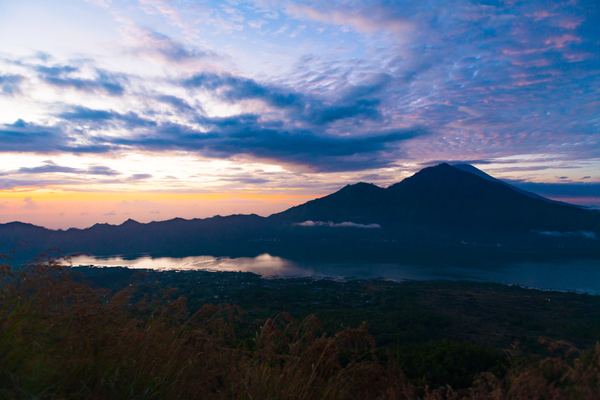
Bali
Volcano tours in Bali: the Mount Batur sunrise trek or jeep ride, the black lava field, the hot springs and the Mount Agung summit.
56 experiences in 5 destinations -
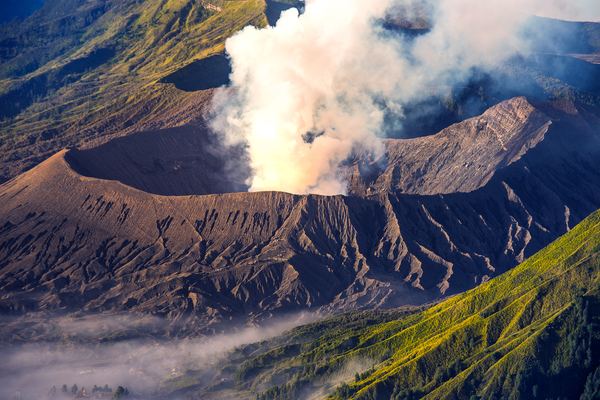
Mount Bromo
Mount Bromo tours from Surabaya, Malang and Bali: sunrise viewpoints, the sand sea, what the ticket costs and the closures that listings do not mention.
12 experiences -
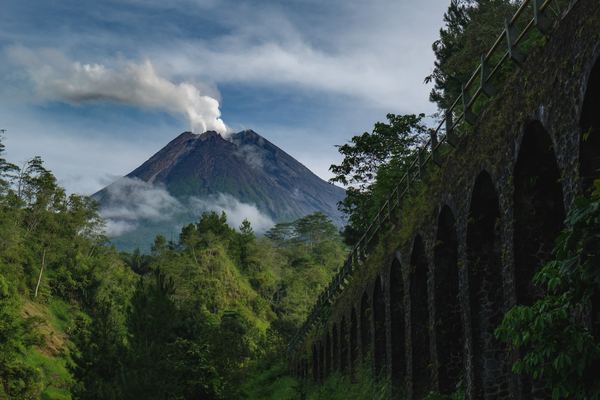
Mount Merapi
Mount Merapi jeep tours from Yogyakarta: what the 2010 eruption left behind, why the summit is not on offer, and how the jeep is really priced.
12 experiences in 1 destination -
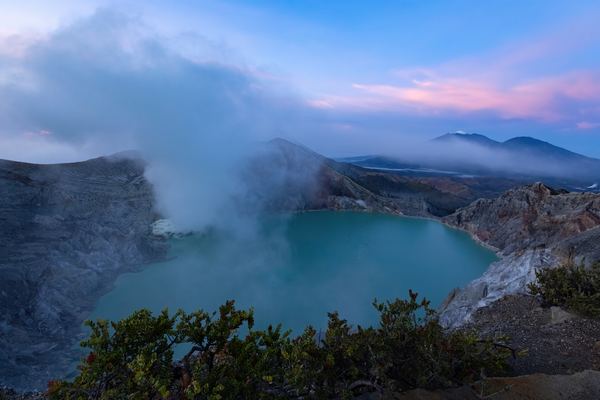
Mount Ijen
Mount Ijen tours from Banyuwangi and Bali: the blue fire, the acid crater lake, the sulphur miners, and the monthly closure nobody publishes.
10 experiences -
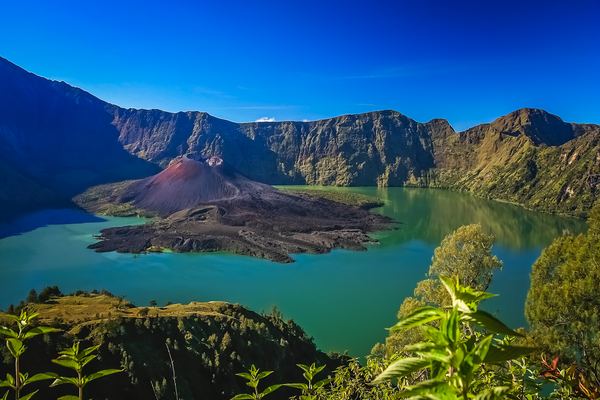
Mount Rinjani
Mount Rinjani treks on Lombok: which routes reach the 3,726 m summit and which stop at the rim, the annual closure, permits, quotas and compulsory insurance.
23 experiences in 2 destinations


Volcano Travel Experiences in Indonesia
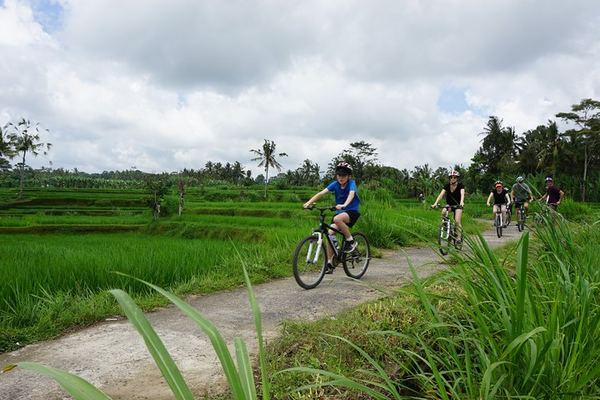
Abuan to Payangan by Manual Bike: Gunung Raung Temple, Subak Fields and Greenkubu
The manual-bike descent from Abuan passes Gunung Raung, the first temple built on Bali in the 8th century, and the Bresela fields, then lunch at Greenkubu.
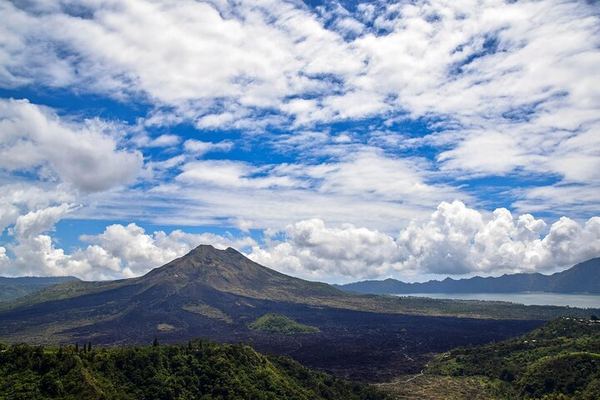
Barong Dance, Celuk Silver and the Batur View from Penelokan
Seven stops in one day: the Barong and Keris trance dance, the silver workshops at Celuk, and the Batur caldera seen from Penelokan. Lunch buffet included.
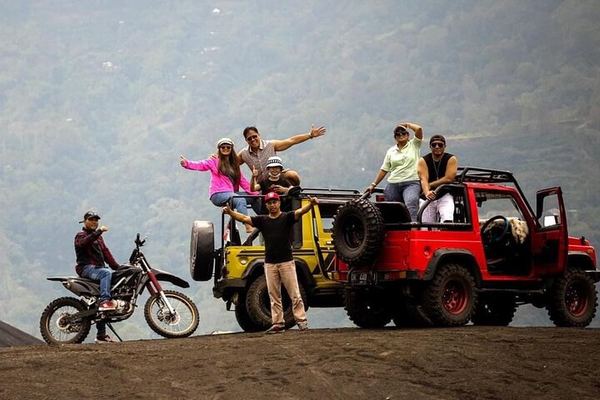
Batur 4WD at 7 am: the Lava Cave at Lava Ball Point and the 1964 Flow
A 7 am start with a certified Mount Batur Guide Association driver, into a cave left by a lava flow and out over the 1964 field, then lunch and a long soak.
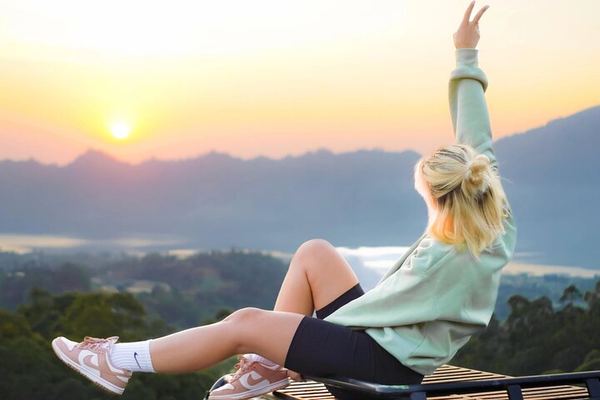
Batur 4WD Jeep All-Inclusive: Breakfast at the Sunrise Point, Then Spring and Coffee
Breakfast is served at the sunrise point before the light arrives, and the morning closes with a hot spring soak and a Balinese coffee, all in the price.
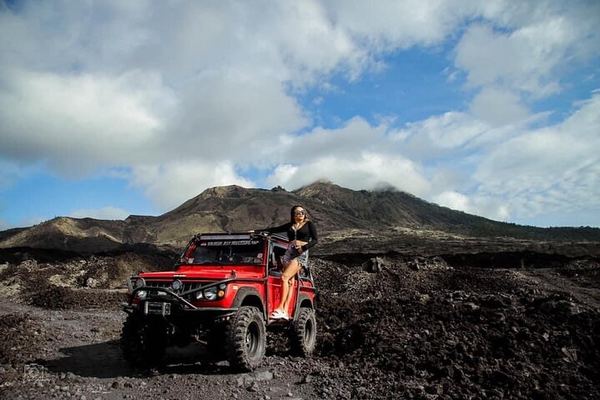
Batur 4WD Jeep over the 1843 and 1963 Lava, with a Kintamani Hot Spring
The jeep crosses two different lava fields, one from 1843 and one from 1963, through Kintamani's farmland, and finishes with an hour or two in a hot spring.
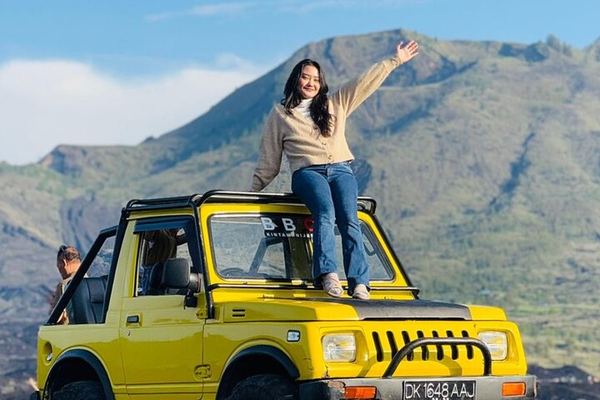
Batur 4WD Jeep Sunrise: Breakfast on Top, and a Driver Who Takes the Photos
No trekking at all: the 4WD reaches the top, breakfast is made there, and the driver doubles as the photographer before the run across the black lava.
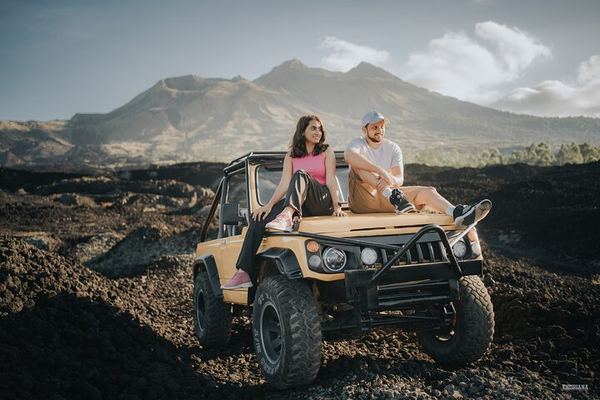
Batur Jeep at Sunset from Bukit Catu, Finishing on the Black Sand
Departure is at noon instead of before dawn, and the sun goes down from the black sand, reached after Bukit Catu and the lava field left by 1963.
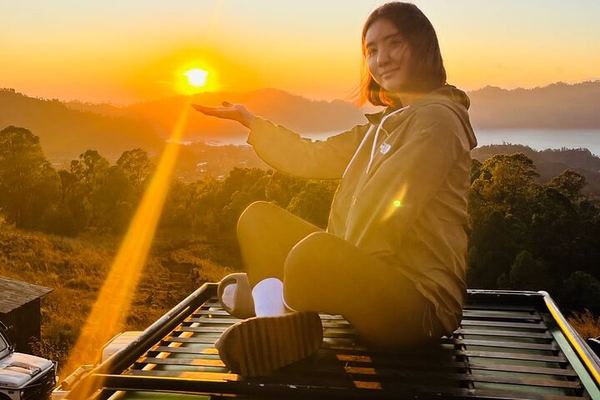
Batur Jeep Sunrise at 1,200 m: Lava, Black Sand or Pura Segara on the Lake
After the sunrise point at 1,200 m you pick where the jeep goes: the lava fields, the black sand desert, or Pura Segara on the shore of Lake Batur.
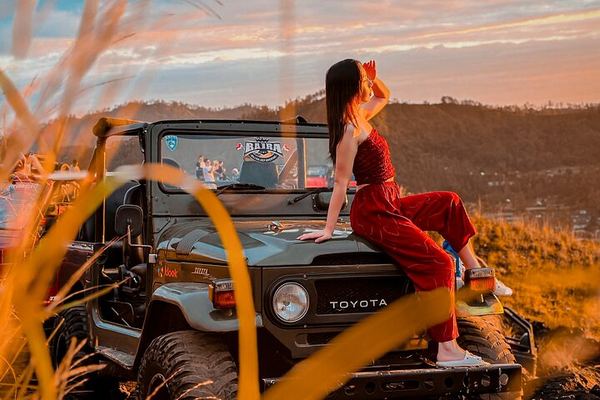
Batur Jeep Sunrise at 1,717 m: Banana or Egg Sandwiches and the 1963 Lava
Sunrise is watched from the roof of the jeep, with banana or egg sandwiches made on the spot and the black field of lava the 1963 eruption left behind.
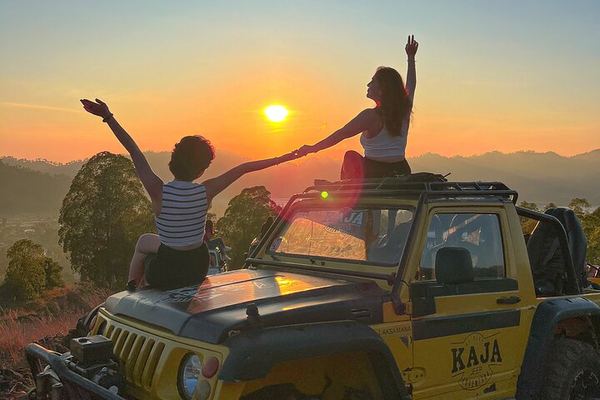
Batur Jeep Sunrise, Black Sand and a Coffee Break at Temen Village
The jeep replaces the trek entirely, the viewpoint lines up Agung, Abang and Batur, and the coffee break is at Temen village with local products to taste.
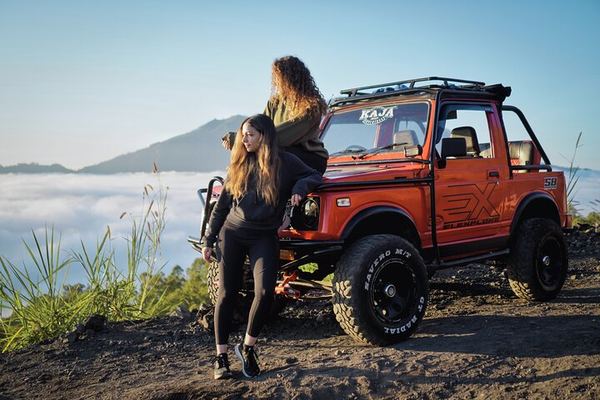
Batur Jeep Sunrise from 2:30 am: Kintamani Light, Then the Black Sand Desert
The clock is fixed: pick-up at 2.30 am, jeep at 5.00, sunrise behind Batur from the Kintamani side, then the black sand desert from 7.00 until 8.30.
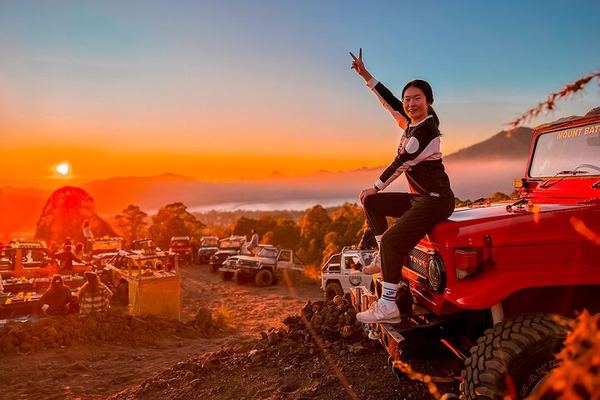
Batur Jeep Sunrise: the Winding Volcanic Track Is Half the Reason
The rough drive up is the point here: winding paths and volcanic trails in a 4x4, then a proper breakfast stop at the summit with the lake below.
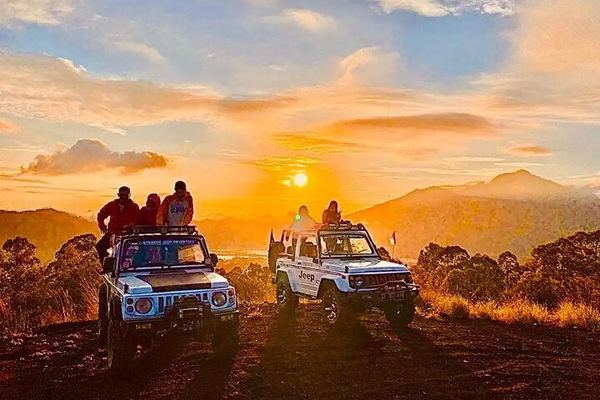
Batur Jeep Sunrise Where the Driver Cooks Breakfast While You Wait
The driver cooks breakfast at the viewpoint while the sky changes, and the route afterwards crosses the 1963 lava and the farmland that grew back on it.
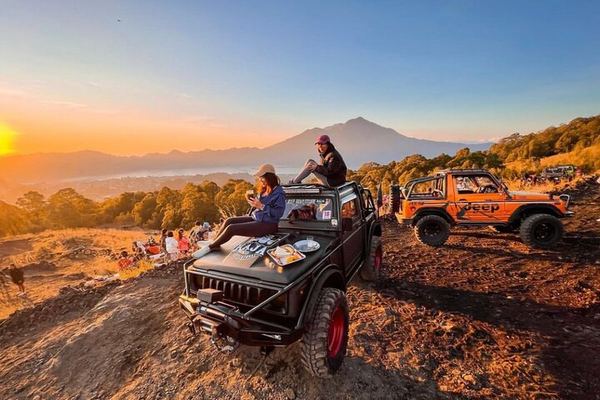
Batur Jeep to the 1963 Lava Field, with a Hot Spring After
The lava crossed after sunrise came out of Batur in 1963, and the jeep is a classic 4WD with a local driver. The coffee farm and hot spring at the end.
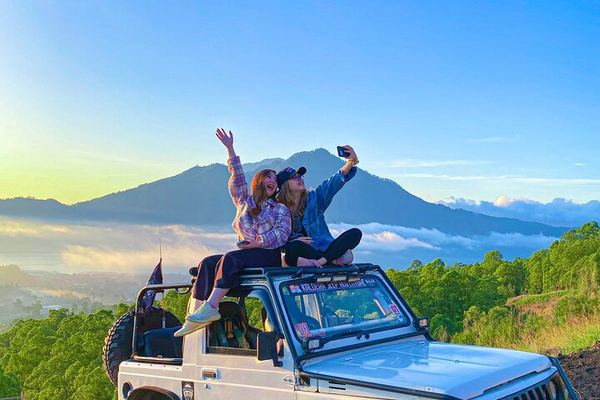
Batur Sunrise by Jeep from a Little-Known Viewpoint, Through Kintamani
The sunrise here is taken from a viewpoint few people use, then comes the Black Lava, the drive through Kintamani and a coffee break with local products.
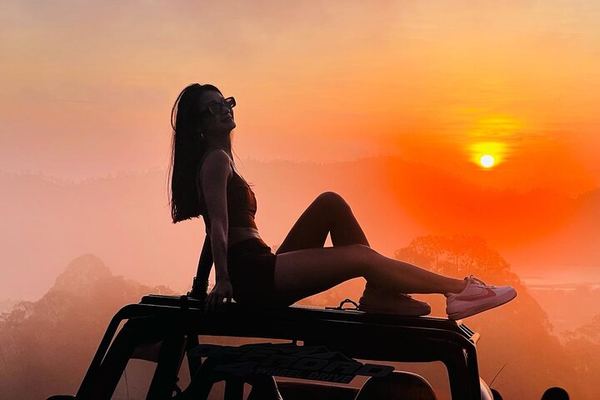
Batur Sunrise by Jeep with No Walking at All, and a 35-37°C Soak
There is no walking at any point, which makes it workable with children or a disability, and the spring afterwards runs at 35 to 37 degrees.
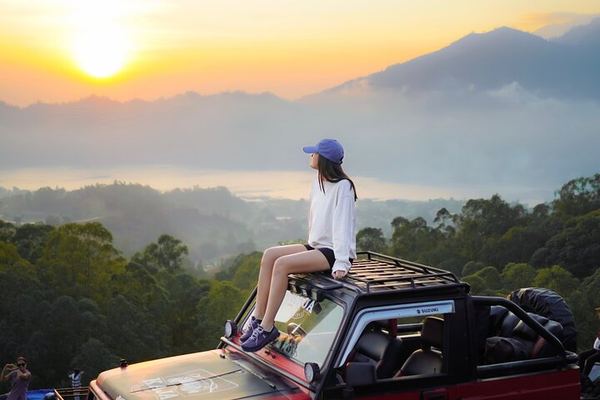
Batur Sunrise by Private Jeep, Add ATV, Rafting or AKASA Coffee
The jeep does the climbing, the driver makes breakfast at the viewpoint, and the afternoon is yours to pick: hot spring, ATV, rafting or AKASA coffee.
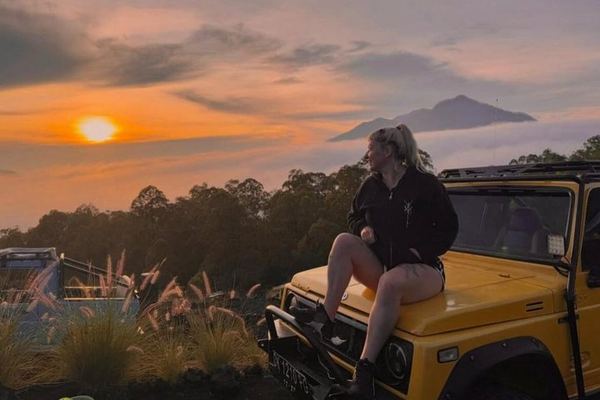
Batur Sunrise by Private Jeep: Breakfast on the Roof, Transfer Included
Breakfast is eaten on the roof of the jeep rather than at a table, the transfer is included, and the black lava field comes after the light is up.
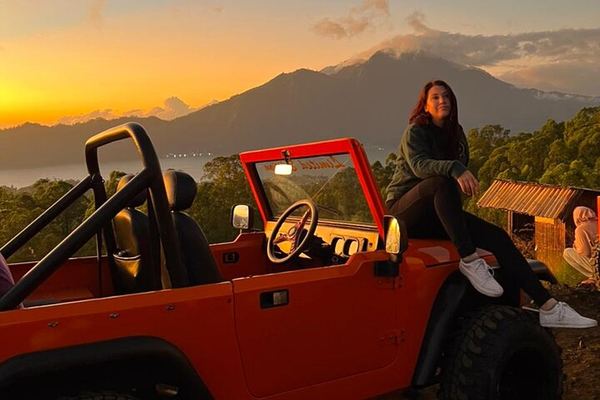
Batur Sunrise in a Classic 4WD Jeep, Breakfast on the Roof at 1,365 m
Breakfast is eaten sitting on the roof of a classic 4WD jeep at 1,365 m, and the black sand crossed afterwards came from the last eruption, in 1963.
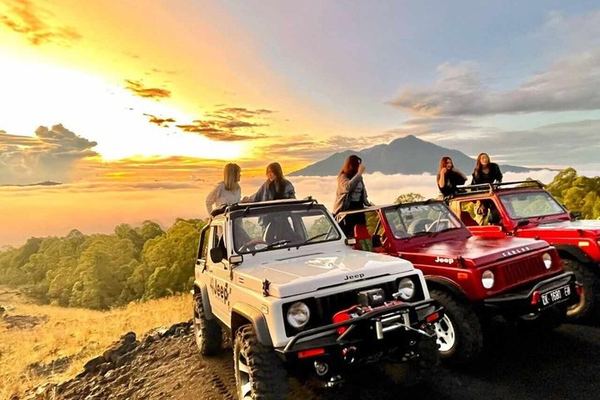
Batur Sunrise Jeep in the UNESCO Geopark, Down Through the Jungle to Toya Bungkah
The jeep climbs a volcano inside a UNESCO Geopark, then comes down the back of it through jungle to Toya Bungkah, over the basalt left by 1963 and 1974.
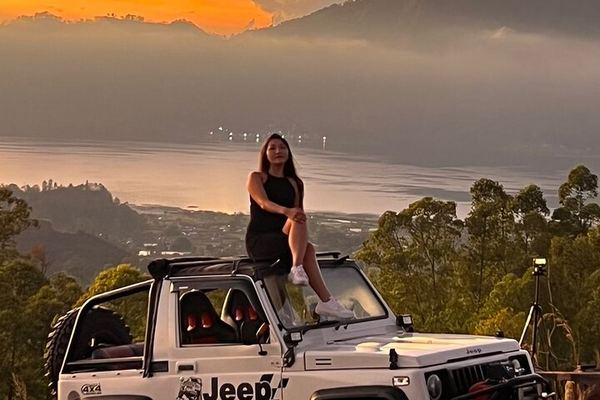
Batur Sunrise Jeep with a Package to Pick: Hot Spring, Waterfall, Swing or ATV
The jeep and the roof breakfast stay the same; the choice is what you add: hot spring, Tegalalang and Tegenungan, the jungle swing, or ATV and rafting.
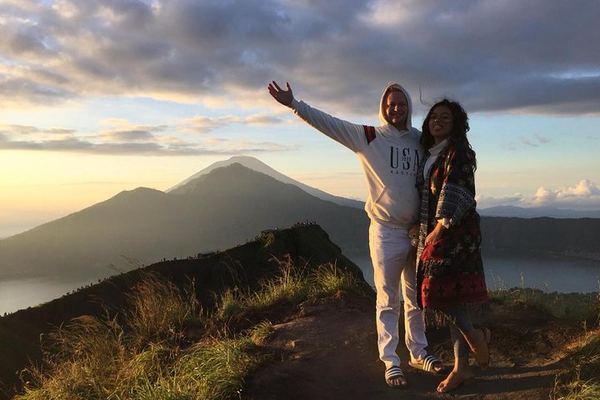
Batur Sunrise Trek, Breakfast at the Summit, Rim Walk on Request
Breakfast at the summit is banana sandwiches, cakes, eggs, fruit and hot drinks, and at 07:00 you choose between going down and walking the crater rim.
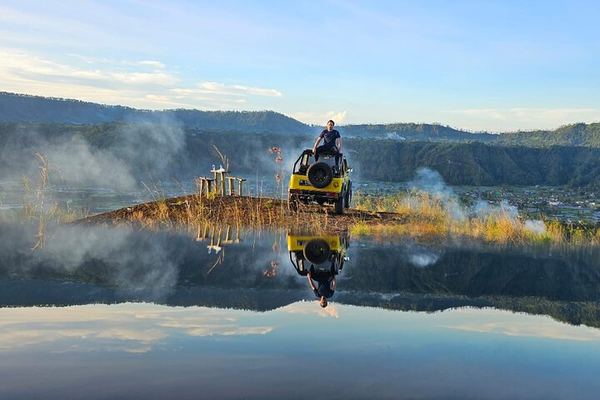
Batur Sunset Jeep from 13:00: Two Hours at the Mid-Mountain Viewpoint
Pick-up is early afternoon and the stop runs 16:30 to 18:30, partway up rather than at the summit, where in some months the sun sets behind the mountain.
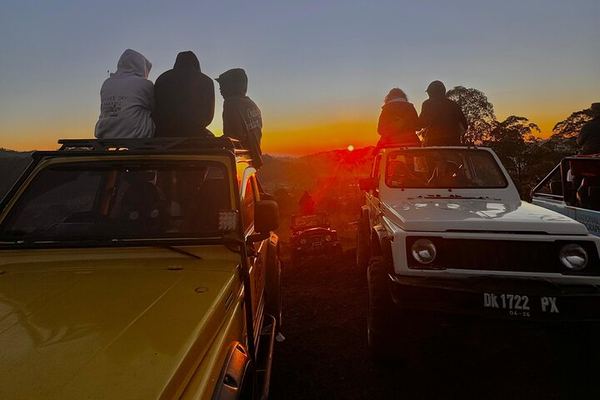
Batur Sunset Jeep to the Lava Field, with Pillow and Ropy Lava Named
The late-afternoon departure trades the sunrise crowd for the golden hour, and the guide names the shapes on the lava field: pillow, ropy, lava balls.
Ratings collected by Viator and Tripadvisor
Five mountains, and none of them substitutes for another
Put side by side they answer completely different questions, and the gap between the ends of the catalogue is more than fiftyfold. Batur on Bali is a short walk up a small cone inside a large caldera, sold in bulk, starting under 20 EUR. Rinjani on Lombok is a three-day trek to 3,726 metres with porters and tents and a floor around 134 EUR. Between them sit Bromo, Ijen and Merapi, and each is defined by one thing the others cannot give you: a caldera of grey ash crossed at dawn, a sulphur crater that burns blue before first light, and a mountain that killed 353 people in 2010 and is now driven across in a jeep.
| Destination | Island | Listings | Price range | How long | Alert level |
|---|---|---|---|---|---|
| Batur and Agung | Bali | 56 | 8 to 96 EUR | Half day to one day | Level I, both |
| Mount Rinjani | Lombok | 23 | 134 to 344 EUR | Two to three days, camping | Level II |
| Mount Bromo | Java, east | 12 | 31 to 441 EUR | One day to four | Level II |
| Mount Merapi | Java, central | 12 | 16 to 230 EUR | Half day, usually with the temples | Level III |
| Mount Ijen | Java, east | 10 | 22 to 175 EUR | One night | Level I |

The alert level is public, and it is not in the listing
Indonesia publishes the state of its volcanoes on a government portal in near real time, free, for anyone to read. The scale runs from Level I, Normal, to Level IV, Awas, and the number sets the exclusion radius around the crater. On 12 August 2026 the board showed 69 volcanoes carrying a published level: none at IV, four at III, twenty-two at II and forty-three at I. Three of the five mountains sold here were above Normal that day. Merapi was at Level III, one step below the top of the scale, while 12 listings on this site sell it.
A raised level rarely cancels a trip. It moves a line on a map, sometimes overnight, and the line is what decides whether you reach the rim or a viewpoint two kilometres short of it. A product description written eight months ago has no way of knowing where that line is today.
What this changes in practice: check the level for your mountain when you book and again the day before you travel. Operators on Bromo and Merapi live with this and reroute without drama. The listings worth suspicion are the ones that describe the crater in detail and say nothing at all about the possibility of not reaching it.

The distance between them is the real cost
Bali, Java and Lombok sit close together on a map of Indonesia and behave like separate countries in a diary. The catalogue shows it without needing an argument: the Ijen trips that begin in Bali cost four to seven times the ones that begin in Banyuwangi, and the difference is not the guide.
| From | To | How | Realistic time |
|---|---|---|---|
| Ubud or Kuta | Ijen, Banyuwangi | Road to Gilimanuk, ferry to Ketapang, road again | About 6 to 7 hours, done overnight |
| Surabaya or Malang | Bromo | Road, pickup around 23:30 | About 3 hours |
| Bali | Bromo | Ferry and road, or a flight to Surabaya | A full night, or bought as a 3-day package |
| Yogyakarta | Merapi | Road | Under an hour, which is why it fits in a temple day |
| Bali | Rinjani, Lombok | Ferry or short flight, then road to Senaru or Sembalun | Half a day before the trek begins |
| South Bali | Batur, Kintamani | Road, pickup 01:30 to 02:30 | Two to three hours |
The Ijen numbers are the ones that surprise people. From Banyuwangi, on the Java side of the strait, the blue fire night sells from 22.43 EUR. The same night bought from a hotel in Bali starts at 105.81 EUR and the most expensive version reaches 175.45. You are paying for roughly eleven hours in a vehicle and two ferry crossings. If Ijen is the reason you are travelling, sleep in Banyuwangi. If it is one line on a Bali holiday, the 105 EUR version exists because you did not want to change hotels, and that is a legitimate thing to buy as long as you know that is what it is.
The eruptions that are still shaping the visit
Six events, and every one of them is still visible in what is sold today.
The origins
1815
Tambora empties itself
The largest eruption in recorded history, on Sumbawa. The following year had no summer in the northern hemisphere: June snow in New England, failed harvests across Europe. Nothing is sold at Tambora today.
1883
Krakatau is heard 4,000 km away
The Sunda Strait eruption destroyed most of the island and remains the loudest sound in the historical record. Its successor cone, Anak Krakatau, grew inside the caldera from 1927.
The growth
1963
Agung erupts for almost a year
Bali's highest mountain kills more than a thousand people. The flows stopped short of the Besakih temple complex on its flank, which Balinese Hinduism has never treated as a coincidence.
1968
Batur lays down the black field
The flow usually credited with the black ground near Kintamani that jeeps now cross. Batur erupted repeatedly through the twentieth century and last in 2000.
Today
2010
Merapi kills 353 people
The deadliest Indonesian eruption of the century so far. The bunker, the buried houses and the ash-filled village are now the stops on the jeep route out of Yogyakarta.
2017-19
Agung closes Denpasar airport, repeatedly
Tens of thousands evacuated and the international airport shut more than once. Climbing stopped entirely and only came back gradually.
When to come, and what the wet season actually takes
The dry season runs roughly April to October and the wet season November to March, and the difference is not rain on your jacket. Four of these five products are sold for dawn, and dawn in the wet season is frequently a grey wall. Rinjani is the strictest case: the national park shuts its trekking routes for the rainy months, so the question there is not whether it will be pleasant but whether it is open at all.
| Month | 1 | 2 | 3 | 4 | 5 | 6 | 7 | 8 | 9 | 10 | 11 | 12 |
|---|---|---|---|---|---|---|---|---|---|---|---|---|
| Batur and Agung, BaliCloud at dawn is normal from November to March, and the dawn is the entire product | 1 | 2 | 3 | 4 | 5 | 6 | 7 | 8 | 9 | 10 | 11 | 12 |
| Mount RinjaniThe park closes its trekking routes for the rainy season; operators sell from about April | 1 | 2 | 3 | 4 | 5 | 6 | 7 | 8 | 9 | 10 | 11 | 12 |
| Mount BromoDry months for the sand sea; the crater rim is the first thing shut when the alert level moves | 1 | 2 | 3 | 4 | 5 | 6 | 7 | 8 | 9 | 10 | 11 | 12 |
| Mount IjenThe trail closes on and off in the wet months, and the blue flame needs a dry, dark, clear night | 1 | 2 | 3 | 4 | 5 | 6 | 7 | 8 | 9 | 10 | 11 | 12 |
| Mount MerapiThe jeep tracks run all year; what the wet season takes is the view of the cone, not the access | 1 | 2 | 3 | 4 | 5 | 6 | 7 | 8 | 9 | 10 | 11 | 12 |
Months shown as numbers. Based on the Indonesian dry season, the operators' published calendars on this site and the Rinjani park trekking season, checked August 2026.
The famous one you cannot book
Search for the best known volcano in Indonesia and you will not find it on this site. There is no bookable Krakatau product in this catalogue at all. Anak Krakatau, the cone that grew inside the 1883 caldera, sits in the Sunda Strait between Java and Sumatra, several hours west of Jakarta and then a boat ride. In December 2018 a flank of it collapsed into the sea and the resulting tsunami killed more than 400 people on the coasts of both islands. Since then the island has spent more time inside an exclusion zone than outside one, and the small operators who run boats from Carita and Anyer do not sell through the platforms this catalogue draws on.
That is a genuine gap rather than an editorial choice, and saying so is more useful than filling the space with something else. If Krakatau is the reason you are going to Indonesia, you are organising it locally, from West Java, and you are checking the alert level first.
What moves the price, and it is never the mountain
Three variables account for almost the whole spread in this catalogue.
Where you slept the night before. Already covered, and it is the largest multiplier here by a distance. The same Ijen night ranges from 22 to 175 EUR on that variable alone.
Private or shared. On Bali the identical sunrise costs 15.70 EUR in a group and 52.73 EUR with your own guide and vehicle. On Bromo a shared jeep day out of Malang is 31.04 EUR while the private version from Surabaya is 134.91. Nothing about the volcano changes.
Nights spent on the mountain. Rinjani's floor of 134.02 EUR is not a markup, it is two days of porters carrying tents, water and food up 1,500 metres of ascent and back down. The three-day summit versions run 149.90 to 343.50 EUR.
One exclusion is worth reading for: at least one Rinjani operator states in its own description that the national park permit is not included and that it invoices the ticket separately after you book. On multi-day treks the inclusions list decides the comparison, not the headline number.
Forty-three of Indonesia's monitored volcanoes sit at Level I. Level I is called Normal, not dormant, and that distinction is the whole reason the country publishes a live map of them.
Questions people actually ask
Which Indonesian volcano is the easiest to visit?
Batur on Bali, without much competition. The trailhead at Toya Bungkah sits at about 1,200 metres and the summit at 1,717, so the walk is roughly 500 metres of ascent in an hour and a half to two hours. It is sold from around 13 EUR, it is over by nine in the morning, and it does not need any equipment beyond shoes and a warm layer. Merapi is easier still if you accept a jeep instead of a walk: it is under an hour from Yogyakarta and usually bundled with Borobudur and Prambanan.
Can you see lava in Indonesia?
Not reliably, and not on any of these five. Ijen's blue flames are the closest thing and they are not lava: they are sulphurous gas burning as it escapes, visible only in darkness before dawn. Merapi and Bromo produce incandescent material during eruptive phases, which is precisely when the exclusion zone keeps you away from it. Anyone promising you flowing lava on a scheduled tour in Indonesia is describing luck, not an itinerary.
Bromo or Ijen?
They are close enough to do both and most of the catalogue does exactly that: nine of the twelve Bromo listings here are combinations that include Ijen, over two to four days. If you have to choose, Bromo is the view, a caldera of grey ash with a smoking cone in the middle, best in the first hour of light. Ijen is the experience: a night walk, a descent towards an acid lake, blue flame, and sulphur miners carrying loads that weigh more than most of the people watching them.
Is it safe with the alert levels where they are?
Under the published system, yes, and the system is the reason. Levels II and III do not close a destination, they push the permitted line further from the crater and the guides are told where it sits that morning. What you should not do is buy a product on the strength of a crater photograph and assume the crater is included. Check the level for your mountain before you pay, and again before you travel.
How many days do I need?
Half a day for Batur, Merapi or a single-day Bromo run. One night for Ijen. Two to three days for Rinjani, plus a day either side to reach Lombok and recover. If you want all five you are looking at roughly two weeks and two internal flights, and almost nobody does that. Most people take one volcano on Bali and one on Java.
What is the best time of year?
June to September, and the reason is dawn rather than rain. Four of these five products are sold for sunrise, and in the wet season from November to March the cloud simply sits on the mountain. Rinjani is stricter: the park closes its trekking routes over the rainy months, so the season there effectively starts in April. Merapi is the exception that runs all year, because the jeep tracks do not care.
Can you really do Ijen from Bali in one night?
Yes, and there are listings built for it, one of them named for the fact that it takes 24 hours. You leave Bali in the evening, drive about four hours to Gilimanuk, cross the strait by ferry, drive another ninety minutes, walk up in the dark, and come back the same way. It works. It costs four to seven times what the same night costs from Banyuwangi, and you will spend most of the following day asleep.
Data verified on. Alert levels read from the national geological agency's MAGMA portal on 12 August 2026. Listing counts, prices and journey times taken from the Indonesian products on this site.