
Mud Volcano Tours in Azerbaijan
More than 400 mud volcanoes, over 300 of them on land: the highest concentration on earth. None of them is a magmatic volcano.
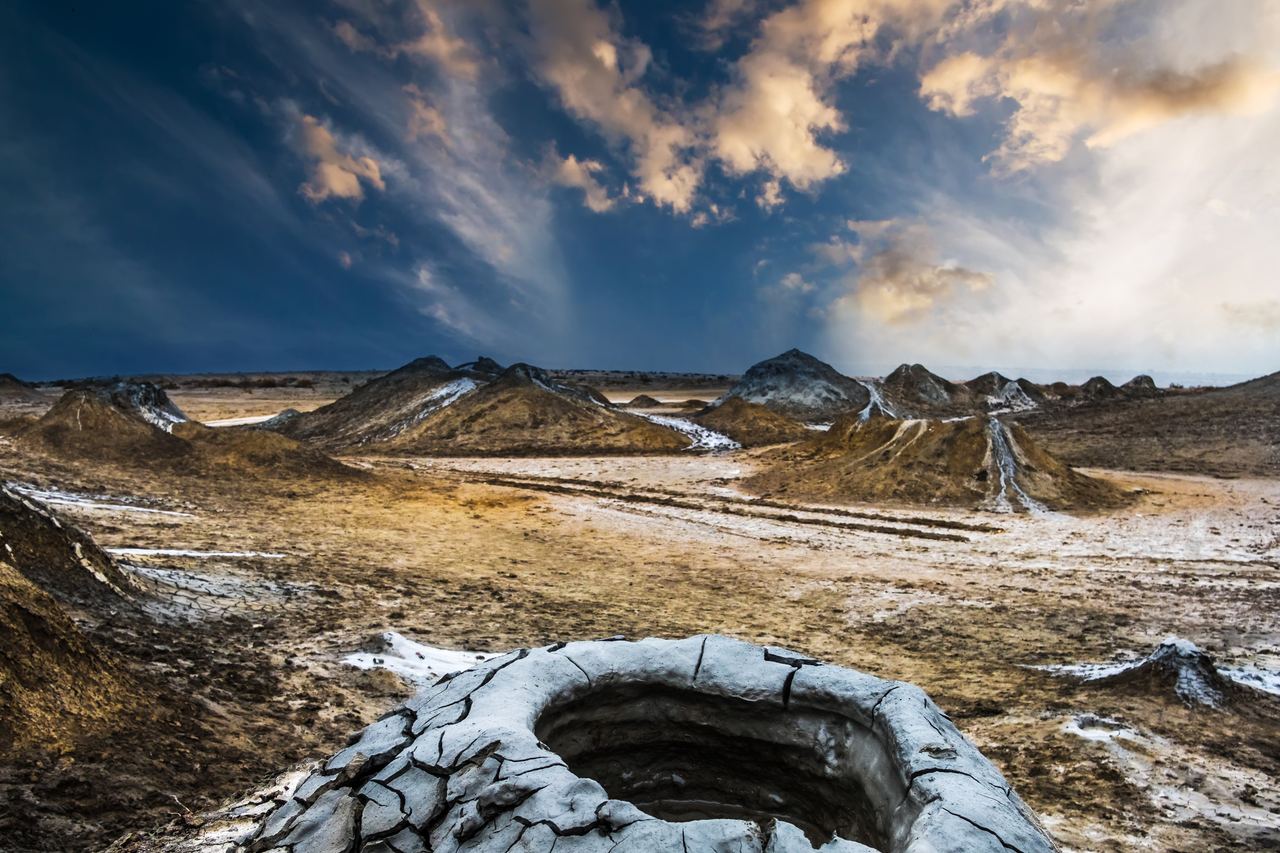
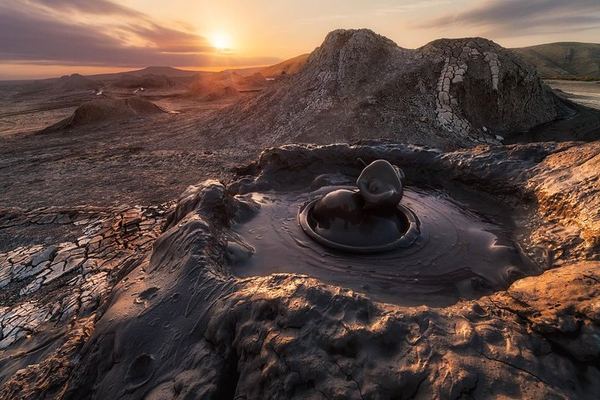
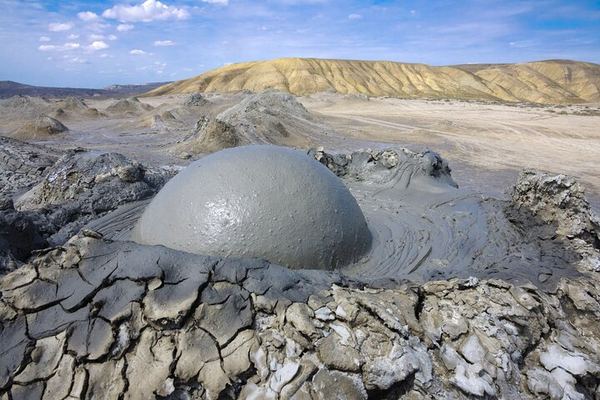
Azerbaijan has more mud volcanoes than any other country on earth, more than four hundred of them, over three hundred on land and the rest under the Caspian. It has no magmatic volcano that has erupted in recorded history. Both halves of that sentence matter, because the thing being sold here is not the thing most people picture when they book. There is no lava, there is no heat, and the cone you drive out to is a grey mound in a dry landscape leaking cold grey mud. Understanding that before you buy is the difference between a strange, memorable morning and a disappointment.
What Azerbaijan does have, and sells alongside the mud, is fire coming out of the ground. Two sites, and they are not the same kind of thing at all: one burns on a genuine gas seep and the other stopped doing so in 1969 and now runs on the city gas supply. Nobody writes that down. This page is the country, the geology and the money. The Gobustan day itself, with the ticket prices and the vehicle you need for the last few kilometres, is on the page below.
Choose a destination in Azerbaijan

Volcano Travel Experiences in Azerbaijan
300 of the World's 700 Mud Volcanoes, an Ezraider Ride and Yanardag's Café
Roughly 300 of the world's 700 mud volcanoes sit here, the off-road stretch is ridden on an Ezraider, and the entrance tickets are already paid for.
Baku's Two Sides in Eight Hours: Gobustan West, the Fires East
The sites sit on opposite sides of Baku and the buses do not reach them all, so the day is built round the driving. The Aliyev Center is a photo stop only.
Fires Attila and Marco Polo Wrote Down, Dated 4,000 to 5,000 Years Old
Attila's annals and Marco Polo both record these flames, and science dates the hearth at four to five thousand years. Two museums at Gobustan first.
Four Absheron Treasures: the Fire Worshippers' Cells and Today's Pilgrims
The fire worshippers' cells still hold the cookware and inscribed slabs the digs found, and pilgrims from Iran and India still climb to the burning hill.
Four Hours to Gobustan and the Cold Mud Volcanoes, Chauvet's Equals
The mud in these craters is cold, not hot, and in wet weather the track closes, so the volcanoes are swapped for the Bibi-Heybat mosque instead.
Gobustan and Absheron: the 1846 Oil Well, the Mud Volcanoes and Dumas's Guest House
The day opens at the first oil well ever drilled, in 1846, and takes in the mud volcanoes, the petroglyphs and the guest house where Dumas stayed.
Gobustan by Soviet Lada: the 1966 Reserve, the Mud Craters and Yanardag
The track to the craters is done in a Soviet Lada, and the reserve has been protected since 1966. Without the ticket option, bring cash for the entrances.
Gobustan's 100,000 Finds, the Yalli Petroglyphs and Ateshgah's Five Sides
The museum reopened in 2011 with over 100,000 finds, and Ateshgah turns out to be five-sided, with the altar standing in the middle of its courtyard.
Gobustan's 20,000-Year Carvings, Mud to Take Home, and Zaha Hadid's Building
Bring an empty bottle for the mineral mud, and the day adds Deniz Mall and Zaha Hadid's building to the carvings and the fire temple. Lunch included.
Gobustan's 6,000 Engravings, and the Flames Marco Polo Wrote About
The site carries 6,000 engravings across 40,000 years of rock art, and the flames at Yanardag are the ones Marco Polo wrote about on his way through.
Gobustan's Blue Clay Craters, Bibi-Heybat Mosque and the Last Fire of Absheron
The mud here is blue clay, the 13th-century Bibi-Heybat mosque is on the way back, and Yanardag is the last of Absheron's fires still burning.
Gobustan, the Mud Volcanoes and a Free Heydar Aliyev Ticket
Nine stops in a day, with the Heydar Aliyev Center ticket included, and an empty bottle worth carrying for the mud at the volcanoes, which is free to take.
Ratings collected by Viator and Tripadvisor
A mud volcano is not a volcano
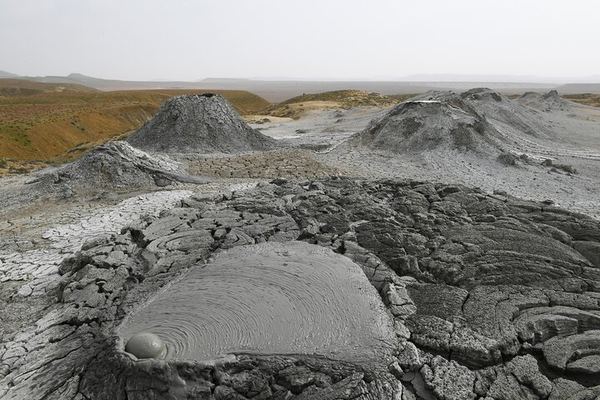
This is the most useful paragraph on the page, so it goes first. A magmatic volcano is molten rock finding its way to the surface. A mud volcano has nothing to do with magma. Underground, layers of fine sediment saturated with water and hydrocarbon gas end up under more pressure than the rock above them can hold. The mixture forces a path upward, carrying mud with it, and builds a cone out of what it deposits. The driving force is buried petroleum, not heat.
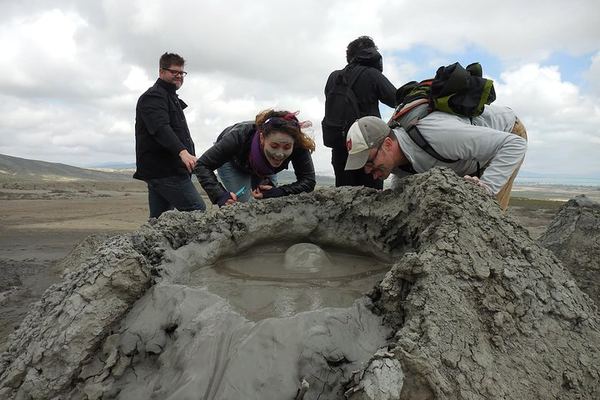
So: no lava, no glow, and nothing warm. Mud volcano material worldwide ranges from around 2 degrees to occasionally near 100, and the Azerbaijani ones are at the cold end, ordinary ground temperature or below. No public source publishes a measured figure for the Gobustan field, and any page that gives you one confidently is guessing. What comes out is grey, thick and moving, with gas bubbling through it in slow pulses, and the sound is the memorable part: a wet, irregular plop that you hear before you are close enough to see it.
About 86 percent of the gas released is methane. That is why these things occasionally catch fire, which is the one respect in which they behave like the volcano you were imagining, and which is covered further down.
| Mud volcano (Azerbaijan) | Magmatic volcano | |
|---|---|---|
| What comes out | Mud, water, gas | Molten rock, ash, gas |
| Driving force | Pressure from buried petroleum deposits | Rising magma |
| Temperature | Cold, roughly ground temperature | 700 to 1,200 degrees |
| Glow at night | None | Often |
| Can it ignite | Yes, the gas is about 86 percent methane | It is already burning |
| How many in Azerbaijan | More than 400, over 300 on land | None active in recorded history |

When they do go off, they go off properly
The quiet field you visit is the normal state, and it is not the only state. Every so often the gas ignites, and the results are on a scale no tourism page in this market seems to use, which is odd, because they are the most spectacular thing about the subject.
On 23 September 2018 the Otman Bozdag mud volcano erupted with flames reported at 200 to 300 metres. On 4 July 2021 an eruption at Dashli Ada, an island in the Caspian, produced a flame around 500 metres high that lasted about eight minutes and was visible from Baku, 74 kilometres away. In 2001 a mud volcano fifteen kilometres from the city made international news with flames of fifteen metres.
You will not see this. It is not on any schedule and it is not what you are buying. It is the honest answer to whether these things are dangerous, and it is why the field you walk on is unfenced but not casual.
The two fires, and only one of them is real
Every product on this page pairs the mud field with the Absheron peninsula fire sites, and the two are consistently described in identical language. They should not be.
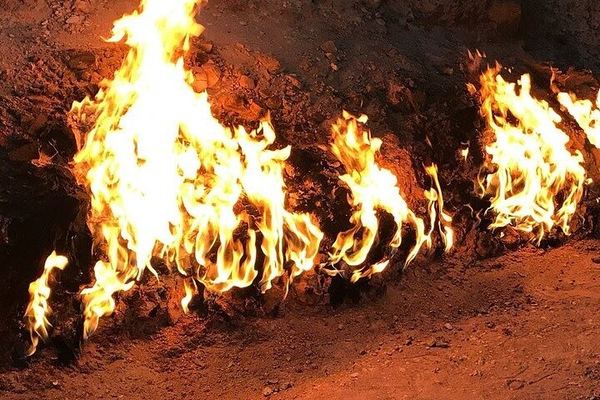
Yanar Dag is genuine. It is a hillside on the Absheron peninsula where gas seeping continuously out of the sandstone burns along the base of a scarp. Flames run about a metre high along roughly fifteen metres of ground, with the reported height varying up to three metres. It has no fuel line and nobody lights it. There is an honest footnote even here: some local accounts say the flame was accidentally started by a shepherd in the 1950s rather than burning for the four thousand years the marketing prefers. The seep is real either way.
Ateshgah is not, and has not been since 1969. The fire temple at Surakhani is a genuine seventeenth and eighteenth century building, a pentagonal complex with cells around a courtyard and a fire altar in the middle, carrying Hindu, Sikh and Persian inscriptions and used by pilgrims for centuries. What it was built on, a natural gas vent, stopped producing after roughly a century of industrial petroleum extraction in the surrounding fields. The eternal flame went out in 1969 and the fire you photograph today is fed by piped mains gas from Baku. That is a better story than the one being sold, not a worse one: the temple is a monument to an extraction industry that consumed the thing it was built to worship.
One more correction. Several operators describe Ateshgah as a UNESCO World Heritage Site. It is not. It has been on Azerbaijan's tentative list since 1998, which is a nomination rather than an inscription.

Gobustan is UNESCO for the carvings, not the mud
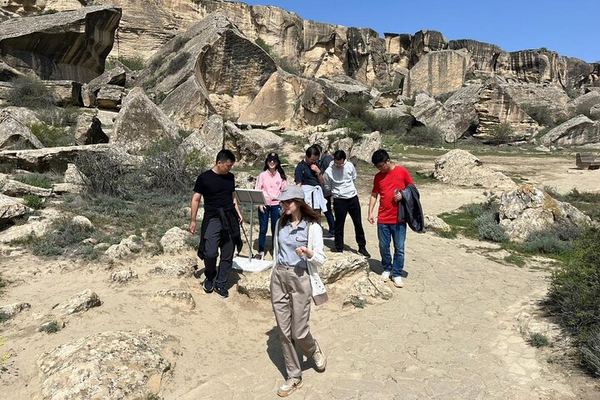
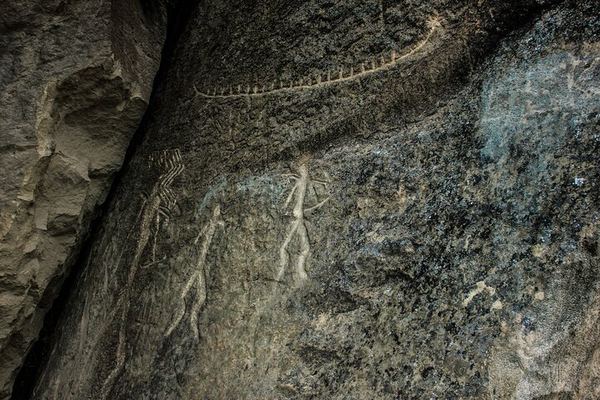
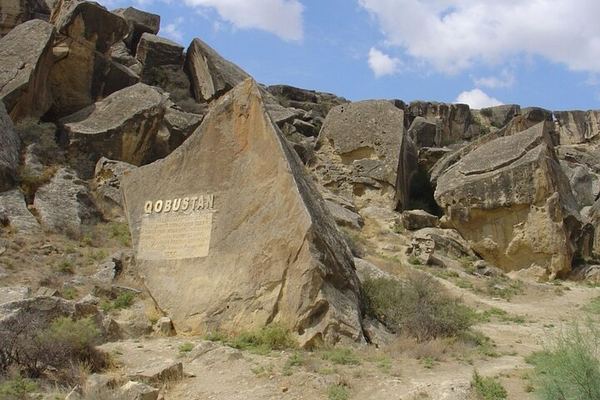
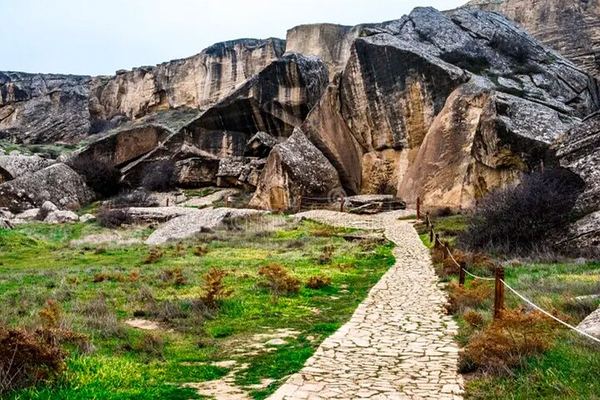
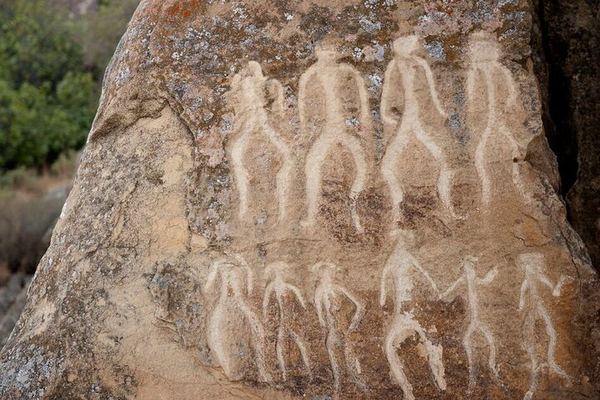
The confusion here is close to universal and it is worth being precise. The UNESCO listing at Gobustan, inscribed in 2007, is the Gobustan Rock Art Cultural Landscape: over 6,000 petroglyphs on more than 1,000 rock surfaces across 537 hectares, some of them many thousands of years old, showing boats, hunts, dancers and cattle. It is one of the most important rock art sites in western Asia and it has a good museum.
The mud volcanoes are a separate place a few kilometres away and are not part of the inscription. Pages describing UNESCO mud volcanoes are wrong, and it matters practically as well as pedantically: the reserve is reached on a paved road with a visitor centre, and the mud field is at the end of a dirt track that ordinary cars cannot always manage. They are two different visits inside one day and they are sold as one line on an itinerary.
What it costs, and the prices that are wrong online
Azerbaijan is the cheapest destination on this site. Twelve products, all leaving Baku, running from 10.58 EUR for a shared coach day to 96.99 for a private car with a guide to yourself. The most booked product costs 25.57 EUR and carries 2,059 reviews at 4.9, which for this market is an unusually clear signal about where the value sits.
The entrance fees are small and widely misreported. Yanar Dag and Ateshgah are 9 manat each for foreign visitors, 2 for residents and 1 for students, and there is a combined ticket at 11 manat valid for 72 hours that covers both. Gobustan is 10 manat with a guide included. Prices of 3 and 2 manat still circulate widely on travel pages; those are old, and wrong by a factor of three to four and a half.
The one number nobody publishes is the off-road transfer for the last stretch to the mud field, which is arranged locally with drivers waiting at the turn-off. On a group tour it is either included or it is not, and the listing usually says. Travelling independently, it is the first question you will need answered and the hardest to research in advance.
| Type of day | Price | How long | Usually includes |
|---|---|---|---|
| Shared group day, Gobustan and Absheron | 10 to 15 EUR | 7 to 9 hours | Transport and guide; entrance fees often extra |
| Shared group with lunch and off-road fee included | 25 to 38 EUR | 7 to 8 hours | The 25.57 EUR product has 2,059 reviews at 4.9 |
| Group tour with a museum or city extension | 35 to 44 EUR | 8 to 9 hours | Adds Heydar Aliyev Center or the old city |
| Private car and guide | 92 to 97 EUR | 4 to 9 hours | Your party only; the 4-hour version is Gobustan alone |
Where all of this comes from
Everything on this page is one geological fact wearing different clothes. The Absheron peninsula sits on one of the oldest and richest petroleum basins in the world, and the pressure of that system is what pushes mud out of the ground at Gobustan, what feeds the flames at Yanar Dag, what fed the temple at Surakhani until extraction drained it, and what put the world's first industrially drilled oil well at Bibi-Heybat on the southern edge of Baku. Several tours stop there, and it is the least photogenic and most explanatory ten minutes of the day.
Two consequences for a visitor. First, the sites are close together because the geology is, which is why a single day out of Baku genuinely covers the subject rather than skimming it. Second, the industry that made the country wealthy is the same one that killed the sacred flame it is now selling tickets to, and that is worth carrying around with you at Ateshgah.
On timing: this works all year. Baku's summer is hot and dusty and its winter is windy and grey, neither of which closes anything. The variable that matters is not the season but the weather on the day, because the last few kilometres to the mud field are unsurfaced. That detail, with what to do about it, is on the Gobustan page.
A century of drilling around Surakhani took the gas that had fed the temple's fire since before anyone was counting. The flame went out in 1969. What burns there now arrives by pipe from Baku.
Questions people actually ask
Are Azerbaijan's mud volcanoes real volcanoes?
No, and this is the thing to settle first. They are built by pressurised mud, water and gas escaping from petroleum-bearing sediments, with no magma involved. There is no lava, no glow and no heat: the material comes out cold. What you get is a grey cone leaking thick mud with methane bubbling through it. If you are expecting anything molten you will be disappointed, and that is a booking problem rather than a problem with the site.
How many mud volcanoes does Azerbaijan have?
More than 400, of which over 300 are on land and the rest under the Caspian. It is the highest concentration anywhere in the world, and it exists because the Absheron and Gobustan region sits on one of the oldest petroleum basins on earth. Azerbaijan has no magmatic volcano that has erupted in recorded history.
Is the fire at Ateshgah natural?
Not any more. The temple was built in the seventeenth and eighteenth centuries on a natural gas vent, and that vent stopped producing after roughly a century of oil and gas extraction nearby. The flame went out in 1969, and the fire burning there today is supplied by mains gas from Baku. Yanar Dag, the other fire site on the same tours, does burn on a genuine and continuous natural seep.
Is Gobustan a UNESCO site?
The rock art is. The Gobustan Rock Art Cultural Landscape was inscribed in 2007 and covers over 6,000 petroglyphs on more than 1,000 rock surfaces across 537 hectares. The mud volcanoes are a separate location a few kilometres away and are not part of the listing, despite being described that way constantly. Ateshgah is not a World Heritage Site either: it has been on the tentative list since 1998.
How much does a Gobustan day trip cost?
From 10.58 EUR for a shared coach day to 96.99 EUR for a private car and guide. The most booked product is 25.57 EUR with 2,059 reviews at 4.9. On top of the tour, entrance fees are 9 manat each for Yanar Dag and Ateshgah, or 11 manat for a combined ticket valid 72 hours, and 10 manat for Gobustan with a guide. Ignore the 2 and 3 manat figures still published on many travel pages.
Do mud volcanoes ever erupt violently?
Yes, and spectacularly, though never on cue. In September 2018 Otman Bozdag produced flames reported at 200 to 300 metres. On 4 July 2021 an eruption at Dashli Ada in the Caspian sent a flame around 500 metres into the air for about eight minutes, visible from Baku 74 kilometres away. These are rare events and nobody sells tickets to them, but they explain why the gas escaping under your feet deserves respect.
When is the best time to visit?
Any month. Nothing here closes for the season, and the sites are open all year. Baku is hot and dusty in high summer and windy in winter, and spring and autumn are the comfortable choices. The condition that actually cancels part of a day is rain, because the final approach to the mud field is an unsurfaced track and at least one operator states plainly that the mud volcanoes are visited in good weather conditions.
Data verified on. Prices and counts read from the 12 Azerbaijani products on this site. Mud volcano geology, eruption events, ticket prices and the UNESCO inscription from published public sources.