
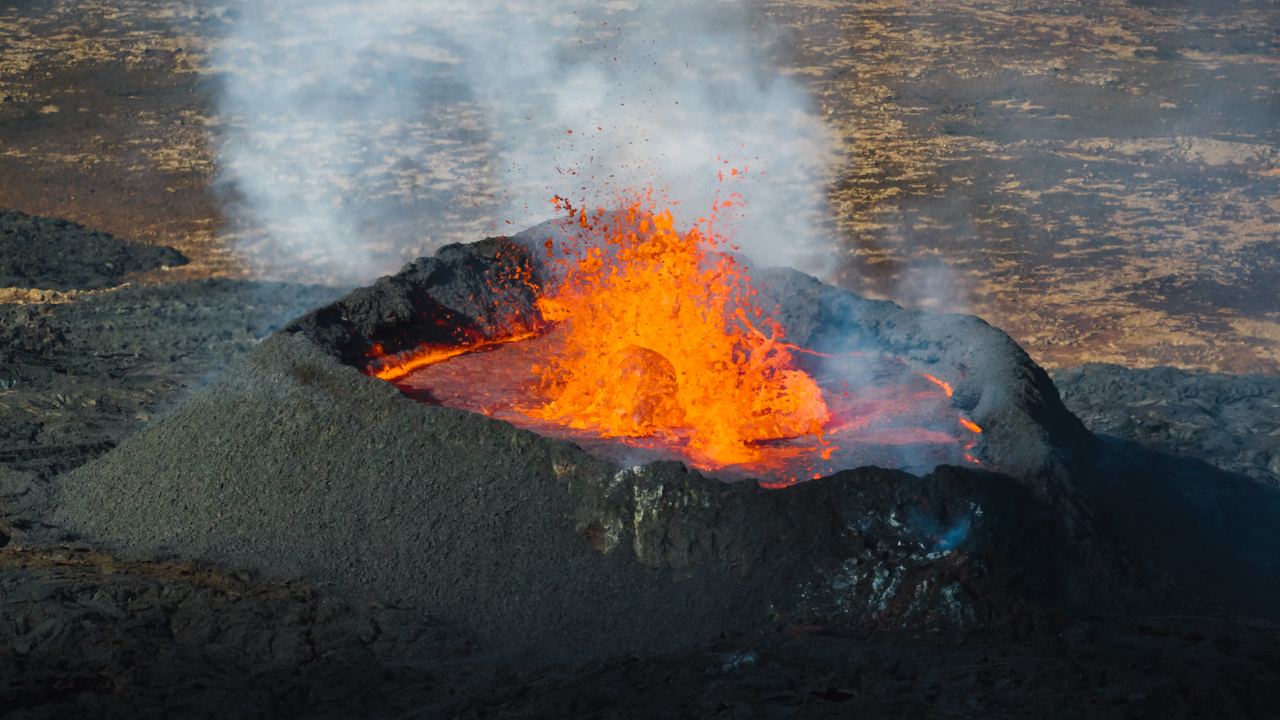
Most volcanoes spend almost all of their existence doing nothing. They build up pressure over centuries, release it in a few violent days, and go back to sleep. That is the normal pattern, and it is why volcano tourism is mostly a tourism of landscapes rather than of eruptions.
Then there is a small group that behaves in the opposite way. They erupt more or less constantly, at a modest scale, for decades. Stromboli has been at it since February 1934. Dukono, in eastern Indonesia, since 13 August 1933. Yasur, in Vanuatu, since roughly 1270, which means it was already going when the last of the medieval Icelandic eruptions were burning out.
These are the volcanoes worth planning a trip around, because they are the only ones with any claim to reliability.
The term is open-vent, and it describes a plumbing problem
The scientific literature calls these systems open-vent volcanoes. The name is mechanical rather than descriptive: the conduit between the magma reservoir and the surface stays open, so gas escapes continuously instead of accumulating until something breaks.
The category was defined around a puzzle. In 1993 a paper in Nature pointed out that persistently active volcanoes emit far more gas than the volume of erupted magma can account for. Enormous quantities of sulphur dioxide come out, while comparatively little lava does. The magma degasses at depth, the gas rises independently, and most of the degassed magma never reaches the surface at all. It sinks back down.
You do not need the geochemistry to travel well, but one consequence matters. An open vent is a pressure release valve, and a valve that is working is safer than one that is stuck. The dangerous moment at these volcanoes is not the routine activity. It is when the routine stops.

Four different shows
Persistent does not mean identical
Lava lakes are the rarest and the most extraordinary: a standing pool of molten rock, circulating, with a crust that tears open and heals. There are only a handful on the planet at any time, and the list changes.
Strombolian activity is the classic show. Gas bubbles rise through the conduit, reach the surface and burst, throwing incandescent fragments a few hundred metres up. It repeats every few minutes. The volcano it is named after does it better than anywhere.
Dome building is slower and less obvious. Viscous lava piles up at the vent until the pile becomes unstable and collapses in glowing avalanches. Santiaguito has been doing this since 1922. Merapi does it too, and the avalanches are what people photograph at night.
Effusive activity is lava simply flowing out. It is the least explosive and often the most approachable, and it is what most people picture when they imagine an eruption.
The list, and the brutal second column
Below are the longest-running eruptions on earth. The second column is the one that matters to a traveller, and it is where the romance drains out of the subject.
| Volcano | Erupting since | Type of activity | Can you get there? |
|---|---|---|---|
| Yasur, Vanuatu | around 1270 | Strombolian | Yes. Flights to Tanna, then a short drive. The rim closes when the alert level rises |
| Santiaguito, Guatemala | June 1922 | Dome building | Yes, from marked viewpoints at a distance |
| Dukono, Indonesia | August 1933 | Explosive and effusive | In practice, no. Remote Halmahera, no tourist infrastructure |
| Stromboli, Italy | February 1934 | Strombolian | Yes. Scheduled ferries, regulated ascent, boat viewing |
| Erebus, Antarctica | December 1972 | Lava lake | No. Scientific access only |
| Bagana, Papua New Guinea | February 2000 | Explosive and effusive | No. One of the least accessible volcanoes on earth |
| Fuego, Guatemala | January 2002 | Strombolian | Not the volcano itself. You watch it from Acatenango, next door |
| Suwanosejima, Japan | October 2004 | Explosive | Barely. A remote island with about eighty residents |
| Popocatépetl, Mexico | January 2005 | Explosive | Not the cone. Climbing has been prohibited since the 1990s |
| Ibu, Indonesia | April 2008 | Explosive and effusive | Difficult, and subject to an exclusion zone |
| Reventador, Ecuador | July 2008 | Explosive | Expedition territory. Amazonian cloud hides it most days |
| Masaya, Nicaragua | lake since December 2015 | Lava lake | Yes, and you drive to it. There is a car park at the rim |
| Sakurajima, Japan | March 2017 | Explosive | The volcano is closed. The city of Kagoshima watches it across the bay |
| Semeru, Indonesia | February 2019 | Explosive | Exclusion zone. Viewed from a distance |
| Merapi, Indonesia | December 2020 | Dome building | From outside a sector-based exclusion zone |
Read that column again and the picture is stark. Of fifteen of the most persistently active volcanoes on the planet, four are genuinely visitable: Stromboli, Yasur, Masaya, and Santiaguito from a distance. Add Fuego, which you watch from its neighbour. That is the whole list.
The most dependable volcanic activity in the world is happening in Antarctica, in Bougainville, and on an Indonesian island most Indonesians could not point to. Reliability and reachability turn out to be almost unrelated.
Why the dates keep changing
If you compare lists of long-running eruptions across different sources you will find the start dates disagree, sometimes by decades. This is not sloppiness. It is the counting rule.
An eruption is treated as ongoing until there is a gap of three months or more. Once that gap happens, the clock resets, even if the volcano wakes up again in month four and behaves exactly as before. So Sakurajima, which has been one of the busiest volcanoes in Japan since the 1950s, carries a start date in 2017. Semeru has been erupting on and off since the 1960s and carries 2019.
The practical lesson: a start date tells you about the current unbroken run, not about the volcano's character. For planning, the character is what you want. Sakurajima has produced hundreds of explosions a year for decades and will keep doing so regardless of which date the catalogue shows this season.
The volcanoes you can rely on are not the ones that erupt most violently. They are the ones that never stopped long enough to be counted twice.
Lava lakes are the exception, and they do not last
A lava lake is the only volcanic phenomenon that is genuinely continuous rather than merely frequent. Molten rock, in the open, all the time. There have never been more than about eight in the world simultaneously, and the membership changes.
Two disappearances are worth knowing about, because they show how fast this can happen. In December 2018 the twin lakes at Benbow and Marum, on Ambrym in Vanuatu, drained in a single event when a dyke of roughly 0.7 cubic kilometres of magma propagated more than twenty kilometres along the island's rift zone and emptied the system beneath them. Two of the most photographed lava lakes on earth, gone in a night, and they have not returned.
Nyiragongo in the Democratic Republic of the Congo held the largest of them, above the city of Goma. The 2021 eruption destroyed it, killed 32 people and levelled 17 villages. The lake has since reformed. What keeps travellers away now is not the volcano.
Masaya's lake, which formed in December 2015, has been weakening since 2017. It is still the easiest lava lake in the world to reach, and I would not assume it will be there in ten years.

What this means if you are booking something
Three practical conclusions come out of all this.
Prefer persistence over fame. A famous volcano that erupts once a decade is a worse bet than an unglamorous one that erupts every twenty minutes. Stromboli is not on many bucket lists and it outperforms almost everything that is.
Check what closes it, not what opens it. For these volcanoes the activity is not the variable. Access is. Find out who sets the alert level, what level closes the summit, and where that number is published, before you commit to dates.
Go sooner. This is the one piece of urgency in this whole subject that I think is honest. Lava lakes drain. Dome complexes stabilise. Arenal ran for 42 years and then stopped in a matter of months. Nothing here is permanent, and the ones that have been going longest have, by definition, been going a long time.
Common questions
What is the longest continuously erupting volcano?
Yasur in Vanuatu, whose current eruptive phase is dated to around 1270. Among volcanoes with precise records, Dukono in Indonesia has been erupting since 13 August 1933 and Stromboli since February 1934.
Is it safe to visit a volcano that is always erupting?
Counter-intuitively, persistent activity is often the safer configuration, because an open vent releases pressure rather than storing it. The dangerous events at these volcanoes are the departures from routine: the paroxysms at Stromboli in 2019, the dome collapse at Fuego in 2018. Regulated access exists precisely because the routine occasionally breaks.
Can I stand on the edge of a crater and look in?
At Yasur, yes, when the alert level permits it, and it is one of very few places on earth where that is true. At Masaya you can look into a lava lake from a railing you drove to. Almost everywhere else, no.
Why is Etna not on this list?
Because Etna erupts in discrete episodes rather than continuously. It is among the most productive volcanoes on the planet and it has produced dozens of lava fountaining events in recent years, but between episodes it goes quiet for long enough to break the counting rule.
The four that are actually reachable
Stromboli is the one most travellers can realistically add to a trip. Ferries run from Milazzo and Naples, and the volcano performs on its own schedule, which is to say constantly.
Stromboli, the reachable one
Erupting since 1934, and the shortest distance between a European airport and molten rock.
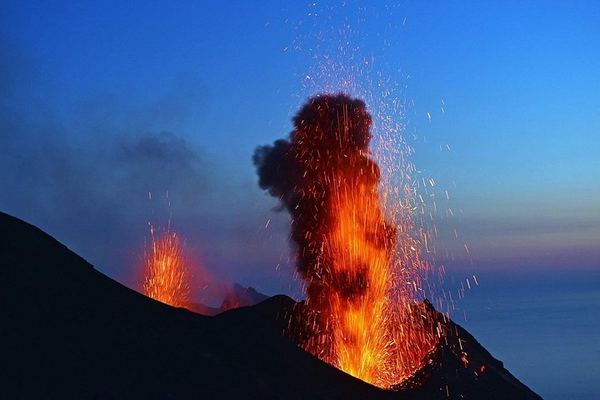
Panarea and Stromboli Boat Trip from Lipari, Sunset at Strombolicchio
Regina Eolie boats from Marina Corta, time ashore at San Pietro on Panarea and at Scari on Stromboli, then sunset off Strombolicchio and the Sciara del Fuoco.
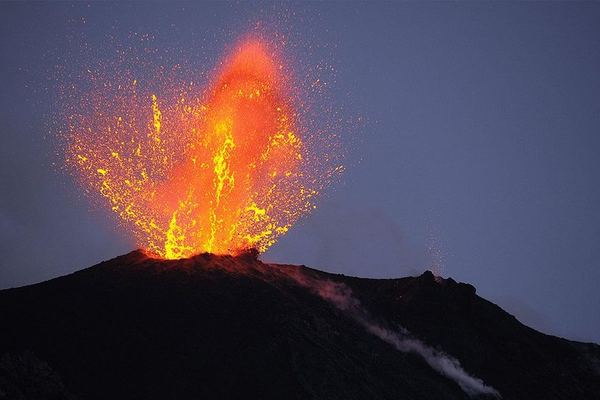
Stromboli at Sunset to 400 m, the Highest a Guide May Take You
The walk stops at 400 metres because that is the highest a volcanology guide may go, and the way down is in the dark with torches. Two hours before sunset.
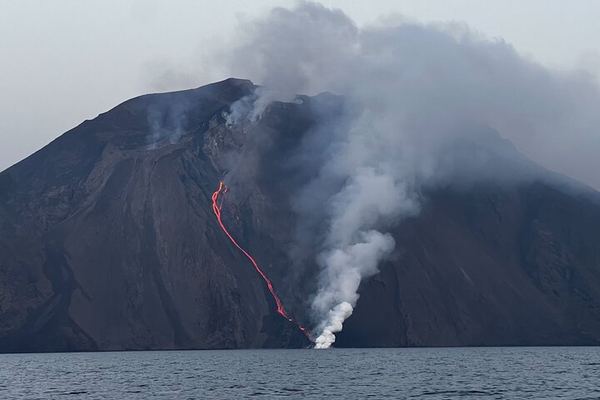
Stromboli by Night: Thirty Minutes Under the Sciara del Fuoco
The time ashore moves with the daylight so the boat is under the Sciara del Fuoco at dusk, and the stop there lasts about half an hour. Tropea by 22:30.
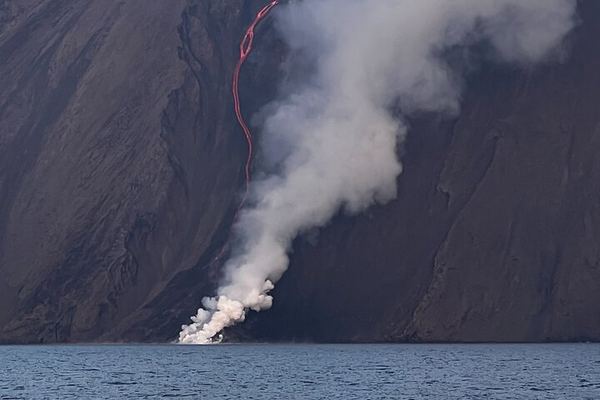
Vulcano, Lipari and Stromboli from Tropea: the Sciara del Fuoco by Day
Savadori's fast boat leaves from Calabria rather than Sicily, and the speed buys longer stops: fumaroles on Vulcano, the Sciara del Fuoco in daylight.
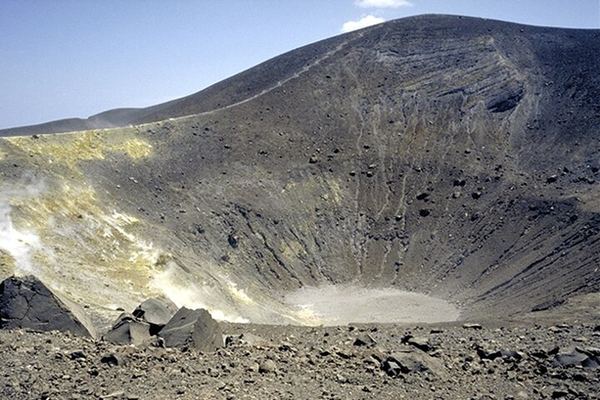
Vulcano, Lipari and Stromboli in One Day by Fast Boat
Stops of 1h15 at Vulcano, 2h20 at Lipari and 1h15 at Stromboli. Commentary is in Italian, and Lipari charges a cash fee to disembark. The boat is a fast one.
Ratings collected by Viator and Tripadvisor
Data verified on. Eruption start dates follow the joint Smithsonian and USGS eruption catalogue. Access rules are set locally and change: verify before travelling. Editorial Policy