

Volcanoes are close to unbeatable as a family destination, for a reason that has nothing to do with adventure. They are one of the few places where the thing a child has drawn at school is standing in front of them, at full size, steaming.
The problem is that the volcano tourism industry sells mostly to people in their twenties and thirties, so the listings are written for them. Which means the question of whether a four-year-old can manage it is answered in reviews rather than in descriptions, and the answer varies from easily to absolutely not, and here is the official age limit.
Three things spoil it, and only one is the walking
The start time. This is the big one, and it is invisible in the marketing. A sunrise trek means waking a child at two in the morning, driving in the dark, and walking uphill by torchlight. Even children who walk happily for hours will not enjoy that, and neither will you.
The cold. Covered in detail elsewhere on this site, and it hits children harder because they are smaller and because they are being carried or waiting rather than generating heat. The gap between the beach and the crater rim before dawn is routinely fifteen to twenty degrees.
The ground. Volcanic scoria is loose and it slides, which is tiring for short legs and slightly alarming for parents on a descent. Sharp a'a lava is genuinely unsuitable for small children off marked paths.
Actual distance and ascent, in our experience, are the least of it. A child who does a two-hour walk at home will manage most of what is on this page.
Age limits: one is official, two are ours
Only one place in this catalogue publishes an age limit. It is worth separating that from the two where we are giving you our own judgement, because the difference matters if you are weighing up an operator who tells you otherwise.
Mauna Kea, Hawai'i — this one is official. The institution managing the mountain advises that children under 13 should not go above the visitor information station at 2,804 metres, along with pregnant women and anyone with heart or respiratory conditions. It is published, it is specific, and a great many stargazing tours drive to the summit anyway. The guidance exists regardless of what the tour says.
Kawah Ijen, Java — our judgement, not a rule. Nobody publishes an age limit here and we are not going to pretend otherwise. But the descent to the crater floor puts you in sulphurous gas measured at several times the safety threshold, on unstable ground, in darkness, and it is a working sulphur mine rather than an attraction. Treat the crater floor as adults only. The rim walk is a completely different and much more reasonable proposition.
Anything glaciated — a practical impossibility rather than a rule. Cotopaxi's summit and Mount Rainier's are roped mountaineering with permits attached. No age limit is published because none is needed.
What works, by age
| Age | What works | Why |
|---|---|---|
| Any age, including a pushchair | Lanzarote and Timanfaya, Santorini's caldera towns, the Azores viewpoints, Rotorua's geothermal parks, Hawai'i Volcanoes visitor areas | Coach or car access, boardwalks and short paved trails, and the spectacle is immediate |
| From about 5 | Vesuvius, Kilauea Iki Trail, Kerid, Hverfjall, the Lanzarote lava caves, Teide by cable car | Under two hours on made ground, with something dramatic at the end |
| From about 8 | Pacaya, Bromo's crater from the sand sea, Sete Cidades, Mount Tarawera, the Poas and Irazu viewpoints | Real walking on volcanic ground, but short, and with a road or vehicle nearby |
| From about 12 | Batur at sunrise, Santa Ana, the Tongariro Crossing in summer with a strong walker, Etna's guided crater tours | Long days, early starts, or altitude. Fine for a child who already hikes |
| Teenagers who walk seriously | Acatenango, Rinjani's crater rim, Fuji in season | These are genuinely hard, and the altitude affects children as unpredictably as adults |

The unexpectedly good ones
Three that children remember more than adults do
A lava tube. Walking inside a tunnel that was full of molten rock is the single best explanation of what a volcano is that exists, and it requires no fitness at all. Lanzarote's and Hawai'i's are lit and level.
Geothermal ground. Rotorua and Furnas do something no photograph conveys: the ground steams, it smells of sulphur, mud boils in pools, and in both places people cook food in it. Children find the smell hilarious, which is the correct response.
An indoor lava show. Real molten rock, poured a few metres away, on a schedule, indoors, warm, with seats. For a family it removes every variable that makes volcano travel difficult and keeps the one thing everyone came for.
What these three have in common is that none of them depends on weather, fitness, or the volcano being in a particular mood. With children, that reliability is worth more than ambition.
Practical things that make a difference
Ask whether there is a shorter version. Many operators run one and do not advertise it, because it looks less impressive in a listing. On several mountains there is also an assisted option: a jeep, a cable car, a horse at Bromo, porters on the multi-day treks.
Take more warm clothing than seems reasonable. This is the single most repeated regret from families on tropical volcanoes, and the layer that gets left behind is always the fleece.
Check the group size and the pace. A private tour on a family trip often costs less than the difference in enjoyment, because you stop when you need to rather than when twelve strangers do.
Pick the volcano for the payoff, not the achievement. A crater lake, a steaming vent, a black beach and a lava tube all deliver something visible at the end. A long walk to a viewpoint that might be in cloud is a harder sell at hour three.
Consider going in the afternoon instead. Sunset tours exist on most of the famous sunrise mountains, they show you the same landscape in the same low light, and nobody has to be woken at two.
Quick answers
What is the best volcano for young children?
Lanzarote, if you want a whole holiday built around it: the volcanic landscape is reached by road, the lava caves are level and lit, and Timanfaya's demonstrations of ground heat are memorable at any age. For a single day out, Vesuvius or the Kilauea Iki trail.
Can children do a sunrise volcano trek?
Physically, many can. The obstacle is the two in the morning start and the cold at the top rather than the climb. If it matters to you, Bromo can be reached later in the morning and Batur runs sunset options, both of which get you the same landscape without the night.
Is the sulphur smell harmful to children?
In the managed geothermal areas at Rotorua, Furnas and Iceland, the smell is hydrogen sulphide at concentrations that are unpleasant rather than harmful, and the walkways are routed accordingly. Where it becomes a genuine issue is close to active vents, in enclosed hollows, and in the Ijen crater, all of which are places to keep children away from regardless of the smell.
Are there family discounts?
Commonly, and they are frequently not shown until checkout. Several national parks also have free entry below a certain age. Worth asking rather than assuming.
The easiest volcanic landscape in Europe
Lanzarote's volcanic country is reached by road, the caves are level, and the ground heat demonstrations work on any age.
The four things parents ask us, and nobody puts in a listing
What happens if we turn back halfway? On a group trek, usually nothing good, because the group continues and the guide cannot split. This is the strongest argument for a private guide on a family trip, and it is worth more than the price difference suggests: it converts a fixed itinerary into one you can abandon at any point without anyone else's day being affected. On the road-accessible destinations it does not arise at all, which is a real advantage of Lanzarote, Rotorua and the Azores over anything that involves a summit.
How do I tell if a child has altitude sickness? With difficulty, and this is the honest answer rather than a reassuring one. The symptoms are headache, nausea, poor appetite and unusual irritability, all of which describe a tired child at the end of a long day. Younger children in particular cannot reliably report how they feel. The rule that works is behavioural rather than diagnostic: if a child who was fine becomes miserable and stays miserable as you go higher, go down. Descending fixes it and costs you an afternoon.
Are there toilets? Almost never above the car park, and this decides more family days than altitude does. The road-served sites have facilities at the visitor centre and nothing beyond it. Plan on the basis that the last toilet is the one at the start.
Does a pushchair actually work anywhere? On the boardwalks at Rotorua and in the developed lava tubes, yes. On volcanic gravel, no: the wheels sink and the surface is loose even where it is flat, including on the graded path at Vesuvius. A carrier is the right answer for anything that is not paved, and it has the additional advantage of keeping a small child warm at a viewpoint, which a pushchair does not.

Lanzarote, the family one
Volcanic country reached by road, level lava caves, and ground-heat demonstrations that work at any age.
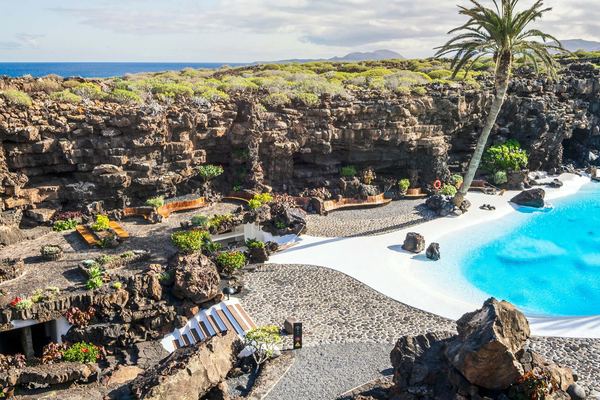
Charco de los Clicos, the Timanfaya Geysers and Jameos del Agua
The Green Lake at El Golfo takes its colour from algae and sulphur, Timanfaya runs its geyser demonstrations, and Jameos del Agua sits in a lava tunnel.
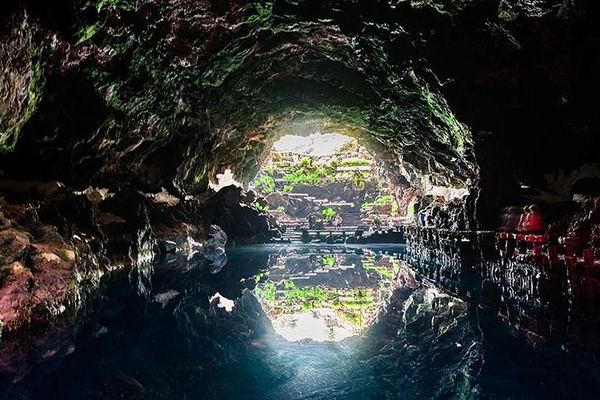
Cueva de los Verdes and Jameos del Agua, Mondays and Fridays
A four to five hour run through the north of Lanzarote on Mondays and Fridays, with a guided visit inside Cueva de los Verdes and free time at Jameos del Agua.
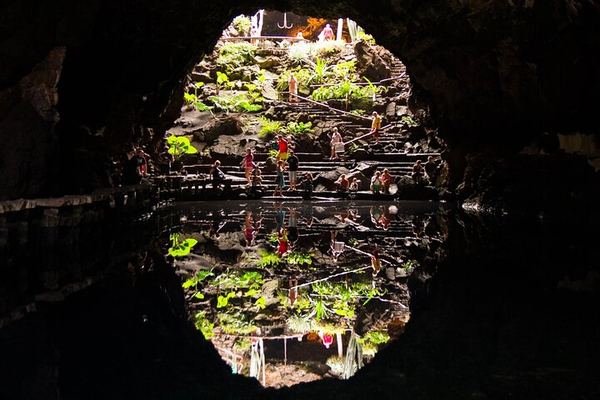
Jameos del Agua, Mirador del Río and the Manrique Foundation, Wednesdays
A Wednesday run through the north of Lanzarote: the Manrique Foundation, the Cactus Garden, Mirador del Río and the clicos crabs at Jameos del Agua.
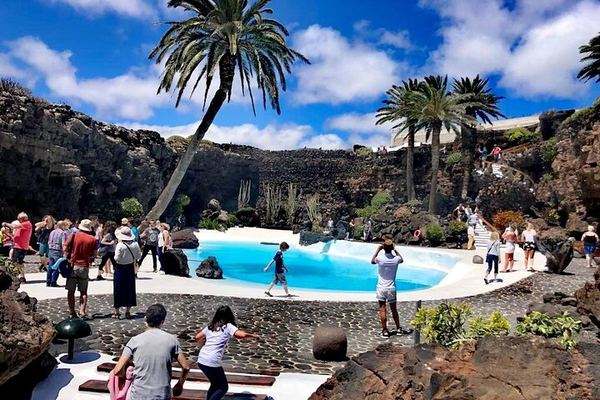
Lanzarote in a Day from the Cruise Port: Timanfaya, Jameos, Lago Verde
Seven stops between the port and Timanfaya, with no queues: Jameos del Agua, the cliff at Mirador del Río, a wine tasting in La Geria and the Lago Verde.
North Lanzarote: Cueva de los Verdes, Jameos, Mirador del Río
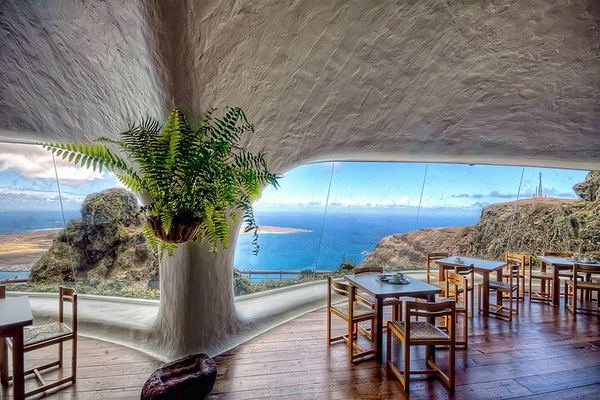
Three paid sites with no queueing, plus Haría's palm valley and the Monumento al Campesino. The Mirador del Río looks across at La Graciosa from 500 metres.
Ten Hours Across Lanzarote: El Golfo, Timanfaya, Jameos del Agua
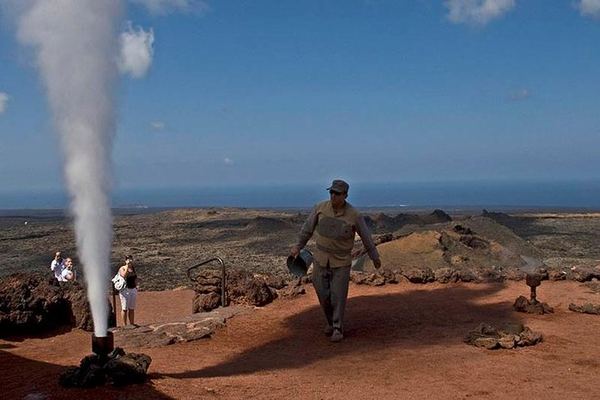
Ten hours Monday to Friday, from the Green Lagoon at El Golfo up to free time at Jameos del Agua, with the Corona volcano above Haría. Lunch not included.
Ratings collected by Civitatis, Viator and Tripadvisor
Data verified on. The Mauna Kea age guidance is published by the institution managing the mountain. Everything else here is our own reading of terrain, timings and what families report. Editorial Policy