
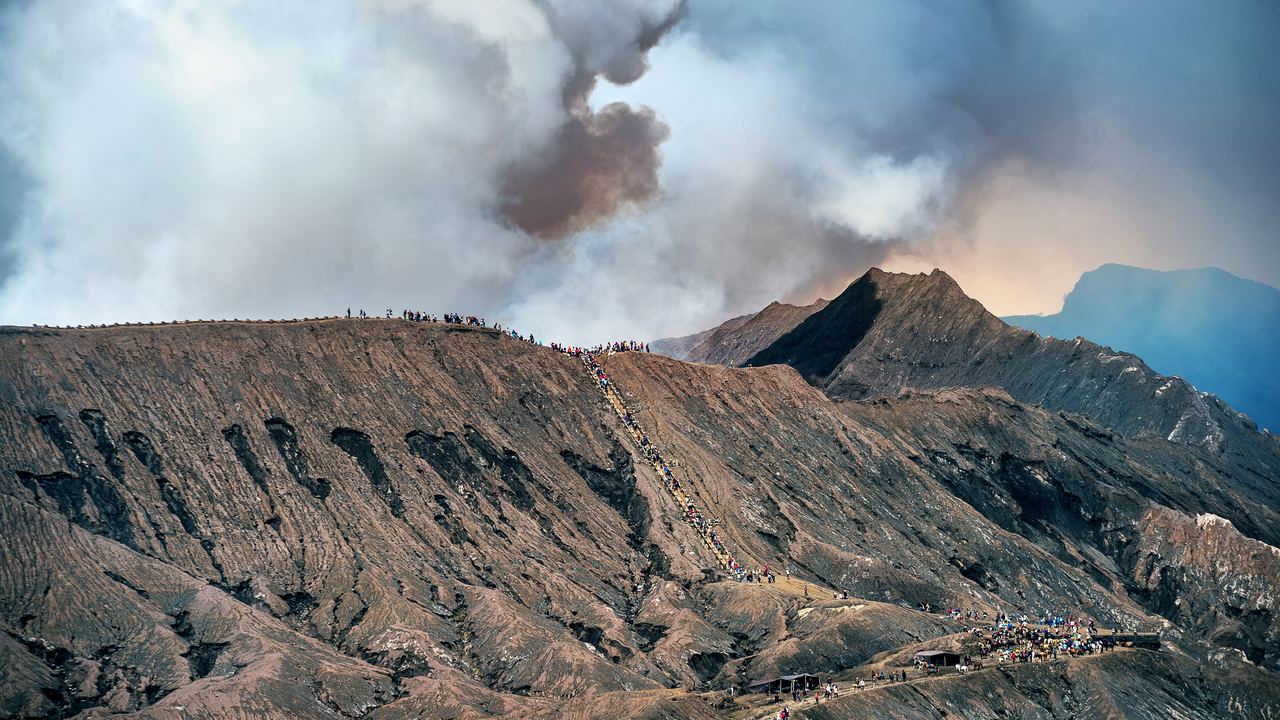
Volcanoes come in a small number of shapes, and the shape is not decoration. It is the accumulated record of everything the volcano has done, and it is a decent predictor of what it will do next.
The cause is the one from the previous page: how runny the magma is. Runny lava spreads out and builds something wide and low. Sticky lava piles up near the vent, or does not come out at all until the pressure wins, and builds something steep. Everything below follows from that.
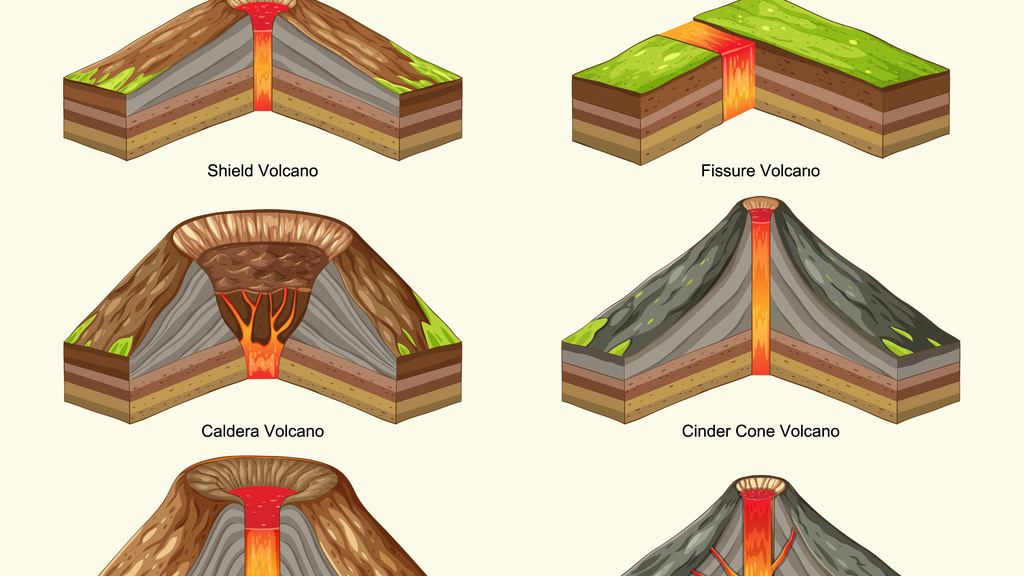
Shield volcanoes
Broad, gently sloping, and enormous. Built from thousands of runny basaltic lava flows that travelled a long way before cooling, stacking into something that looks less like a mountain than like a landscape that has been slightly inflated.
The scale is easy to underestimate because the slopes are so gentle. Mauna Loa on Hawai'i is one of the largest volcanoes in the solar system by volume, and standing on it feels like standing on a wide hill.
Where you can see one: Hawai'i, comprehensively. Kilauea and Mauna Loa are the textbook examples, and the reason the Big Island exists.
What they do: effusive eruptions, lava flows, fire fountains. Dangerous to property, rarely to people who move. These are the volcanoes where lava viewing has historically been possible.
Stratovolcanoes, or composite cones
The classic volcano of the imagination: steep, symmetrical, snow-capped, photogenic. Built in alternating layers of lava and ash, which is where the name composite comes from, and the alternation is the point. Each explosive eruption lays down ash, each effusive phase caps it with lava, and the sandwich is what allows the cone to stand at an angle loose ash could not hold on its own.
They occur where plates collide, which means their magma is sticky and gas-rich. That combination is what makes them beautiful and what makes them lethal.
Where you can see one: Fuji, Vesuvius, Merapi, Fuego, Rainier, Cotopaxi, Agung, Taal, Villarrica. Most of the famous names.
What they do: explosive eruptions, ash columns, pyroclastic flows, lahars. Almost every historical volcanic disaster involved one of these.
Calderas
Not a shape the volcano builds but one it collapses into. When a very large eruption empties the magma chamber quickly, the roof of the chamber has nothing left to rest on and drops, leaving a basin that can be tens of kilometres across.
Calderas are the most commonly misread volcanic landscape, because from inside one you cannot see it. Santorini's caldera is the bay: the famous cliffs are the inner wall, and the ferry sails across the collapsed chamber. Visitors photograph it constantly without registering that the view is of the volcano.
Where you can see one: Santorini, Sete Cidades and the Lagoa do Fogo in the Azores, the Tengger caldera at Bromo, Batur on Bali, Rinjani, Aso in Japan, Campi Flegrei beneath the western suburbs of Naples.
What they do: most sit quiet for very long periods with hydrothermal activity, hot springs and new small cones growing inside. Nea Kameni in Santorini's bay is exactly that: a young volcano growing in the hole left by an old one.

Nested and confusing
Most real volcanoes are several of these at once
The textbook categories are cleaner than the ground.
Batur is a cone, inside a caldera, inside a larger and older caldera, with a lake in it. Which of those is the volcano? All of them.
Teide is a stratovolcano standing inside the Las Canadas caldera, and the caldera wall is what you drive through to reach it.
Etna has several summit craters that change number and position between eruptions, plus more than three hundred flank cones, so its published height changes and its shape is a moving target.
Vesuvius is a cone growing inside the remains of the older Monte Somma, whose surviving wall you can see from the north as a ridge alongside the modern cone.
None of this makes the categories useless. It just means the right question at any volcano is not which type is this but which parts of it am I looking at, and in what order did they arrive.
Cinder cones
The small ones, and by far the most numerous. A single vent throws out fragments of frothy lava that fall back around it and build a steep cone of loose scoria, usually a few hundred metres high, usually in one eruptive episode, and then it is finished. Most cinder cones erupt once and are done.
They are also the volcano type most likely to appear somewhere nobody expected, including in the middle of a field, which is how Paricutin famously arrived in Mexico in 1943.
Where you can see one: Lanzarote's Timanfaya is a field of them, and the ones on Iceland's Reykjanes are being built now. Hverfjall in northern Iceland is a related form, a tuff ring, from a wetter and more violent version of the same process.
What they do: build fast, then stop. Their loose scoria is also what makes them exhausting to walk on.
Lava domes
What happens when the lava is so viscous it barely flows at all. It squeezes out of the vent and piles up on top of itself, forming a steep, unstable mound that grows outwards and upwards in slow motion, sometimes for decades.
The hazard is not the growth, it is the collapse. A dome that has grown too large fails under its own weight and the fragments, still hot and full of gas, avalanche downhill. That is a pyroclastic flow, and it is the most dangerous thing volcanoes do.
Where you can see one: Santiaguito in Guatemala, growing since 1922; Merapi in Java. Both viewed from a distance for very good reasons.
What they do: incandescent block avalanches, which look spectacular at night from a permitted viewpoint and are the reason the permitted viewpoint is where it is.
Fissure vents
Not a mountain at all. A crack in the ground, sometimes kilometres long, from which lava emerges along its length like a wall of fire before the eruption concentrates into a few points.
This is what happens where the crust is being pulled apart rather than pushed together, so it is the characteristic Icelandic form, and it produces lava fields rather than cones. Iceland's Laki fissure in 1783 produced one of the largest lava flows in recorded history and killed a fifth of Iceland's population through the famine that followed.
Where you can see one: the Reykjanes peninsula in Iceland, where the flows of the 2020s are still bare rock, and Lakagigar, a row of over a hundred craters along the 1783 fissure.
And the ones that are not volcanoes
Mud volcanoes look the part and involve no magma at all. Pressurised gas, usually methane, pushes water and sediment to the surface, and the mud that comes out is cold. Azerbaijan has hundreds of them and Colombia has one you can climb into and float in.
Geothermal fields are volcanic in origin without having a volcano visible on the surface. Groundwater heated by magma at depth produces geysers, hot springs, mud pots and fumaroles. Rotorua is one, Furnas in the Azores is another, and both are among the most rewarding volcanic destinations precisely because the activity is continuous and safe to walk around.
Quick answers
Which type is the most dangerous?
Stratovolcanoes and lava domes, for the same reason: sticky, gas-rich magma that produces explosive eruptions and pyroclastic flows. Shield volcanoes destroy property and rarely kill people. Almost every historical volcanic catastrophe involved a composite cone or a dome.
Is Santorini really a volcano?
Yes, and the bay is the volcano. The cliffs the towns sit on are the inner wall of a caldera formed when the chamber emptied and collapsed, and Nea Kameni in the middle is a new cone growing inside it. It is one of the clearest examples anywhere of a landscape that is entirely volcanic and does not look like a volcano.
Why does Etna's height keep changing?
Because its summit craters are actively building and collapsing. Material accumulates during eruptive episodes and collapses in others, so the published figure shifts by tens of metres over a few years. It is the only volcano in Europe where the official height is genuinely a moving number.
What is a supervolcano?
A term for eruptions at the very top of the explosivity scale rather than a distinct type of mountain. They produce calderas, not cones, which is why the best-known examples are places you can stand in without noticing: Campi Flegrei west of Naples, and Yellowstone.
See a caldera you can sail across
Santorini's bay is the collapsed magma chamber of one of the largest eruptions in European history. The boat trip to Nea Kameni lands on the volcano growing inside it.
Data verified on. Standard volcanological classification, with examples drawn from the destinations in our catalogue. Editorial Policy