

Some of the best volcanic destinations have no volcano in view at all. What they have is ground that is unmistakably alive: steam coming out of cracks in a car park, mud thumping in a pool, water at temperatures that would be lethal to fall into, and a smell that everybody comments on within about four seconds.
Geothermal areas are also, for a traveller, the most dependable thing in this entire subject. They do not depend on an eruption, an alert level, or a clear sky. Rotorua has been steaming since before anybody was selling tickets and will be steaming next year.
How it works
Three ingredients, and all three have to be present.
Heat at depth. A cooling magma body, or unusually hot crust, within a few kilometres of the surface.
Water. Rain or snowmelt that percolates down through permeable rock until it meets the heat.
A way back up. Fractures that let the heated water and steam return to the surface.
What arrives at the top depends on how much water there is and how the plumbing is shaped, and that is the entire difference between the features below.
| Feature | What it is | Where to see it |
|---|---|---|
| Hot spring | Water heated at depth, rising steadily and pooling | Iceland, Azores, Rotorua, Costa Rica, everywhere geothermal |
| Fumarole | Steam and gas only. Not enough water to make a pool | Vulcano, Furnas, Solfatara, Whakaari, Teide's summit |
| Solfatara | A fumarole depositing sulphur, hence yellow crusts and the smell | Campi Flegrei, Ijen, Vulcano in the Aeolians |
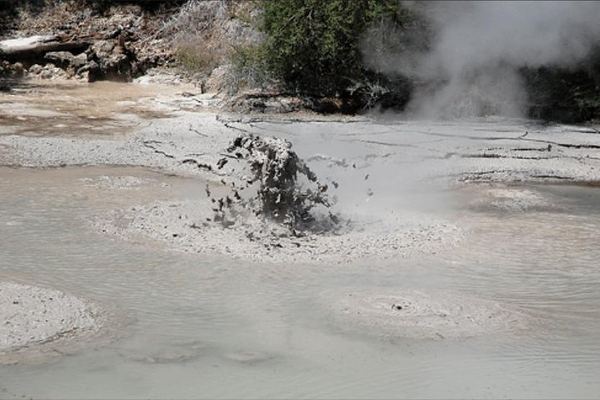
| Mud pot | Acidic steam breaking rock down into clay, then bubbling through it | Rotorua, Rincon de la Vieja, Iceland's Hverir |
| Geyser | A hot spring with a constriction that lets pressure build and release | Iceland, Rotorua, Yellowstone, El Tatio, Kamchatka |
| Steaming ground | Heat rising through soil with no vent at all | The Furnas valley, much of Rotorua's town |
Why geysers are so rare
There are perhaps a thousand geysers in the world, and they are concentrated into a handful of fields. Almost everything else on the list above is common; geysers are not, and the reason is that they need a very specific piece of plumbing.
A geyser requires a narrow constriction in the channel. Water below it becomes superheated, held above boiling point by the weight of water above. Eventually some of it flashes to steam, which pushes water out of the top, which reduces the pressure below, which causes the rest to flash violently. The system empties, refills, and does it again.
Get the geometry slightly wrong and you have a hot spring instead. That is why the world's geyser fields are a short list: Yellowstone, Iceland, Rotorua, El Tatio in Chile, Kamchatka. Between them they hold the great majority of geysers on the planet.
They are also fragile. Iceland's Geysir, which gave every other geyser its name, has been largely dormant for decades, and its neighbour Strokkur does the work now, going off every few minutes. Drilling for geothermal power nearby has ended geyser fields elsewhere. What is erupting when you visit is not guaranteed to be erupting a generation later.

Three cultures, one idea
People have been cooking in this ground for centuries
It is the detail that turns a geothermal field from a spectacle into a place where people live, and it evolved independently in at least three places.
Furnas, in the Azores. The cozido das Furnas is a stew of meat and vegetables in a large pot, lowered into a hole in the ground beside the lake in the morning, covered over, and dug out five or six hours later. Restaurants in the village have their own numbered holes. You can watch the extraction, which happens at a fixed time and draws a crowd.
Rotorua, in New Zealand. Maori communities at Whakarewarewa have used the geothermal field for cooking and bathing for centuries, steaming food in flax baskets in the hot pools. The village is still lived in, which makes visiting it a different proposition from visiting a park.
Iceland. Rye bread is buried in a pot near a hot spring and left for around twenty-four hours, producing a dense, dark, faintly sweet loaf. It is served with butter and smoked trout and it is worth going out of your way for.
All three are things you can actually eat. Very little else in volcano tourism can be said to be edible.
The Blue Lagoon is an industrial by-product, and that is the best thing about it
Iceland's most photographed bathing spot is not a natural hot spring. It formed in the 1970s when a geothermal power station began discharging its used water into a lava field, where the silica in it sealed the porous rock and formed a pool that would not drain away.
People started bathing in it, someone noticed that the silica seemed to help skin conditions, and a resort grew around what was essentially a puddle of power station outflow. The water arrives at the plant from a reservoir two kilometres down, is used to generate electricity, and then goes into the lagoon.
That origin is better than a natural one would have been, and it is a fair summary of Iceland's relationship with its geology: the country heats around nine in ten of its homes with water from the ground and generates almost all of its electricity from geothermal and hydro, most of it for heavy industry. The famous tourist attraction is what was left over.
It also has a maintenance problem that follows from the same chemistry. The silica that sealed the lava floor keeps sealing it, so the pool silts up and new basins periodically have to be excavated. The lagoon you bathe in is not the one from the 1970s.
Where to go
Rotorua, New Zealand. The most complete geothermal destination on earth: the largest geyser in the southern hemisphere, a living Maori village on the thermal field, and a whole town that smells faintly of sulphur. It works in any weather, and cold days improve it, because steam shows up better against cold air.
Furnas, Sao Miguel. A valley of fumaroles, hot springs, mineral water fountains and the cooking holes, with a thermal garden to bathe in. The Azores are cloudy for much of the year and none of this cares.
The Golden Circle and Myvatn, Iceland. Strokkur erupting every few minutes, the Hverir mud pots in the north, and a landscape where steam rising in the distance usually turns out to be a power station.
Rincon de la Vieja and Arenal, Costa Rica. Mud pots, fumaroles and an entire resort industry built on hot springs. Arenal's springs are heated by the volcano that stopped erupting in 2010, and they are the reason La Fortuna survived losing its main attraction.
The Campi Flegrei, near Naples. The most under-visited geothermal area in Europe, in the middle of a caldera with a city built on it. The Solfatara crater gave its name to an entire class of vent.
A word about not getting hurt
Geothermal areas are the volcanic environment where visitors are most likely to be injured, precisely because they feel safe. Three things.
The crust lies. Ground that looks solid can be a thin mineral crust over near-boiling water, which is why the boardwalks are where they are. Injuries in geothermal parks are overwhelmingly caused by people stepping off them.
Hot springs are hotter than they look. Steam only becomes visible when it condenses, so a spring that is not steaming is not necessarily cool.
Gas collects in hollows. Carbon dioxide and hydrogen sulphide are heavier than air and pool in depressions on still days. This is the reason for barriers around some pits in geothermal parks, and it is not about the view.
Follow the boardwalk, keep children and dogs on it, and the whole category is one of the safest things in this catalogue.
Quick answers
Why do geothermal areas smell of eggs?
Hydrogen sulphide. The human nose detects it at extraordinarily low concentrations, far below harmful levels, which is why an area can smell strongly and be entirely safe. The dangerous property is the opposite one: at high concentrations it deadens the sense of smell, so it stops smelling before it stops being present. In open, managed areas this is not a concern.
Can you swim in a hot spring anywhere?
Only where it is designated for it. Temperatures in undeveloped springs vary from pleasant to fatal within metres and are not signposted, and some contain enough acid or dissolved minerals to be harmful. In Iceland, New Zealand and the Azores the bathing spots are clearly marked and the rest are not for bathing.
Is the water safe for skin?
In the developed bathing sites, yes, and several have long-standing reputations for helping skin conditions. Silica-rich water can dry hair badly, which is why the Icelandic lagoons hand out conditioner and mean it.
Do geysers erupt on a schedule?
Some are regular enough to predict, like Strokkur every few minutes. Most are not, and even the reliable ones change. Geysers respond to earthquakes, to rainfall and to nearby drilling, and several famous ones have stopped altogether within living memory.
The most reliable volcanic experience there is
Rotorua steams in any weather, on any alert level, in every season. It is the one volcanic destination that cannot disappoint you on a technicality.

Rotorua geothermal tours
Geysers, mud pools and a living village on the thermal field. Weather is not a factor.
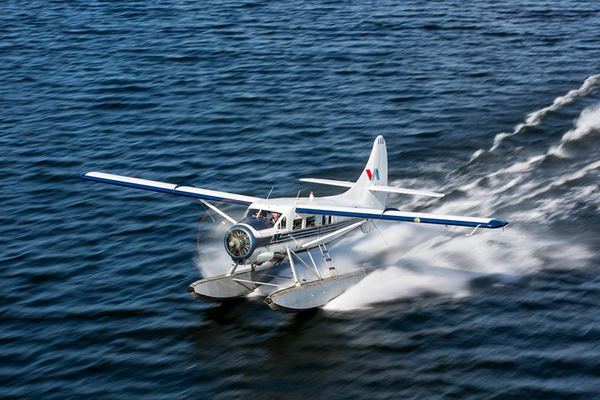
30 Minutes by Floatplane over Tarawera, Waimangu and Whakarewarewa
The seaplane lifts off the lake in front of town and covers in half an hour the crater lakes, Tarawera, Waimangu and Whakarewarewa, with flight times to suit.
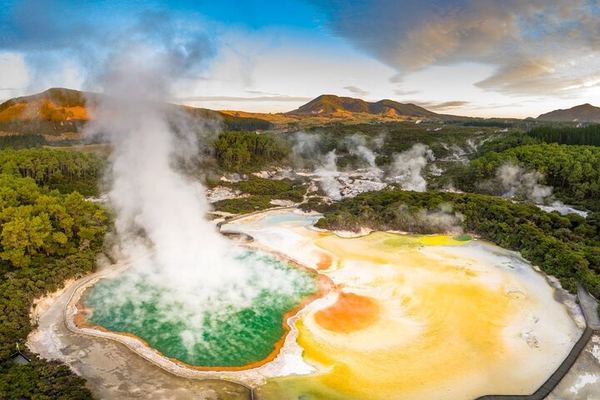
Auckland to Rotorua: Wai-O-Tapu, a Private Cedar Hot Tub, and Tirau's Corrugated Iron
The afternoon is a private cedar tub in native forest rather than another walk, and the road passes Tirau, the corrugated iron capital of the world.

A Whole Day at Te Puia: Hāngī Buffet, Haka and Time to Actually Stay
One destination instead of two, so the hāngī buffet, the haka and the guided geothermal walk all fit without anyone hurrying you back to the minibus.
Boutique Rotorua Day from Tauranga: the Native Bush Walk That Beats the Redwoods
The operator surveys every group, and the stop they name most is the Tikitapu bush walk, not the Redwoods. Ohinemutu, Te Puke orchards and a foot soak too.
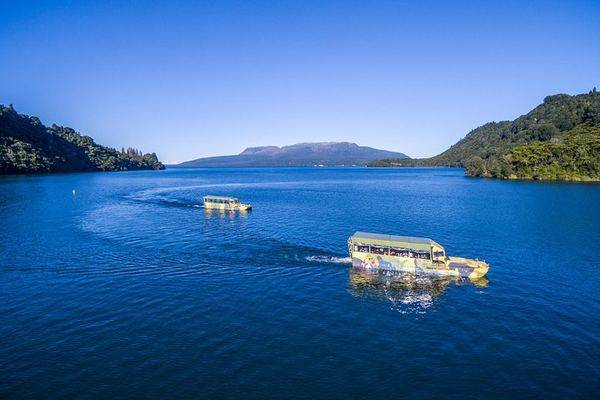
Four Rotorua Lakes in a WWII Amphibious Duck: Three of Them Entered by Water
The vehicle drives into three of the four lakes rather than stopping at them, and the Tarawera commentary is given from the water at the mountain's foot.
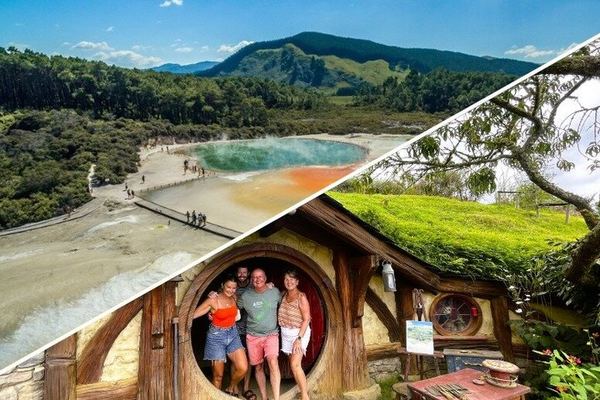
Green Hills to Devil's Bath: Hobbiton and Wai-O-Tapu in One Day from Auckland
Farmland and 44 hobbit holes in the morning, the Devil's Bath and boiling mud in the afternoon, with no hire car and no route to plan yourself.
Ratings collected by Viator and Tripadvisor
Data verified on. Geyser fields change: what is erupting now may not be in a decade, and several famous geysers have stopped within living memory. Editorial Policy