
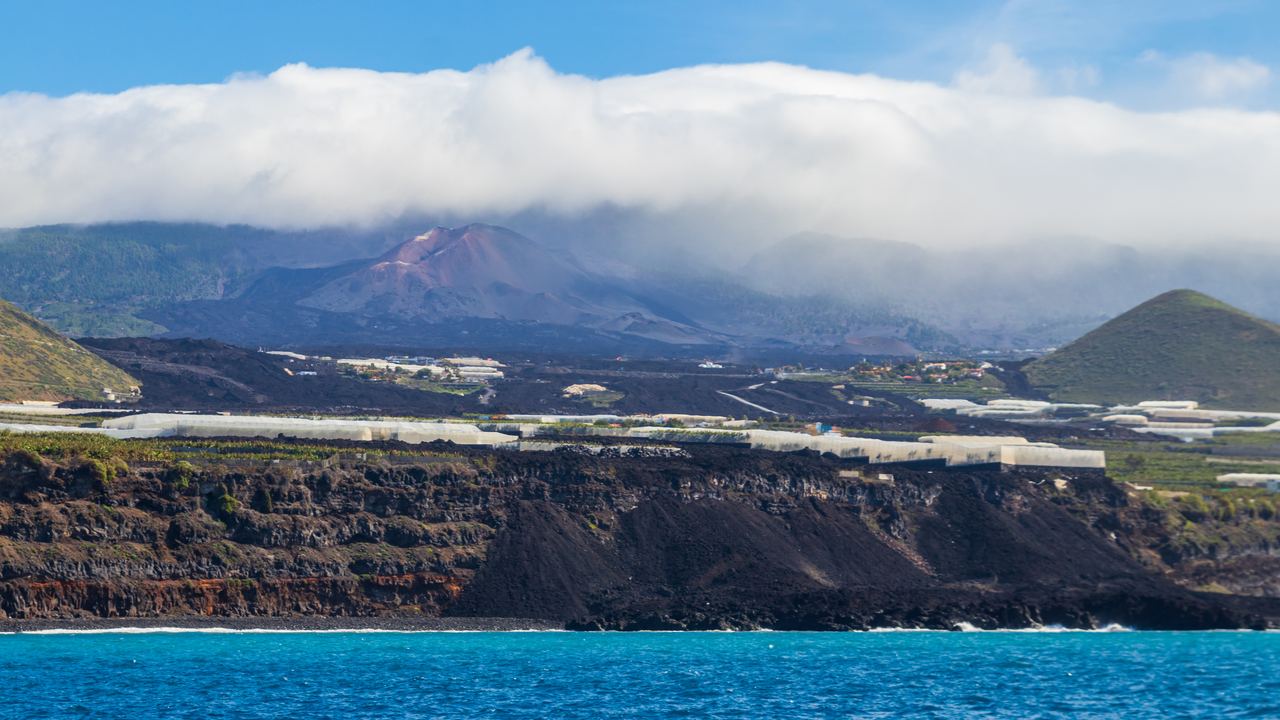
La Palma Volcano Tours: Walking the Tajogaite Lava Fields
Seven listings from 27 to 137 EUR. The cone sits inside an exclusion zone and needs a guide; the viewpoints over the 2021 flow are free.
There is one island in Europe where you can walk to the edge of a crater that did not exist when the current secondary school intake started primary school. On 19 September 2021 a fissure opened on the western flank of La Palma, and for the next three months it rebuilt the map of the Aridane valley. What is left is a black cone about two hundred metres tall with its own name, a lava delta that pushed the coastline out into the Atlantic, and a set of viewpoints looking down onto roofs that stop halfway out of the rock.
Two things make this island harder to research than it should be. The first is that most of what is written about it uses the wrong name for the volcano. The second is that the access rules have changed repeatedly since 2021, so a page written eighteen months ago describes a walk that no longer exists, usually by understating how close you now get. Both are worth sorting out before you book anything, and so is a road closure that no English-language page seems to have noticed.
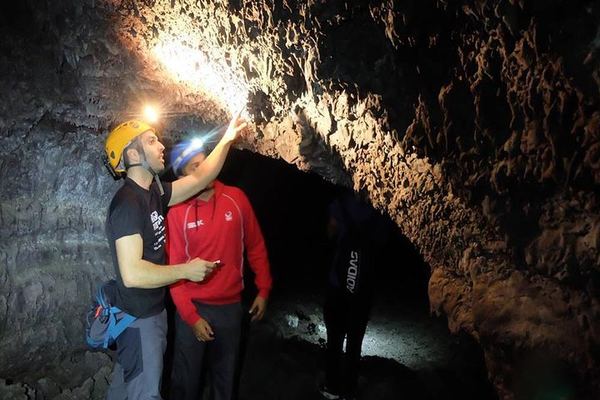
Caving the 1949 San Juan Lava Tube, 560 Metres of It
A guided walk through 560 metres of lava tube left by the 1949 San Juan eruption, lit by more than ten openings, some of them old fumaroles. Expert guide.
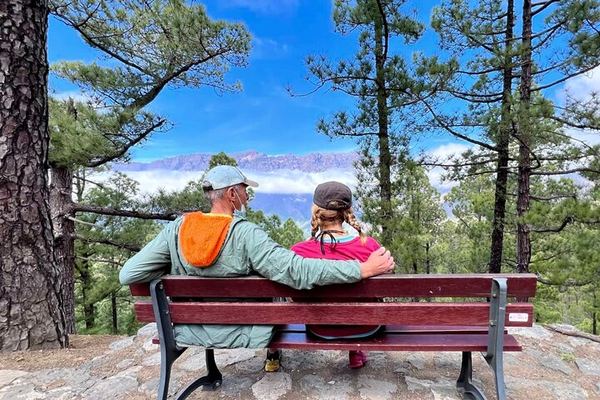
La Palma in a Day from Tenerife: the 2021 Lava and La Cumbrecita
Out on the 8:30 ferry from Los Cristianos and back on the 5 o'clock, with La Cumbrecita, the Tacande exclusion zone and the road built on the 2021 lava.
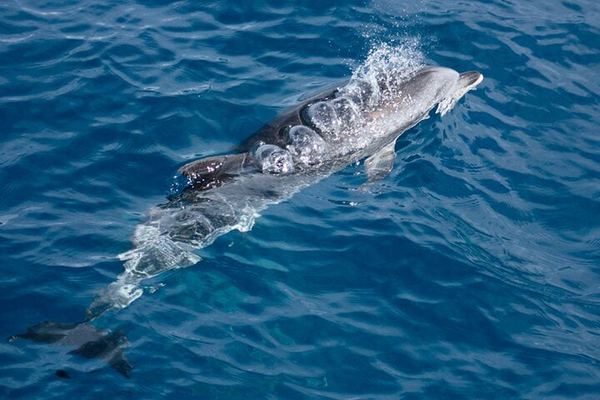
La Palma's Northwest Coast by Boat, Past Tijarafe and Puntagorda
From the sports dock at Tazacorte along the cliffs of Tijarafe and Puntagorda, then out into open water for whales, dolphins and turtles. Sunsets some days.
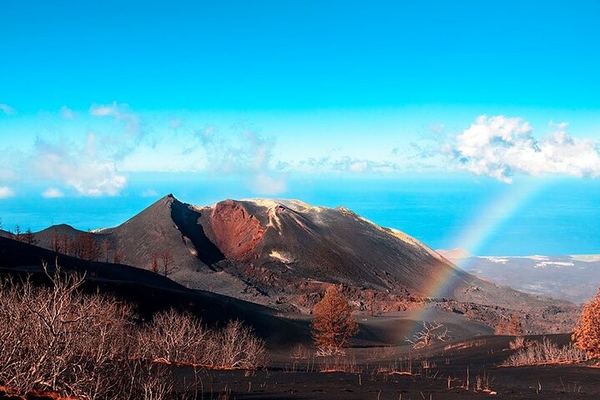
One Metre from the Crater Rim: the New La Palma Volcano on Foot
An 8 km walk over ash to the crater rim of the volcano that opened in 2021, closing to a metre from the edge. Departure at 08:45 from the office in El Paso.
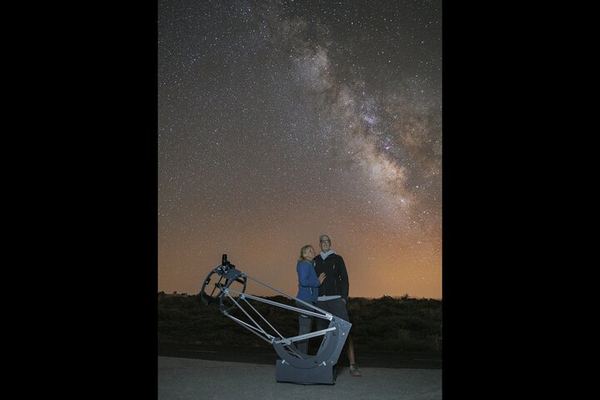
Roque de los Muchachos by Night, Private, Next to the Observatories
A private, deep-sky telescope session on the same summit as La Palma's observatories, meeting by the museum. Dress warm: 2,000 metres at night is very cold.
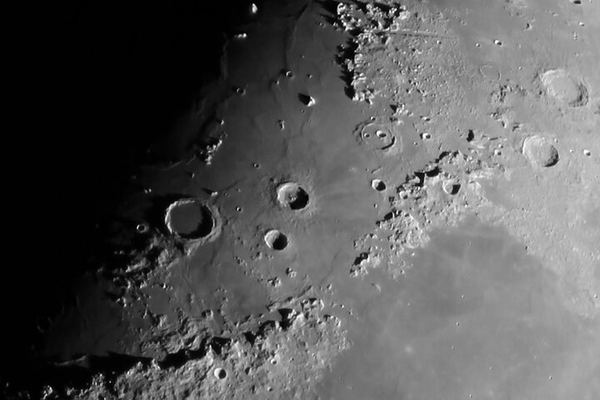
Stargazing on La Palma, an 8-Inch Maksutov and the Southern Cross
One Skywalker Maksutov with an 8-inch mirror, constellations picked out with a laser, and in summer the Southern Cross. Astrophotography is part of the night.
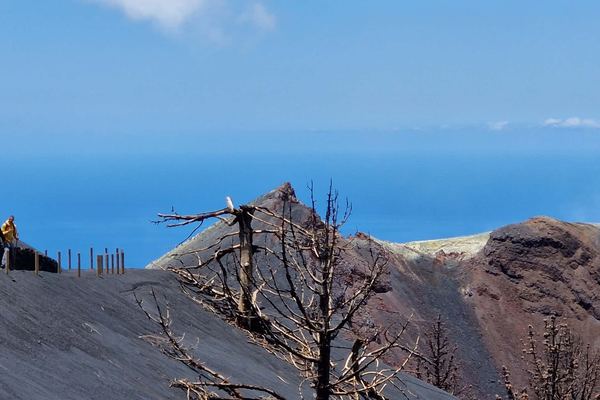
Tajogaite on Foot: 300 Metres from the 2021 Crater
Two and a half kilometres of ash and lapilli bring you within 300 metres of the crater. Five kilometres in all, or a seven-kilometre version that goes closer.
Ratings collected by Viator, Tripadvisor and Civitatis
Its name is Tajogaite, and Cumbre Vieja is something else
For two years the 2021 volcano had no official name and everybody called it Cumbre Vieja. On 9 February 2024 the Cabildo of La Palma settled it with a unanimous vote: the volcano is the Volcán de Tajogaite, after the place it destroyed. Tajogaite is the name to search with, the name the guides use, and the name on the interpretation panels.
Cumbre Vieja is not a volcano. It is the ridge, about fourteen kilometres of it, running down the southern half of the island and carrying dozens of vents of different ages, including the 1949 and 1971 eruptions. Calling the 2021 cone Cumbre Vieja is like calling a single house the street it stands on. Almost every English-language source still does it, including the ones you would expect to know better, which is worth knowing when you are cross-checking what you read here against anything else.
Eighty-five days and eight hours
The eruption began at 15:11 on 19 September 2021 and stopped at 22:21 on 13 December, and it was formally declared over on Christmas Day. That is 85 days and 8 hours, the longest in the recorded history of the island, longer than San Juan in 1949 and far longer than Teneguía in 1971, which lasted three weeks.
The numbers behind it are worth reading slowly. More than 200 million cubic metres of material. 1,219 hectares buried, most of it banana plantation and the villages inside it. 2,988 buildings destroyed, around 7,000 people evacuated, and one death attributed to the eruption, a man who went back to clear ash from a roof. For an event of that size in a populated valley, the death toll is remarkable, and it is the direct result of an evacuation ordered before the ground opened.
The cone that grew out of it stands roughly two hundred metres above the surface it built on, putting its summit at about 1,120 metres. Four years on, the interior of the flow is still cooling, and there are places on the guided routes where the ground under your boots is warm enough to notice.
How close you can actually get
This is where old pages do the most damage. Access to the cone has been relaxed in stages since 2021, and the descriptions have not kept up. If a page tells you the walk stops about 400 metres from the crater, it is describing an itinerary that no longer exists. One of the operators here says so in its own listing, in as many words: previously about four hundred metres from a crater, now a metre from the edge of another one.
What has not changed is that the cone sits inside an exclusion zone. You cannot walk up on your own, and the routes on sale are the only lawful way onto it. Three lengths are offered, and all of them start in or near El Paso, usually with a transfer up to the Llano del Jable at about 1,200 metres before anyone puts a boot down.
| Route | Distance | Ascent | Time | Price |
|---|---|---|---|---|
| Short route from Llano del Jable | 5 km | About 200 m | 3 to 3.5 hours | From 35 EUR |
| Extended route, minimum age 10 | 7 km | About 370 m | About 4 hours | 35 to 48 EUR |
| Full circuit to the crater edge | 8 km | About 300 m | 3.5 to 4 hours | 40 EUR |
| Bad-weather variant, one way to Las Manchas | 6.5 km | Descent of 600 m | Same | 40 EUR |
| Viewpoints only, no walking | Free | None | As long as you like | Free |
The ground on every one of these is ash and lapilli, which walks like deep coarse sand and is why a five kilometre route takes three hours. There is no shade anywhere and no water. Groups are small, eight to a booking on one operator, and the guides are firm about not leaving the marked line, which is not officiousness: parts of the surface are a thin crust over voids.
The four viewpoints cost nothing and are open to anyone with a car. Llano del Jable looks across the ash field from above. Tacande and Tajuya face the cone directly and are where the news cameras stood in 2021. El Time, high above the Barranco de las Angustias, gives you the whole valley and the new coastline in one frame. If you have half a day rather than a full one, two of those viewpoints beat a rushed booking.
The road that is shut on weekdays
La Palma's other summit is the Roque de los Muchachos at 2,426 metres, the rim of the Caldera de Taburiente and the site of one of the most important observatories in the northern hemisphere, including the Gran Telescopio Canarias and its ten-metre mirror. The island is a Starlight Reserve and the night sky here is protected by law rather than by luck.
The LP-4, the road that climbs to it, is currently closed Monday to Friday for resurfacing, with access only from the Garafía side. That single sentence rearranges an itinerary, and it appears on no English-language page we could find. If a stargazing evening at the Roque is the reason you are coming, check the day of the week before you book the flight, and expect the drive from the Aridane valley to be considerably longer than the map suggests.
One more rule of the same kind, on the other side of the caldera. La Cumbrecita, the main viewpoint into the Caldera de Taburiente national park, has a car park that must be booked in advance, and the sanction for not turning up or arriving after your slot is severe: a ban on booking again for a year. It is an unusually hard penalty for a car park and it is enforced.
Puerto Naos, and why the gas is still the story
The lava stopped in December 2021. The carbon dioxide did not. Because the gas is heavier than air it collected in basements and low streets on the coast, and the two seaside villages of Puerto Naos and La Bombilla stayed evacuated long after the eruption ended, which is the part of this story that the international coverage dropped.
The return has been slow and is measured rather than assumed. By April 2026 more than 1,177 homes had been re-authorised and 42 businesses had reopened, monitored by a network of over 1,300 sensors that is now the most extensive of its kind in Europe. Visitors are not the ones at risk here and the reopened areas are reopened precisely because they are measured, but it is the reason a beach resort that looks perfectly normal has a sensor on the wall of every other building.
Four years after the lava stopped, the thing that still decides where people may sleep on this island is not rock. It is a colourless gas that pools in cellars, and a thousand sensors watching for it.
The rest of the catalogue is thin, and unusually good
| Listing | Price | Rating |
|---|---|---|
| Caving in the Cueva de las Palomas lava tube | 27 EUR | 4.8 from 31 |
| Guided walk to the Tajogaite cone, from El Paso | 35 EUR | 4.8 from 2,449 |
| Hiking route to the new volcano, 8 km | 40 EUR | 4.8 from 40 |
| Stargazing with a telescope | 42 EUR | 4.8 from 32 |
| Private stargazing at the Roque de los Muchachos | 59 EUR | 4.9 from 68 |
| Boat along the north-west coast and its cliffs | 61 EUR | 4.8 from 56 |
| Day trip from Tenerife: the volcano and La Cumbrecita | 137 EUR | 4.7 from 108 |
Seven listings is very little for an island this famous, and the imbalance shows in the reviews: one product carries nearly 2,500 ratings and the other six carry fewer than 350 between them. That is a market with more demand than supply, and it has two consequences. The volcano walks sell out in high season, so book before you fly rather than when you land. And the small operators here are worth choosing on their own merits rather than by review count, because the count mostly reflects who got listed first.
Two of the six deserve a specific recommendation. The caving trip at 27 EUR is the cheapest volcano experience anywhere in the Spanish catalogue and it takes you inside a lava tube rather than past one. And the private stargazing at the Roque is the highest rated thing on the island at 4.9, which on an island with this sky is not surprising, but check the road closure above before you commit to a weekday.
Questions people actually ask
Is it called Tajogaite or Cumbre Vieja?
Tajogaite. The Cabildo of La Palma approved the name unanimously on 9 February 2024. Cumbre Vieja is the fourteen kilometre ridge the vent opened on, and it carries many other cones including the 1949 and 1971 eruptions. Most English-language sources still use the ridge name for the 2021 volcano.
Can you climb the Tajogaite volcano on your own?
No. The cone is inside an exclusion zone and the only lawful access is on a guided route. The guides take you to the crater edge, which is closer than the older descriptions suggest. The free viewpoints at Llano del Jable, Tacande, Tajuya and El Time need no booking and no guide.
How long and how hard is the walk?
Between five and eight kilometres depending on the route, with 200 to 370 metres of ascent, and three to four hours on the ground. It is not technical, but the surface is deep ash and lapilli, there is no shade and no water anywhere, and the longer version has a minimum age of ten.
Is there any lava to see?
No molten lava. It stopped on 13 December 2021. What you walk on is black rock four years old, with steam in a few places and interiors that are still cooling. The photographs circulating of orange fountains were taken during the eruption, and no operator is selling anything else.
What is the LP-4 closure?
The road up to the Roque de los Muchachos observatory is currently closed Monday to Friday for resurfacing, with access from the Garafía side only. It affects anyone driving to the summit for stargazing or for the caldera rim. Check the current position before booking an evening at the top, and plan for a much longer drive.
How much should I budget?
Thirty-five to forty-eight euros for the guided volcano walk, twenty-seven for the caving trip, forty-two to fifty-nine for stargazing, and about sixty-one for the coastal boat. The only listing above a hundred euros is the day trip that starts on Tenerife, which is good value for what it covers and a very long day.
Is it insensitive to visit?
The Cabildo actively encourages it and the guided routes are run by local companies employing people from the valley. Nearly three thousand buildings were destroyed and the people showing you round mostly know someone who lost one. Ask before photographing a house in the flow, and it will be fine.
Data verified on. Eruption figures and the 2024 naming decision from the Cabildo de La Palma and Involcan. Route lengths, prices, meeting points and ratings read from the seven products on this site.