

Mount Fuji Tours from Tokyo
Twelve ways to spend a day at the foot of a 3,776 m volcano, none of which goes up it. What decides the day is not the price but what time you reach the lake.
Almost nobody searching for a Mount Fuji tour wants to climb Mount Fuji. That sounds like a slight, and it is not: it is the shape of the market. Of the twelve Fuji experiences sold here, every one is a day at the foot of the mountain, at the lakes, in Hakone or inside a lava cave, and the highest any of them gets is the Fuji Subaru Line 5th Station at 2,300 m, where a coach can park. The summit is 1,476 m further up and belongs to a different trip entirely.
What follows is the operational half: where the twelve listings actually go, which of the four trails does what if you do decide to walk up, and the one scheduling problem nobody selling a Fuji day trip will mention. The wider question of why Japan sells this mountain and not the hundred and ten others sits on the Japan page above.
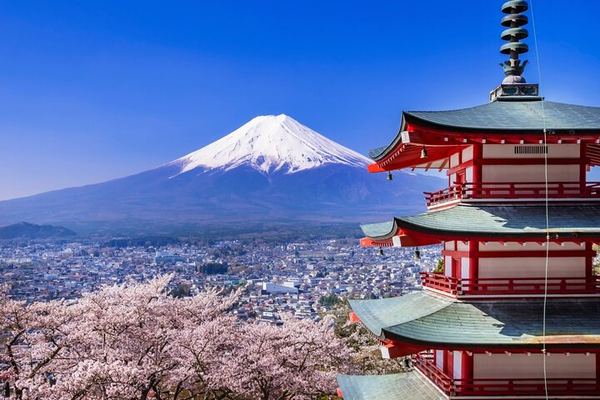
Eight Fuji Viewpoints in a Day: Chureito's 400 Steps and the Lawson Everyone Photographs
Chureito Pagoda at the top of 400 steps, the shrine that held a ceremony after the 807 eruption, and the blue convenience store everyone photographs.
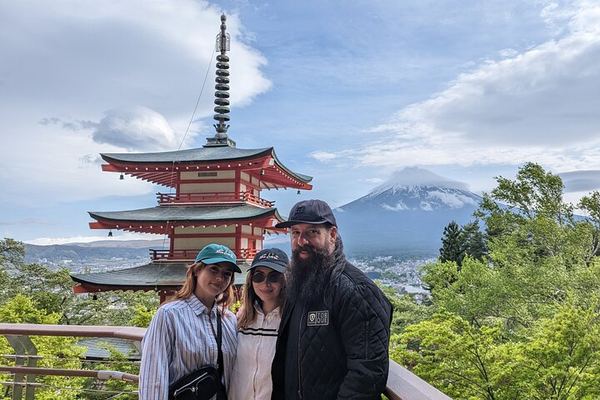
Fuji or Hakone by Private Car: a Menu of Stops, You Choose
A licensed guide and driver for the day and two lists to choose from, one round Lake Kawaguchiko and one round Hakone. The 5th Station toll is paid on site.
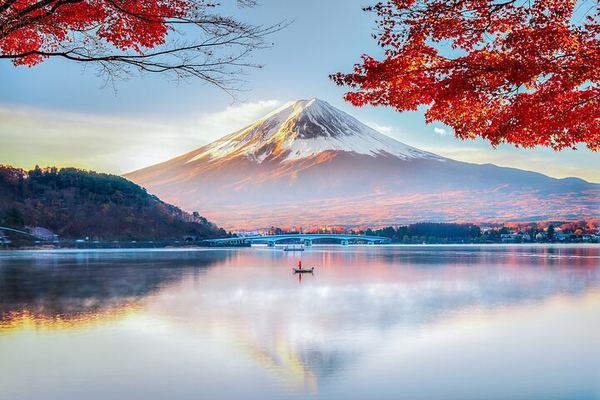
Fuji, the Kamakura Buddha You Can Step Inside, and Lake Ashi: Basic or Full
The full option adds the 13.35-metre bronze Buddha you can walk inside and the Lake Ashi cruise; the basic one is the Fuji lakes without meals.
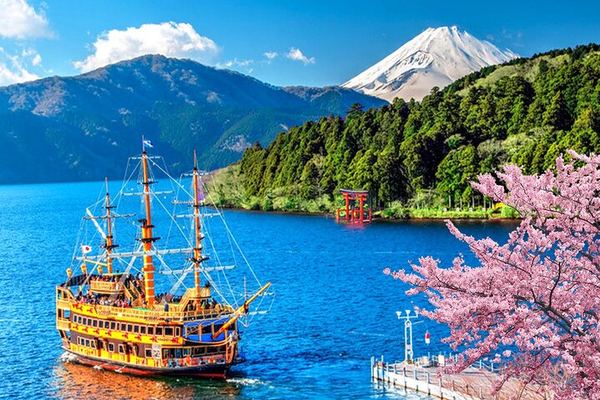
Hakone and Fuji: Black Eggs at Owakudani, a Ropeway and a 757 AD Shrine
The pirate ship costs about USD 12 extra and is skippable by bus, and the ropeway crosses the steaming valley where the black eggs are boiled.
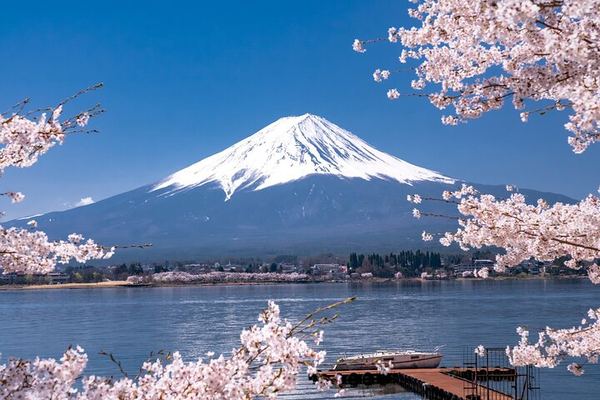
Kawaguchiko with Live Translation in 75 Languages (Bring Earphones)
Live voice and text translation covers up to 75 languages alongside the English guide, so bring earphones. The cruise rounds the only island in the lakes.
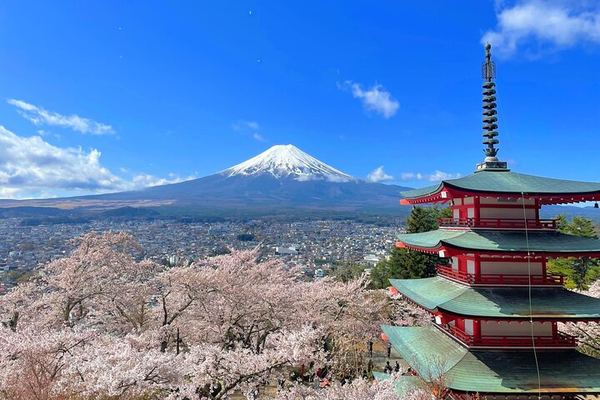
Making Hōtō Noodles Under Mount Fuji, and Eating What You Made
You make the Yamanashi noodles by hand and eat them for lunch, with the Kawaguchiko cruise before and the pagoda at Arakurayama after.
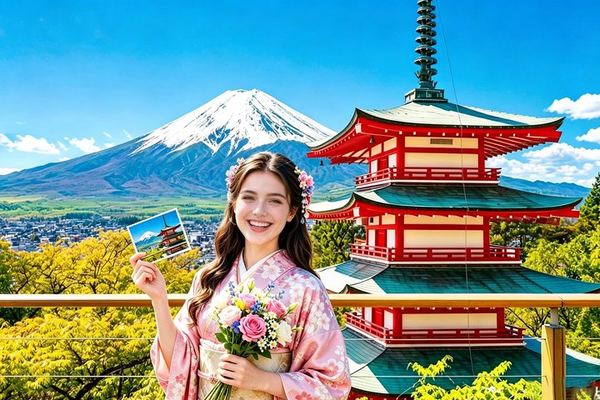
Mount Fuji Day Trip from Tokyo: Chureito Pagoda, Oshino Hakkai and Lake Kawaguchi
English-guided run of seven Fuji viewpoints, from the 398 steps at Chureito Pagoda to the spring ponds of Oshino Hakkai. Leaves from Shinjuku or Tokyo Station.
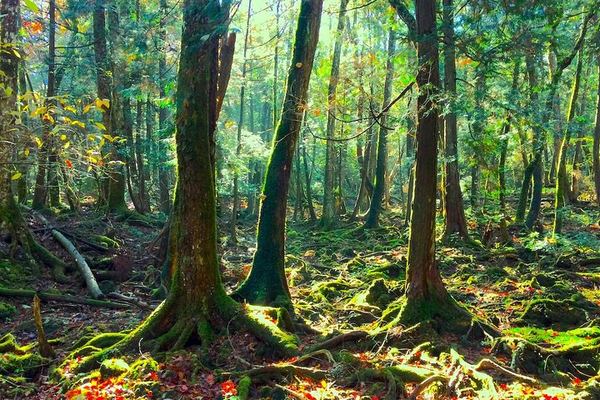
Mt. Fuji Ice Cave in Aokigahara: No Lights, No Handrails
The cave needs a special permission to enter, and inside there are no handrails and no lights: one headlamp each, three hours, twelve people at the most.
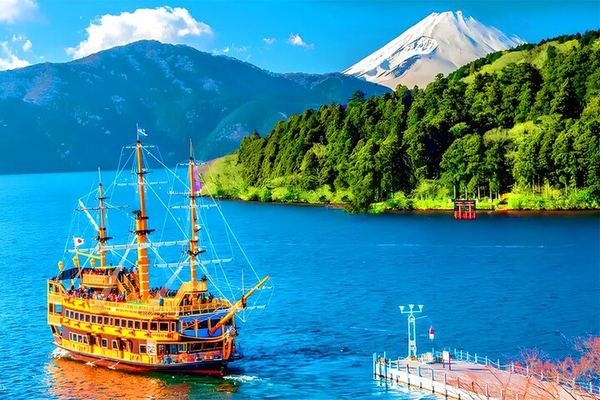
Owakudani Black Eggs, the Pirate Ship and the Fuji Peace Park
Owakudani's black eggs are boiled in the geothermal water and said to add seven years to your life. The lake crossing is on a pirate ship. Depart 8:00 sharp.
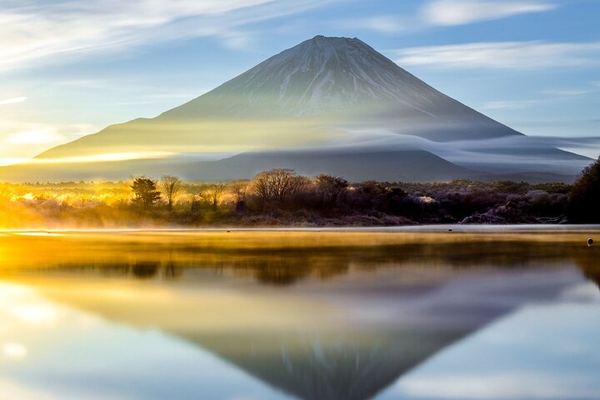
Private Fuji and Hakone by Car: Two Itineraries, and the Clock Starts When You Do
Two itineraries to pick from, with the return starting in the seventh hour and overtime charged past the eighth. The 5th Station is never guaranteed.
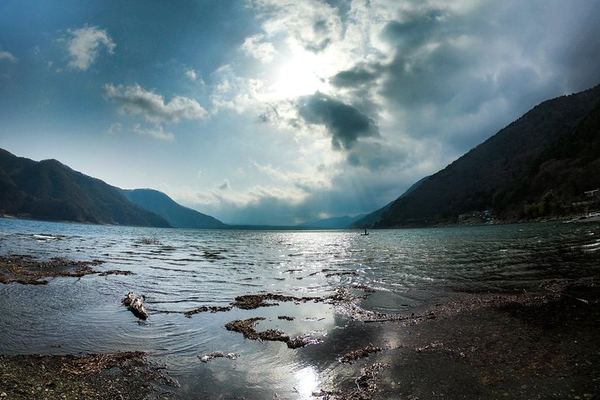
Private Fuji Walks with a Local English-Speaking Guide: the 864 AD Lava Forest
A resident English-speaking guide walks you into the Sea of Trees, grown on lava from the 864 AD eruption, and finishes at sunset over one of the lakes.
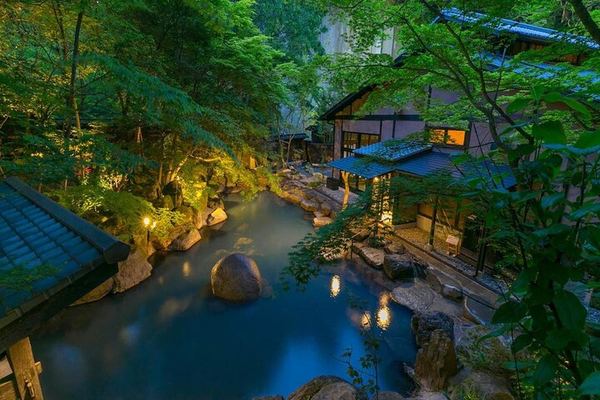
Private Hakone Day: Tattoo-Friendly Onsen, a 400-Year-Old Teahouse, Picasso Outdoors
Every hot spring on this route admits tattoos, and the day also holds a 400-year-old teahouse on the Tōkaidō and a thousand sculptures in a garden.
Ratings collected by Viator and Tripadvisor
Where the twelve listings actually go
Read the itineraries rather than the titles and the catalogue sorts itself into four things. Ten of the twelve start in Tokyo, generally at Shinjuku, and two start at Fujikawaguchiko for people who are already staying under the mountain. The stops repeat across operators because there are only so many places a coach can reach and turn around in a day.
| What you book | Listings | Price | Ratings |
|---|---|---|---|
| Shared coach, the Five Lakes circuit | 4 | 47 to 91 EUR | 4.7 to 4.8 |
| Shared coach, Fuji with Hakone | 3 | 67 to 80 EUR | 4.6 to 4.9 |
| Lava cave walk from Fujikawaguchiko | 1 | 45 EUR | 4.9 |
| Private car, driver and licensed guide | 4 | 282 to 646 EUR | 4.9 to 5.0 |
The stops themselves are worth separating, because two of them have nothing to do with the volcano and one of them is the only genuinely volcanic thing on the whole page.
The Fuji Subaru Line 5th Station, at 2,300 m, is the road head on the Yoshida side and the top of the standard day trip. It has shops, a shrine and a car park, and it is where a coach turns around. The Five Lakes, mostly Kawaguchi, give the reflection photograph, and three of the listings add a lake cruise or Oishi Park. Arakurayama Sengen Park, above Fujiyoshida, is the pagoda-and-Fuji picture that carries most of the mountain's image abroad, reached by a stair climb of several hundred steps. Hakone is a separate volcanic system about 40 km east, with the Lake Ashi boats, the floating torii and the Owakudani ropeway over sulphur vents. And the Kamakura Great Buddha, a 13 m bronze at Kotoku-in that appears on one listing, is a fine thing to see and is not a volcano.
The one that is: the lava caves in and around the Aokigahara forest, formed in a flow that ran off the mountain's northern flank in the ninth century. One listing here is nothing else, three hours at 45 EUR, and its own description is unusually straight about what that means: entry needs a permit and an English-speaking guide, and there are no handrails and no lighting inside. It carries a 4.9 from 269 reviews, which is the highest satisfaction on the page for the lowest price, and it is the only product here where you touch the volcano rather than photograph it.
The mountain you may not see
This is the single largest source of disappointment on a Fuji day trip and it is entirely predictable. Fuji is completely clear on roughly 134 days a year, about 37 per cent. In January the mountain is at least partly visible on close to 98 per cent of days. In June that falls to 24 per cent, and in July to 35.
Time of day compounds it. A full view is about 1.6 times more likely at eight in the morning than at four in the afternoon, because the cloud builds over the flanks as the ground warms. Now put a shared coach on that curve: it leaves Shinjuku between eight and nine, spends two and a half hours on the road, and reaches the lakes somewhere between eleven and one. The standard day trip is structurally scheduled to arrive after the best window has closed.
Nothing an operator can do fixes this, and none of them will say it. If the photograph is the point, sleep at Kawaguchiko the night before and walk to the lake at first light, or take a private car and set the departure yourself.
The private listings are worth their premium mainly here. Four of them, between 282 and 646 EUR, buy a driver who can leave at six, change the route when the cloud sits on the summit, and go to the lake that is clear rather than the one on the itinerary. For two people that is a lot of money for weather insurance. For four it stops being unreasonable.
The four trails, if you do go up
Fuji has four routes to the summit and they start at wildly different heights, which is the fact that decides the day. They are open 1 July to 10 September 2026, with the summit and the crater rim walk open from 10 July, and each carries a 4,000 yen fee per person. The rules differ by prefecture and are set out on the Japan page above.
| Trail | Prefecture | Trailhead | Time up | What it means |
|---|---|---|---|---|
| Yoshida | Yamanashi | 2,300 m | 5 to 7 hours | The busiest, the most huts, and the one the buses serve |
| Subashiri | Shizuoka | 2,000 m | 5 to 8 hours | Quiet below, then it merges into the Yoshida crowd high up |
| Gotemba | Shizuoka | 1,400 m | 7 to 10 hours | The longest by a wide margin, and the only one with no first-aid post |
| Fujinomiya | Shizuoka | 2,400 m | 4 to 7 hours | Shortest and steepest, from the highest road head |
The spread between Gotemba at 1,400 m and Fujinomiya at 2,400 m is a thousand metres of climbing, or roughly three extra hours, for the same summit. People pick a trail on the strength of a blog post about the sunrise and then discover which one they chose at about the fifth hour. If you are going up once, the number in the second column matters more than anything written about the view.
Eleven centuries of Fuji, and three years of rules
The eruptions that built what the day trips visit, and the regulations that arrived after the crowds did.
The origins
864
The Jōgan eruption
Lava runs off the north-western flank and cools into a tube system. The forest of Aokigahara grows on top of it, and the caves inside it are the only part of this volcano the day trips actually enter.
1707
The Hōei eruption begins
In December a flank vent opens on the south-eastern side and drops ash on Edo, a hundred kilometres away. The crater it leaves is still the most obvious scar on the mountain.
The growth
1708
And ends
The eruption stops in January. Nothing has come out of Mount Fuji since, which makes it dormant rather than extinct, and it has been monitored on that basis ever since.
2013
UNESCO listing
On 22 June the mountain is inscribed as a cultural site rather than a natural one, for its place in Japanese art and pilgrimage. Visitor numbers climb from there.
Today
2024
A gate on the Yoshida trail
Yamanashi installs a gate, caps the trail at 4,000 climbers a day and shuts it from 14:00 to 03:00 to stop people walking through the night without a hut booking.
2026
Four thousand yen, four trails
Both prefectures now charge 4,000 yen per person. Shizuoka adds compulsory booking through an app and an e-learning course with a test; Yamanashi does not.
Getting there, and what the fare leaves out
From Tokyo the mountain is about a hundred kilometres and two and a half hours by road, longer on a summer weekend. That drive is most of what you buy on a shared day trip: ten to twelve hours door to door, of which perhaps four are spent anywhere you would want a photograph. It is not a bad deal at 47 EUR, but it is worth knowing the ratio before booking.
Four practical things that sit outside every price you will compare:
Private cars are banned on the Fuji Subaru Line from 3 July to 10 September. In exactly the weeks when a hire car feels like the obvious answer, it is not allowed, and the coach or the shuttle is the only way up. No listing advertises this, and it is the strongest argument any of them has.
There is no cash machine at the fifth station, and the mountain toilets take 100 to 300 yen in coins. Arrive with coins.
Tents are illegal on the mountain. If you are climbing overnight, a hut bed is the only lawful way to break the walk, and it has to be booked separately and early. The 14:00 gate closure exists specifically to stop the alternative.
Boots and a wind layer are not a suggestion. The official climbing site states that hiking boots, rain gear and cold-weather clothing are essential and that equipment may be checked before you are allowed onto the mountain. The summit runs roughly twenty degrees colder than the car park below it, and the ground is loose volcanic scoria that fills anything lower than an ankle boot.
Questions people actually ask
Do any of these tours climb Mount Fuji?
None of the twelve. The highest they reach is the Fuji Subaru Line 5th Station at 2,300 m, which is a car park with shops rather than a stage of the climb. Guided ascents run only between 1 July and 10 September, come from a separate set of Japanese operators, and take two days for most people.
Will I actually see Mount Fuji?
On average, on about 37 per cent of days it is completely clear, and the odds swing hard with the season and the hour. January is close to 98 per cent of days with at least a partial view; June is 24 per cent. Morning is roughly 1.6 times better than late afternoon. A shared coach from Tokyo arrives at the lakes around midday, which is the wrong end of that curve.
Which trail should I use if I climb?
Yoshida if you want huts, company and bus access, and it is the only one on the Yamanashi side. Fujinomiya if you want the shortest walk, from the highest trailhead at 2,400 m, and do not mind that it is the steepest. Subashiri for a quieter start. Gotemba only if you actively want a long day: it begins at 1,400 m and takes seven to ten hours up, with no first-aid post on the route.
Fuji or Hakone, if I only have one day?
Hakone if the weather is poor, because the ropeway over the Owakudani sulphur vents, the Lake Ashi boats and the hot springs all work under cloud, and Fuji does not. Fuji and the Five Lakes if the forecast is clear, ideally in winter. Five of the twelve listings do both, which is a long day in a coach but hedges the sky.
Is the lava cave worth doing?
It is the cheapest listing on the page at 45 EUR, it holds the joint-highest rating, and it is the only one that puts you inside the volcano rather than in front of it. The trade-off is stated plainly in its own description: no handrails, no lighting, and a permit and guide required. Three hours, from Fujikawaguchiko rather than Tokyo, so it works best as an add-on for people already staying at the lakes.
How far in advance should I book?
For the day trips, a few days is usually enough outside the autumn colour weeks and cherry blossom. For a climb, book the hut rather than the permit: hut beds are the genuinely scarce thing on the mountain, and the daily cap on the Yoshida trail has not yet been the binding constraint in practice.
What should I take on a day trip?
Layers, because the fifth station at 2,300 m is often ten degrees colder than Tokyo and windy even in August. Coins for the toilets. And something to do for the five hours in the coach, which is the honest majority of the day.
Data verified on. Trail heights, season dates and climbing rules from the Yamanashi and Shizuoka prefectural pages for 2026. Prices, ratings and itineraries read from the Fuji products on this site.