
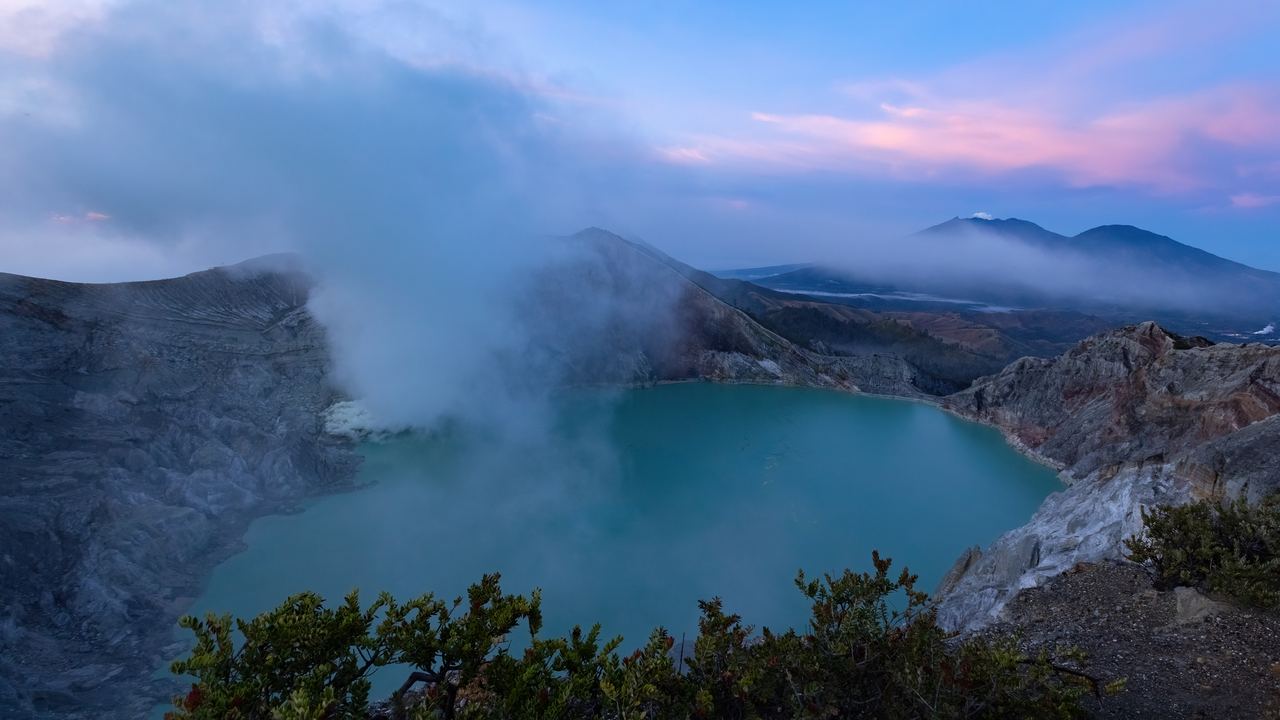
Almost everything written for visitors about volcanic gas says the same three things: it can be dangerous, follow your guide, leave if you feel unwell. All true, and none of it tells you anything you could act on.
The reason is structural. Volcano observatories publish gas data for scientists and civil protection, in tonnes per day, which measures the strength of the source and tells a person standing on the crater rim nothing whatsoever. Health agencies publish exposure limits designed for a factory worker over an eight-hour shift, which is not what you are doing either.
There is one exception. Iceland's environment agency publishes sulphur dioxide guidance explicitly calibrated for a maximum exposure of ten to fifteen minutes, which is exactly the length of a stop at a viewpoint. As far as we can establish it is the only such table in the world, and it has never been applied to Ijen, Etna, Masaya or Hawai'i. So we have set it out here.
Sulphur dioxide, on the timescale of a visit
| Concentration | Roughly | What you would notice | What to do |
|---|---|---|---|
| 0 to 20 ug/m3 | essentially nothing | Nothing at all | Normal air. Small children can sleep outdoors in it |
| 21 to 350 ug/m3 | under 0.1 ppm | Nothing for most people | Fine. Sensitive individuals should not sleep outside |
| 351 to 600 ug/m3 | 0.1 to 0.2 ppm | Irritation of eyes, nose and throat, in healthy people too | Limit physical effort |
| 601 to 2,600 ug/m3 | 0.2 to 1.0 ppm | Coughing | Breathe through your nose only |
| 2,600 ug/m3 | 1.0 ppm | The 15-minute occupational limit | Not without a mask and a detector |
| 2,601 to 9,000 ug/m3 | 1.0 to 3.0 ppm | Coughing and headache | Get indoors |
| 9,000 to 14,000 ug/m3 | 3.0 to 5.0 ppm | Moderate to severe symptoms in everyone | Follow the authorities' instructions |
| over 14,000 ug/m3 | over 5.0 ppm | Severe symptoms even in healthy people | Emergency |
Two useful things fall out of this. Irritation in a healthy person starts at concentrations far below any occupational limit, so if your eyes sting at a crater rim you are not being dramatic, you are reading an instrument. And there is a diagnostic trick: if an air quality monitor shows sulphur dioxide as acceptable while fine particulate is poor, and the particulate is roughly half the coarse fraction, what you are in is volcanic smog rather than ordinary pollution.
For context on how this scales: a 2025 study measuring 32 points inside the Ijen crater found a sulphur dioxide risk index of 17.67 at the mining face, where the threshold for safety is 1. At the points where tourists gather it was 3.65, and at the sunrise viewpoint 3.81. Not the mining face. The viewpoint.
The two gases that behave treacherously

Hydrogen sulphide
It stops smelling exactly when it becomes dangerous
Hydrogen sulphide is the rotten-egg smell of every geothermal area, and the human nose detects it at concentrations far below anything harmful. That sounds like a good warning system, and it is, right up until it is not.
Two things happen as the concentration rises. First the smell changes, becoming sweetish rather than foul, somewhere around 30 parts per million. Then, between roughly 100 and 150 ppm, it disappears entirely as the gas paralyses the olfactory nerve.
Here is the coincidence that makes this worth knowing. The concentration at which you stop smelling it is essentially the same as the concentration American occupational health authorities designate as immediately dangerous to life and health. The warning system switches off at the exact point the warning becomes urgent.
So the rule reverses everything intuition tells you. A sudden loss of the smell is not relief, and a smell turning sweet is not an improvement. Both mean leave, uphill and upwind, and keep going until you can smell it properly again or you are well clear.
In managed areas with boardwalks this is unlikely to arise. In an undeveloped geothermal field, or in a hollow on a still day, it is the single most useful thing on this page.
Carbon dioxide is worse, because it has no properties at all. No smell, no colour, no heat, no plume. It is about one and a half times denser than air, so on calm days it flows downhill like water and fills depressions, cellars, hollows and caves.
The death toll is not hypothetical. A catastrophic release from Lake Nyos in Cameroon killed 1,746 people in 1986. A gas release at Dieng in Java killed 149 in 1979. At Mammoth Mountain in California, three ski patrollers died in 2006 after falling into a snow depression where carbon dioxide had accumulated.
What this means in practice: the danger is the hollow, not the height. In geothermal areas, stay out of pits, hollows, cellars and caves you have not been taken into by someone who knows the ground. And note that no respirator filters carbon dioxide. Filters remove contaminants from air; they cannot add oxygen to air that does not have enough.
What masks actually do
This causes real trouble, because a great many people arrive at Ijen with a dust mask believing themselves protected, and a smaller number arrive with a gas mask believing the same thing. Both are mistaken, and the second one surprises people.
Particulate masks, including N95 and FFP2, filter ash and do not filter gas. Ash and gas are different problems needing different equipment, and the health guidance says so explicitly.
Gas masks are not recommended for the general public. This is not our opinion, it is the position of the international body that writes the health guidance for volcanic hazards. The reasoning is practical: a cartridge respirator only works if you have selected the right cartridge for the right gas, if it has been fit-tested against your face, and if you have been trained to use it. Get any of those wrong and you have a false sense of security strapped to your head, which is worse than nothing.
There is measured evidence for how badly this fails. A study of the flat-fold masks widely used in Indonesia found they filtered over 98 per cent in a laboratory rig and let through 35 per cent when worn on an actual face. The gap is the seal.
Wetting a cloth does not help. This advice circulates widely and comes from a guidance pamphlet whose authors have since corrected it: the current version states that dampening the fabric does not improve filtration.
Against carbon dioxide, nothing works. Filters remove contaminants from air; they cannot add oxygen to air that does not have enough.
Which leaves the honest conclusion, and it is not the one people want: for a visitor, the protection is distance, altitude and time. Stay upwind, stay out of hollows, stay high, and keep the visit short. If a place needs a respirator to be survivable, it is a workplace, not a viewpoint.
Masks handed out on Ijen tours vary from adequate to decorative, and we would treat the descent into the crater as a decision to make on its own merits rather than one a mask solves.
Ash, and why it collapses roofs
Volcanic ash is not soft. It is pulverised rock and glass, angular and abrasive, and it does three things.
It abrades. Eyes, contact lenses, camera sensors and lenses, aircraft windscreens. If you wear contacts and there is ash in the air, switch to glasses.
It is inhalable. The fine fraction reaches the lungs and irritates airways, which matters for asthma and other respiratory conditions.
It is heavy, especially wet. A few millimetres closes an airport and makes roads slippery. Ten centimetres, soaked by rain, will collapse a roof, and roof collapse is the leading cause of death in ash-fall eruptions. Not suffocation. Structural failure.
This is also the reason airspace closures feel arbitrary. Ash is invisible to weather radar and from an aircraft window, so a decision taken on satellite data and dispersion modelling looks, from the departure lounge, like an overreaction under a clear blue sky.
The hazards that need no eruption at all
This is the part that surprises people most, and it is where visitor casualties actually cluster.
Steam-driven explosions. Groundwater meets hot rock and flashes to steam with no new magma involved, which means none of the precursors that monitoring networks watch for. This is what killed 22 people at Whakaari in New Zealand in 2019, and 63 hikers on Mount Ontake in Japan in 2014, on a fine autumn Saturday on a busy mountain.
Thin crust over hot ground. Geothermal areas are dangerous in a way that feels absurd until it happens: what looks like solid ground can be a mineral crust over near-boiling water. Injuries in geothermal parks are overwhelmingly caused by people stepping off the boardwalk.
Lahars. Rain on old ash deposits produces mudflows with the consistency of wet concrete, travelling fast and far down river valleys. These occur years after an eruption and are triggered by weather.
Lava bench collapse. New land where lava enters the sea rests on loose debris and gives way without warning.
Laze. Where lava meets seawater, the plume contains hydrochloric acid and glass particles, with acid rain at pH between 1.5 and 3.5. Two people died at an ocean entry in Hawai'i in 2000.
The observatories are explicit about this. New Zealand's states plainly that at the lowest alert level, hydrothermal activity, earthquakes, landslides, gas and lahars all remain. The Italian bulletins go further and note that certain phenomena can occur without any warning at all, which means the level of hazard is never zero.
Who should think harder about this
If you have asthma or a respiratory condition, geothermal areas and crater rims deserve a conversation with a doctor before the trip and a mention to your guide when you arrive. Carry your inhaler where you can reach it rather than in a bag. Vog in Hawai'i can affect large areas far from the volcano.
If you have a heart condition or are pregnant, the altitude guidance matters as much as the gas guidance, and the official advice at Mauna Kea excludes both groups above the visitor centre.
If you wear contact lenses, carry glasses. Ash and lenses are a poor combination and the crater rim is a bad place to discover it.
And if you are travelling with children, the crater floor at Ijen is not a place for them, whatever the tour says.
The short version
Stay on the boardwalk. It is where it is because of what is underneath it.
Stay out of hollows. Gas collects at the bottom, and the bottom looks exactly like the top.
If the smell stops, or turns sweet, leave, uphill and upwind.
A mask is not the answer. Dust masks do not filter gas, gas masks are not recommended for untrained users, and nothing filters carbon dioxide. Distance is the answer.
Believe the closure. Every exclusion zone in this catalogue was drawn because of something that happened, usually to someone standing somewhere that looked fine.
Quick answers
Is the sulphur smell at a geothermal park harmful?
In managed areas with boardwalks, no. The nose detects hydrogen sulphide far below harmful levels, which is why somewhere can smell strongly and be entirely safe. The concern is enclosed spaces, hollows, and the point at which the smell changes or disappears.
Should I buy a gas mask for Ijen?
The international guidance on volcanic health hazards specifically does not recommend gas masks for the general public, because they require the correct cartridge, a proper fit test and training, and without those they give false confidence rather than protection. A dust mask filters ash and no gas at all.
What that leaves is a decision about the descent itself rather than about equipment. The crater rim in normal conditions is a reasonable place to be. The crater floor is a working sulphur mine with measured exposure several times the safety threshold, and the honest framing is that people go down there because it is extraordinary, not because it is safe.
What about the smell in Rotorua? People live there.
They do, and the town has smelled of hydrogen sulphide for as long as it has existed. Long-term low-level exposure has been studied there more than almost anywhere. For a visitor it is a curiosity rather than a hazard, and the managed thermal areas are engineered around it.
Can I bring my inhaler up a volcano?
Yes, and you should, in a pocket rather than a bag. Cold air, exertion and gas can each provoke symptoms and volcanoes offer all three. Tell your guide you have it and where it is.
Where to check the air before you go
Gas levels and alert states belong to the national observatories, who publish them and update them. Here is who to ask for each destination.

Data verified on. Sulphur dioxide bands follow the Icelandic environment agency's visitor guidance. Mask guidance follows the international volcanic health hazard network. Not medical advice. Editorial Policy