

Stromboli Tours by Night and the Sciara del Fuoco
Explosions every ten to twenty minutes, and a hard ceiling at 400 metres. Three of the five boats here leave from Calabria, not from the islands.
Stromboli is the most reliable volcano in Europe, in the plain sense that it does something every ten to twenty minutes and has been doing it, more or less without stopping, since 1934. The cone stands 924 metres above the sea by the operators' figure, 926 by other accounts, and rises more than 2,700 metres from the seabed, so about two thirds of the mountain is underwater. Italian civil protection currently holds it at the yellow alert level. What you buy here is not a summit and has not been for years: it is a viewpoint at 400 metres, or a boat sitting offshore in the dark while material rolls down the Sciara del Fuoco into the water.
The archipelago as a whole, how you reach it and how Stromboli's rules differ from Vulcano's are on the Aeolian Islands page above. This one is only about this island: what the ceiling means in practice, why the same operator's night trip scores lower than its day trip, where the boats actually start from, and which format to avoid unless you enjoy sitting on a boat for most of a day.
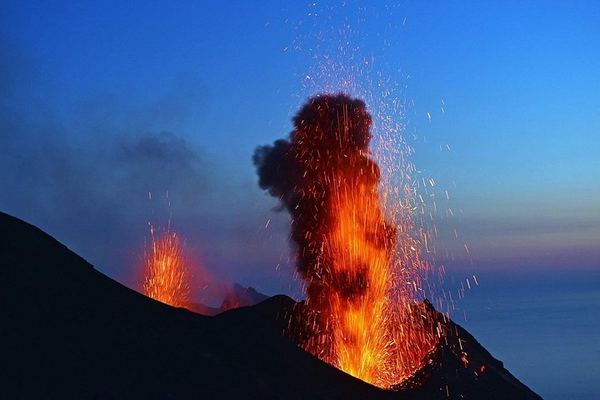
Panarea and Stromboli Boat Trip from Lipari, Sunset at Strombolicchio
Regina Eolie boats from Marina Corta, time ashore at San Pietro on Panarea and at Scari on Stromboli, then sunset off Strombolicchio and the Sciara del Fuoco.
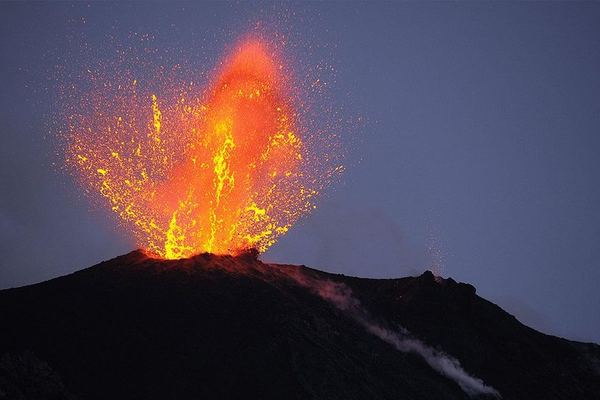
Stromboli at Sunset to 400 m, the Highest a Guide May Take You
The walk stops at 400 metres because that is the highest a volcanology guide may go, and the way down is in the dark with torches. Two hours before sunset.
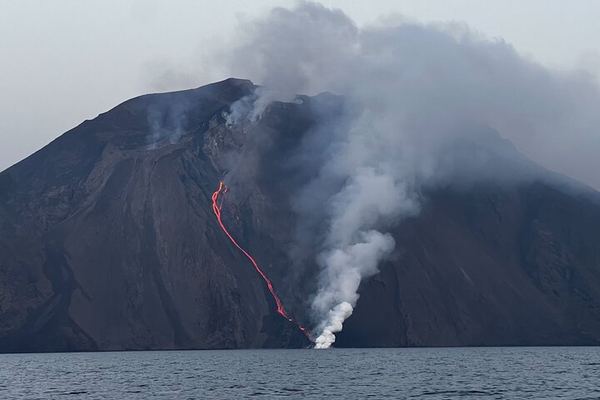
Stromboli by Night: Thirty Minutes Under the Sciara del Fuoco
The time ashore moves with the daylight so the boat is under the Sciara del Fuoco at dusk, and the stop there lasts about half an hour. Tropea by 22:30.
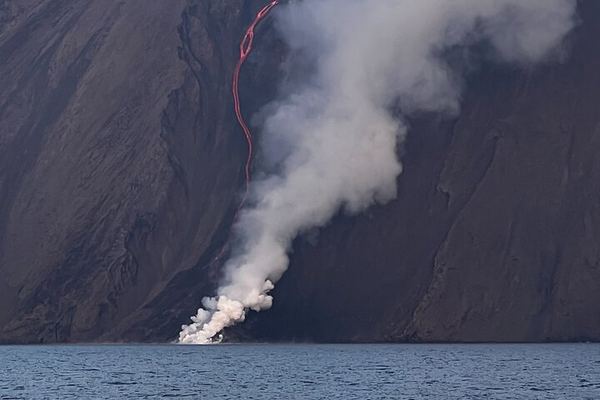
Vulcano, Lipari and Stromboli from Tropea: the Sciara del Fuoco by Day
Savadori's fast boat leaves from Calabria rather than Sicily, and the speed buys longer stops: fumaroles on Vulcano, the Sciara del Fuoco in daylight.
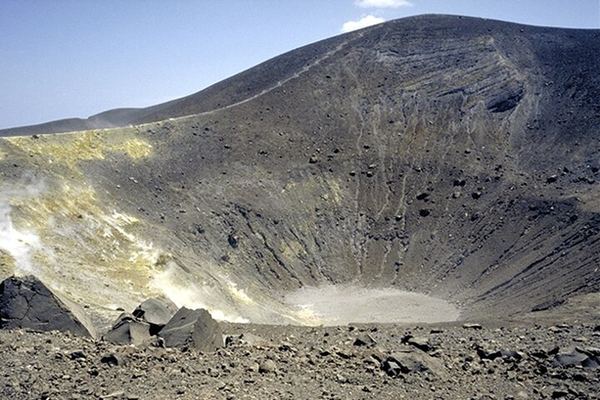
Vulcano, Lipari and Stromboli in One Day by Fast Boat
Stops of 1h15 at Vulcano, 2h20 at Lipari and 1h15 at Stromboli. Commentary is in Italian, and Lipari charges a cash fee to disembark. The boat is a fast one.
Ratings collected by Viator and Tripadvisor
The 400 metre line, and where it came from
Three bands, and they are worth memorising because they are enforced. You can walk to roughly 290 metres, at Punta Labronzo, on your own and for nothing. Between 290 and 400 metres you must be with an authorised guide. Above 400 metres nobody goes, and the fines start above 500 EUR.
The craters that produce the explosions are at about 700 metres. So they are three hundred metres above the line, and no commercial product can take you to them. This matters because listings still circulate with titles promising a trek to the craters of Stromboli, and whatever those tours are doing, it is not that. The 30 EUR walk sold here is correctly named for what it is: a climb to the viewpoint over the Sciara del Fuoco, which looks onto the slope the material runs down rather than into the vents themselves.
The rules are not bureaucratic caution. On 3 July 2019 a paroxysmal explosion, far larger than the routine ones, killed a walker on the island, and a second paroxysm followed at the end of that August. Stromboli's ordinary behaviour is metronomic and its exceptional behaviour arrives without a useful warning, which is precisely the combination that makes a height limit the only workable rule.
What the island has done, and why the rules look like this
The origins
11 September 1930
The largest explosion of the century here
A major eruption threw blocks into the villages and generated a wave. Several people were killed. It is still the benchmark for what this volcano can do when it stops being routine.
The growth
1934
The persistent phase that is still running
The activity you will watch tonight belongs to a phase usually dated from here: small explosions every few minutes to every hour, year after year, which is what made the word strombolian.
December 2002
Flank eruption and a wave
Lava opened on the flank and part of the Sciara del Fuoco collapsed into the sea, sending a tsunami into the villages and damaging the waterfronts. The island was evacuated.
Today
3 July 2019
The paroxysm that set the limits
A far larger explosion than the routine ones killed a walker on the island; another followed in late August. The access bands in force today are the direct consequence.
Today
Yellow alert, and a hard ceiling
Italian civil protection holds the island at the yellow level. Free to 290 m, guided to 400 m, nothing above it, and the craters at 700 m stay out of reach.
Most of these boats leave from the mainland
Three of the five listings here depart from Tropea, in Calabria, which is on the mainland and not in the Aeolian Islands at all. They are run by the same operator, on fast boats, and they are the best-reviewed products on this page after the walk.
If you are already on the Calabrian coast this is excellent: you get to Stromboli without ever staying in the archipelago, and you sleep in your own bed. If you have booked a hotel on Lipari because you assumed the boats went from there, it is a three-hour transfer in the wrong direction. Check the departure point before you book the accommodation, not after.
The remaining two start in the islands: the 30 EUR sunset walk, which meets on Stromboli itself two hours before sunset, and a 100 EUR boat day that takes in Panarea on the way, with swimming stops, which is a different sort of outing altogether.
| What it is | Leaves from | Price | Rating | Worth knowing |
|---|---|---|---|---|
| Sunset walk to the Sciara del Fuoco viewpoint | Stromboli | 30 EUR | 4.6 (305) | The cheapest volcano experience in Italy; meets two hours before sunset |
| Evening boat, Stromboli by night | Tropea | 65 EUR | 4.5 (100) | The lowest-rated of this operator's three, and the weather has more say than they do |
| Lipari and Stromboli, full day | Tropea | 65 EUR | 4.7 (270) | The most reviewed product on the page |
| Vulcano, Lipari and the Sciara by day | Tropea | 65 EUR | 4.7 (31) | Daylight version: you see the slope, not the glow |
| Boat day via Panarea with swimming stops | Aeolian Islands | 100 EUR | 5.0 (31) | More a sea day than a volcano day, and rated accordingly |
Why the night trip scores lower than the day trip
Look at the three Tropea listings. Same operator, same boats, same crew. The two daytime trips carry 4.7. The one sold as Stromboli by night carries 4.5, and the gap is not an accident.
A daytime crossing sells you islands, coastline and swimming, and it delivers those whatever the volcano is doing. The night trip sells you an eruption. Stromboli obliges most of the time, but on a hazy evening, or when the activity has quietened for a few hours, or when the swell keeps the boat further out than the skipper would like, you get steam lit orange from below and a long ride home. Nobody has cheated you. The product simply has a variable at the centre of it that the operator does not control, and a two-star review from somebody who saw nothing is the cost of selling it.
Buy the night boat expecting the volcano to be the second best thing about the evening, and it will be. Buy it expecting fireworks on demand and you are gambling with a 65 EUR stake.
The format to avoid
Somewhere in every Sicilian catalogue there is a day trip to Stromboli from the east coast, usually from Taormina. The worst-rated product on this entire site is one of them: 3.63 stars from 242 reviews, and the reason is arithmetic rather than incompetence.
Taormina to Stromboli and back is thirteen or fourteen hours, of which the overwhelming majority is spent moving. You board in the afternoon, you sail, you look at a volcano for perhaps forty minutes in the dark, you sail back, and you reach your hotel somewhere after two in the morning. The operators are not hiding this; it is in the itineraries. People book it anyway because it appears on a list of things to do from Taormina, and then they rate what they actually got.
If Stromboli is what you want, get closer to it first. From Tropea the same evening is an outing. From the islands themselves it is a walk up a hill before dinner.
What the island is like when you get there
Small, black and steep. Two settlements: San Vincenzo and Scari on the north-east, where the boats come in and where everything happens, and Ginostra on the south-west, which has no roads, a harbour that takes one small boat at a time, and a few dozen residents. Getting to Ginostra is the entire point of Ginostra.
A kilometre offshore stands Strombolicchio, a sheer stack of rock with a lighthouse on top, which is the eroded plug of a vent far older than the cone beside it. It is the oldest thing you will see all day and it looks it.
The season runs April to October and there is no useful argument for coming outside it, because the boats largely stop and the crossings that do run get cancelled by the sea. Within the season, September and early October give you the same volcano with an earlier sunset, which shortens an evening trip by well over an hour. The Aeolian Islands page has the month-by-month comparison against Vulcano.
Questions people actually ask
Can you climb Stromboli to the craters?
No. Access above 400 metres is prohibited and the craters are at roughly 700, so no commercial tour reaches them and anyone advertising otherwise is describing something they cannot deliver. You can walk freely to about 290 metres and, with an authorised guide, to 400. Fines for going higher start above 500 EUR.
Will I actually see an eruption?
Probably. Explosions come every ten to twenty minutes and the island has been behaving this way since 1934, which is as close to a guarantee as any volcano offers. What is not guaranteed is visibility: haze, swell and the occasional quiet spell all get in the way, and the evening boats are priced as if you will see something rather than insured against not.
How much does a Stromboli tour cost?
30 EUR for the sunset walk to the Sciara del Fuoco viewpoint, which is the cheapest volcano experience in Italy. 65 EUR for the fast-boat trips from Tropea, whether by day or after dark. 100 EUR for a full boat day that also takes in Panarea with swimming stops.
Where do the Stromboli boats leave from?
Three of the five here leave from Tropea, on the Calabrian mainland, and only two from the islands. That is worth checking before you book a hotel, because a boat from Tropea is no use to you on Lipari and the transfer between them is around three hours.
Is Stromboli safe to visit?
Under the current rules, yes. Italian civil protection holds the island at the yellow alert level and the access bands exist because of what happened on 3 July 2019, when a paroxysm killed a walker. The routine activity is not the danger; the exceptional activity is, and the height limit is the response to it.
Is the sunset walk hard?
It is a steady climb of a few hundred metres on a path, taking a couple of hours with the guide and the briefing, in warm evening air. Most reasonably fit people manage it easily. Take a torch for the descent, more water than you think, and something with a grip on it, because you are coming down in the dark on volcanic ground.
Day or night?
Night, if you can only pick one and the forecast is clear: the explosions are barely visible in daylight and dramatic against a dark sky. Day, if you want islands, coastline and swimming as well and you would rather not gamble the whole outing on what the volcano does in one particular hour. The ratings on this page reflect exactly that trade-off.
Data verified on. Prices, ratings and counts from the 5 Stromboli listings on this site. Height, access bands and alert level from INGV and Italian civil protection.