

Vesuvius and Pompeii in One Day
Twelve combined days from four cities, 13,782 reviews between them, and one ordering decision that a timed entry slot makes for you.
Pompeii and Vesuvius are sold together because neither fills a day on its own and they sit half an hour apart by road. The ancient city covers sixty-six hectares, roughly two thirds of it excavated, and a guided route through the parts that matter takes two to three hours. The crater at the top of the volcano takes about ninety minutes, walk up and walk down included. Add the transfers and you have the seven to ten hour day that all twelve listings on this page are selling. What separates them is not the itinerary, which is more or less the same everywhere. It is where you start, who is guiding you, whether both entrance tickets are in the price, and whether lunch is a pizza or a table at a winery.
The volcano itself, what it has done and how the crater path works are on the Mount Vesuvius page above this one, and there is no point in repeating them. This page is the mechanics of the combined day: which site comes first and why that is rarely your choice, how much ground you actually cover on foot, what priority access is doing in eight of these twelve titles, and which of the two halves is worth defending if the day runs short. If you would rather have the better preserved ruins than the more famous ones, the Herculaneum page is the one to read.

Pompeii and Vesuvius from Naples: Choose the Crater Trail or the Valley of Hell
On Vesuvius you pick the trail: the summit crater, or the 1944 lava flows and their small cave. Pompeii comes first, with an archaeologist and a wine lunch.
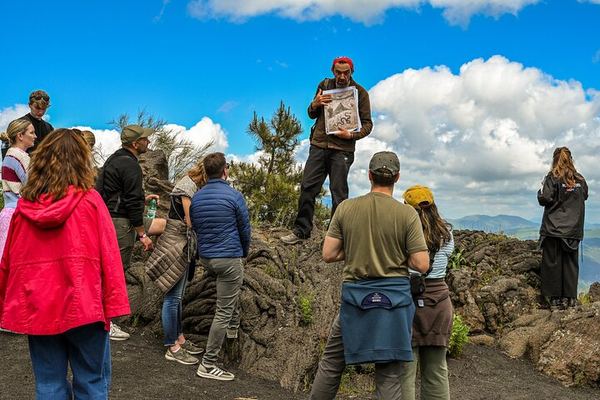
Pompeii and Vesuvius from Naples with an Archaeologist, a Mountain Guide and Lunch
An archaeologist leads the two hours inside Pompeii and a mountain guide takes the crater, with skip-the-line entry at both gates and lunch in between.
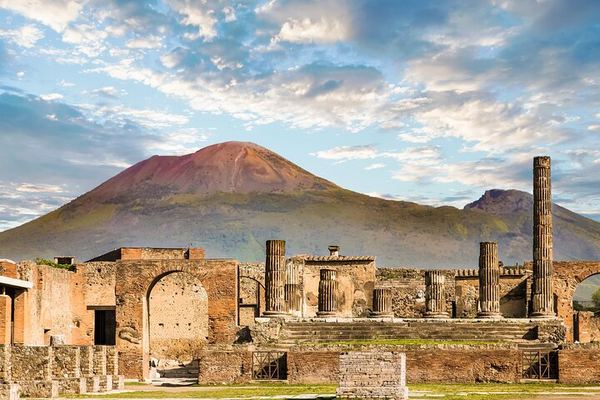
Pompeii from Rome with City Wonders: Vesuvius Crater or a Geologist's Walk
City Wonders runs it from Piazza del Popolo, and Vesuvius splits two ways: a hike to the crater rim, or a naturalistic walk with a professional geologist.

Pompeii Guided Tour & Horse Riding on Vesuvius with Lunch
Skip-the-line Pompeii with an archaeologist, lunch and Vesuvian wine at a ranch, then a guided ride at 500 metres. The horses go at a walk, not a gallop.
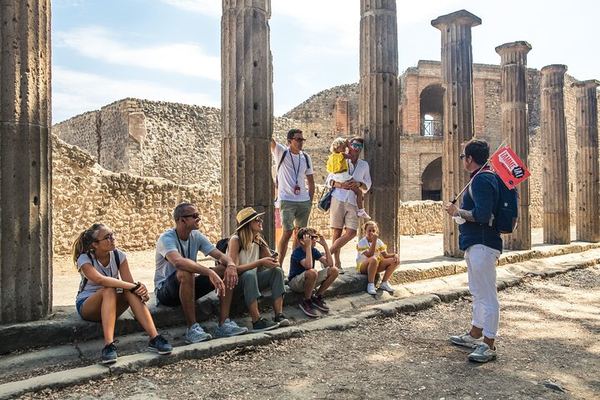
Pompeii in Two and a Half Hours, then Vesuvius at 1,280 m
An early departure to beat the queues, two and a half guided hours inside Pompeii, and the last 200 metres of Vesuvius on foot to the crater rim at 1,280 m.
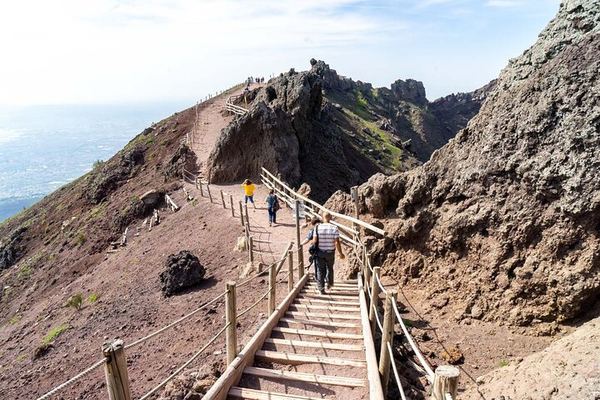
Pompeii Tickets, Lunch, and a Mountain Guide at the Crater
Entrance tickets and a light lunch are in the price, and a mountain guide meets the group at the crater rim of Vesuvius, 1,280 metres up. Sorrento or Naples.
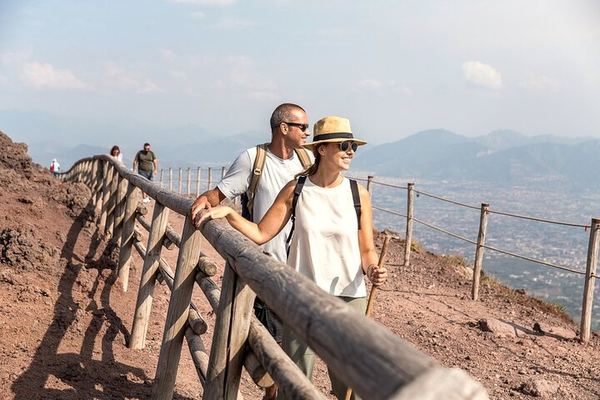
Pompeii with a Guide for 2h30, Then the Last 200 m up Vesuvius
Two and a half hours in Pompeii with a guide and skip-the-line entry, then the coach to 1,000 metres on Vesuvius and the last 200 on foot to the crater.
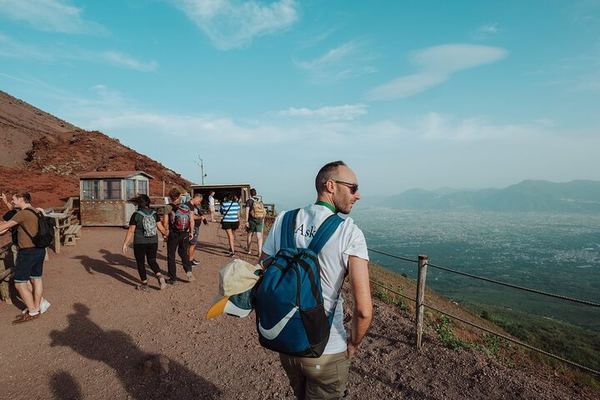
Pompeii with an Archaeologist, Vesuvius with a Hiking Guide
An archaeologist at Pompeii and a hiking guide on the volcano, with a minibus for up to 14 in between. The crater still smokes; closed shoes are essential.
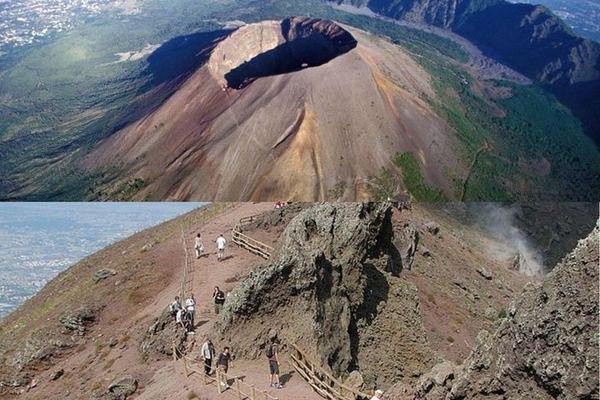
Two Hours in West Pompeii, Then the Gran Cono Path
Two hours in the western half of Pompeii with an archaeological guide, then the Gran Cono path to the crater from the square at 1,000 metres. Hotel pick-up.
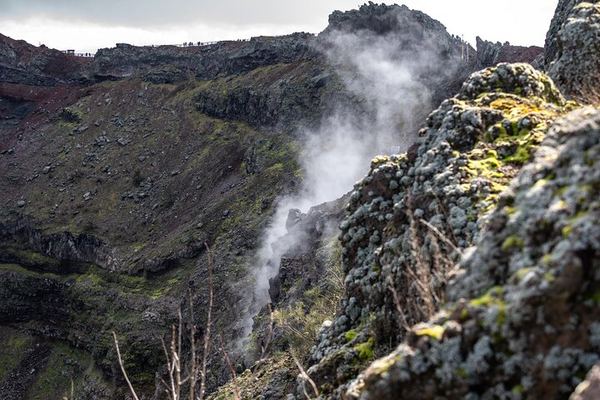
Vesuvius First, Then Pizza, Then Pompeii
Vesuvius to the crater at 1,281 metres with an alpine guide, a Margherita or Marinara on the slopes, then two hours in Pompeii with an authorised guide.
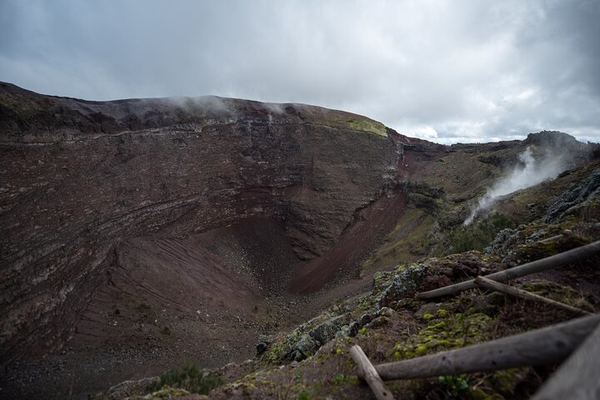
Vesuvius First, then Pompeii, with a Margherita or Marinara in Between
Vesuvius comes first, then pizza on its slopes, Margherita or Marinara, and Pompeii with an authorised guide in the afternoon. Sorrento or Vico Equense.
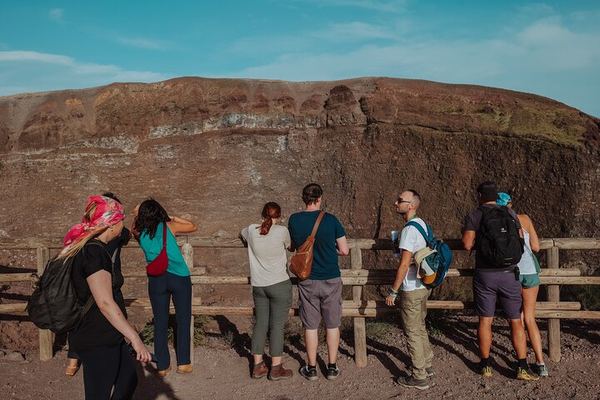
Vesuvius Only, Picked Up at the Pompeii Gate
The volcano on its own, with pick-up at the Pompeii gate and a hiking guide for the climb. The first 30 minutes from the entrance are the steep part. Minibus.
Ratings collected by Viator and Tripadvisor
Which site comes first, and why it is rarely your decision
Both orders exist in this catalogue. One operator meets you at the main entrance of Pompeii and drives up the mountain afterwards. Another starts by climbing to a thousand metres and leaves the ruins for the afternoon. Neither is a philosophy. Both are working backwards from an entry slot.
Vesuvius sells its crater tickets online only, in ten-minute slots, capped at 360 visitors an hour. Pompeii, since 15 November 2024, issues nominative tickets and admits a maximum of 20,000 people a day, with time slots running from the middle of March. Two capped, timed sites in one day leave an operator with exactly one degree of freedom, and it is not the one you care about. When two tours look identical and run in opposite orders, the difference is usually just which slot each of them could get.
If the choice does fall to you, take the volcano first between June and September. The cone is bare dark gravel that stores heat all morning, there is no shade on any part of it, and afternoon storms close the path without notice. Between November and March do the ruins first, because the summit often sits inside cloud until the sun has been on it for a couple of hours, and paying to walk up into a white wall is the most common complaint about this day.
How far you actually walk
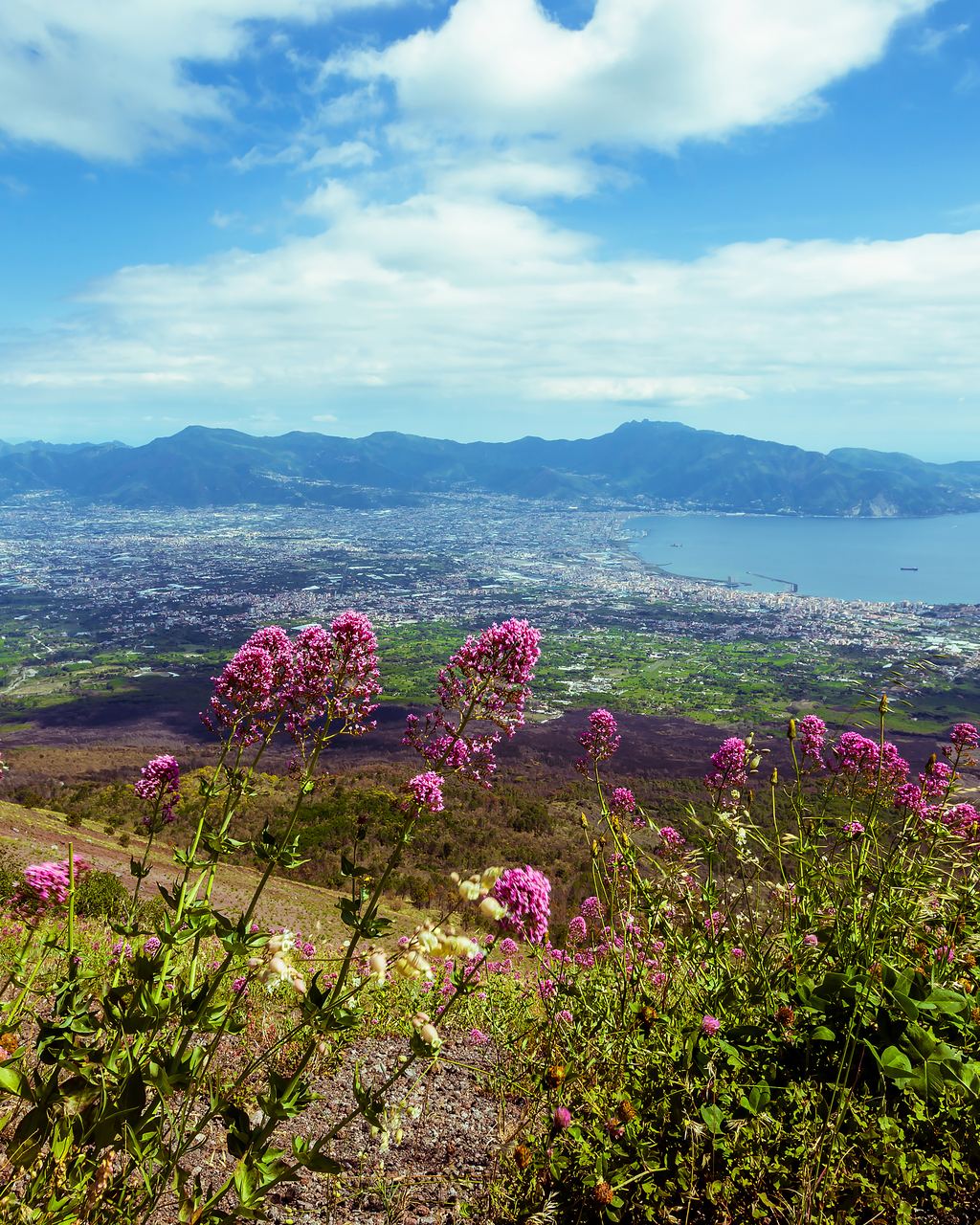
Nobody mentions this before you book, and it is what ruins the afternoon for people in the wrong shoes. A guided route through Pompeii covers two to three kilometres, all of it on Roman basalt paving with deep cart ruts, raised stepping stones at the junctions and a high kerb at every crossing. It is uneven in a way no modern street is, and between eleven and four there is almost nowhere to stand out of the sun.
Then the volcano. Path no. 5 runs 4.010 kilometres there and back from San Vito at about a thousand metres to a high point of 1,175, so roughly 175 metres of climbing on loose lapilli, and the park allows two and a half hours for it. Six to eight kilometres on hard, uneven, largely unshaded ground is a normal total for this day. Carry more water than feels sensible and wear something closed with a grip on the sole. It is the descent off the cone, not the climb, that puts people on the ground.
| You start in | Listings | Price | Typical day | What it costs you |
|---|---|---|---|---|
| Naples | 4 | 92 to 128 EUR | 8 to 9 hours | Shortest transfers and the most departures to choose from |
| Sorrento | 4 | 71 to 169 EUR | 9 to 10 hours | An hour each way on the coast road, at both ends of the day |
| Pompeii | 3 | 65 to 165 EUR | 5 to 8 hours | You are already at one of the two sites, so only the volcano is a drive |
| Rome | 1 | from 68 EUR | 12 hours or more | Vesuvius is a paid upgrade rather than part of the headline price |
What priority access buys at Pompeii, and what it does not
Eight of these twelve titles promise skip the line or priority access, and the phrase has been worn smooth by overuse. At Pompeii it means something specific, and it is worth knowing exactly what.
Since November 2024 the ticket carries the visitor's name, and the site admits twenty thousand people a day and no more, fifteen thousand of them in the morning band. What an operator sells you is a named, time-slotted place inside that cap, bought in advance. On a Saturday in August that is not a shortcut past a queue, it is the difference between getting in and being turned away. On a Wednesday in February it is worth nothing, because there is no queue and no pressure on the cap, and it should not carry a premium.
No ticket of any kind thins the crowd once you are inside. The Forum, the House of the Faun and the brothel on Vicolo del Lupanare are congested from mid-morning whatever you paid, and the fix is not a better ticket but a better entrance. Pompeii has three: Porta Marina, Piazza Esedra and Piazza Anfiteatro. The last is the quiet one, at the far end of the city from the coach parks, and an operator who uses it is telling you how many times it has done this before.
A cloud was rising, and its shape was like a pine tree, for it rose to a great height on a sort of trunk and then split off into branches.
The date on the plaque is probably wrong
Everybody is told 24 August, AD 79. That date reaches us through the manuscripts of Pliny the Younger's two letters to Tacitus, written around twenty-five years after the event by a seventeen-year-old's memory, and the surviving manuscripts do not agree with one another about what it says.
In October 2018, excavators working in Regio V, a block that had never been fully dug, found a line of charcoal writing on a wall in a house under repair. It was a workman's scribble of the kind that gets painted over within weeks, and it carried a date: the sixteenth day before the calends of November, which is 17 October. Charcoal writing does not survive a winter on a wall, so somebody was working in that room in the autumn, and the eruption has to come after it.
It fits what the site had already been saying for years. The storerooms held pomegranates, walnuts and dried figs, all autumn produce. Braziers had been set up in the houses, which nobody does in a Campanian August. Some of the victims were dressed more heavily than a summer needs. And the wind that carried the column south-east over Pompeii rather than north over Naples follows the autumn pattern rather than the summer one.
The argument is not formally closed and the old date still sits on plenty of signage. It is, though, the single best question to put to a guide, because you will know within four seconds whether they are reading from a script or thinking.
What is in the price, and what is waiting for you at the gate
Two entrance tickets belong to this day, and they are not always both included. Pompeii is 20 EUR on its own, 25 with the suburban villas and 30 for the Pompeii Plus route; Vesuvius is 10, with the park's own volcanological guide already inside that price. Read the inclusions rather than the headline, because a tour that covers only one of the two is not cheaper, it is smaller.
Lunch appears in half the listings and means different things. Three include a pizza, which in this part of Italy is not a compromise. One includes a winery table with the wine. The rest give you a break and a recommendation. Five of the twelve are listed with a discount of between five and twenty per cent off a higher figure, so compare the money you actually hand over rather than the size of the percentage.
Radio headsets are standard for any group larger than a handful at Pompeii and are usually in the price. If a listing does not mention them and the group is big, expect to catch about a third of what the guide is saying.
Bags are limited to 30 by 30 by 15 centimetres. Anything larger goes into the free left luggage at the entrance, which has its own queue at the busy end of the morning. Water is the one thing you need not carry much of: the ancient street fountains have been re-plumbed and run drinking water, which is a small and unreasonably satisfying thing about the place.
| 1 | 2 | 3 | 4 | 5 | 6 | 7 | 8 | 9 | 10 | 11 | 12 |
Questions people actually ask
Can you really do Pompeii and Vesuvius in one day?
Yes, and twelve tours here are built to do exactly that. Seven to ten hours depending on where you start. The constraint is not the distance between them, which is half an hour, but the fact that both sites are capped and timed, so the day has to be assembled around two fixed slots rather than around your morning.
Which one should I do first?
Usually you do not get to choose, because the operator has built the day around the crater slot it was able to book. Where there is a choice: volcano first from June to September, because the cone bakes by late morning and storms close the path in the afternoon. Ruins first from November to March, because the summit tends to sit in cloud until midday.
How much walking is involved?
Six to eight kilometres in total, and almost none of it on flat modern surfaces. Pompeii is two to three kilometres of Roman basalt with cart ruts and high kerbs. The Vesuvius path adds four kilometres there and back with about 175 metres of climb on loose gravel, and the park allows two and a half hours for it. Closed shoes with grip, and more water than you think.
Is skip-the-line worth paying for at Pompeii?
In July and August, yes, and not for the reason people assume. Pompeii admits twenty thousand visitors a day and issues named, time-slotted tickets, so a pre-booked place is insurance against the cap rather than a shortcut past a queue. In winter it buys you almost nothing, because there is no queue to skip.
How much does a Pompeii and Vesuvius tour cost?
From 65 to 169 EUR, with a median of 98. The two entrances behind it are 20 EUR for Pompeii and 10 for Vesuvius, so most of what you pay is transport, guiding and lunch. Sorrento departures sit at the top because they are an hour further away at both ends of the day.
Is it worth doing this as a day trip from Rome?
Only if Naples is not on your itinerary at all. There is one listing here that runs from Rome, and it carries more reviews than anything else in the area, but it is twelve hours or more with most of that on a coach, and the volcano is an optional upgrade rather than part of the price you first see. From Naples or Sorrento the same day costs you four fewer hours of motorway.
If I only have time for one, which half do I keep?
Pompeii, without much hesitation. The crater is a two-hour walk to a view, and the view exists from a dozen other places around the bay. Pompeii is a Roman city with its streets, its shops, its graffiti and its water system still in place, and there is nowhere else on earth quite like it. Keep the ruins and look at the volcano from the ruins, which is the angle the eruption came from anyway.
Data verified on. Prices and counts from the 12 combined listings on this site. Cap, nominative tickets, entry prices and bag limit from the Parco Archeologico di Pompei; path data from the Parco Nazionale del Vesuvio.