

Sete Cidades & Lagoa do Fogo Tours
Two lakes in a caldera six kilometres by five, one green and one blue, and a second volcano in the afternoon.
Sete Cidades is a hole in the western end of São Miguel, six kilometres across, with two lakes on the floor and a village between them. The walls stand 200 metres above the water on one side and 500 on the other. Most people see it from a railing at Vista do Rei and leave twenty minutes later, which is a reasonable way to spend a morning and about a third of what the place is. The other two thirds are the tracks along the rim, the floor of the caldera itself, and the second volcano that half of these tours visit after lunch.
This page is about the area rather than the island. What follows is the difference between the vehicles people sell you, which viewpoint is worth the walk, why the two lakes are different colours, and what happens to your booking when the cloud sits below the rim. The wider island, the drive times and the choice between a hire car and a guide are on the São Miguel page above.
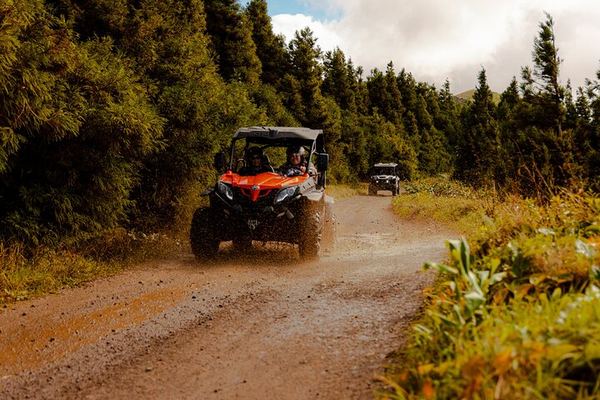
Buggy to Pico da Cruz at 845 m and the Old Whale Factory
A side-by-side buggy over tarmac and dirt to Pico da Cruz at 845 metres, with the Blue Lagoon tracks and the whale factory chimney at São Vicente Ferreira.
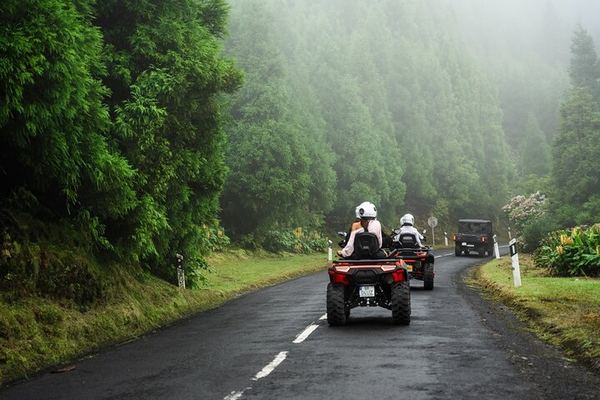
By Buggy to the Sete Cidades Crater and the Abandoned Hotel
Tracks on the crater rim that cars cannot use, the lookout over both lagoons at Cumeeiras, and the abandoned Hotel das Sete Cidades at the Vista do Rei.
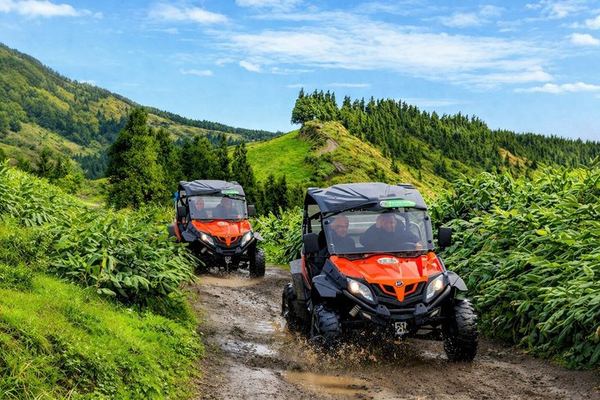
Driving Your Own Buggy Around the Sete Cidades Caldera: 5 km Across, 400 m Deep
Why one lagoon is green and the other blue has a physical answer, not just the legend, and you get to both viewpoints driving the buggy yourself.
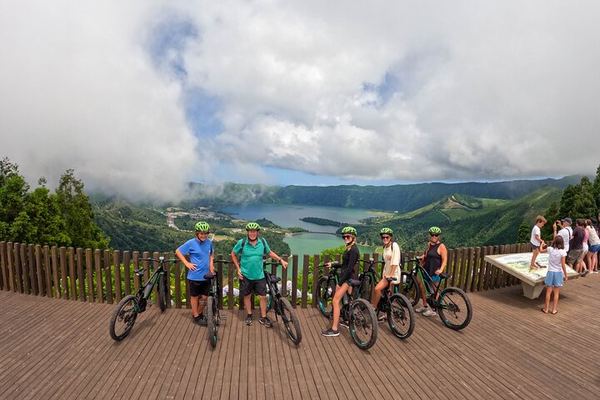
E-Bike Into the Sete Cidades Crater, with the Climb Back Assisted
An e-bike along the crater rim at Sete Cidades and down to the green and blue lakes, with the motor doing the 300-metre climb back and a stop at Santiago.
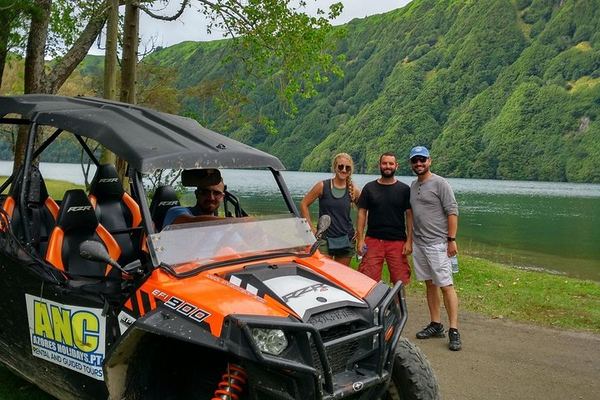
Half-Day Shared Buggy to Sete Cidades and Pico do Carvão
A shared buggy on the tracks above the Sete Cidades crater, by way of Pico do Carvão and Vista do Rei. A licence valid in Portugal is needed to drive.
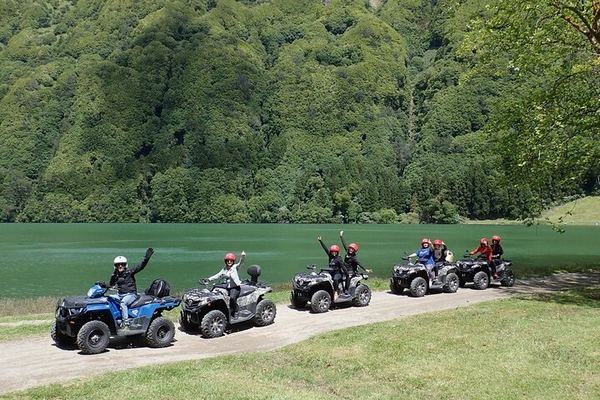
Off-Road to the Sete Cidades Caldera, One Quad Between Two
One quad between two around the Sete Cidades caldera, with the green and blue lakes below. Drivers need a licence valid in Portugal and sign a liability form.
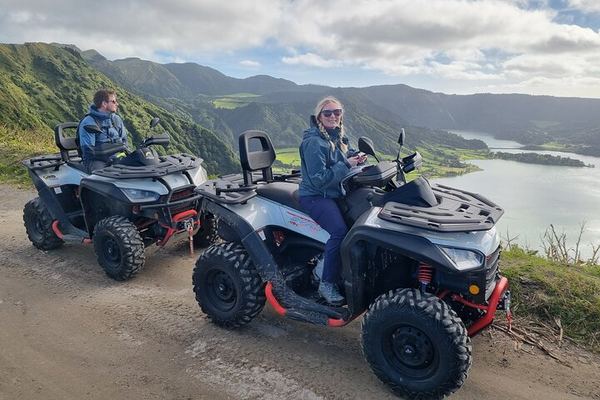
Quads on the Azores Rallye Trails, above Sete Cidades
You drive the quad, on tracks that are stages of the Azores Airlines Rallye, up to 845 metres at Pico da Cruz with all four lagoons in view below. Half day.
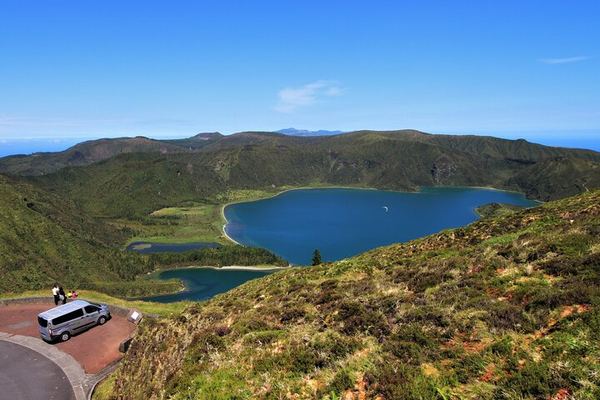
Sete Cidades and Lagoa do Fogo by Electric Van, Eight Seats
Eleven stops across western São Miguel in a fully electric van with eight seats, from Pico do Carvão to Lagoa do Fogo, with an Azorean lunch included.
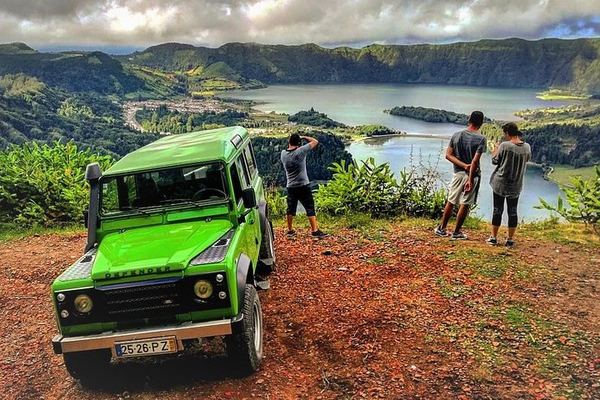
Sete Cidades and Lagoa do Fogo by Jeep, over Pico da Barrosa
A full day by jeep over the rim of Sete Cidades at 650 metres and the 947-metre Pico da Barrosa, with lunch and drinks at a local restaurant included.
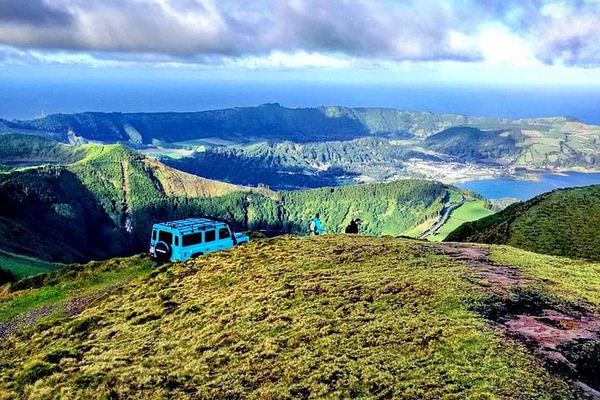
Sete Cidades by Land Rover on the Crater Rim Track
Land Rovers on the dirt track around the crater rim, a stop inside at the church of São Nicolau, and the green and blue lakes from the bridge between them.
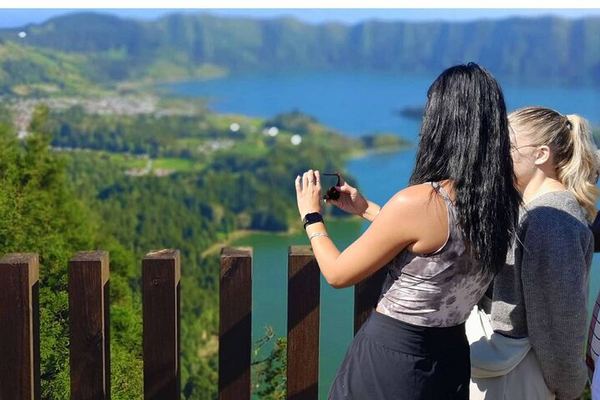
Sete Cidades for Cruise Passengers, with the Pineapple Greenhouses
A cruise call spent at the pineapple greenhouses with a liqueur tasting, the blue and green lakes from Vista do Rei, and the cliffs at Escalvado. Back on time.
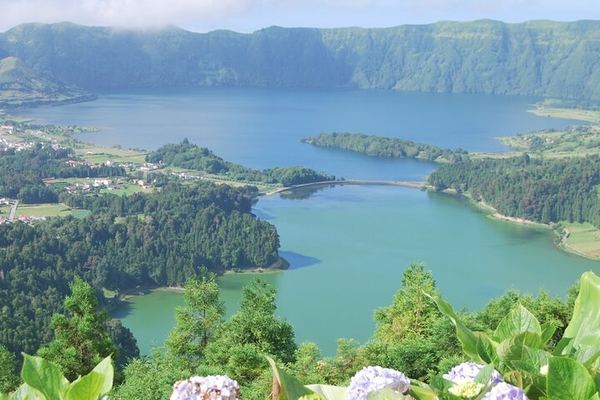
West São Miguel: a Whaling Lookout, 947 Metres Over Lagoa do Fogo, Lunch Included
The westernmost point on this route was a whaling lookout, and the afternoon reaches 947 metres over Lagoa do Fogo. Lunch, drinks and dessert are included.
Ratings collected by Viator and Tripadvisor
Why one lake is green and the other is blue
The two lakes are one body of water. They meet at a narrow strait with a road bridge over it, and the water passes underneath. That single fact rules out the explanation most people reach for: there is no chemical difference between the blue lake and the green one.
What differs is depth and what is suspended in the water. Lagoa Verde is the shallower of the two, tucked against the wooded western wall, and it carries cyanobacteria all year round. Lagoa Azul is deeper and more open to the sky, and its phytoplankton comes and goes with the season. Depth and suspended material decide which wavelengths come back out, so the shallow lake under the trees returns green and the deep open one returns the colour of the sky above it. From Vista do Rei on a clear afternoon the line between them is sharp enough to look edited.
The legend is far better known than the optics, and it is worth telling as a legend. A princess with green eyes, a shepherd with blue ones, a king who forbade the whole thing, and two lakes made out of their crying. It is folklore, and one of the jeep operators on this page still sells the trip as a look at "the twin lake with the princesses and sheppards tears". There is nothing wrong with that, as long as nobody offers it to you as the reason for the colours.
The caldera did not collapse once
Sete Cidades is, by the count in the published volcanological record, the most active volcano in the Azores: seventeen eruptions in the last five thousand years. The caldera you look into is the product of three separate collapses spread over twenty thousand years, and the smaller cones and maars scattered across its floor came afterwards. One of the buggy operators tells guests the volcano is thirty-six thousand years old, which is close enough to the first collapse to be fair.
How the hole got there
Four dates from the published record, and two that matter to the visit.
The origins
35,700 years ago
The first collapse
The summit of the volcano dropped into its own emptied chamber and the caldera opened for the first time.
28,750 years ago
The second collapse
A second collapse widened it. The floor was still dry ground.
15,740 years ago
The third collapse
The last of the three, and the one that gave the caldera the outline you photograph. The lakes filled the floor after it.
The growth
Around 500 AD
The last eruption inside the caldera
A cone called Caldeira Seca built up on the floor. Nobody watched it: the Portuguese arrived roughly nine centuries later.
1563
The neighbour erupts instead
Água de Pau, the volcano that holds Lagoa do Fogo, produces a hydromagmatic eruption inside its caldera followed four days later by lava. It has done nothing since.
Today
18 June 1982
Lagoa do Fogo becomes a nature reserve
No road reaches the shore and nothing is built inside the crater. That is a legal condition rather than an accident, and it is why the afternoon half of these tours looks the way it does.
Jeep, quad, buggy, bike or van
Twelve products cover this area and the real choice is what you sit in, because the route barely changes. Everything goes up onto the rim, most things come down to the village, and the difference is whether you are driving, being driven, or pedalling.
The jeeps take the unpaved rim tracks that a hire car is not allowed on, and they are the highest-rated things here: the half-day at 48 EUR holds a 5.0 across 642 reviews. The quads and buggies go to the same places with more noise and more of your own effort, and they are the ones with a licence requirement. The small-group van is the comfortable version and includes lunch. The e-bike is the outlier and probably the best of them for anyone reasonably fit: it runs the rim and then drops into the caldera to the village, which is a descent nobody else offers.
| Vehicle | Price | How long | What it means |
|---|---|---|---|
| Jeep, shared, half day | 48 EUR | 3.5 hours | Rim tracks a hire car cannot use. Rated 5.0 across 642 reviews |
| Jeep, full day with lunch | 80 to 90 EUR | 8 hours | Adds Lagoa do Fogo after lunch |
| Small-group van, full day with lunch | 85 EUR | 8 hours | Electric van, eight guests, 20-minute walk each way to Boca do Inferno |
| Buggy, shared | 69 to 80 EUR | 3 to 4 hours | Driving licence valid in Portugal required to drive |
| Quad or ATV | 79 to 140 EUR | 3 to 4 hours | The 140 EUR one is a two-seat quad, priced per vehicle |
| Side by side | 79 EUR | 3 to 4 hours | The family version of the quad day |
| E-bike on the rim | 75 EUR | Half day | Rides the crater rim, then descends inside to the village |
| Cruise-passenger van | 46 EUR | Half day | Timed to the ship, with a pineapple plantation attached |
Lagoa do Fogo is a different volcano
Half the products here put Lagoa do Fogo in the afternoon, and it is worth knowing that you change volcano when you get back into the vehicle. Fogo is not part of Sete Cidades. It sits in the Água de Pau massif in the middle of the island, its inner caldera collapsed about fifteen thousand years ago, and its last eruption was in 1563.
The lake surface is at 575 metres and the rim above it reaches about 949. The water is three kilometres by two and a half and thirty metres deep. There is no road to the shore, no house on it, and nothing built inside the crater at all, because the basin has been a nature reserve since 18 June 1982. What every tour on this page gives you is the pull-off on the Serra da Barrosa road, on the flank of Pico da Barrosa at around 947 metres, looking down onto it.
Getting to the water is a walk, it is in none of these products, and it is a real descent and a real climb back out. The footwear people arrive in is the reason most of them turn round.
Four viewpoints, and which one earns the walk
Vista do Rei is the one on the postcards, on the southern rim at about 650 metres, with both lakes below it and the shell of the abandoned Monte Palace hotel beside it. It is also where the coaches stop, and the railing is the reason people leave disappointed.
Boca do Inferno is the better photograph and it costs you a walk. One operator states twenty minutes each way on a path and says plainly that it is not suitable for guests with limited mobility. It looks along the caldera instead of across it and takes in Lagoa de Santiago as well as the twin lakes.
Miradouro da Lagoa de Santiago and Lagoa do Canário are the quiet ones, and several operators stop at them precisely because Vista do Rei is full. Down on the floor, the village of Sete Cidades has a church, a café and the bridge over the strait. Standing on that bridge is the cheapest possible way to understand that the two lakes are one lake.
One more thing appears in two of the jeep itineraries and gets no explanation from anybody: the Muro das Nove Janelas, a stone wall on the rim pierced by nine arched openings.
| 1 | 2 | 3 | 4 | 5 | 6 | 7 | 8 | 9 | 10 | 11 | 12 |
Should all of our Land Rover Defenders be sold out we may offer a Smaller 4X4 Suv.
The things that are not in the listing
Four things about this area that change what you get, and none of them are in the price.
The 140 EUR quad is priced per vehicle, not per person. It seats two. Set against the 79 EUR single quad it is the cheaper option for a couple, and it looks like the most expensive thing on the page.
You need a driving licence valid in Portugal to drive anything with an engine. Two operators state it in their own text and say they check it before departure. Riding as a passenger is possible; a discount for doing so is not.
The 46 EUR product is a cruise excursion. It is timed to the ship and part of its morning goes to a pineapple plantation. If you are not on a ship, the 48 EUR jeep is a longer day in the caldera for two euros more.
Nobody refunds a cloudy viewpoint. What the better operators do instead is reverse the running order and put Sete Cidades in the afternoon when the morning is closed in. The small-group products are the ones with the flexibility to do it; a van of thirty on a fixed circuit is not.
Questions people actually ask
Why is one Sete Cidades lake green and the other blue?
Because of depth and what is suspended in the water, not chemistry. They are hydrologically a single lake joined by a strait under a road bridge. Lagoa Verde is shallower, sits under the wooded western wall and carries cyanobacteria all year; Lagoa Azul is deeper and more open, so it returns the colour of the sky. The story about the princess and the shepherd crying two lakes is folklore, and a good one, but it is not an explanation.
Can you walk around the whole crater?
Yes. The trail around the caldera rim is about twelve kilometres and takes three to four hours at a walking pace, with the two lakes below you for most of it. It is not part of any product on this page, all of which are vehicle-based, so it is a hire-car-and-your-own-legs day. Start early: the same cloud that closes the viewpoints closes the whole rim.
Jeep, quad or buggy: which should I book?
Jeep if you want to look out of the window, quad or buggy if the driving is the point. The jeeps reach unpaved rim tracks that are closed to hire cars and they are the highest-rated products here. The quads and buggies cover much the same ground with you at the controls, which is either the appeal or the problem, and they require a licence valid in Portugal. The e-bike at 75 EUR is the one that gets you inside the caldera under your own power.
Do Sete Cidades and Lagoa do Fogo fit into one day?
They do, and that is exactly what the 80 to 90 EUR full days are: Sete Cidades in the morning, lunch, Lagoa do Fogo in the afternoon, back to Ponta Delgada by early evening. Eight hours. The two are different volcanoes about forty minutes apart and neither needs more than half a day on its own, so the pairing is the sensible one rather than a compromise.
Is Vista do Rei free to visit?
Yes. It is a public viewpoint on a public road with a car park, and you can drive to it in a hire car for the price of the fuel. What the tours sell is everything the viewpoint is not: the unpaved rim tracks, the floor of the caldera, the walk to Boca do Inferno, and somebody who knows before you set off whether the rim is in cloud today.
What happens if it is cloudy?
You see cloud. The viewpoints are between 650 and 950 metres and from November to March the cloud base is usually underneath them, which is the single biggest reason people come away flat. There is no refund for weather anywhere in the Azores. The practical defences are to book early in your stay so you can go twice, to take a small-group tour that can flip its running order, and to keep the Furnas valley for the day that looks worst.
Data verified on. Prices, durations and inclusions read from the twelve products on this page. Caldera dimensions and eruption dates from the published volcanological record for São Miguel.