
Volcano Hikes & Eruption Sites, Reykjanes
Twelve guided walks onto the lava that came out of the ground between 2021 and 2025, from 100 EUR. Nothing has erupted in Iceland since August 2025.
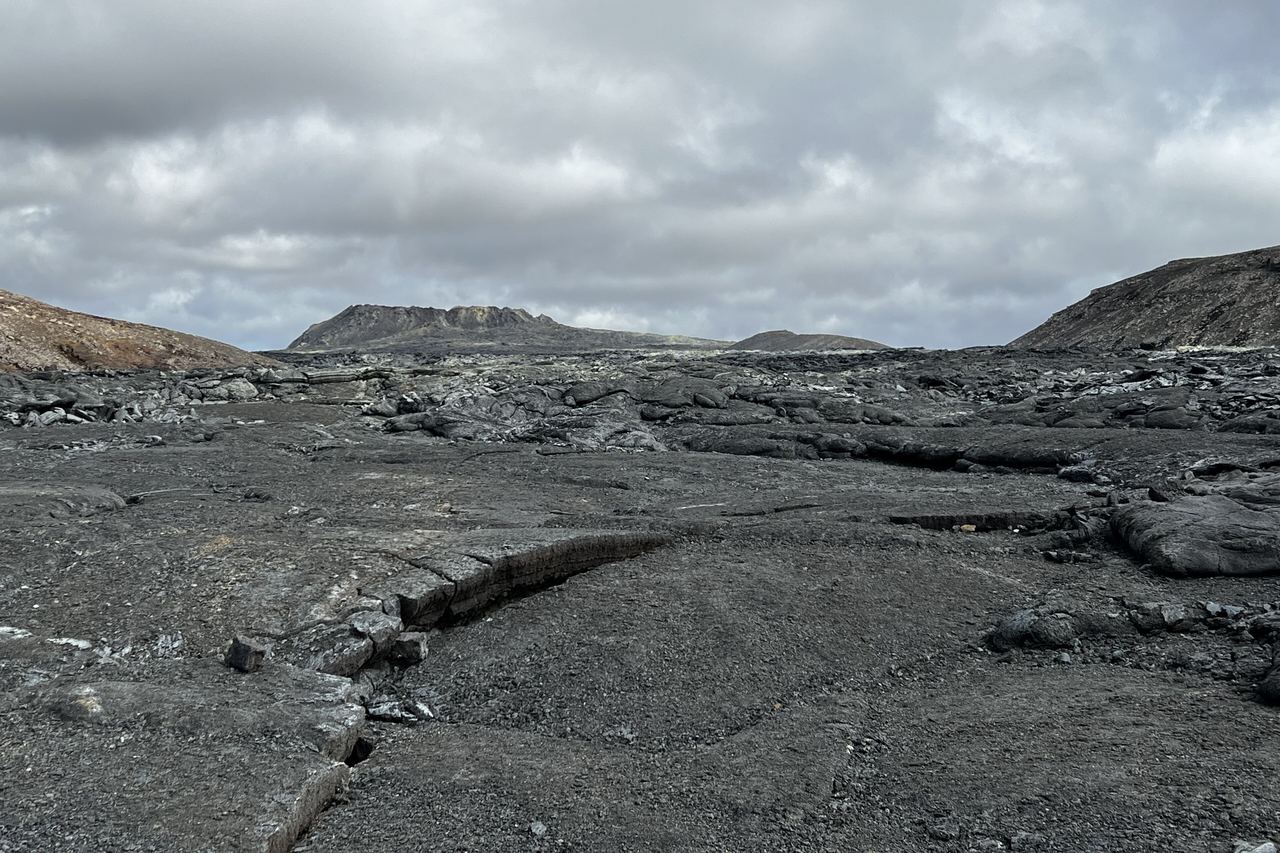
Between 19 March 2021 and the first week of August 2025 the Reykjanes peninsula erupted twelve times. It has not erupted since. That single sentence is the most useful thing on this page, because almost every photograph used to sell these tours was taken during those four and a half years, and what you walk on today is the same rock with the heat gone out of it. It is a genuinely good day out. It is not an eruption, and a few listings are still worded as though it might be.
What this page covers is the ground itself: which flow each tour walks on, how old it is, what the surface is like underfoot, and which of the twelve listings describes honestly what it is selling. The eruption sequence as national history, and what it did to the town of Grindavík, is on the Iceland page above.
An Hour over Reykjanes by Helicopter, Seltún to the Blue Lagoon
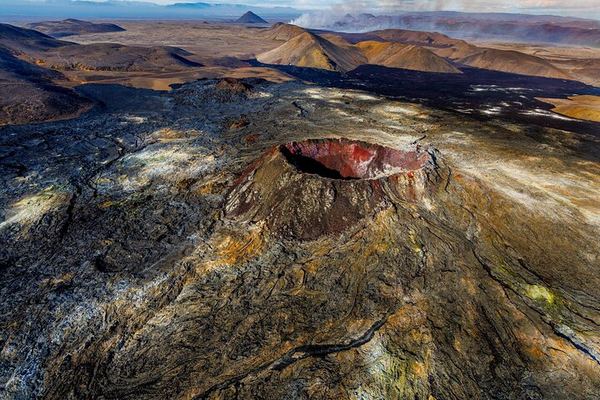
One hour above the Seltún geothermal field, Grænavatn and Kleifarvatn, the lava fields and the Blue Lagoon. Departure is the east side of the city airport.
Fagradalsfjall and Meradalir, and the 2023 Sundhnúkur Scars
The peninsula erupted in 2021, 2022 and 2023, and the route across those sites depends on the weather and on what is judged safe that day. Sundhnúkur included.
Fagradalsfjall and Meradalir Hike, then the Blue Lagoon: Admission Included
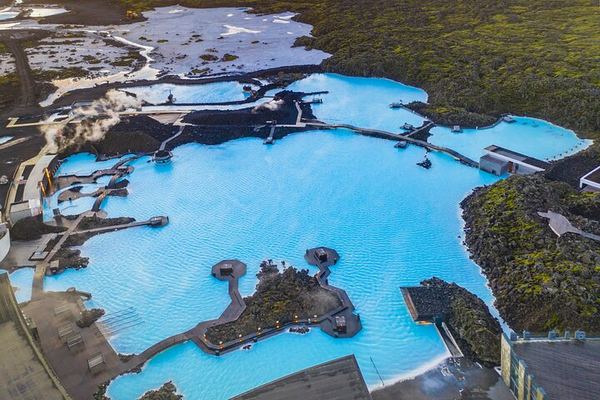
Two hours of walking each way to the 2021 eruption field, then the Blue Lagoon with entry included. Waterproofs and proper shoes needed; jeans are a mistake.
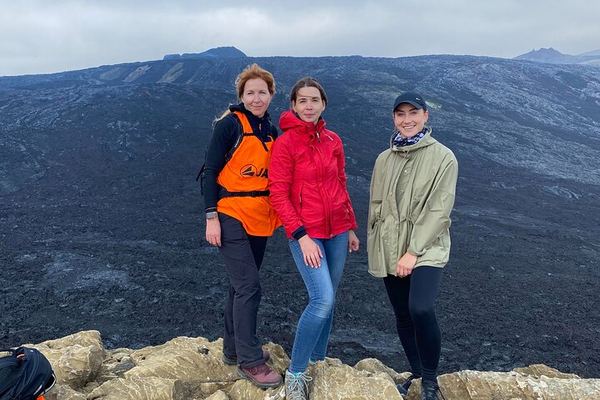
Fagradalsfjall and Reykjanes: Walk Between Two Continents on a 15-Metre Bridge
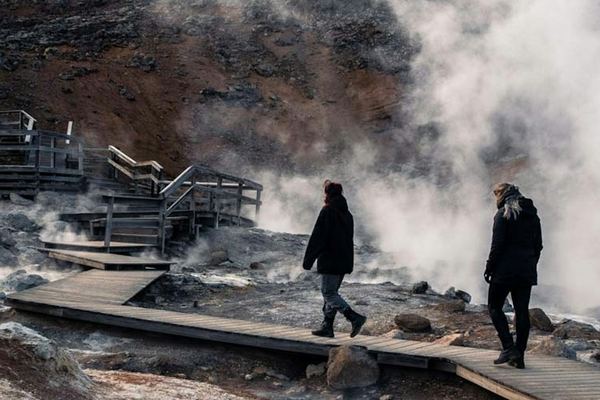
A moderate hike onto the July 2023 lava, then a 15-metre bridge from the Eurasian plate to the American one, a lighthouse and the mud pots at Gunnuhver.
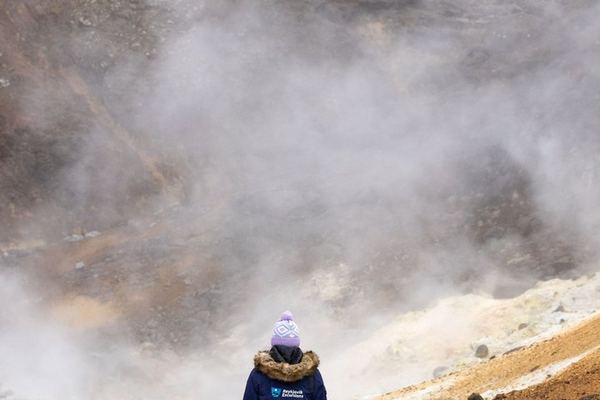
Fagradalsfjall in 45 Minutes and Grindavik's Lava Barriers
A 45-minute walk to the viewpoint, short enough for most people, then the barriers Grindavik's residents built against the lava. Seltun's mud pools first.
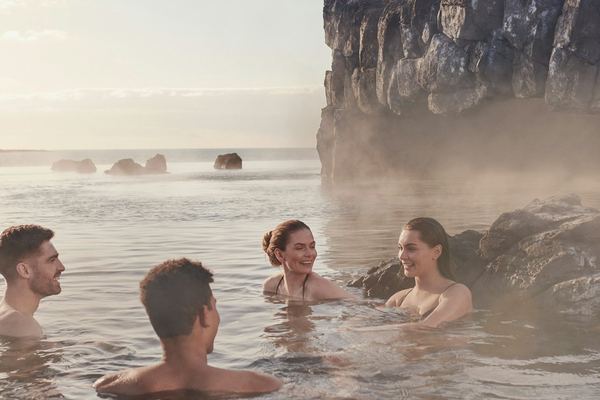
Fagradalsfjall, then the Seven-Step Ritual at Sky Lagoon
A walk up to the viewpoint over Iceland's youngest volcano, then the seven-step ritual at Sky Lagoon. The peninsula sits where the two plates pull apart.
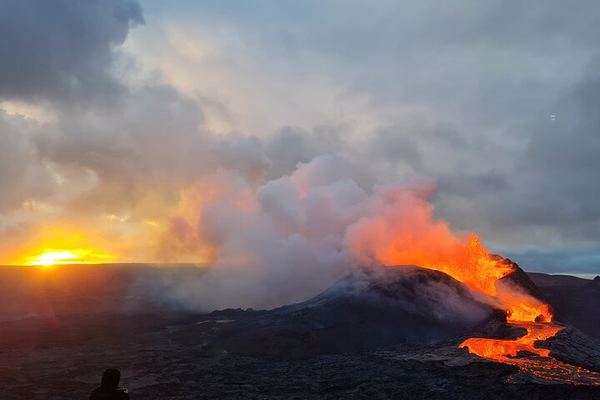
Fagradalsfjall with a Geologist, an Hour and a Half Each Way
A geologist leads the walk over lava that came out in 2021, up to an hour and a half each way. Glowing lava is never guaranteed. Small group from Reykjavík.
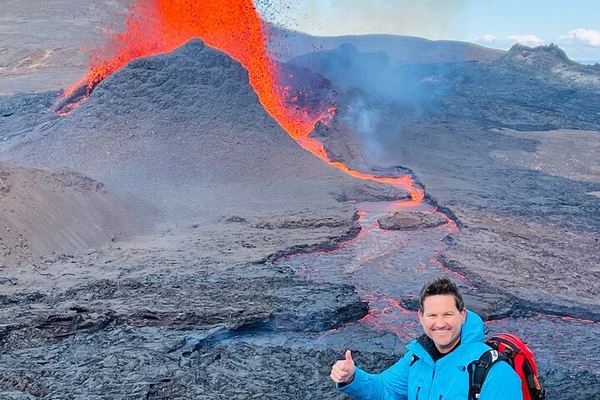
Fagradalsfjall with the First Local Guides: 8 km on Lava Laid Since 2021
Guides from Grindavik who lived through the eruptions, on lava laid as recently as July 2025. The Reykjavik pick-up adds three stops the self-drive option lacks.
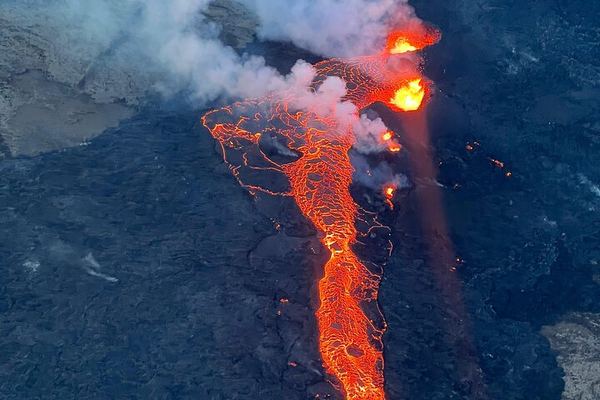
Helicopter over the Reykjanes Eruption Site, Minimum Four to Fly
A 5 to 6 seat helicopter over the lava fields and craters left by the Reykjanes eruptions. The volcano is not active, and four passengers are needed to fly.
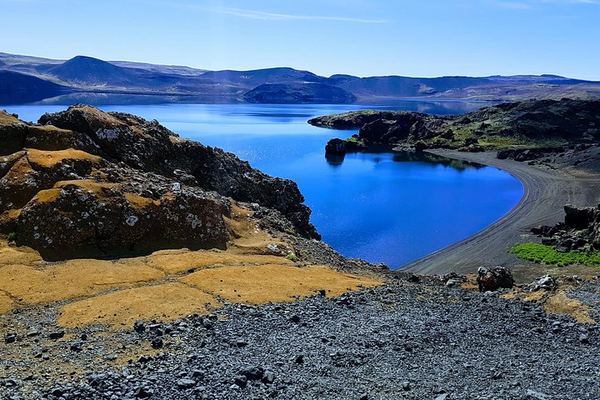
Private Reykjanes Day: a 50-Minute Volcano Film First, Then the Craters
It starts with a documentary at the Volcano House, then a private minivan to the craters half an hour away. Trolls and Norse gods come with the geology.
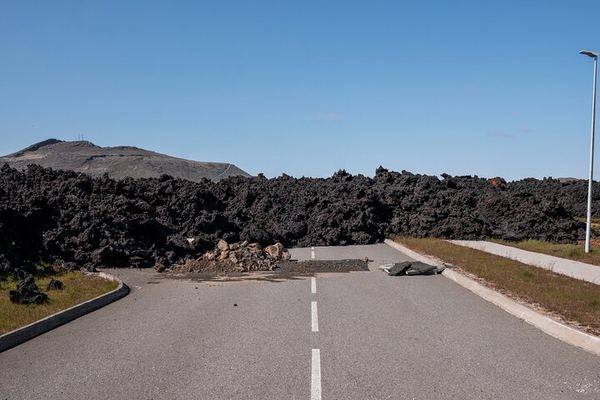
Reykjanes and Grindavík by Minibus, the Town the Lava Emptied
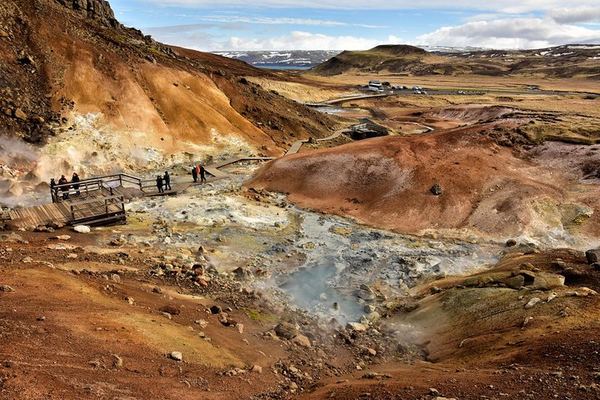
Half a day from Reykjavík over the Reykjanes peninsula: the 97-metre-deep Kleifarvatn, the mud pools at Seltún, and Grindavík after the 2023 eruptions.
Reykjanes Geopark in Seven Hours, with Drop-Off at the Airport or Blue Lagoon
Seven hours round the peninsula, ending at Keflavik airport or the Blue Lagoon if you want. The green lake, the oldest lighthouse, and Grindavik's new lava.
Ratings collected by Viator, Tripadvisor and Tiqets
What is actually on the ground now
The Reykjanes peninsula had produced nothing for 815 years before 2021. The last comparable episode, known as the Reykjanes Fires, ended in 1240. Then in four and a half years it built four separate lava fields, and those four fields are the entire product on this page.
The oldest and largest is Fagradalsfjall 2021, which ran for 181 days from 19 March, the longest Icelandic eruption of this century, and left about 4.8 square kilometres of new rock in the Geldingadalir valleys. Most tours go here, because it is the most walkable and the cone is still recognisable as a cone. Next to it is the smaller 2022 flow, eighteen days in August, and beyond that Litli-Hrútur from July 2023, twenty-six days and about 1.5 square kilometres. The fourth is different in character: the Sundhnúkur crater row, nine eruptions between December 2023 and July 2025, which erupted beside a town rather than in an empty valley.
Five years is nothing in geological terms and a great deal in walking terms. The 2021 field has settled, the surface has stabilised and moss has not yet started, so it is black and sharp and looks exactly like what it is. The 2025 rock is newer than most people's phones.
| When | Where | How long | What you can visit |
|---|---|---|---|
| 19 Mar to 18 Sep 2021 | Fagradalsfjall, Geldingadalir | 181 days | Yes, the main walking site, about 4.8 km² |
| 3 to 21 Aug 2022 | Fagradalsfjall, Meradalir | 18 days | Yes, usually combined with the 2021 field |
| 10 Jul to 5 Aug 2023 | Litli-Hrútur | 26 days | Yes, about 1.5 km², a longer walk in |
| 18 Dec 2023 | Sundhnúkur crater row | Days | From the road, near Grindavík |
| 14 to 16 Jan 2024 | Sundhnúkur | 3 days | Fissures opened 450 m from the houses |
| 8 to 9 Feb 2024 | Sundhnúkur | 2 days | From the road |
| 16 Mar to 9 May 2024 | Sundhnúkur | 55 days | From the road |
| 29 May to 22 Jun 2024 | Sundhnúkur | 25 days | From the road |
| 22 Aug to 5 Sep 2024 | Sundhnúkur | 15 days | Largest of the series |
| 20 Nov to 9 Dec 2024 | Sundhnúkur | 20 days | Second largest |
| 1 Apr 2025 | Sundhnúkur | About 6 hours | Briefest of the twelve |
| 16 Jul to early Aug 2025 | Sundhnúkur | About 3 weeks | The most recent lava in Iceland |
The listings that still sell an eruption
Nobody here is lying, but the copy has not all caught up. Several of these products were written while the ground was open and have been left running, so the tense is wrong rather than the content. The names give it away: eruption site hike, volcanic eruption area, newest volcano. All of those are accurate descriptions of a place and misleading descriptions of an event.
The cleanest example runs the other way. The 550.00 EUR helicopter listing states in its own description that the volcano is not currently active before describing what you will see from the air. That is the standard to hold the others to, not the exception. Where a listing does not say it, assume the ground is cold, because it is.
The test that works: if the tour promises glowing lava, ask the operator what the volcano did this week. Every honest guide on Reykjanes will tell you the same thing, and most of them will tell you before you ask.
The reason to go anyway is that a five-year-old lava field is a strange and specific thing that will not exist in this form for long. There is no vegetation on it at all. The cones are unweathered. You can see the flow direction in the surface, the pressure ridges where the crust buckled, the collapsed roofs of tubes that drained. In twenty years moss will have covered most of it and it will look like the rest of the peninsula.
What the walking is actually like
Fresh basaltic lava of the rubbly kind is the worst surface most people will ever walk on. It is sharp, it is loose, and blocks the size of a suitcase tip when you stand on them. Nothing about it resembles a path, and a fall onto it removes skin rather than bruising. This is why every tour here is guided and why they all stay on routes that have been walked in and marked.
The second reason for the marked routes is less obvious. A lava field this young is still hot inside. The surface cools within weeks; the interior of a thick flow holds heat for years, and in places a thin crust bridges a void over rock that is still very warm. Guides know which sections have been probed and which have not. Wandering off to get a better photograph is the specific behaviour that gets people hurt here.
Beyond that it is ordinary Icelandic hillwalking with no shade and no shelter. The peninsula is flat, treeless and open to the Atlantic on three sides, so wind is the variable that decides whether a tour runs. Bring waterproofs regardless of the forecast, wear boots with an ankle and a stiff sole, and take more layers than the temperature suggests, because the wind chill on an exposed lava plateau is not the number on your phone.
The twelve, sorted by what they are
| Type of day | Price | How long | Ratings |
|---|---|---|---|
| Guided hike onto the Fagradalsfjall flows | 112.59 to 182.00 EUR | Half to full day | 4.7 to 5.0 |
| Hike plus a Reykjanes sightseeing loop | 100.43 to 141.08 EUR | 6 to 7 hours | 4.7 to 4.8 |
| Hike plus Grindavík | 119.92 EUR | Full day | 4.8 |
| Hike plus a thermal lagoon | 207.61 to 244.36 EUR | Full day | 4.6 to 5.0 |
| Shared helicopter over the crater rows | 550.00 EUR | Short flight | 4.7 |
| Private helicopter or private vehicle | From 3,415 EUR | 1 hour to a full day | 4.9 to 5.0 |
Two of the twelve deserve singling out. The highest rated on the page, at a clean 5.0 across 750 reviews, is run by a local team from Grindavík who have been guiding this area since the first eruption in 2021, which means the person walking in front of you watched it happen and in all likelihood lost a house to it. The other is the 182.00 EUR small group led by a working geologist or volcanologist: more expensive, twelve people rather than thirty, and the difference is that you get answers rather than a script.
At the bottom of the range, the 100.43 EUR combination is the best value here. It puts the eruption site together with the Bridge Between Continents, the Gunnuhver hot springs, Lake Kleifarvatn and the Reykjanesviti lighthouse, which is the whole peninsula in a day for less than most single-site tours.
When the helicopter is the right answer
550.00 EUR is a lot for a short flight and it is occasionally the correct purchase, for one specific reason. On the ground a lava field reads as rubble. You are inside it, everything is black, and the scale that makes it remarkable is invisible from within. From the air the same field reads as a flow: you can see where it came from, which way it went, where it pooled and where it stopped a few hundred metres short of a road.
So the choice is not luxury against thrift. It is comprehension against contact. Most people should walk, because the surface underfoot and the smell of the rock are half of it. Anyone with limited mobility, a single day, or a genuine interest in how the flows are shaped should look hard at the flight. The private version at over 3,400 EUR adds the Seltún geothermal field and the Grænavatn and Kleifarvatn lakes on a full hour, and is priced for a whole aircraft rather than a seat.
Grindavík, and how to visit it
One listing at 119.92 EUR pairs the hike with the town. It should be said plainly what that means. Grindavík was evacuated on 10 November 2023 when magma split the ground beneath the streets, lava reached the houses in January 2024, and a community of roughly 3,000 people is now home to about a hundred. It is not a ruin and it is not a museum. It is a place where people are still deciding whether to come back.
Visiting is not automatically wrong. The guides who run these tours are largely from there, they are clear about what they want shown and what they do not, and the money goes into an economy that lost its main employer overnight. But go with a local operator rather than on your own, keep the camera pointed where the guide points it, and understand that the ground fissures through the town are the reason the barriers exist.
Season, daylight and the wind
These walks run all year and the peninsula is low, coastal and rarely snowbound, so there is no closed season to plan around. What changes is daylight and footing. Between May and August you can leave at almost any hour; in December there are roughly four usable hours and every departure is squeezed into the middle of the day.
Winter adds ice to a surface that is already the wrong shape for walking, which is the one genuine argument for going in summer. The thing that actually cancels a tour on Reykjanes, in any month, is wind: the plateau has nothing on it to break the weather, and operators call it off at thresholds that look conservative from a hotel window and are not.
Questions people actually ask
Can I see an eruption on the Reykjanes peninsula right now?
No. The twelfth and most recent eruption of the sequence began on 16 July 2025 and ended in the first week of August 2025, and nothing has erupted in Iceland since. What these tours visit is the cooled lava from 2021 to 2025, which is remarkable in its own right and is black rather than orange. Any listing promising glowing lava is describing a period that has ended.
Will it erupt again?
Almost certainly, and nobody can give you a date. The peninsula was quiet for 815 years and then produced twelve eruptions in four and a half, which volcanologists read as the resumption of a long-running cycle rather than an isolated episode. That is a statement about decades, not about your trip.
Which lava field do the tours actually walk on?
Mostly the Fagradalsfjall flows in the Geldingadalir and Meradalir valleys, from the eruptions of March 2021 and August 2022, because they are the most accessible and the cone is still intact. Some go on to the Litli-Hrútur flow of July 2023, which is a longer walk. The Sundhnúkur crater row next to Grindavík is generally seen from the road rather than walked.
How hard is the hike?
Moderate in effort and awkward in surface. There is no great height gain, but fresh lava is sharp, loose and unstable, and the ground is open to the Atlantic wind with no shelter. Most listings run half a day to a full day. You need boots with an ankle and a stiff sole, and full waterproofs whatever the forecast said.
Is it safe to walk on lava that recent?
On a marked route with a guide, yes. Two hazards matter. The surface is genuinely dangerous to fall on, and a thick flow of this age still holds heat deep inside, with thin crust bridging voids in places. Guides stay on ground that has been checked. Leaving the route for a photograph is how people get hurt here, and it is the one instruction worth taking literally.
How much does a Reykjanes volcano hike cost?
From 100.43 EUR for a half day that also takes in the Bridge Between Continents and the Gunnuhver hot springs, which is the best value on the page. A dedicated Fagradalsfjall hike runs 112.59 to 149.01 EUR, a small group with a working geologist is 182.00, a lagoon bundle 207.61 to 244.36, and the shared helicopter 550.00. The private charters are priced per aircraft or per vehicle rather than per person.
Helicopter or hike?
Hike, for almost everyone. The surface underfoot is half the experience and 550 EUR is a great deal of money for a short flight. The flight wins if you have limited mobility, only one day, or a specific interest in how the flows are shaped, because scale and direction are invisible when you are standing inside a lava field and obvious from a thousand feet.
Can I do this without a guide?
The Reykjanes viewpoints, the Bridge Between Continents and the Gunnuhver springs are free and reachable in a hire car. The lava fields themselves are a different matter: routes are unmarked outside the walked-in paths, the surface hides voids, and access has changed repeatedly since 2021 as new flows covered old routes. A guide costs 100 EUR and knows which ground was checked this season.
Data verified on. Prices, durations and ratings read from the twelve Reykjanes products on this site, 12 August 2026. Eruption dates and flow areas from the Icelandic Meteorological Office record.