
Wai-O-Tapu Tours: The Champagne Pool and the 10:15 Geyser
The Lady Knox geyser erupts at 10:15 every morning because a member of staff pours surfactant into it. The park says so itself. Be there by 9:45.
The Lady Knox geyser erupts at 10:15 every morning because a member of staff walks up to it at 10:14 and pours a measured dose of surfactant down the vent. The park says so on its own website, where the event is listed as a presentation rather than an eruption, and a guide explains the chemistry to the crowd while it happens. Almost nothing written about Wai-O-Tapu mentions this. It is worth knowing before you set an alarm for it, and it takes nothing away from the rest of the park: the Champagne Pool behind it is 73 to 75 degrees and nobody helps it along.
What follows is the operating detail: what each feature is, why the colours are the colours, when to arrive, and which of the nine ways this park is sold makes sense for the way you are travelling. The comparison with the other geothermal fields in the district sits on the Rotorua page above.
Auckland to Rotorua: Wai-O-Tapu, a Private Cedar Hot Tub, and Tirau's Corrugated Iron
The afternoon is a private cedar tub in native forest rather than another walk, and the road passes Tirau, the corrugated iron capital of the world.
Green Hills to Devil's Bath: Hobbiton and Wai-O-Tapu in One Day from Auckland
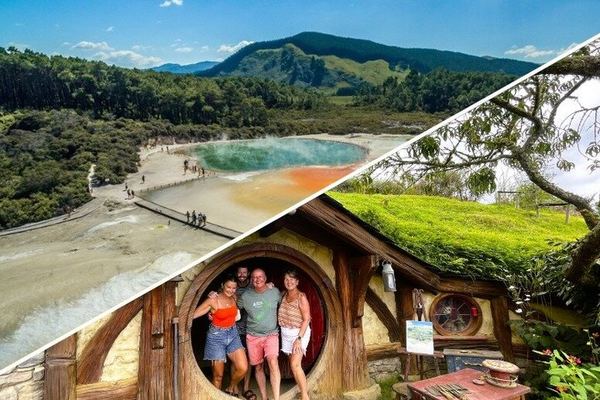
Farmland and 44 hobbit holes in the morning, the Devil's Bath and boiling mud in the afternoon, with no hire car and no route to plan yourself.
One Geothermal Morning, Five Afternoons: Wai-O-Tapu and a Rotorua Choice
The geothermal morning and lunch are fixed; the afternoon is a treewalk, a spa, hot tubs, Te Puia or a zipline, and you pick it when you book.
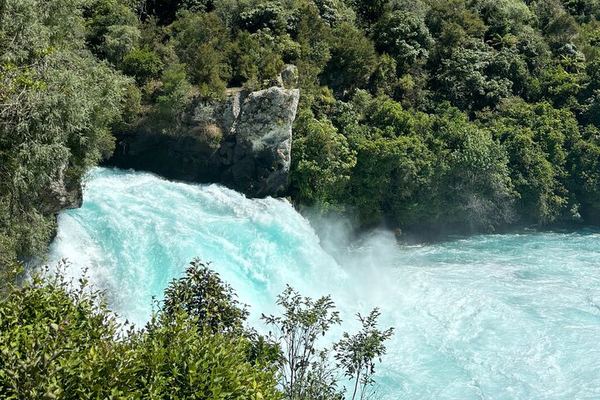
Private Day to Wai-O-Tapu, Huka Falls and Lake Taupo: 220 Cubic Metres a Second
Your vehicle only, from two people up, with the running order adjustable and Huka Falls pushing 220 cubic metres a second at the viewing point.
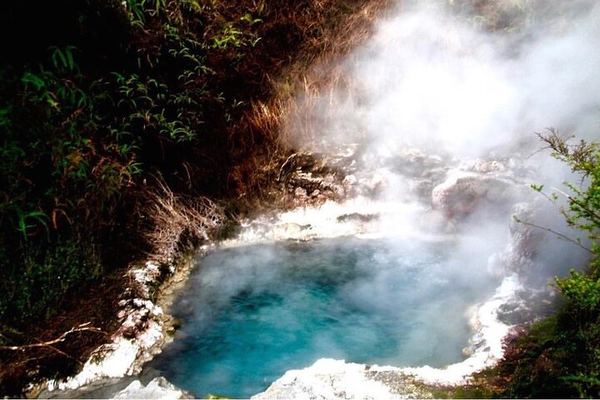
Taupo in a Day from Rotorua: Choose Waiotapu or Orakei Korako, Eleven Seats
The day fits Waiotapu or Orakei Korako, not both, and the entry to whichever you pick is in the price. Eleven passengers maximum, lunch at Taupo on you.
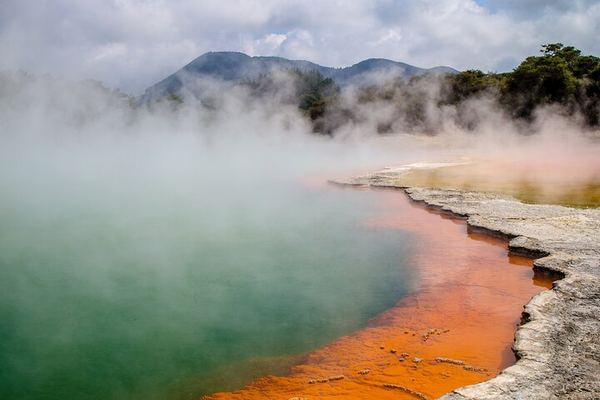
Wai-O-Tapu's Artist's Palette, Then a Bath in the Same Chemistry at Polynesian Spa
The morning is the Artist's Palette and the Champagne Pool behind a barrier; the afternoon is the same geothermal water, alkaline and acidic, to sit in.

Wai-O-Tapu's Devil's Bath and a 30-Metre Geyser: Two Parks and Lunch from Auckland
The Devil's Bath and the Champagne Pool in the morning, then ninety guided minutes at Te Puia where Pōhutu goes up to 30 metres. Swimming is not allowed.
Wai-O-Tapu, Te Rā at Te Puia and a Haka in the Carved Meeting House
The afternoon includes the full performance inside the carved meeting house, pōhiri to haka, on top of the 90-minute Te Rā walk through the valley.
Wai-O-Tapu, the Redwoods and the Spring Behind New Zealand's Bottled Water
The third stop is the spring that supplies most of New Zealand's bottled water, at 11°C and 42 cubic metres a minute, after Lady Knox erupts at 10.15.
Ratings collected by Viator and Tripadvisor
The geyser that goes off because someone puts soap in it
Lady Knox was found in 1901 by prisoners from a nearby camp who were washing clothes in what they took for a convenient hot spring. The soap dropped the surface tension of the water, the column destabilised, and the thing erupted over them. The park has been repeating the trick every morning since, with a measured dose of surfactant rather than laundry, and the geyser reaches somewhere between 10 and 20 metres and then keeps going for the best part of an hour.
None of that is a secret and none of it is a scandal. The plumbing is real, the water is real, the pressure and the temperature are real, and without the surfactant it would still erupt, just unpredictably and every day or two instead of at a quarter past ten. What is worth objecting to is how it gets sold. Several listings describe it simply as a geyser eruption, some build the whole morning around being there for it, and a visitor who has driven three hours from Auckland to watch a natural wonder is entitled to know that the natural wonder runs to a schedule because a person with a sachet runs to a schedule.
Be at the geyser by 9:45. It sits at its own site a short drive from the main gate, the seating is a natural amphitheatre that fills up, and the talk starts well before the pour. From Rotorua that means leaving by about 9:15.
The Champagne Pool, and the reason the rim is orange
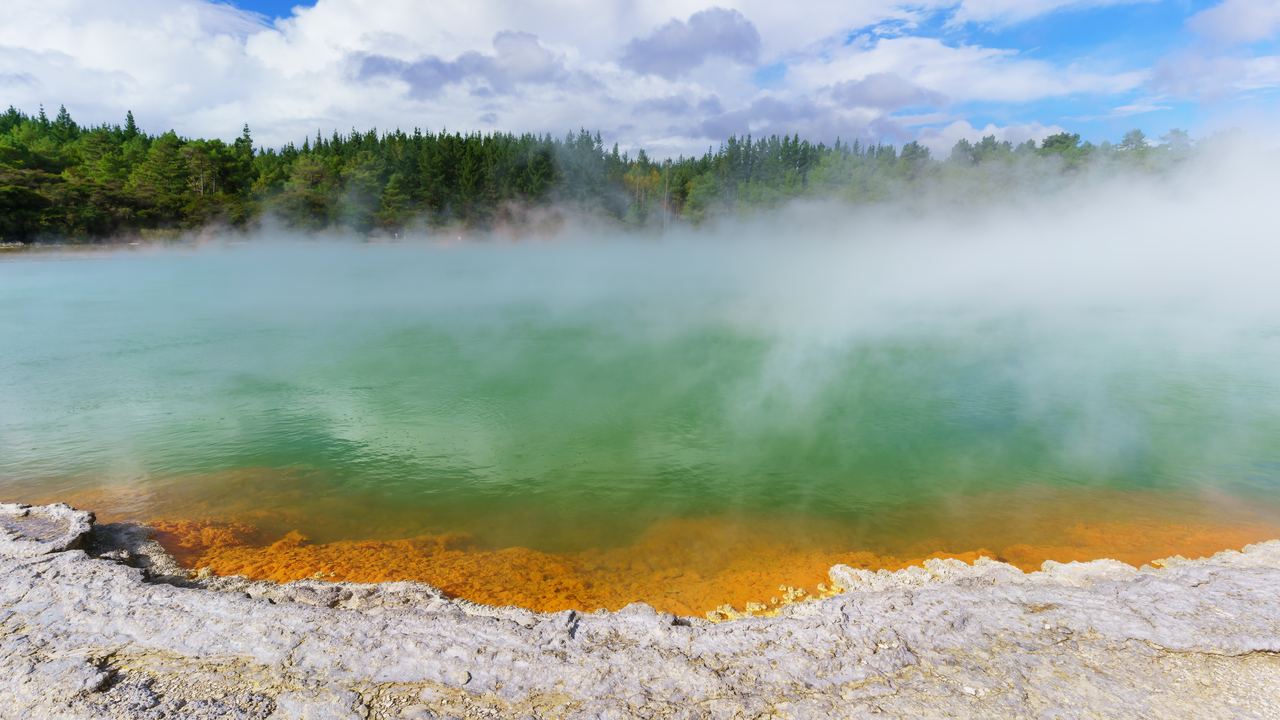
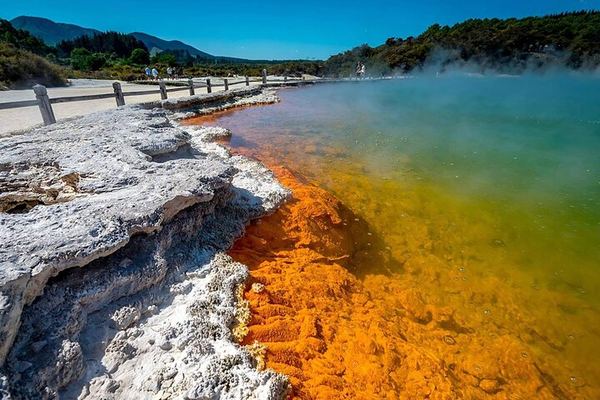
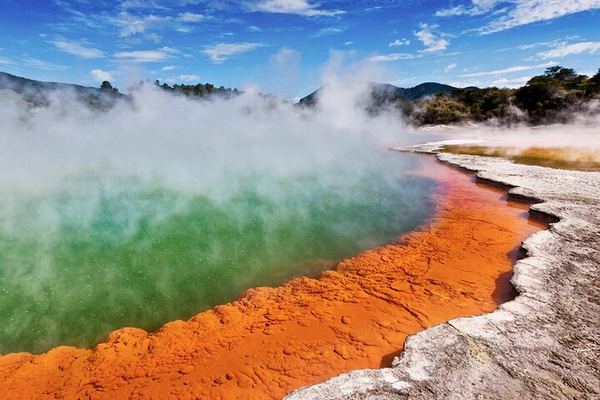
This is the reason to come. The Champagne Pool is a hot spring about 65 metres across and roughly 62 metres deep, formed by a hydrothermal eruption around 900 years ago, holding water between 73 and 75 degrees Celsius. The name comes from carbon dioxide coming out of solution across the whole surface, which does look exactly like a glass that has just been poured.
The orange shelf around the edge is the part worth understanding. It is a precipitate of arsenic and antimony sulphides dropping out of the water where the pool cools at its margin, in colours running from mustard to deep orange depending on the light and the season. It is one of the most concentrated natural deposits of its kind anywhere, which is another way of saying that the prettiest thing in the park is also the most toxic. The barrier and the boardwalk are not there for the view.
Steam moves across the surface constantly and the pool is often invisible from the near side. If the wind is wrong when you arrive, walk on and come back at the end of the loop rather than standing there waiting.
| Feature | What you see | Why it looks like that |
|---|---|---|
| Champagne Pool | A 65-metre pool at about 74 °C with an orange rim | Carbon dioxide degassing; arsenic and antimony sulphides precipitating at the cooler margin |
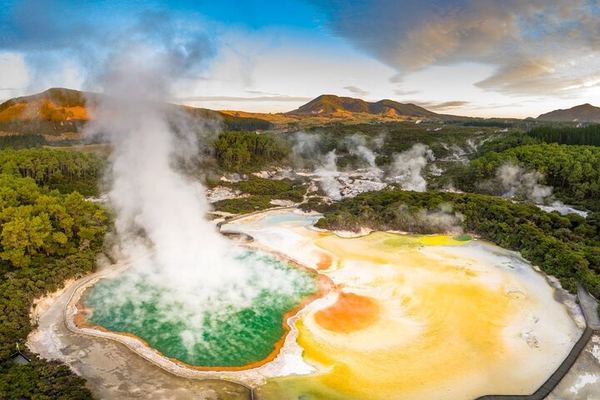
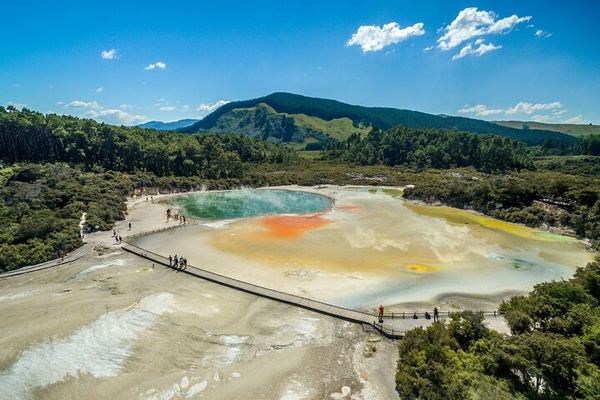
| Artist's Palette | A wide shallow terrace in yellow, green, orange and white | Overflow from the Champagne Pool spreading out, with different minerals dropping out at different temperatures |
| Devil's Bath | A flat pool of opaque yellow-green, the colour of antifreeze | Colloidal sulphur suspended in water rich in ferrous salts |
| Primrose Terrace | A pale sinter staircase, the largest in New Zealand | Silica deposited by the Champagne Pool overflow over roughly 900 years |
| Devil's Ink Pots | Black bubbling mud | Crude oil and graphite in the clay |
| Lake Ngakoro | A green crater lake at the far end of the loop | The lowest point of the drainage, where everything upstream ends up |
| Mud Pool | New Zealand's largest boiling mud pool | The remains of a collapsed mud volcano, outside the gate and free |
What the walk is actually like
The circuit is three connected loops and most people do the full one in about 75 minutes without hurrying. The short version cuts back after the Champagne Pool and takes about half that. It is flat, gravelled and boardwalked throughout, and pushchairs manage it.
Two things nobody tells you. The order is fixed and one-way, so you meet the Champagne Pool at roughly the two-thirds point rather than at the start, and people who leave after twenty minutes because it all looks the same have quit before the good part. And the Devil's Bath is at the very end, past the point where most tour groups turn back to make their coach. It is the most photographed thing in the park and it is the easiest one to miss.
Times, tickets, and the best thing outside the gate
The park opens at 8:30 seven days a week and closes at 16:30, with the last admission at 15:00 and the gates shut only on Christmas Day. Turning up at 14:45 gets you in and gives you the circuit, but the light is going by then and you have missed the geyser by five hours.
Wai-O-Tapu does not publish an admission price anywhere on its own website. It is one of the most visited attractions in the country, and to find out what it costs you have to start a booking or read it off a reseller. That is a choice somebody made, and it is why the price column for this park on the Rotorua page above says what it says.
The one thing everybody drives past: the Wai-O-Tapu mud pool, the largest in New Zealand, sits on the roadside a few hundred metres before the main entrance and costs nothing at all. It is a wide grey basin of clay boiling in slow bursts, it photographs better than most of what is behind the fence, and it is outside the ticket. Stop there on the way in. Several of the guided day trips do exactly that and describe it as a highlight, which tells you something.
How this park gets sold, and the problem with it
Nine listings on this site include Wai-O-Tapu and not one of them is a gate ticket. Eight leave from Auckland and one from Rotorua. They run 150 to 391 EUR, they take 11 to 12 hours, and the pickups start between 5:45 and 7:00 in the morning.
That is a perfectly reasonable product if you are based in Auckland without a car. Rotorua is three hours away, the coach handles it, and the better operators fill the rest of the day with genuinely different things: the Hobbiton film set, the Redwoods, a hot tub in the forest, Te Puia, or a second geothermal park. The 4.9 ratings across several hundred reviews are earned, and the 12-hour version that adds the Blue Spring and the corrugated-iron dog at Tirau is a better-constructed day than its name suggests.
It is a poor product if you are already in Rotorua. The park is 31 kilometres down State Highway 5, the drive is 27 minutes, and you would otherwise be paying two hundred euros for a seat on a coach that starts and ends three hours away. The single Rotorua departure in this group, a seven-hour day pairing a geothermal park with Huka Falls and Lake Taupō at 150 EUR, is the sensible version of the same idea and it lets you choose Orakei Korako instead if you have already done this one.
| What you book | From | Price | Rating |
|---|---|---|---|
| Geothermal park plus Huka Falls and Lake Taupō, 7 hours | Rotorua | 150 EUR | 4.9 over 28 |
| Wai-O-Tapu, lunch and a choice of five afternoon experiences | Auckland | 170 EUR | 4.8 over 431 |
| Wai-O-Tapu, the Redwoods and the Blue Spring, 12 hours | Auckland | 182 EUR | 4.9 over 36 |
| Wai-O-Tapu and Te Puia with lunch | Auckland | 193 EUR | 4.6 over 88 |
| Wai-O-Tapu and the Polynesian Spa | Auckland | 198 EUR | 5.0 over 44 |
| Wai-O-Tapu and forest hot tubs with lunch | Rotorua | 201 EUR | 4.7 over 132 |
| Wai-O-Tapu, Te Puia and a haka performance | Auckland | 208 EUR | 5.0 over 106 |
| Hobbiton film set and Wai-O-Tapu | Auckland | 224 EUR | 4.9 over 510 |
| Private day: Rotorua, Taupō, Wai-O-Tapu and Huka Falls | Auckland | 391 EUR | 5.0 over 38 |
Lady Knox geyser presentation 10.15am daily, arrive by 9.45am.
Practical
Closed shoes rather than sandals: the gravel is sharp and there are sections where steam crosses the path. The whole park smells of hydrogen sulphide and it will stay in wool and hair for a day. Silver jewellery tarnishes here within about an hour, which catches people out reliably.
There is no season to plan around and no seasonal chart on this page, because the park opens every day of the year except Christmas and the pools are the same temperature in July as in January. If anything it is better in bad weather. Cold, still, overcast mornings give the strongest steam and the most saturated colour; hot afternoon sun flattens the Artist's Palette and washes out the Devil's Bath entirely. Go early, take the Lady Knox slot for what it is, and leave the long loop until the coaches have gone.
Questions people actually ask
Is the Lady Knox geyser real?
The geyser is real and so is the water, the pressure and the heat. The timing is not. Park staff add surfactant at about 10:14 each morning to drop the surface tension and set it off, which is why it erupts at 10:15 rather than at some point in the next forty-eight hours. The park calls it a presentation on its own website. It is still worth watching; it is just not a natural event happening to coincide with your visit.
Do I have to see the geyser?
No, and if 9:45 does not fit your morning, skip it without regret. The Champagne Pool, the Artist's Palette and the Devil's Bath are the reason this park has a reputation, and none of them are on a timetable. Arriving at 11:00 and walking the full circuit in decent light is a better visit than rushing for a scheduled eruption and then doing the loop at speed.
How long do I need?
About 75 minutes for the full three-loop circuit at a normal pace, or two and a half hours if you add the geyser and want to stand at the Champagne Pool waiting for the steam to clear. The short loop is around 40 minutes and it cuts out the Devil's Bath, which is the wrong thing to cut.
Can I swim anywhere here?
No. Nothing in the park is swimmable: the Champagne Pool is near boiling and its margin is loaded with arsenic and antimony, and the coloured pools are acidic. The hot pools people swim in around Rotorua are separate commercial bathhouses with treated, temperature-controlled water. Nothing on this circuit is one of them.
Wai-O-Tapu or Waimangu?
Wai-O-Tapu for colour: it is the more photogenic park by a wide margin and it takes half the time. Waimangu for meaning: it is a valley created by the 1886 Tarawera eruption, the youngest geothermal system on earth, with a boat on Lake Rotomahana. If you are doing both, the small-group morning tour from Rotorua at 96 EUR covers them together with entry included.
Is it worth it as a day trip from Auckland?
If Auckland is your base and you have no car, yes, and the ones rated 4.9 across hundreds of reviews are doing it properly. Understand what it is: 11 to 12 hours, a pickup before seven, and roughly six hours in a vehicle for 90 minutes of walking. If you are staying in Rotorua, drive the 31 kilometres yourself and keep the two hundred euros.
Is it suitable for children and pushchairs?
Yes to both. The circuit is flat, gravelled and boardwalked throughout with no steps of consequence, and the whole thing can be done in 40 minutes on the short loop if attention runs out. The one caution is the same as everywhere in the district: the barriers exist because the ground beyond them is thin crust over water above boiling.
Data verified on. Opening hours, the Lady Knox timing and the distance from Rotorua are from the Wai-O-Tapu website. Prices, durations and ratings from the products on this site.