
Poás Volcano Tours: the Acid Crater Lake near San José
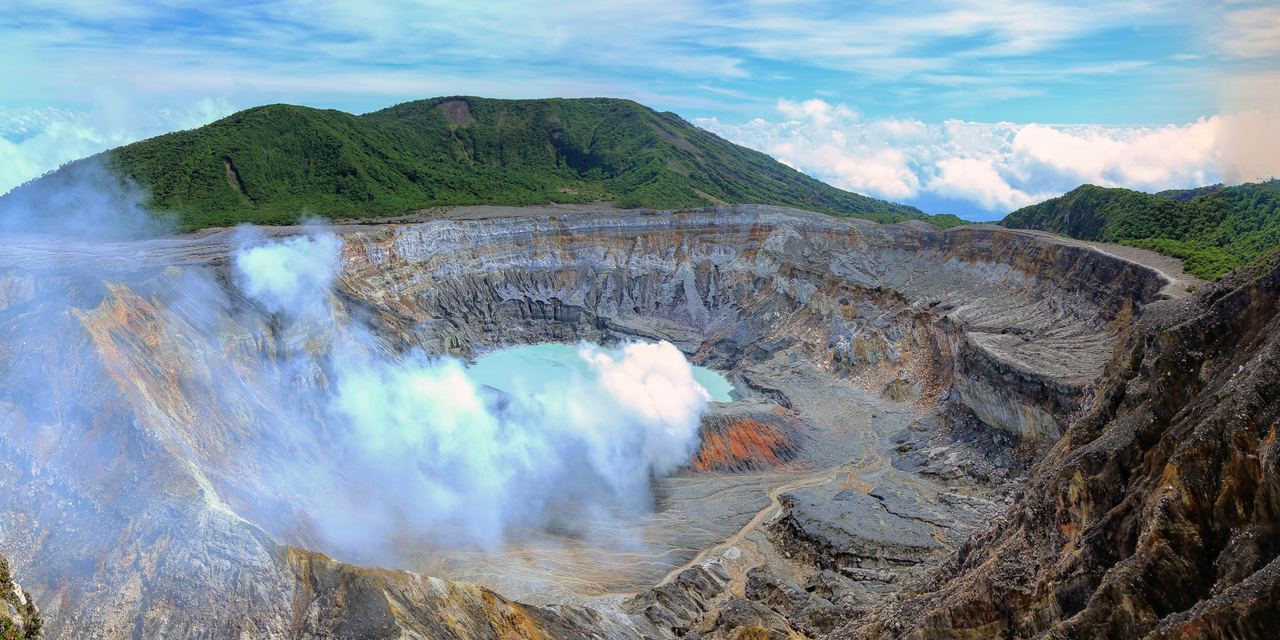
One of the largest acid crater lakes on earth, 300 metres below the railing. What you are allowed to do up there moves with the alert level.
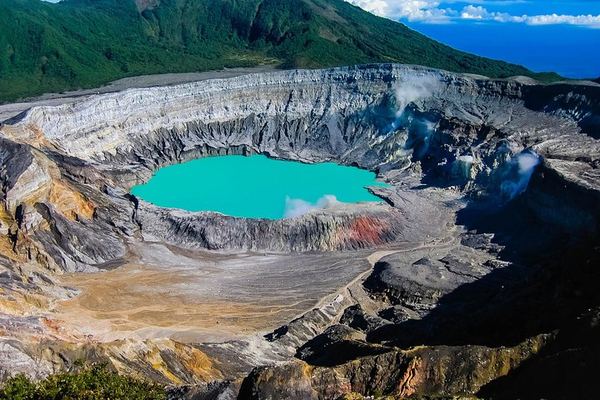
Poás is the rare volcano where the hard part is the paperwork. The walk from the car park to the lookout is a few hundred metres of pavement, flat enough that operators sell the trip as suitable for wheelchairs and for every level of fitness. What stands at the end of it is a crater 1.3 kilometres across with a hot acid lake at the bottom, 300 metres below your feet, running at a pH below 1. Getting to that railing means a slot booked in advance, a passport number, and a set of rules that has been rewritten four times since 2024.
Almost everything published about visiting Poás is out of date, and the way you can tell is that none of it carries a date. Search the opening hours and you will find six different versions on one page of results, two different slot intervals and three different daily capacities. All of them were true at some point. This page tries to do the one thing that helps, which is to put the date next to the number and explain the mechanism underneath, so that you can work out what applies on the morning you actually go.
Doka Breakfast, 40 Minutes Inside Poás, and La Paz Waterfall Gardens
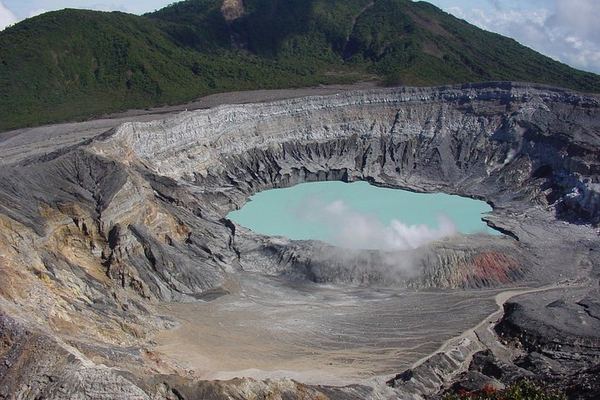
The stop inside the national park is exactly 40 minutes, and the rest of the day goes to La Paz Gardens, its butterfly observatory and a buffet lunch.
Doka Estate, Twenty Minutes at the Poás Crater, and La Paz Gardens
The crater stop is capped at 20 minutes by the volcanic safety authority, so the day's weight sits on Doka's plantation tour and the La Paz exhibits.
Poás: a Crater a Mile Across, 40 Eruptions since 1828, and the Fraijanes Coffee Farm
The crater measures over a mile across and 1,050 feet deep, and the coffee stop at Fraijanes walks the nursery, wet mill, drying patio and roaster.
Poás and Botos Lagoon with a Four-Fork Buffet at La Paz Gardens
The lunch here carries a four-fork rating from the Costa Rican Tourism Council, and the walk at Poás continues past the crater to the Botos Lagoon.
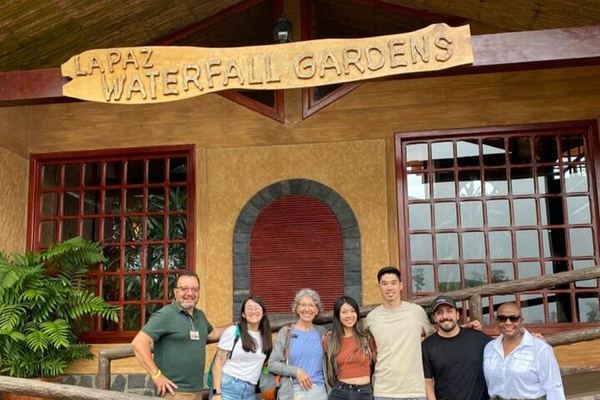
Poás and the Botos Lagoon, Familia Vargas Coffee, and the Five La Paz Falls
The walk here goes past the crater to the Botos Lagoon, and the day ends with 100 rescued species, a 35-option buffet and the five La Paz falls.
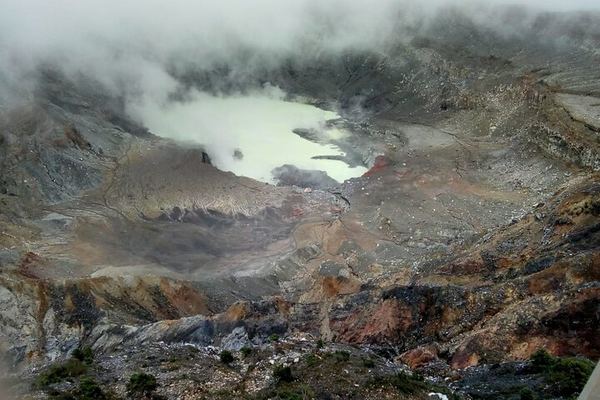
Poás at 2,708 m, the Starbucks Farm at Hacienda Alsacia and Sarapiquí
Two coffee farms on one day: the Hacienda Alsacia estate and Mi Cafecito in Sarapiquí, plus the El Congo waterfall and the crater at 2,708 m.
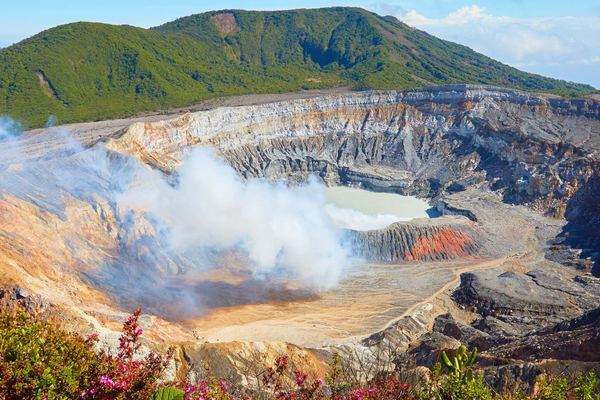
Poás Before Lunch: a Mile-Wide Crater and Gallo Pinto First
A 6:30 start, back at your hotel by 1 pm, with gallo pinto, yucca chorriada and gallos for breakfast before the mile-wide crater at the top of the volcano.
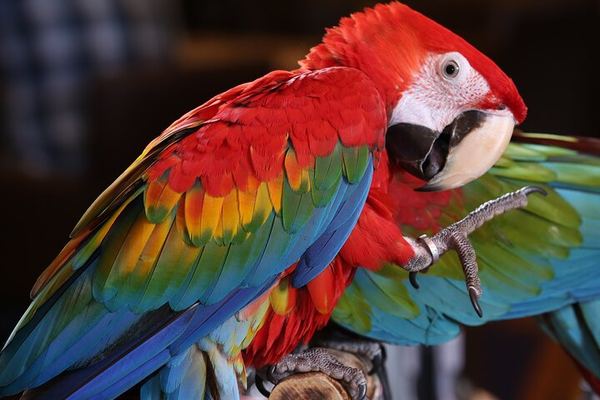
Poás in Eruption Period, Doka's Organic Estate, and the Viewpoint Behind the Falls
A tasting of chocolate, liquor and coffee at Doka, a crater in its eruption period, and a viewpoint that puts you behind the water curtain at La Paz.
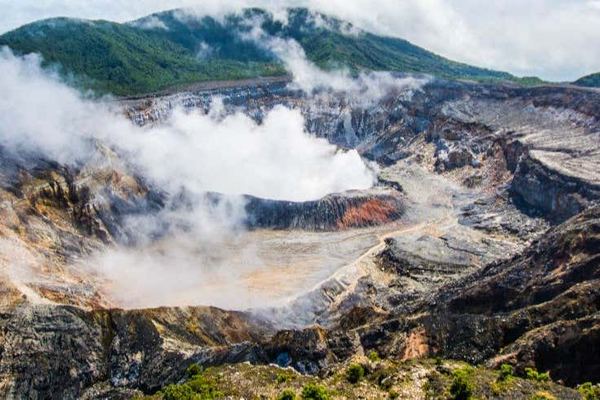
Poás, La Paz and a Coffee Plantation in Eight Hours
Eight hours with pick-ups in San José, Heredia and Alajuela, and a coffee plantation at the end. The order of the stops can change with availability.
Poás Volcano Half Day: the Sulphur Crater, Past the Strawberry and Fern Farms
Half a day up through the coffee, fern, flower and strawberry farms to the main crater of Poás, where the sulphur fumaroles are still at work.
Ratings collected by Viator, Tripadvisor and Civitatis
What is actually down there
The main crater is about 1.32 kilometres from rim to rim and drops roughly 300 metres from the lookout to the water. The water is the Laguna Caliente, around 300 metres across and 40 deep at most, and it is one of the most acidic bodies of water on the planet: a pH below 1, which is to say more corrosive than stomach acid, sitting on a floor of liquid sulphur. Its temperature moves between about 20 and 50 °C depending on what is happening underneath. Nothing lives in it except acid-tolerant bacteria.
That chemistry is the reason for every rule on this mountain. The lake is a lid on a shallow hydrothermal system, and when the system pushes, it does so as steam rather than lava, which is why the eruptions here arrive quickly and without much warning. It is also why the smell reaches the car park on a still morning, and why the park closes on days when the gas is drifting the wrong way rather than on days when something is visibly erupting.
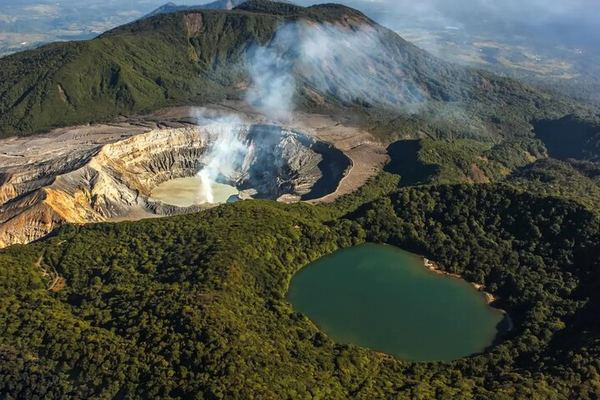
A second crater sits a short walk further on. Botos is extinct, cold, and green, a rainwater lake in cloud forest, and the 800-metre paved trail to it reopened in August 2024 after years shut. It takes twenty minutes and hardly anybody does it, which on a mountain this crowded is worth knowing.
The rules move with the volcano, and that is the whole system
Every article that tells you flatly that you get twenty minutes at the lookout and must wear a helmet is quoting one setting of a dial, usually without knowing there is a dial. Here is how it actually works, which will still be true when the specific numbers below have moved on.
When the alert level is low, the park runs generously. On 1 August 2024 the daily capacity was raised from 1,064 to 2,052 visitors, the twenty-minute limit at the lookout was abolished, helmets stopped being required, and the Botos trail reopened. When the alert level rises, the same park becomes small, timed groups, a compulsory safety video, a helmet handed to you at the entrance, and a strict spell at the railing before you are moved along. Recent visitor accounts describe the strict version back in force.
So the useful question before you book is not what the rules are, but what the volcano has been doing this month. The observatory publishes that. The reservation system reflects it in how many slots exist and how far apart they are. Both are more current than any guide, including this one.
Nine years of Poás opening and closing
Every date below changed what a visitor was allowed to do. None of them is the last one.
The growth
April 2017
The eruption that emptied the park
On 12 April the largest eruption since 1953 throws a column of gas and ash roughly three kilometres up. The park closes indefinitely and stays shut for about seventeen months, with a safety perimeter of 2.5 kilometres around the crater.
August 2018
Reopening, with a stopwatch
Visits resume under a regime nobody here had seen before: an online booking, a hard daily cap, a helmet, and a few minutes at the railing before the group is moved on.
2019
Two reminders
An eruption in February throws ash about 200 metres. Two more in September reach two kilometres. The park keeps operating around them, which is the pattern from here on.
1 August 2024
The rules relax
Daily capacity goes from 1,064 to 2,052, the twenty-minute cap at the lookout is dropped, helmets are no longer required, and the 800-metre trail to the Botos lagoon reopens.
Today
23 March 2025
Closed again
A new eruptive phase shuts the park. The alert is lowered to green on 2 July and the park reopens on 30 July, with access managed according to conditions rather than a fixed timetable.
21 January 2026
Closed by a bridge
The park closes again, and this time the volcano has nothing to do with it: the bridge over the Quebrada Tigre on Route 120 is judged at risk of collapse. Reopening is put back more than once.
February to April 2026
Eruptions, and thirty people in the wrong place
Eruptive episodes through February and March keep the observatory at level 2. More follow on 27 and 28 April, when thirty people are stopped inside the restricted zone.
12 August 2026
Selling tickets, no notices
Checked on the national reservation system: Poás is bookable normally, with nothing flagged. Visitor accounts from recent weeks describe helmets, a safety video and a capped stay back in force.
The closure that was a bridge
This deserves its own heading because of what it does to people's plans. In January 2026 Poás closed and the news travelled as it always does, compressed into two words: Poás closed. Travellers cancelled. What had actually happened was that engineers judged the bridge over the Quebrada Tigre, on the road up, to be at risk of collapse. The volcano was behaving.
The distinction matters because the two kinds of closure have completely different shapes. A volcanic closure is open-ended and can last seventeen months. A road closure has a repair schedule, and a traveller who understands the difference rebooks for the following month instead of writing the volcano off. When you see that Poás is shut, the first thing worth finding out is which of the two it is, and almost nobody publishing about this park makes that easy.
The ten trips, and which of them puts you at the crater first
Of the ten Poás listings here, two go to the volcano and come home. The other eight bolt on the Doka coffee estate and the La Paz waterfall gardens, which are genuinely good and which cost you the clear hour. The itineraries that spell out an order put the coffee first: one begins the day at an organic plantation, another has you tour the estate and eat breakfast before continuing towards the volcano. That is roughly two hours of the morning spent below the cloud line while the cloud line does its work.
| Park only | Volcano with coffee estate and waterfall gardens | |
|---|---|---|
| Listings here | 2 | 8 |
| Price | 103 to 119 EUR | 120 to 184 EUR |
| Door to door | 6 to 6.5 hours | 9 to 11 hours |
| At the crater | First stop of the day | After the coffee, where the itinerary says |
| Traveller rating | 4.4 to 4.5 | 4.4 to 4.9 |
| What it is really for | Seeing the crater | Seeing the country the crater sits in |
Look at the ratings row for a second, because it is telling you something the marketing is not. The combined trips score higher than the volcano-only ones. That is not because the crater is better on those trips. It is because a day that also contains hummingbirds, a waterfall and a good lunch survives an hour of cloud at the top, and a day built entirely around a crater does not. If you are the kind of traveller who will forgive a lost view, book the combination. If you are not, book the early half day and accept that you have bought a lottery ticket with better odds.
The cheapest listing here is also the one that gets you to the railing first. That is not usually how travel pricing works, and it is worth a second look before you upgrade.
Booking it yourself
Entry is 15 US dollars for a non-resident adult and 5 for children aged 2 to 12, and 13 per cent tax makes the real figure 16.95. Parking is 2,000 colones and the machine takes cash only. The booking is made through the national park reservation system, by time slot, and it asks for the passport number of every person in the party, so a friend booking for six needs six documents in front of them. Tickets are neither refundable nor transferable to another day.
Take the earliest slot on offer. The cloud comes over the rim somewhere between ten and half past on a normal morning, in any season, and a slot after that is a coin toss you cannot re-enter. Bring a windproof layer: at 2,708 metres in cloud forest it is cold and wet even when the capital is warm, and the crater lookout is exposed. Anyone with a respiratory condition should know that the gas is the reason for the timed visits, and that a sulphur smell at the railing is normal rather than a warning.
One line on seasons, since the pattern here is the same one that governs the whole Central Valley and is set out on the page above: the driest mornings run from December to April, and the clock is unchanged in every other month.
Questions people actually ask
Is Poás open right now?
On 12 August 2026 it was bookable through the national reservation system with no notices attached, which is the most reliable public signal there is. Because that changes without much warning, check the reservation system rather than an article, and when you find a closure notice, look for the reason. A volcanic closure can run for a year or more. A road closure, like the one that shut the park in January 2026, has an end date.
How long do you get at the crater?
It depends on what the volcano is doing. In the relaxed regime introduced on 1 August 2024, there was no time limit at all and no helmet. When the alert level rises, the park reverts to timed groups with a compulsory helmet, a safety video and roughly twenty minutes at the lookout. Recent visitor reports describe the strict version. Plan for twenty minutes and treat anything more as a bonus.
Do I need to book in advance?
Yes. Tickets are sold only through the national park system, by time slot, and since August 2023 nothing is sold at the gate. You will need the passport number of every visitor to complete the booking, and the ticket cannot be refunded or moved to a different day. A tour that includes admission has already handled all of this, which is a meaningful part of what the cheaper half-day trips are charging for.
Will I actually see the crater?
If you are at the railing before ten, usually. After that, often not. The lake is 300 metres below the lookout inside a crater that generates its own cloud, and the moist air coming up the flanks closes it in through the middle of the day for most of the year. This is the single biggest complaint about Poás and it is not the operators' fault; it is a mountain in the tropics behaving normally.
Is it suitable for children or for someone with limited mobility?
Unusually, yes. The route from the car park to the lookout is short and paved, and several operators list the trip as wheelchair accessible and suitable for all fitness levels. The limits are altitude and weather rather than terrain: 2,708 metres, often cold, often wet, and a sulphur smell that some people find unpleasant. The Botos lagoon trail beyond it is 800 metres and also paved.
Is it dangerous?
The park is closed when it is judged unsafe, and it has been closed a lot: seventeen months after 2017, again in March 2025, and repeatedly during the eruptive episodes of early 2026. The risk that reaches visitors is gas rather than lava, which is why the visits are timed and why the perimeter exists. Thirty people were stopped inside the restricted zone in April 2026, which is a better guide to the real hazard than any warning sign: the rules are enforced because people ignore them.
Should I add the coffee estate and La Paz?
Only if you are relaxed about the crater. Eight of the ten trips here include them, they cost 120 to 184 EUR against 103 to 119 for the volcano alone, and the itineraries that specify an order put the coffee first. They rate well and the waterfall gardens are worth a morning of anyone's time. But you are trading your clearest hour for them, and on this mountain that hour is the product.
Data verified on. Prices, durations and ratings from the ten Poás products on this site. Fees, capacity, booking status and closure dates checked on the SINAC reservation system and observatory bulletins.