
The Volcanic Wine Harvest Calendar: Lanzarote Picks in July, Etna in October
Lanzarote had Malvasía in the winery in the first week of July. Etna had not begun by late September. Four months separate two volcanic harvests, and altitude explains far more of it than latitude does.
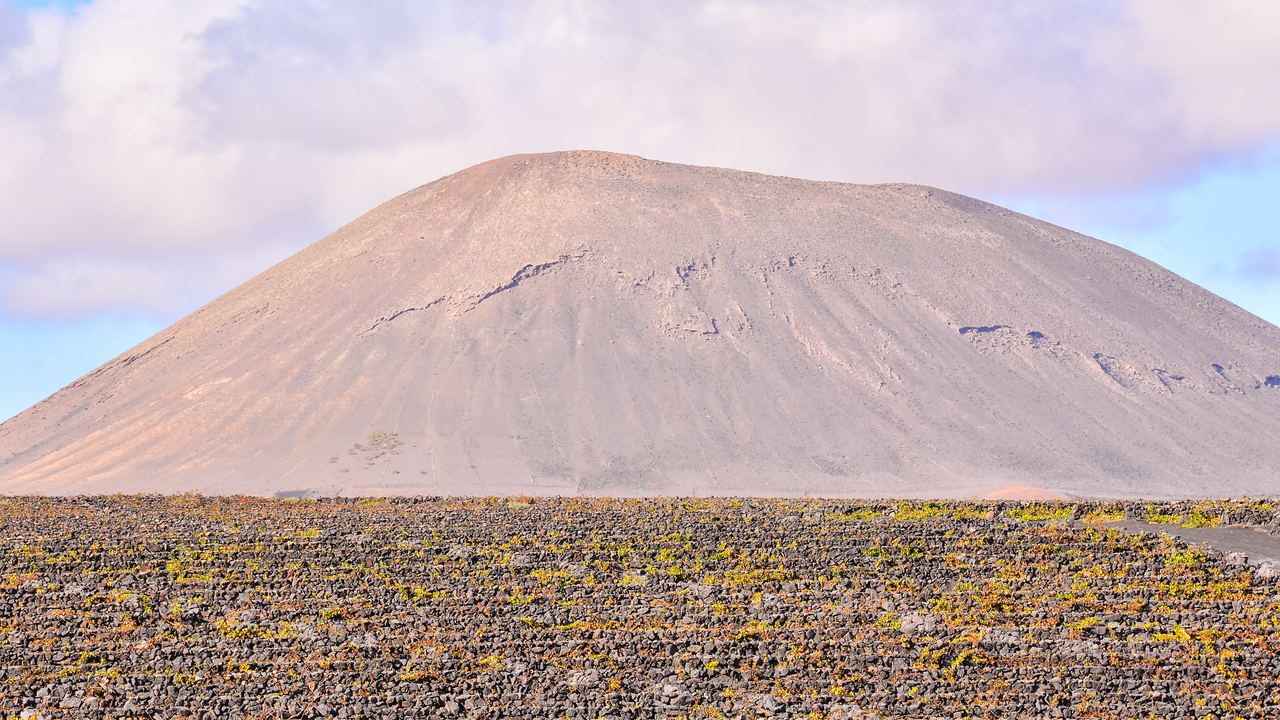
On 9 July 2026, the president of the Consejo Regulador of the volcanic wine denomination on Lanzarote told the island's press that Malvasía Volcánica was already coming into the wineries and that the year might reach around 2.5 million kilos. Two and a half thousand kilometres east, on Etna, nobody had picked anything. The consortium there was still waiting on September.
That gap is the most useful thing about volcanic wine, and almost nobody writes it down. Harvest calendars for the wine world tend to say August to October, northern hemisphere and leave it there. On volcanic islands the spread is nearly four months, the islands sit at similar latitudes, and the thing doing the work is not latitude at all.
What follows is the calendar, read off the denominations' own rules and the producers' own harvest reports rather than off a wine-tourism page. It also deals with the claim that comes attached to every bottle of this stuff, which is that you can taste the volcano. One of these documents makes that claim in law. The geological literature says it cannot be true. Both are quoted below.
Four months, three islands, one variable
Lanzarote, Santorini and Etna are spread across roughly seven degrees of latitude. Lisbon to Naples, more or less. If latitude drove ripening they would pick within a fortnight of each other. Instead the first grapes of the European year come off Lanzarote in the first week of July and the last ones come off Etna in the second half of October.
Almost all of that gap is altitude. The Etna denomination's own rules put its vines between 300 and 900 metres above sea level, reaching 1,100 on the drier south-western flank. Lanzarote's sit a few dozen metres above the sea. A vine most of a kilometre up a mountain is living in a different year from a vine on a desert island at 50 metres, and it ripens accordingly.
Water does the rest. Lanzarote's growing season is hot and very nearly rainless, and the black lapilli the vines are planted in takes in night moisture and holds it. Etna's rules record annual rainfall from about 600 millimetres on the south-west flank to 1,200 on the north and north-east, well above the rest of Sicily. More height and more water make a longer, slower season, which is the whole of the four months.
Wind is the third factor, and it does something stranger. On Santorini and Lanzarote it blows hard enough that the vine is not grown upright at all. That changes the microclimate every bunch sits in, and it is also why both islands look nothing like a vineyard.
| Where | Main grape | How the vine is grown | When it picked in 2026 |
|---|---|---|---|
| Lanzarote, Canary Islands (DOP Vinos de Lanzarote) | Malvasía Volcánica | A single vine in a hoyo, a pit dug down into the lapilli, sheltered by a low wall of lava stones called a zoco | First week of July; the general start ran to mid and late July |
| Santorini, Greece (PDO Santorini) | Assyrtiko | Kouloura: the vine woven into a low basket on the ground, with the fruit inside the ring | Mavrotragano from 6 August, Assyrtiko from 8 August, finished 26 August at one estate |
| Etna, Sicily (DOC Etna) | Nerello Mascalese and Carricante | Bush vines and trellis, between 300 and 900 metres, reaching 1,100 m on the south-west flank | Late September into October, by the consortium's own forecast |
| Pico, Azores (UNESCO cultural landscape, inscribed 2004) | Verdelho | Currais: thousands of small plots, each walled in black basalt against wind and salt spray | No date we could source. See the last section |
Lanzarote picks first because the island is a quarry with vines in it
The eruptions of the 1730s buried a quarter of Lanzarote and dusted the rest in black ash and lapilli, called picón or rofe locally. What the islanders did next is the most extreme piece of agricultural engineering in European wine. They dug.
Each vine lives at the bottom of its own hand-dug pit, down through the ash to the soil beneath. On the north-eastern side of each pit there is a low crescent of stacked lava stones. The pit holds the vine out of the wind and stops the sides collapsing; the ash above acts as a mulch, taking in the night humidity and stopping it evaporating by day. Nothing about it can be mechanised, which is why yields here are low by construction rather than by choice.
It also ripens absurdly early. Spanish trade press covering the 2026 northern-hemisphere harvest put Lanzarote's Malvasía in the winery at the start of July, ahead of every other Spanish region. The regulator's own explanation for the 2026 start was blunt: the week's high temperatures had accelerated ripening in some plots.
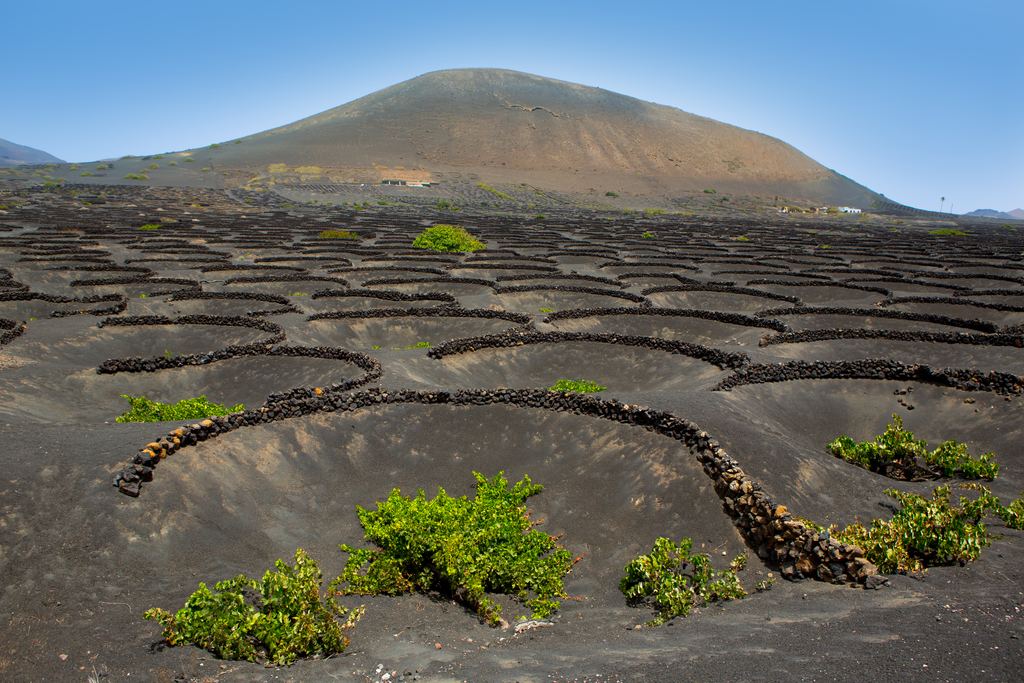
La Geria, Lanzarote
One vine, one pit, one wall
This is the unit the whole island is built from. A hollow scraped down through the black lapilli, a single vine at the bottom of it, and a crescent of interlocking lava stones on the windward side.
Multiply it across the La Geria valley and you get the landscape that every photograph of Canary wine is taken in. It is worth knowing before you go that the pits are the attraction. There are no rows, no trellis and very little green.
Santorini picks in August, and the vines are woven into baskets
Santorini's harvest is over before most of Europe starts. Domaine Sigalas, which publishes a harvest report every year, began on 6 August 2026 with Mavrotragano and brought in the first Assyrtiko on 8 August, starting with the lower vineyards around Oia and Messaria and working up to the higher villages. The last fruit, Mandilaria and Aidani, came in on 26 August.
The estate's own account of the year is worth repeating because it is the opposite of the story people expect from a Greek island. The winter brought 310 millimetres of rain, close to the island's average. The summer was relatively mild with no prolonged heatwaves. The damage came at flowering, from persistent south-easterly winds reaching Force 9. Their oenologist called it an Assyrtiko year, because a mild summer let the grapes ripen steadily and keep their acidity.
The wind is also why the vines are shaped the way they are. Young shoots are trained low and curled inwards until the plant becomes a tight circular basket lying on the ground, a kouloura, with the bunches hidden inside the ring. The leaves on the outside thicken into something closer to a small hedge. It protects the fruit from wind, salt and the worst of the midday sun, and it keeps what little humidity there is close to the plant.
One number from the Sigalas report deserves attention. Some of their newer plantings reached 3,000 kilos per hectare, which the estate described as approaching levels once more commonly seen on Santorini. Read that sentence twice. A yield worth reporting as good news is one that gets back towards what used to be ordinary. Santorini's vineyards have been shrinking and its yields falling for years, and the island's wine is expensive for reasons that start in the vineyard rather than in the marketing. We are not printing a figure for the long-run decline, for reasons in the last section.
Etna picks last, because its vineyards are most of a kilometre up
The Etna denomination is the one with the paperwork, and the paperwork is unusually readable. Its rules describe the production zone as a semicircle around the volcano, open on the western side, taking in parts of 20 towns and no whole one, because each town's territory is a wedge with its point at the central crater while the denomination only covers the middle band.
The same document breaks the mountain into flanks and effectively gives you a ripening map. The eastern flank around Giarre and Santa Venerina is the earliest, because of its exposure and the sea breeze. The southern flank around Biancavilla and Paternò has bigger day-to-night swings and is described, in the document's own word, as a later environment. The northern flank around Randazzo and Linguaglossa gets the most rain and the sharpest temperature swings of all.
For 2026 the Consorzio di Tutela Vini Etna DOC forecast production in line with the average of recent vintages, after roughly 80,000 quintals in 2024 and 94,700 in 2025, and said the shape of the vintage would only become clear between the end of September and October. Bottling was up 13.6% over the first eight months of the year.
So the working answer for anyone planning a trip around the picking is October on Etna, with the late sites running on past it. We have not been able to source a 2026 November pick to the consortium, so this piece does not claim one, although the structural case for it is in the rules: vines at 1,100 metres on the flank described as the latest are not finishing with the ones at 300.

The volcanic harvest, in the order it happens
Ordered as a sequence rather than by date, because every one of these windows moves with the year. The 2026 dates are given where a regulator or a producer published them.
The origins
Early July
Lanzarote opens the European year
Malvasía Volcánica comes into the wineries in the first week. In 2026 the regulator attributed the early start to the week's high temperatures accelerating ripening in some plots.
Mid to late July
Lanzarote's general start
The island picks in a staggered way rather than all at once, with the broader start between the middle and the end of the month. The 2026 crop was put at around 2.5 million kilos.
The growth
Early August
Santorini begins
Mavrotragano from 6 August 2026, Assyrtiko from 8 August, starting in the lower vineyards around Oia and Messaria before moving up to the higher villages.
Late August
Santorini is already finished
The last fruit, Mandilaria and Aidani, came in on 26 August 2026. The island's harvest is over before the rest of Europe has properly started.
Late September
Etna starts, four months after Lanzarote
Carricante and Nerello Mascalese begin coming in. The consortium said the character of the vintage would be settled between the end of September and October.
Today
October
Etna's main harvest
The bulk of the picking. The eastern flank, with its sea breeze, runs earlier than the southern flank, which the denomination's own rules call a later environment.
The late sites
The highest vineyards, last of all
Vines sit up to 1,100 metres on Etna. We could not source a November pick for 2026 to the consortium, so no date is claimed here, but the altitude spread makes the tail of this harvest the longest of the four.
Four volcanoes, four answers to the same question
The shapes these vines are trained into are not folklore. Each is a response to a specific thing the volcano does, and they are worth lining up because they are the clearest evidence that the soil-and-wine relationship here is physical rather than mystical.
Lanzarote dug pits because the ash was deep and the trade winds relentless. Santorini wove baskets because the wind comes off the Aegean with salt in it. Pico, in the Azores, did something else again: it walled the island. Thousands of small rectangular plots, the currais, each enclosed in black basalt, with longer walls running inland from the shore to break the wind and keep the sea spray off. The whole landscape was inscribed by UNESCO in 2004 as a cultural landscape of vineyard culture, and the grape inside the walls is Verdelho.
Etna is the outlier, and the reason is that Etna is a mountain. It has altitude to play with and does not need to hide its vines, so it grows them more or less conventionally and lets the elevation do the work that walls and pits do elsewhere.

What the law says about volcanic soil, and what the geologists say
Here is the part worth the detour, and it is the reason this piece exists rather than being another gallery of pretty vine pits.
The link between volcanic soil and wine is not a marketing invention. It is written into Italian law. The production rules for the Vesuvio denomination, published in the Gazzetta Ufficiale on 27 December 2016, set out in Article 4, on viticulture, which land may be planted at all:
Sono pertanto da ritenersi idonei i terreni di buona esposizione in declivio, di natura vulcanica, ricchi di potassio.
Soils of good exposure on a slope, of volcanic nature, rich in potassium, are therefore to be considered suitable. Particularly damp land is excluded. That is a legal requirement about geology, enforceable, in a document that also caps yields at 10 tonnes per hectare for Vesuvio bianco.
The Etna rules go further and put a number on it. In the section on the link with the geographical environment, the document states that the area's viticulture sits 80% on andic and leached brown soils of volcanic origin, and the remaining 20% on alluvial soils and vertisols. It describes those volcanic soils as loose, full of coarse fragments and therefore very permeable, rich in micronutrients and available potassium, and moderately supplied or poor in nitrogen and available phosphorus. If you have seen the figure that 80% of Etna's viticulture is on volcanic soil quoted without a source, that is where it comes from, and it is worth knowing it sits in the descriptive section rather than among the binding rules.
Then the same document says this, in the part describing the causal interaction between the land and the wine:
The composition of the volcanic soils confers on the wines a particular and pleasant sensation of minerality, contributing, especially in the whites, to improving their longevity.
That is a sensory claim about taste, made in a legal instrument, asserting a causal chain from rock to glass. And the geological literature rejects it.
The reference paper is Alex Maltman's, in the Journal of Wine Research, published online on 14 May 2013 while he was at the Institute of Geography and Earth Sciences at Aberystwyth. Its abstract ends on a sentence that leaves no room:
Whatever minerality is, it cannot literally be the taste of minerals in the vineyard rocks and soils.
The argument is about solubility and about tasting. Our mouths can only taste things in solution, and the geological minerals in a vineyard are solid and for practical purposes insoluble. Of the common ones, only calcite dissolves to any degree, and even that at no more than about 47 parts per million in ordinary water; feldspar and quartz are far less, and the clay minerals effectively zero. Practically all geological minerals are tasteless. The one real exception is halite, which is table salt, and salinity is something vineyards avoid.
What vines do take up is dissolved nutrient ions, which Maltman notes are only distantly related to the crystalline compounds in the rock. And the law's favourite nutrient is the one he singles out. Potassium is the vine's primary mineral nutrient, so Vesuvio's rules are pointing at something real. But potassium in finished wine rarely exceeds about 1,000 parts per million, roughly 0.1% of the wine, and in one analysed set it averaged 577 parts per million, 0.06%. The total inorganic content of wine typically runs between 0.15% and 0.4%. Those nutrients also lack flavour.
So the honest version, which is what our standing page on why volcanic soil makes remarkable wine is built around, goes like this. The soil matters enormously, and the mechanism is physical. Loose, stony, permeable ground drains hard and forces roots down. Lapilli hold night moisture through a rainless summer. Low fertility keeps vigour down and concentration up. None of that is in dispute, and all of it ends up in the glass. What does not happen is a transfer of rock flavour. When a wine list tells you that you are tasting the volcano, the volcano it means is the drainage.
One footnote on the age of the idea. The Etna document cites Andrea Bacci's Storia dei vini d'Italia of 1596, which praised the wines of the hills around Catania and put their quality down to Etna's ashes. That belief is four and a quarter centuries old and it is now carried, nearly verbatim in spirit, inside a denomination's rules. It is a good illustration of how a plausible idea becomes an official one without ever being tested.
If you want to see a harvest, pick the island before the month
Two practical consequences fall out of the calendar, and they run opposite to how most people plan.
The first is that the volcanic harvest is not an autumn event. If the picking is what you want to see, July means the Canaries and August means the Cyclades. By the time the rest of Europe's harvest tourism gets going in late September, Santorini has been finished for a month. Our month-by-month guide to when to go is built on thirty-year climate normals rather than on harvest dates, and the two do not line up: the best month to visit a place and the month it picks are different questions.
The second is that harvest week is often the worst week to book a winery visit. Nobody at a small estate has time for you while the fruit is coming in, and on islands where none of the work can be mechanised that is more true, not less. The shoulder either side is usually better, and for Etna that means the back half of October and into November, when the cellar is busy but the vineyard is calm. The Etna wine and food listings are the ones that actually visit wineries, as opposed to the mountain days that end with a glass; the La Geria trips on Lanzarote go through the pits on foot, by bike and by road, and the Santorini listings are built around the caldera and the crater rather than the vineyards, which tells you something about where that island's tourism money goes. Several of the terms in this article are defined in our volcano glossary for travellers.
What we could not verify
Four things this article does not tell you, and why.
The long-run climate figures for Santorini. There is a peer-reviewed study in the journal OENO One on the effects of climate change on Santorini viticulture, and it is the right source for the warming trend, the rise in days above 30 degrees and the fall in yields. Its site returned a 503 on every attempt on 6 October 2026, for both the abstract and the full text. We are not publishing figures we could only read in search summaries, and the numbers in circulation disagree with each other about whether the headline warming is an annual mean or a summer figure. What we have instead is first-hand and dated: Sigalas reporting 3,000 kilos per hectare in their better new plots as approaching levels once more common on the island.
The strontium-isotope work. There is a real literature on using isotope ratios to tie a wine to its bedrock, including a 2025 paper on the Italian volcanic districts and one on Tenerife. Both publishers refused our requests. So this piece does not quote their values. Maltman's point stands on its own and does not depend on them: he notes that attempts to fingerprint provenance from a wine's inorganic content have had to fall back on trace elements, isotopes and heavy statistics precisely because the relationship with the vineyard's geological minerals is indirect.
Pico's harvest dates. The UNESCO listing page was behind a bot challenge on 6 October 2026, and the inscription details above are as reproduced in secondary sources. We found no regulator or producer statement giving a 2026 picking window for the Azores, so the table says so rather than guessing.
A November pick on Etna for 2026. Widely described, not sourced to the consortium, not claimed here.
One last thing that is not a gap but a caution. Every date in this article is a date from 2026. Harvest windows move with the season, and the European harvest has been running progressively earlier. Treat the order as durable and the dates as a snapshot.
The questions people actually type
When is the grape harvest in Lanzarote?
Earlier than anywhere else in Europe. In 2026 Malvasía Volcánica was coming into the wineries in the first week of July, and the island's general start ran through the middle and end of the month. The president of the Consejo Regulador DOP Vinos de Lanzarote attributed the early start to high temperatures accelerating ripening in some plots, and put the expected crop at around 2.5 million kilos. Lanzarote picks in a staggered way rather than all at once, so there is no single day to turn up for.
When is the Santorini harvest?
August, and it is over quickly. At Domaine Sigalas in 2026, picking began on 6 August with Mavrotragano, the first Assyrtiko came in on 8 August, and the last fruit was in by 26 August. Within the island it runs from the lower vineyards around Oia and Messaria upward to the higher villages, so the exact dates depend on where an estate's parcels are. By the time most of Europe starts harvesting, Santorini has finished.
When is the Etna wine harvest?
Late September into October, with the highest and latest sites running on after that. For 2026 the Consorzio di Tutela Vini Etna DOC said the character of the vintage would be settled between the end of September and October, and forecast production in line with recent vintages, following about 80,000 quintals in 2024 and 94,700 in 2025. The flanks differ: the denomination's own rules call the eastern side, around Giarre and Santa Venerina, the earliest, and the southern side a later environment.
Why do volcanic wine regions harvest months apart?
Altitude, water and wind, in that order, and not latitude. Etna's vines sit between 300 and 900 metres and reach 1,100 on the drier south-western flank, while Lanzarote's are barely above sea level. Etna also gets 600 to 1,200 millimetres of rain a year depending on the flank, well above the rest of Sicily, where Lanzarote's season is hot and almost dry. More height and more water make a longer season, so the mountain finishes about four months after the island.
Does volcanic soil really make wine taste mineral?
Not in the way the phrase implies. The production rules for Etna state that the composition of the volcanic soils gives the wines a sensation of minerality, but the geological literature rejects the mechanism. Alex Maltman, writing in the Journal of Wine Research in 2013, concluded that whatever minerality is, it cannot literally be the taste of minerals in the vineyard rocks and soils: the minerals in rock are effectively insoluble and tasteless, and what the vine takes up are dissolved nutrient ions in minuscule quantities. Volcanic soil does change the wine, through drainage, low fertility and moisture retention. It does not put rock flavour in the glass.
What is a hoyo, a kouloura and a curral?
Three different answers to wind. A hoyo is the pit dug down through the volcanic lapilli on Lanzarote, each holding one vine, shielded on the windward side by a low crescent wall of lava stones called a zoco. A kouloura is the Santorini method of weaving the vine into a low basket lying on the ground, with the bunches tucked inside the ring, away from wind, salt and midday sun. A curral is one of the thousands of small walled plots on Pico in the Azores, enclosed in black basalt against wind and sea spray.
Is volcanic soil required by law in these denominations?
In at least one case, yes. Article 4 of the Vesuvio production rules, published in the Gazzetta Ufficiale on 27 December 2016, states that suitable land is land of good exposure on a slope, of volcanic nature and rich in potassium, and excludes particularly damp ground. The Etna rules are descriptive rather than prescriptive on this point: in the section on the link with the geographical environment they record that 80% of the area's viticulture sits on andic and leached brown soils of volcanic origin and 20% on alluvial soils and vertisols.
Is harvest time a good time to visit a winery?
Often not. During picking a small estate is working flat out, and on islands where the terrain rules out machinery that is more true rather than less. The weeks either side tend to give you more attention and a cellar that is still active. On Etna that means the back half of October and into November. One caveat on Santorini: if you want to see picking there you have to be on the island in the first three weeks of August, which is also its hottest and busiest stretch.
Etna wine trips, while the harvest is on
Chosen because each of these actually visits a working winery, rather than being a mountain day that finishes with a glass. Ordered by how many reviews they carry.
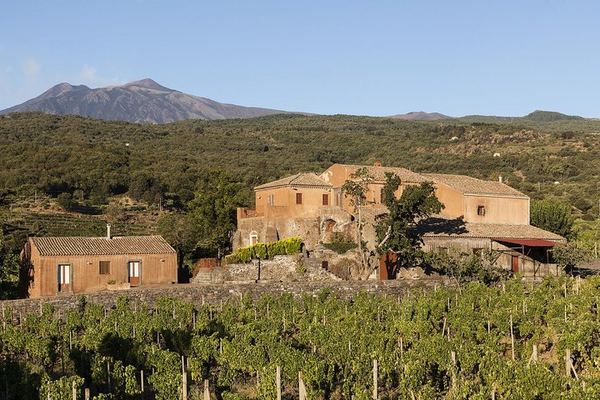
Three Etna Wineries in Six Hours, Entrance Fees Included
Six hours and three Etna estates with food, drinks and entrance fees all in the price. From two people, or semi-private for up to eight. Whites, rosés and reds.
Etna from Taormina: the Five 1865 Sartorius Craters and Gambino Winery
Pick-up in Taormina, not Catania, then the five craters the 1865 eruption opened along one fracture, and two hours at Gambino winery for lunch and wine.
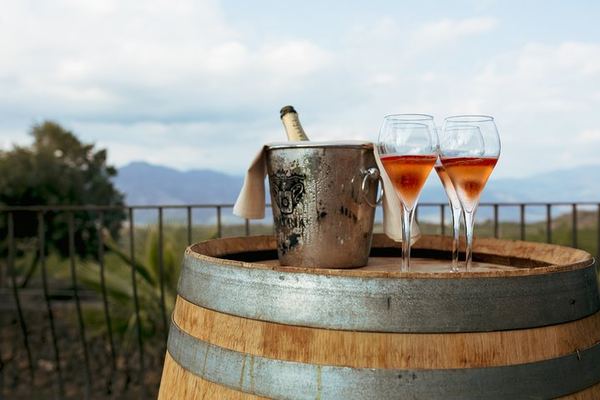
Etna Wine Country from Taormina: Five Glasses and Two Estates
Six hours in the Etna wine country with a licensed local guide: a family winery with five glasses and cold cuts, then an old farmhouse for the food.
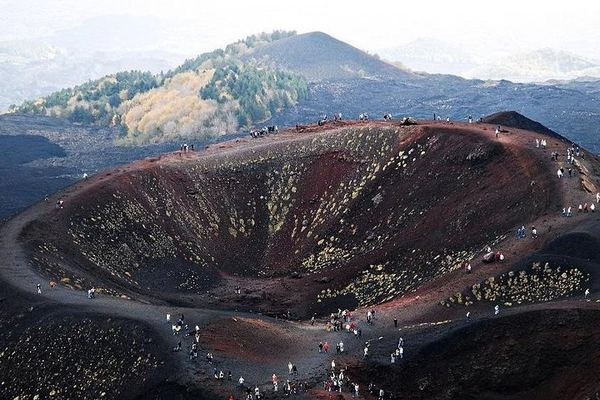
Private Etna from Taormina: a Family Winery, a Sommelier and Four Glasses
Your party alone in an air-conditioned car, a family-run cellar where the sommelier pours four Etna wines, and lunch of cheeses, salami and a pasta dish.
Ratings collected by Viator and Tripadvisor
Data verified on. DOC Etna and DOC Vesuvio production rules read in full; Domaine Sigalas 2026 harvest report; Diario de Lanzarote of 9 July 2026; Consorzio Etna DOC forecasts; Maltman, Journal of Wine Research, 2013. Editorial Policy


