
The Gas Mask They Rent You at Ijen Does Not Stop the Gas
The mask handed over at the Ijen car park is a particulate filter, and sulphur dioxide is a gas. What the published testing says it stops, what the Indonesian observatory recommends instead, and the one place where the observatory and the health researchers flatly disagree.

The Ijen gas mask is the most reassuring object in Indonesian volcano tourism, and for the job people think it is doing it is close to useless. It arrives at the car park in the dark, or it comes folded into the price of the trip, listed in the inclusions somewhere between the headlamp and the bottled water. Then the wind turns on the crater rim, and several hundred people put their faith in it at the same moment.
Sulphur dioxide is a gas. A particulate filter, which is what most masks are, catches solid specks: dust, ash, the mineral fragments that make up a volcanic plume. Gas molecules go through it the way water goes through a tennis net. This is not a point for specialists. It is the difference between equipment that works and equipment that makes you feel better while you breathe the same air you would have breathed without it.
What follows is narrow on purpose. It is not a piece about whether you should go to Ijen, and it is not medical advice, which nobody should take from a travel site. It is about one object, what the published testing says it does, and what the Indonesian observatory and the international body on volcanic health actually recommend, including the one place where they contradict each other outright. The wider ground is on our standing page about volcanic gas, ash and what actually hurts people.
What the Ijen gas mask filters, and what walks straight through it
Respiratory protection splits into two families that look alike and do unrelated jobs.
The first filters particles. An N95, an FFP2, a surgical mask, the flat-fold masks sold across Indonesia: these are mechanical filters, and against volcanic ash the good ones are genuinely good. A 2018 study in the International Journal of Hygiene and Environmental Health put a range of respiratory protection through filtration tests with volcanic ash and found four types above 98% median efficiency, an Indonesian basic flat-fold among them. Standard surgical masks came in at 89 to 91%.
The second family removes gases, and it does that chemically rather than mechanically. It needs a cartridge packed with a sorbent that binds the particular gas. For sulphur dioxide and hydrogen sulphide that means a cartridge rated for acid gases, which in the American system carries a white label. No amount of particulate filtration substitutes for one. When Kilauea was erupting in 2018 and masks were being handed out across Hawaii, the state health department said it plainly: what was being distributed protected against ash, not against the gas.
| What you might be wearing | Against volcanic ash | Against sulphur dioxide and hydrogen sulphide |
|---|---|---|
| N95 or FFP2, correctly fitted | Above 98% median filtration efficiency in the ash tests | Nothing. It is a mechanical filter, and these are gases |
| Standard surgical mask | 89 to 91% median filtration efficiency | Nothing |
| Cloth: bandana, scarf, T-shirt, handkerchief | No cloth material tested above 44% | Nothing |
| The same cloth, wet | Wetting does not improve filtration, and makes breathing harder | Nothing |
| Half-mask respirator with an acid-gas cartridge | Needs a particulate filter added as well | Works, within limits, if the cartridge is right and the mask seals |
The limits in that last row are where the argument really sits. A half facepiece respirator is assigned a protection factor of 10, which is a formal way of saying it is expected to cut your exposure roughly tenfold and no further. It has to be fit tested, and the wearer is meant to check the seal every time it goes on. A stubbled chin, a pair of glasses, a strap pulled on in the dark over a woolly hat, and the seal is gone. Air takes the easy route, which is round the edge of the mask rather than through the cartridge.

Two hundred and thirty parts per million, against a mask rated for ten
Numbers turn this from an argument into arithmetic, and Indonesia has just published some.
On 24 September 2026, before dawn, blue flames appeared at Kawah Manuk in the Papandayan complex, in Garut Regency, West Java. It is the same phenomenon Ijen is famous for: sulphurous gas escaping hot enough to ignite when it meets the air. Badan Geologi, the Indonesian geological agency, sent people to measure it, and the figures carried by the national press in the last days of September were sulphur dioxide at 230 ppm and hydrogen sulphide at 120 ppm at the fumarole cracks. Climbing was closed and a 500 metre exclusion was set around the active craters.
One caveat before those numbers go anywhere, because it matters. They are from Papandayan, not Ijen, and they were taken at the vents rather than where a visitor stands. We looked for a recent published measurement inside the Ijen crater and did not find one. What the Papandayan survey gives is the order of magnitude of a blue-fire gas field in Indonesia, measured this month by the agency whose job that is. Read it as the scale of the thing, not as a reading for another mountain.
| Value | The number | What it means |
|---|---|---|
| Sulphur dioxide measured at Kawah Manuk | 230 ppm | A reading at the vents, published by the national geological agency |
| Hydrogen sulphide measured at Kawah Manuk | 120 ppm | Same survey, same vents |
| Immediately dangerous to life or health, sulphur dioxide | 100 ppm | Above this, filtering respirators are not recommended at all. Only supplied air |
| Immediately dangerous to life or health, hydrogen sulphide | 100 ppm | Same figure, same consequence |
| Concentration at which asthmatics may respond | 0.2 to 0.5 ppm | Below the vent readings by a factor of several hundred |
| Protection factor of a half-mask respirator | 10 | Expected to cut exposure tenfold, if fit tested and properly sealed |
Two conclusions come out of that table, and neither is comfortable. The first is that at concentrations of the kind measured at a blue-fire vent, no cartridge mask is the right equipment at all: above the immediately dangerous threshold the guidance stops recommending filters and starts recommending an air supply. A rented half mask multiplied by ten does not get you from 230 down to anywhere you want to be.
The second involves hydrogen sulphide, and it may be the most useful thing on this page. Hydrogen sulphide is the rotten-egg smell, which the human nose picks up somewhere around 0.008 ppm. That is why people assume they will smell trouble arriving. At about 100 ppm the olfactory nerve fatigues within two to fifteen minutes and the smell goes away; at 150 ppm paralysis of the nerve has been reported. The smell stopping is not the gas clearing, and it can mean the opposite. Anyone standing in a fumarole field waiting for their nose to tell them when to leave has handed the decision to the least reliable instrument they brought with them.
Asthmatics are among the most sensitive groups to sulphur dioxide, and may respond to concentrations as low as 0.2 to 0.5 parts per million. The walk to the Ijen crater rim is roughly two hours of hard uphill in the dark, which is to say that it is exercise.
The rule requires a mask, and bans the people it would not have protected
Here is where it turns strange. Indonesia does regulate this, and the regulation asks for the object that does not work.
The conditions of entry to the Kawah Ijen nature tourism park, as reported by Indonesian outlets from late 2024 onward and still described as current through 2026, require visitors to be physically and mentally well, to have no history of asthma or heart disease, and to produce a doctor's certificate of fitness issued no more than three days before the visit. The certificate is checked when the booking barcode is exchanged for the physical climbing ticket. Personal safety equipment is required too: non-slip shoes, a warm jacket, and a mask.
Part of that we can corroborate from our own listings, which is a better position than it sounds. Two of the Ijen products on this site include a health certificate in what you are paying for, and one of them puts in writing that the check is required by local government regulations of everyone going up, so it is neither optional nor an invention of the operator's. Operators are budgeting for a rule, which is decent evidence that the rule is being enforced.
So the park asks for a mask, and the mask is the one item on that list that does not address the hazard people associate with it. Meanwhile the rule that would work, excluding anyone with a history of asthma, is stricter than anything the tour operators say. On our listings the same restriction turns up as not recommended for participants who suffer asthma, among a dozen other soft advisories about back problems and vertigo. Not recommended and not permitted are different sentences, and the gap between them is where somebody with a rescue inhaler in their pocket quietly decides it will probably be fine.
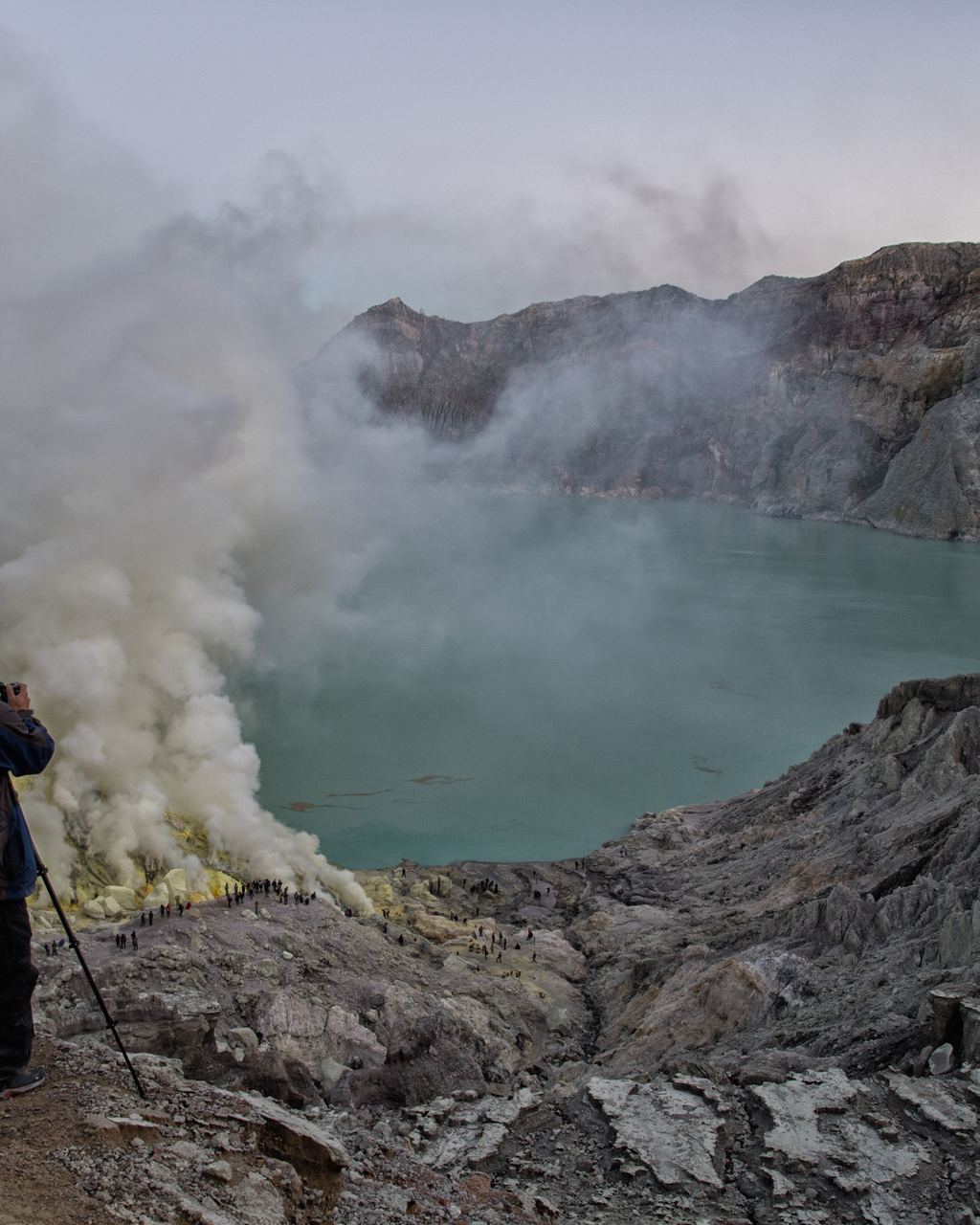
The people who do this every night
The miners are not a reassurance, and they are not a control group
The sulphur miners carry loads out of the Ijen crater in paired bamboo baskets on a shoulder pole, and on our own listings the weight is given as 80 to 100 kilos, one way. Visitors report being offered a miner's own mask, which is generous and ought to be refused, because it leaves the person who works a full shift down there without it.
Their presence gets read as evidence that the crater floor is survivable. It is evidence of something else. Occupational exposure is a different category from tourism, and a working life spent in that air is not an argument for spending twenty minutes in it.
Our own listings do not agree about the crater floor
PVMBG, the Indonesian volcanology agency, has been explicit about Ijen, and explicit at Level I, which is the ordinary state rather than a crisis measure. Ijen was lowered from Level II to Level I in August 2024 and, on everything readable on 29 September 2026, it has held there through this year. The recommendations attached to that decision ask residents, visitors, tourists and miners alike not to approach the crater rim, not to descend to or approach the crater floor, and not to spend the night within 500 metres.
Now compare two products on this site. Both live, both on the same mountain, both with a gas mask in the price.
One carries the operator's own fine print:
All tourist are not allowed to go down to the crater but allowed to see blue fire from 1km off limit from the crater (ijen rim).
The other describes the itinerary as an hour up to the top and then thirty minutes down into the crater, which is where the blue flame is and where the miners are working while you look at it, with time for photographs before turning back.
Both are bookable today. They are not describing different mountains, and one of them is not describing the same rules as the other. We publish both, because the job here is to list what exists rather than to pretend the catalogue is tidier than it is, and because we do not operate any of it. What we can do is say which of the two matches the observatory's recommendation, and it is the one that keeps you on the rim.
All ten of the Ijen trips we carry in English sit on the Mount Ijen listings, and on this particular question the fine print deserves more of your attention than the photographs. If you are trying to work out what you have actually bought, our page on how to choose a volcano tour is about this exact kind of reading.

On a wet cloth, PVMBG and the health researchers flatly disagree
This is the contradiction, and it is worth setting out with both versions rather than quietly picking one.
The PVMBG recommendation for Ijen closes with advice for anyone who catches a sharp smell of gas: use a mask over the airways, and in the short term or an emergency a wet cloth over the nose and mouth will serve.
The published testing says a wet cloth is worse than a dry one. Wetting a material does not improve its ability to filter volcanic ash, wet material is harder to breathe through, and in the filtration tests no cloth of any kind got above 44% median efficiency even dry. Against a gas none of it does anything at all, wet or dry. Folding a bandana three times took it from 29% to 40%, which gives a sense of the ceiling being argued over.
So a national observatory recommends a measure the international literature has tested and rejected. We are following the literature, because it is the more circumstantial of the two, it publishes its method, and it was testing these exact materials. Both positions are on the record, and readers can weigh them. The practical upshot is the same either way: by the time you are holding wet fabric over your face, the equipment question has already been settled badly, and the only instrument left is your legs.

Ijen blue fire safety is distance, height and time
Take the mask out of the picture and what remains is unglamorous, and works.
Distance. Gas concentration drops steeply as you move away from a vent, which is why every exclusion an observatory writes is a radius rather than an instruction about equipment. The 500 metres at Papandayan and the 500 metres at Ijen are doing work a mask cannot.
Height. Sulphur dioxide and carbon dioxide are heavier than air and pool in hollows, which on a volcano means the crater floor and the drainage lines running off it. The Ijen recommendations flag the Banyupait river for that reason. Going down is the single decision that changes exposure most, and it is also the one being sold as the highlight. Several of the words in this paragraph are defined in our volcano glossary for travellers, which is duller than the flames and more use.
Time. Dose is concentration multiplied by duration. Twenty minutes in a plume is not four times five minutes, there is no threshold below which the arithmetic stops applying, and the response figures quoted above come from short controlled exposures rather than from a two-hour walk at altitude.
Wind is the variable nobody controls. It decides within seconds which side of the rim is breathable, which is why accounts of the same night at Ijen run from pleasant to frightening depending on where people happened to be standing. Rain brings the other hazard the observatory keeps naming, which is the crater wall: landslides on it are reported as likelier when rainfall triggers them, and Ijen sits in a country with a wet season.
The night, and where the exposure actually sits
Ordered by sequence rather than by clock time, because departure times differ by operator and we are not publishing hours we could not confirm at source.
The origins
Pick-up
Late evening, or the small hours
You are collected in Banyuwangi, or the previous afternoon in Bali on the longer products. Nothing to do with gas yet. This is the stage at which a doctor's certificate either exists or does not.
The gate
Paltuding
Tickets, the health certificate check, and the point where a mask is handed over or rented. Worth looking at what you have actually been given: a chemical cartridge, or a paper filter.
The growth
The climb
Roughly two hours up
Steep, dark, and hard enough to leave most people breathing through their mouths. Exertion raises the volume of air you move, which raises the dose at any given concentration.
The rim
The decision point
From here the lake, the flames on a good night and the sunrise are all visible. The observatory's recommendation stops you here, and so does the fine print of at least one of the tours on this site.
The descent
Thirty minutes down, on the products that offer it
Into the hollow where the gas pools, close to the vents, in the dark, on loose ground, with the wind deciding what you breathe. This is the part no mask makes safe.
Today
The way out
Uphill again, then the long walk down
The climb back out of the crater is done on whatever your lungs have left. Coughing, chest tightness and burning eyes come up repeatedly in visitor accounts of this stage.
Afterwards
The following days
Bronchial irritation and infection after the visit appear often enough in visitor accounts to be worth knowing about in advance. Whether that applies to you is a conversation with a doctor, not with a travel site.

What we could not verify
Three gaps, stated rather than filled, because a declared hole is worth more than a confident guess.
The opening hour of the Ijen trail is not something we can source to the park authority. Indonesian travel sites converge on a gate opening in the small hours, and our own listings show pick-ups from late evening onward, but the managing body does not publish it anywhere we could open, and the domains of the Indonesian park bodies have a history of not resolving. So there are no times in this article.
The alert level and its recommendations we read on 29 September 2026 through Indonesian news reporting of the PVMBG letter, rather than by opening the bulletin ourselves. Ijen was at Level I on everything readable, and the crater-floor recommendation is quoted consistently across outlets, including the 500 metre overnight exclusion. Read the live position at MAGMA Indonesia, at magma.esdm.go.id, which publishes every Indonesian volcano's level and updates twice a day. It is the only source that can be current, and this page cannot.
There is no gas measurement for Ijen here, at the rim or on the crater floor, because we could not find a recent published one. The Papandayan figures are a different mountain, and we have said so each time they appear.
One thing that is not a gap, and that the whole subject gets wrong: an aviation colour code is not an alert level. It describes ash in the atmosphere as a hazard to aircraft, and says nothing about whether the air at a crater rim is breathable. If you go looking for Ijen's status and come back with a colour, you picked up the wrong instrument. Our guide to checking whether a volcano is erupting covers where the two numbers live, and why they disagree.
The questions people actually type
Does the gas mask at Ijen actually work?
Against ash, a properly fitted particulate mask works well. Against sulphur dioxide and hydrogen sulphide, which are the gases at Ijen, it does nothing, because it is a mechanical filter and they are gases rather than particles. Stopping them needs a cartridge rated for acid gases, fit tested and sealed to the face, and even then a half mask is only expected to cut exposure about tenfold.
What kind of mask stops sulphur dioxide?
A respirator with a chemical cartridge rated for acid gases, which in the American classification carries a white label. Two conditions have to hold: the cartridge has to be the right type and not exhausted, and the mask has to seal against your skin, which is why industrial users are fit tested and check the seal every time. Glasses, stubble and a strap pulled on in the dark all break that seal. Above the immediately dangerous threshold of 100 ppm, published guidance stops recommending filtering respirators altogether and calls for supplied air.
Can you go down into the Ijen crater?
The Indonesian volcanology agency asks visitors, tourists and miners not to descend to or approach the crater floor, and not to spend the night within 500 metres. That recommendation applies at Level I, Ijen's ordinary state, rather than only during a crisis. Some tours honour it and say in their own fine print that nobody is allowed down. Others sell thirty minutes on the crater floor. Both are bookable, and only one matches the advisory.
Does a wet cloth help against volcanic gas?
No, and the evidence says it is worse than useless. Wetting a material does not improve its ability to filter ash and makes it harder to breathe through, and no cloth of any kind exceeded 44% filtration efficiency even dry. Against a gas, cloth does nothing wet or dry. The Indonesian advisory for Ijen does suggest a wet cloth as a short-term emergency measure, which contradicts the international research. We are following the research, and flagging the disagreement rather than hiding it.
Can you visit Ijen if you have asthma?
The published conditions of entry say no. The park requires visitors to have no history of asthma or heart disease, and to produce a doctor's certificate of fitness. That is stricter than the tour operators, who tend to word it as not recommended. There is a reason for the strictness: asthmatics are among the most sensitive groups to sulphur dioxide and may respond at 0.2 to 0.5 ppm, and the climb itself is exercise, which is the condition under which that sensitivity was measured. Whether it applies to you is a question for your doctor.
Do you need a doctor's certificate for Kawah Ijen?
On the rules as reported from late 2024 and still described as current through 2026, yes: a certificate of fitness issued no more than three days before the visit, checked when you swap your booking barcode for the physical climbing ticket. Two of the Ijen products listed on this site include the health certificate in the price, and one states that the check is required of everyone by local government regulation, which suggests it is being enforced rather than ignored.
Is Mount Ijen at a dangerous alert level right now?
We are not printing a live status. On everything readable on 29 September 2026, Ijen was at Level I, Normal, where it has sat since being lowered from Level II in August 2024. Normal does not mean the gas is absent: the crater-floor recommendation and the 500 metre overnight exclusion apply at exactly that level. Check the current position at MAGMA Indonesia, magma.esdm.go.id, which publishes every Indonesian volcano's level and updates twice a day.
Why does the smell of sulphur go away at the crater?
Because your nose stops working, not because the gas has gone. Hydrogen sulphide is detectable by smell at around 0.008 ppm, but at roughly 100 ppm the olfactory nerve fatigues within two to fifteen minutes, and paralysis of the nerve has been reported at 150 ppm. Losing the smell in a fumarole field can mean the concentration has risen, not fallen. It is the main reason your nose is a poor instrument for deciding when to leave.
What is bookable on Ijen
Read the fine print on each of these before you read the photographs. The descriptions differ on the one question this article is about, which is whether you go down into the crater or stay on the rim.
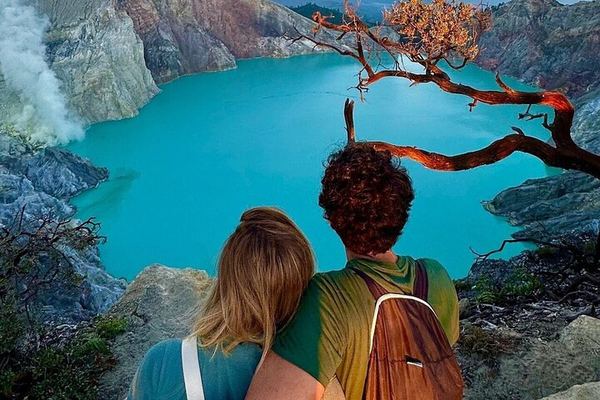
From Banyuwangi or Bali Sunrise Ijen Vulcano Hiking All Inclusive
A 1 hour 30 transfer to Paltuding, the climb to the blue flames before dawn, then the summit at sunrise over the largest acidic crater lake in the world.
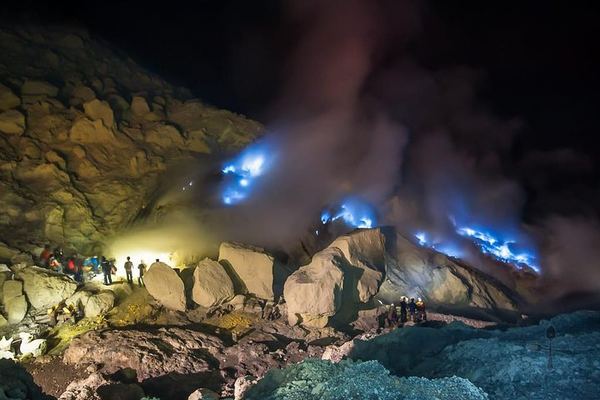
Ijen at Midnight, with a Coffee Plantation on the Way Back
Ninety minutes through rainforest to the car park, an hour up and thirty down into the crater, and a coffee plantation and a waterfall on the drive home.
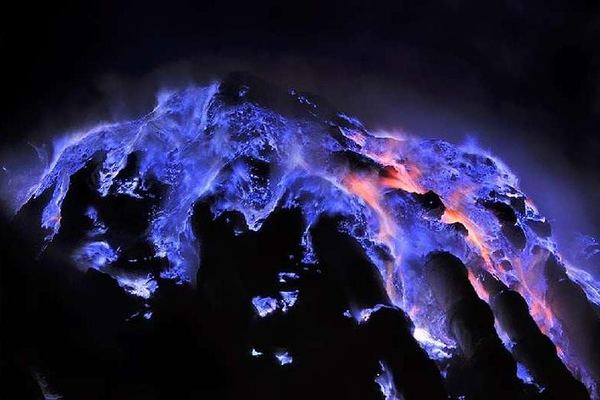
Ijen at Night, Past the Miners Carrying 80 to 100 Kilos
The miners you pass on the way up are carrying 80 to 100 kilos of sulphur in bamboo baskets, one way, and the route ends at the sunrise spot above the lake.
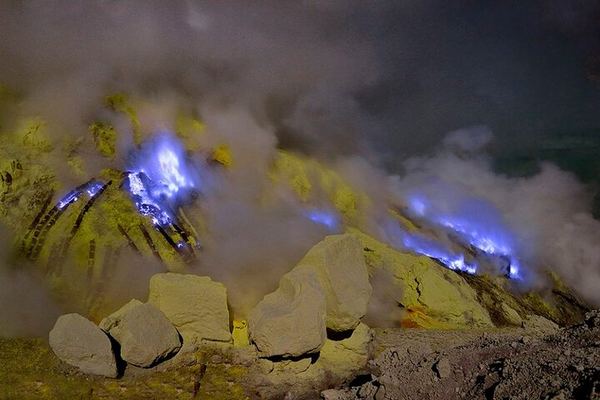
Ijen Blue Fire, and the Sunrise Window from May to September
The acid lake inside the crater covers a square kilometre, the largest on Java, and the operator puts the best sunrises of the year between May and September.
Ratings collected by Viator and Tripadvisor
Data verified on. NIOSH chemical hazard guides, the 2018 volcanic ash filtration study, Indonesian press of Sept 2026 on the PVMBG Ijen letter and the Papandayan gas survey, and the live listings on this site. Editorial Policy


