
The Best Month for Etna Is Not August, and the Italian Data Says So
Italy's own monthly series puts the year's biggest share of foreign arrivals in Sicily in September, not August. August is the Italians' month. On a mountain whose summit runs 16 °C colder than the coast, that distinction decides more than the crowd.

Search for the best time to visit Mount Etna and the answer comes back as summer, which is true in roughly the way that a beach is warm in summer. Italy's own statistics say something narrower and a great deal more useful: the month that brings the largest share of foreign visitors to Sicily is not August. It is September.
August is the peak of total arrivals, and it is the peak because it is the month Italy takes its holiday. Schools, offices and a good part of the manufacturing sector stop at the same time, Ferragosto sits in the middle of it on the 15th, and the country moves to the coast in one block. Italian trade-press accounts of the 2026 season put that domestic movement at around sixteen million travellers in August alone.
The two peaks are both real, and they are stacked in different months by different people. Then they get added together into one sentence, Sicily is busiest in summer, which is a perfectly accurate sentence and no help at all to somebody flying in from Manchester or Chicago. Pulling the two apart changes the answer, and it changes what the mountain looks like on the day you walk on it.
Two peaks in the same summer, and only one of them is yours
Italy's national statistics institute publishes arrivals by region and by month, split between residents and non-residents. On that series, as read on 18 August 2026, September carries 14.7% of the year's foreign arrivals in Sicily, the largest share of any month, with May and October immediately behind it. August leads the other column.
This is not a weather effect and it is not a recent fashion. An academic study of Sicilian tourism seasonality, working on the monthly international series, found the same double-peaked shape two decades ago: international arrivals rising to one peak in spring and a second in September, rather than the single July-and-August mountain the headline figures imply. Its data are old, which in this case is the useful part. A shape that has held for twenty years is a structure, not a fluctuation.
One caution about the Italian series, and it is why this article gives shares rather than growth. The statistics were revised between 2024 and 2025 to widen the coverage of non-hotel accommodation: short lets, rooms, agriturismi. Any year-on-year comparison across that break is partly an artefact of counting more beds rather than of more people arriving. Monthly shares inside a single year survive the revision. Year-on-year percentages across it do not, which is why you will find none here, and why the ones you meet elsewhere deserve the question compared with which coverage?
Why September is the best time to visit Mount Etna, and May is second
The crowd figure is only half the argument. The other half is that Etna is not a Sicilian summer destination in the way the coast is. It is a mountain with a summit above 3,300 metres, and air cools by roughly 6.5 °C for every thousand metres of height. Run that gradient from sea level to the summit crater area and a coast at 30 °C becomes something near 10 °C before you allow for wind, which is the single most reliable way people get the day wrong. Our packing page exists largely because of that arithmetic.
The same heat that makes the coast pleasant in August is what ruins the view from the top. Sun warms the lower slopes, humid air rises, and cloud builds around the summit through the late morning: guides on the mountain describe a clear window early and a band of cloud sitting at mid-altitude for much of the afternoon. It is why every serious Etna itinerary starts at an hour that looks unreasonable on the booking page, and why the good operators are blunt about it.
September keeps the warm coast and sheds a good deal of the haze. The air carries further, the walking is easier, and the day is shorter in a way that mostly helps, because a sunrise departure in late September is a civilised hour rather than a punishment. May does the same job from the other side of summer. That is exactly why the Italian series shows May and October sitting behind September rather than July and August: the foreign visitor and the mountain want the same two shoulders.
| 1 | 2 | 3 | 4 | 5 | 6 | 7 | 8 | 9 | 10 | 11 | 12 |
Where you actually sleep
The coast empties before the mountain cools
Almost nobody bases an Etna trip on Etna. They base it in Catania or Taormina, and those two run on the coastal calendar rather than the mountain's. The Italian holiday block breaks in the last days of August, and the beds it was filling come back on the market while the sea is still warm enough to swim in.
That is the practical content of the statistics: the same room, the same transfer, often the same guide, one to three weeks later, with a different set of people in the queue for it. One gap survives the change of month. On our own listings, the same trip costs more leaving from Taormina than from Catania, and the difference is the length of the transfer rather than anything that happens on the volcano.
Sicily is a seven-times destination. Greece is a twenty-times one
The question when should I go carries different weight in different places, and the weight can be measured. Take the busiest month of arrivals in a destination, divide it by the quietest month of the same year, and you have a number that says how much of the decision the calendar is making for you. The three below come from our own reading of the national statistics offices on 18 August 2026. We could not reopen those portals on the day this was written, so treat them as dated readings rather than live figures.
| Destination | Busiest month divided by quietest | What that means when you pick a date |
|---|---|---|
| Sicily | 7.43x | The month matters. Get it wrong and you pay in crowds and price, but there is no month when the island stops working. |
| Greece | 20.67x | The month decides the trip. Outside the season a large part of the infrastructure is simply not running. |
| Canary Islands | 1.29x | There is effectively no season. A volcano trip there is as available in February as in August. |
Etna sits in the middle case, and the middle case is the interesting one. It has a wrong month rather than a closed season. Nothing about Sicily in February prevents a volcano trip; the cable car runs, the lower craters are there, the wine estates are open and the island is cheap. What February takes away is the summit, which is the thing most people came for.
Greece is the extreme at one end. A Santorini caldera in January is a real place with real residents and very little else, and the compression of its season into a few summer weeks is most of that island's tourism story. The Canaries are the extreme at the other, which is why this site treats them as the destination without a calendar: at 1.29x, the difference between the best and the worst month is smaller than the difference between two consecutive weeks of weather.
If you want the same reading for the other thirty-odd volcanoes in our catalogue, it is laid out destination by destination in when to go, destination by destination, on thirty-year climate normals rather than on arrivals.
August is Sicily's busiest month. September is its foreign one. Almost every «best time to visit» page merges the two, and then answers a question nobody asked.
The best time to visit Mount Etna depends on which Etna you booked
Etna is sold as at least four separate days out, and they want different things from the calendar. Treating them as one product is how people end up buying a summit trip in a month that will not give them a summit, or a wine day three weeks before anything is picked.
Four different mountains, four different calendars
All of them run out of the same two towns. Only one of them has a fixed season.
Summit craters
The highest and the most weather-dependent. It wants the clearest air and the least cloud build-up, which means the early part of the day in May, June, September or October. It is also the product most often shortened or rerouted, and not by the weather.
Sunrise departures
Leaves the coast in the dark to reach height before the cloud cycle starts. September is the kind month for this: sunrise is later than in June, so you get the same view for an extra hour of sleep and a warmer wait at the top.
Wine and food on the slopes
The one Etna product with a genuinely fixed season, and a late one. Picking here runs into October and November, later than almost any other Italian region, because the vineyards sit roughly between 600 and 1,000 metres and the fruit ripens slowly at that height.
Jeep and 4x4 runs
The least weather-sensitive of the four. The vehicle does the altitude, the stops are lower, and it is the usual fallback when the summit is shut. Worth knowing about before you arrive rather than after.
The one thing a good month does not fix
Everything above is climate and crowds, which are the two things a calendar can predict. The volcano is not one of them. No month is safer than another, no month is likelier to produce lava, and anyone selling you a season for eruptions is selling you a coin toss with a date on it.
Etna has just produced a dated example of how this plays out, and it is worth reading carefully because it contains the most misreported idea in the subject. On 14 September 2026 Italian outlets reported a red aviation alert and an ash column given as four kilometres high, with Catania airport suspending arrivals and departures on two sectors until 10:00 the following morning. By 18 September the same outlets were reporting the explosive activity attenuating and the aviation notice stepping back down from red to orange.
That red was an aviation colour code. It describes ash in the atmosphere as a hazard to aircraft. It is not the civil-protection alert level, it says nothing about the risk to a person standing on the mountain, and the two instruments are quoted interchangeably until neither means anything. A volcano can be orange for aviation and unremarkable on the ground on the same morning, and frequently is.
We are reporting those as dated press accounts of things that have already happened, not as a current state. This site publishes an eruptive state only when it has opened the source on the day of writing, and on 22 September 2026 what was readable from here was bulletin indexes and news reports rather than an opened primary document. So there is no alert level in this article. The places to read one are the Etna observatory of Italy's national institute of geophysics and volcanology, which publishes a weekly multidisciplinary bulletin and separate volcanic activity notices, and the Sicilian civil protection department for the access zones on the mountain itself.
Two practical consequences. The first is that the summit is not somewhere you simply walk to, and the rule everyone repeats about it, that a guide becomes compulsory above 2,900 metres, is not in any ordinance we could find. The second is that an ash cloud is a travel problem before it is a geological one, and what you are actually owed when it cancels your flight is a question with real answers, worked through on our page about what happens if the volcano erupts.

Reading this in September means you are booking for next year
This piece is published inside the month it argues for, which is deliberate and slightly unusual. If you are on the island right now, you can check the claim by looking around you at who is queuing for the cable car and in what language. Almost nothing else on this site can be verified by standing still.
For everyone else the timing is the whole point. The only national series we have found that asks travellers directly how long they had been thinking about the trip is Icelandic, and on the reading we took on 18 August 2026 it splits leisure visitors into cumulative classes: 13.8% had been considering it for less than three months, 45.4% were inside nine months, and 42.2% had been thinking about it for more than a year. The excursion itself behaves in the opposite way, booked in days and often the night before.
So the flight is a nine-month decision and the volcano is a two-day one. An article about September is therefore worth reading in September, for a trip you will take the September after. If you want to start from the other end, the Mount Etna listings show what is actually bookable, and the wine and food days on the slopes are the ones that make the late shoulder worth a flight on their own.
The sources behind this article, for anyone who wants to go and check: Italy's national statistics institute for the regional monthly arrivals series, read through its data portal on 18 August 2026; a published study of Sicilian tourism seasonality for the shape of the international series; Italian travel trade press of July 2026 for the August domestic movement; Italian national and Sicilian press of 14 to 18 September 2026 for the ash column and the aviation notice; the weekly bulletin index of the Etna observatory of Italy's national institute of geophysics and volcanology; the Icelandic tourist board for the planning-horizon classes; and our own when-to-go dossier and the live listings on this site for everything about the mountain and the products on it.


The questions people actually type
What is the best month to visit Mount Etna?
September, with May close behind it and October third. Those are the months when a warm coast and a walkable summit overlap, and when the daily cloud build-up that hides the top in high summer is at its weakest. Italy's monthly arrivals series supports the same answer from a different direction: September carries the largest share of the year's foreign arrivals in Sicily, 14.7% on the series as read on 18 August 2026.
Is August a bad time to visit Etna?
Not bad, but the worst of the good months. August is the peak of Italian domestic holidays, which means the highest prices and the fullest transfers of the year, and the heat drives a daily cloud cycle that closes the summit view through much of the afternoon. If August is the only month you have, book a departure that leaves before dawn and accept that the middle of the day is not when you will see anything.
Why do statistics say August is Sicily's busiest month if September is better?
Because the two figures count different people. August is the peak of total arrivals, driven by Italian holidaymakers, with trade-press accounts putting the 2026 domestic movement at around sixteen million travellers in that month. September is the peak of foreign arrivals. Almost every guide adds the two together into a single claim about summer, which is accurate and useless if you are flying in.
Can you visit Mount Etna in winter?
Yes, but it is a different trip. From December to March the upper mountain runs on snow and the summit routes are frequently out of reach, while the lower craters, the lava caves, the cable car and the wine estates carry on. Sicily as a whole has a ratio of about 7.4 between its busiest and quietest months of arrivals, so winter is quiet and cheap rather than closed.
How cold is it at the top of Etna compared with Catania?
Air cools by roughly 6.5 °C for every thousand metres, and the summit is above 3,300 metres. A coast at 30 °C therefore corresponds to something near 10 °C at the top before any wind, and the gap is why people in shorts get turned back at the cable car. Layers are not optional in any month, September included.
Is Mount Etna erupting right now?
We are not printing a current state. This site publishes an eruptive state only when it has opened the source on the day of writing, and on 22 September 2026 that was not possible from here. What we can report as dated fact is that Italian outlets described an ash column and a red aviation alert on 14 September 2026, with Catania airport suspending two sectors until the following morning, and the same outlets reported the activity attenuating and the notice dropping to orange by 18 September. Read the current position at the Etna observatory of Italy's national institute of geophysics and volcanology.
Does the aviation colour code tell me whether it is safe to climb?
No, and this is the most common mistake in volcano coverage. The aviation colour code describes ash in the atmosphere as a hazard to aircraft. The civil-protection alert level describes the risk to people on the ground. They are separate instruments, set by different criteria, and they can disagree on the same morning. A red aviation code tells you something about your flight, not about your walk.
When is the Etna grape harvest?
Late. Picking on the volcano runs into October and in places November, which is later than almost any other Italian wine region, because the vineyards sit roughly between 600 and 1,000 metres and the fruit ripens slowly at that height. It is the one Etna product with a genuinely fixed season, and the reason the late shoulder is worth a flight on its own.
What is bookable on Etna
Twelve experiences under the destination, from jeep runs on the southern flank to guided summit days. Prices and durations come from the operators' feeds and change without us.
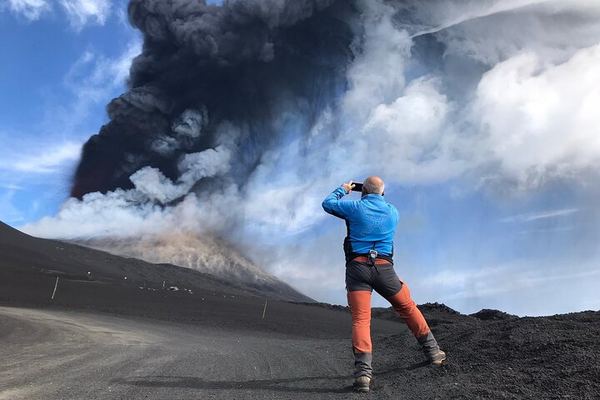
Etna 3,000 m with Alpine Guides: Barbagallo, Torre del Filosofo, 3 Hours on Foot
The cable car and jeep ticket is paid in cash on site, not included. Four hours of walking to Barbagallo, the 2002 vent and Torre del Filosofo.
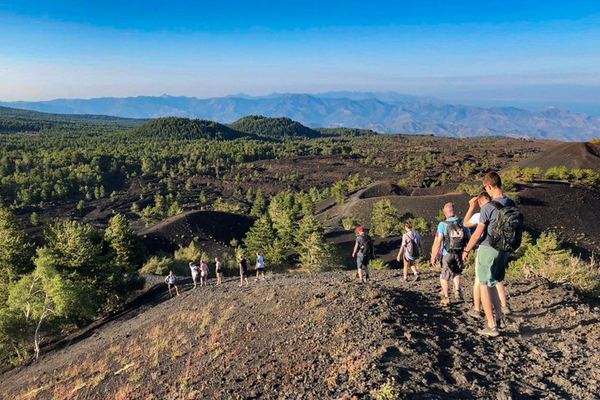
Etna and Alcantara: Birch Woods, a Lava Tunnel and the Basalt Columns
A certified environmental guide, 3 km through birch woods to the Sartorius craters, and the canyon entered barefoot from the municipal stairs. Max eight people.
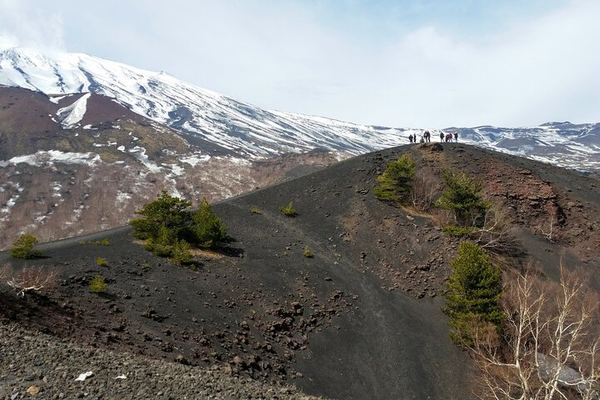
Etna and Alcantara by 4x4: One of 190 Lava Caves, and the Riverbed at 25 m
The jeep gets left at the top and the walk goes down to the riverbed itself, under 25 metres of basalt. Honey and Fuoco dell'Etna at Piano Provenzana first.
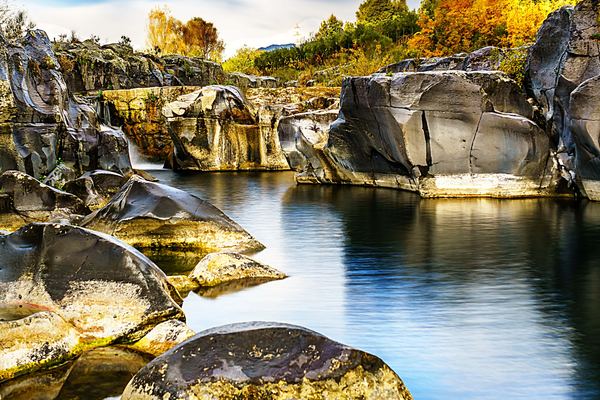
Etna and Alcantara by 4x4, with a Tasting of Wines and Honeys
A 4x4 out of Piazza dei Martiri at 8:30 and back by 4:30, with extinct craters on foot and a tasting of local wines, honeys and liquors between the two parks.
Ratings collected by Viator, Tripadvisor and Civitatis
Data verified on. ISTAT regional monthly arrivals (read 18 Aug 2026), INGV-OE bulletin index and Italian press of 14-18 Sep 2026, our own when-to-go dossier, and the live listings on this site. Editorial Policy


