
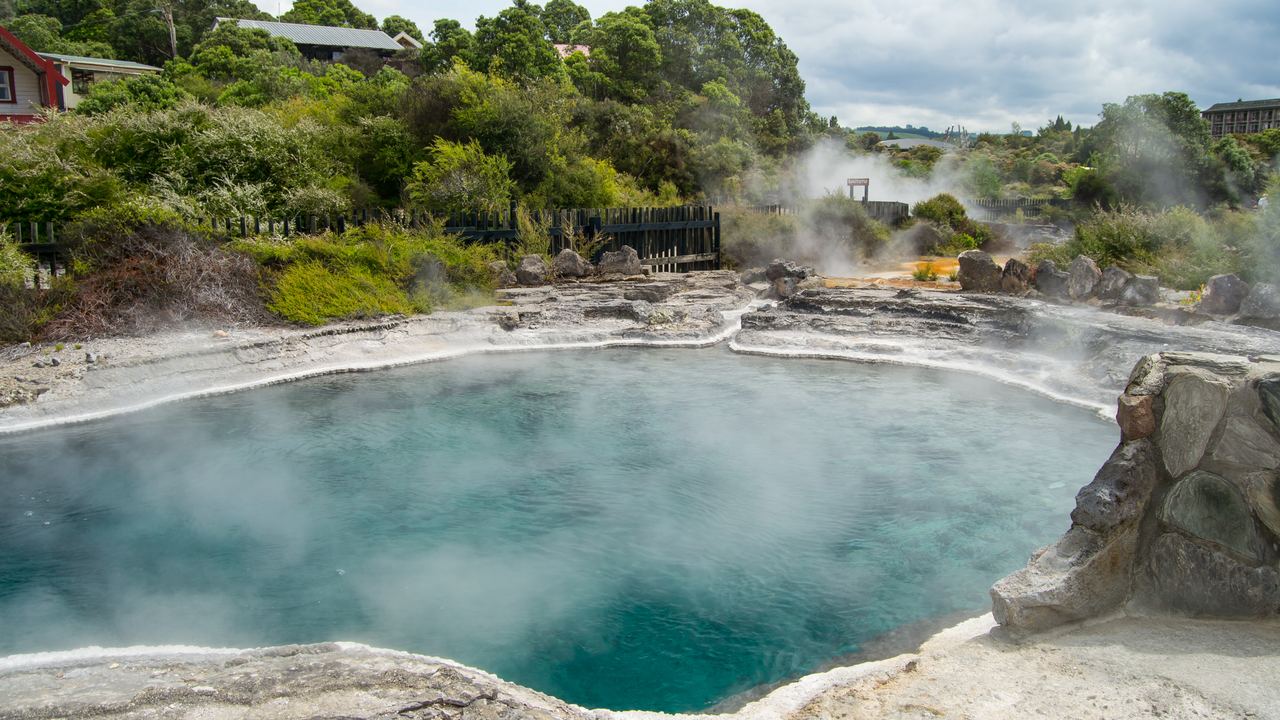
Te Puia and Whakarewarewa: Two Gates, One Geothermal Valley
Te Puia is NZD 105 and has the Pōhutu geyser. The village next door is NZD 55 and has people living on the same field. They are not the same ticket and most visitors find that out late.
There is one geothermal valley and there are two gates. Te Whakarewarewa sits on the southern edge of Rotorua, and it has an entrance on each side: Te Puia on Hemo Road, and Whakarewarewa the Living Māori Village on Tryon Street. They are separate businesses with separate tickets, separate car parks and separate opening hours, and the number of people who buy one believing they have bought the other is the most reliable confusion in Rotorua tourism. The geyser is on the Te Puia side. That is the sentence that resolves most of it.
What follows is the operating detail: which gate buys what, when the geyser goes off, what the village asks of you, and which of the six coach days from Auckland make sense. The geology of the district and the comparison between the six geothermal fields belong to the Rotorua page above.

A Whole Day at Te Puia: Hāngī Buffet, Haka and Time to Actually Stay
One destination instead of two, so the hāngī buffet, the haka and the guided geothermal walk all fit without anyone hurrying you back to the minibus.
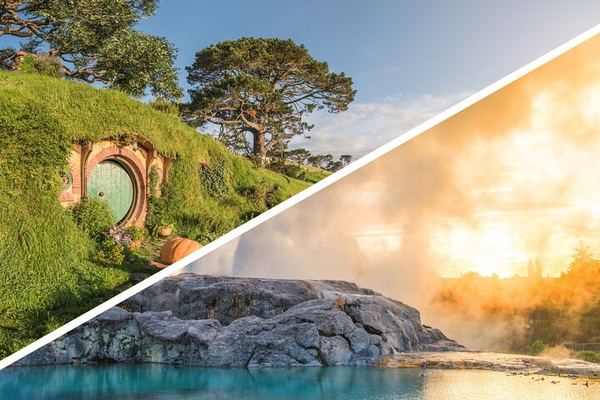
Hobbiton and Te Puia from Auckland: Small Group, Two Attractions
Cheeky Kiwi Travel runs this one in a small group: two and a half hours inside Hobbiton with a Green Dragon drink, then Te Puia guided in the afternoon.

Hobbiton's 44 Hobbit Holes and Te Puia: a 12-Acre Film Set and a Geyser in One Day
Two and a half hours inside the 12-acre set with its 44 hobbit holes and a drink at the Green Dragon, then Te Puia's geyser and the Māori arts school.
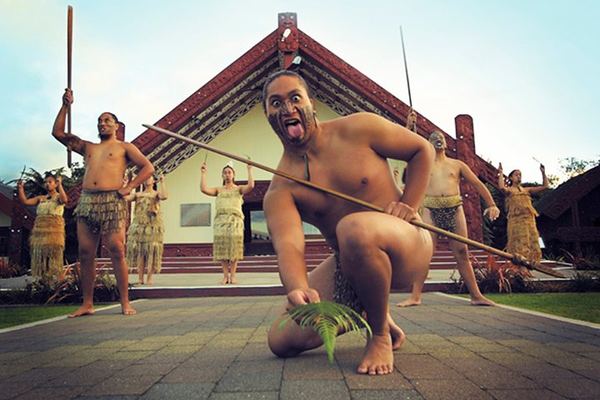
Rotorua and Te Puia in a Day: the Small-Vehicle Route the Big Coaches Miss
A small-vehicle day that reaches roads the coaches skip, with Te Puia's valley, a marae performance, a kiwi awake, and Rachel's Spring in the gardens.
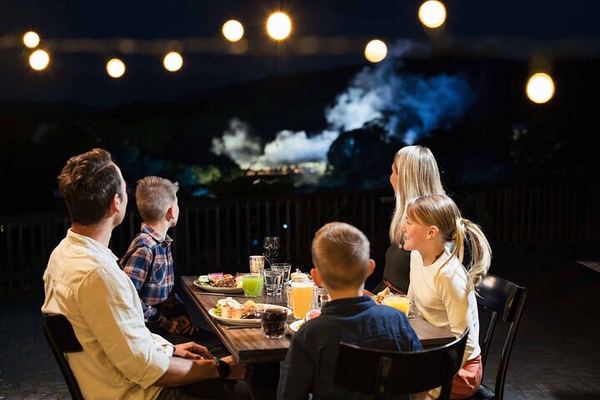
Te Pō at Te Puia: Hāngī Lifted from the Pit, then Pōhutu Under Lights
The evening opens with the hāngī being lifted out of the earth oven and closes with hot chocolate beside Pōhutu, with the thermal valley lit around it.
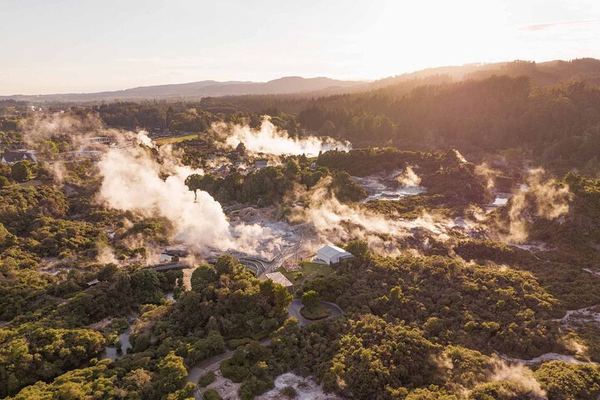
Te Puia Te Rā: 90 Guided Minutes with Pōhutu, the Carving School and a Kiwi
A kaiārahi walks you through the geothermal valley in 90 minutes, past Pōhutu, into the nocturnal kiwi enclosure and the carving school while it is teaching.
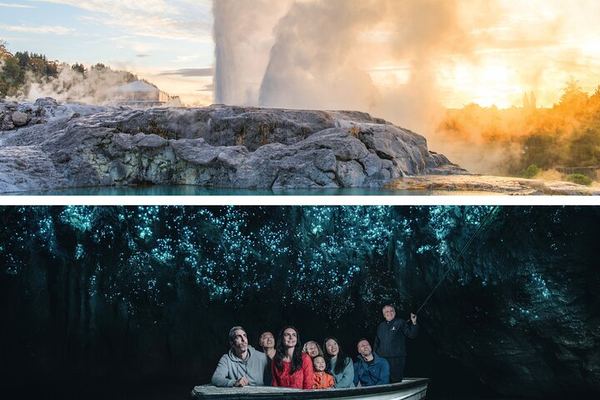
Waitomo Glowworms and Te Puia in One Day: Underground Lights, Then the Geyser
The glowworm boat under Waitomo in the morning and 90 guided minutes at Te Puia after it, in a minibus small enough for the guide to talk to everyone.
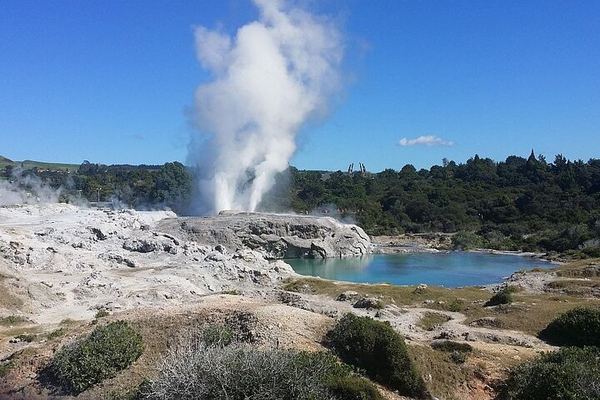
Whakarewarewa Living Village from Tauranga: Hāngī Lunch Steam-Cooked in the Ground
Six and a half hours with a village guide, lunch cooked in the in-ground steam boxes, and a 30-minute concert, plus Te Puke where 85% of the crop grows.
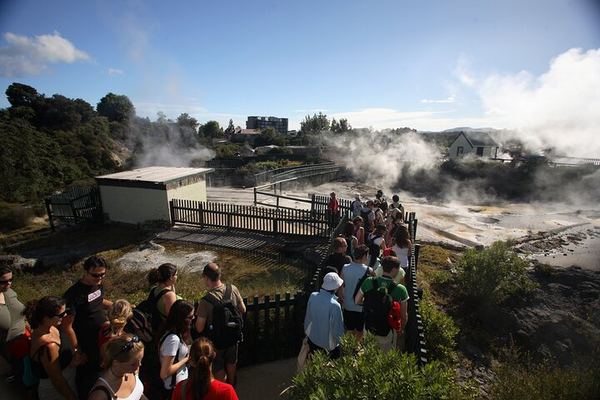
Whakarewarewa Village: Two Hundred Years of Guiding, and Corn Cooked in a Hot Pool
The guides descend from the first Māori guides in New Zealand, and the tour includes corn cooked in the village's largest hot pool rather than a kitchen.

Whakarewarewa with the Iwi Who Guided the Pink and White Terraces
The village people here are the iwi who guided visitors to the Pink and White Terraces, and the concert can be swapped for the Polynesian Spa at no extra cost.
Ratings collected by Viator and Tripadvisor
Which gate has the geyser
Pōhutu is the largest active geyser in the southern hemisphere. It fires up to twenty times a day, reaching around 30 metres, and each eruption runs for ten to twenty minutes rather than the few seconds people expect from a geyser. The smaller Prince of Wales Feathers vent beside it usually goes first, which is the cue to stop walking and sit down.
Access to it is on the Te Puia side. Te Puia's whole layout is built around the geyser terrace: you stand above the silica mound with the vent in front of you and the steam crossing the path when the wind turns. The village across the valley describes its own position differently depending on which of its products you read, and this is worth being precise about because the two statements do not match. The village's own website says its self-guided geothermal trails do not include access to the geyser. The description of its guided village tour, sold through the operator, says visitors view Pōhutu from two viewing platforms.
Both may be true of different tickets, and neither is a reason to guess. If the geyser is why you are coming, buy Te Puia, where the terrace is the point of the site and there is nothing to interpret. If you buy the village, buy the guided tour rather than the self-guided trails, and treat any view of the geyser as a bonus rather than the reason.
| Te Puia | Whakarewarewa Village | |
|---|---|---|
| Entrance | Hemo Road | 17 Tryon Street |
| Guided ticket | NZD 105, 90 minutes | NZD 55 adult, NZD 27.50 child, NZD 148.50 family, 1 hour |
| Cheaper ticket | NZD 49 for the geyser light trail after dark | NZD 42 self-guided, no geyser access |
| Evening option | NZD 203 with hāngī dinner and a 45-minute performance | None |
| Departures | Hourly | First 9:00, last 15:00, admissions close 15:30 |
| Pōhutu geyser | Yes, the terrace is the centre of the site | Disputed between their own two descriptions |
| What is only here | The national carving and weaving school, and a kiwi enclosure | A working village where people live on the field |
| Wheelchair access | Partial, the terrace is not level | Throughout |
| Rating here | 4.5 over 369 reviews | 4.7 over 521 reviews |
Te Puia: the carving school is what you are paying for
Te Puia is the more expensive gate and most of the extra money is not going on the geyser. The New Zealand Māori Arts and Crafts Institute is inside it, set up by an Act of Parliament in 1963: a working carving school and a weaving school where students train for years and the pieces on the benches are commissions rather than displays. You walk through it while people are working. That is unusual anywhere, and it is the reason to pay the difference.
The rest of the site holds a kiwi enclosure, a reconstructed marae, mud pools and the geyser terrace. Three tickets are sold. Te Rā is the daytime guided experience at NZD 105, about 55 EUR, running 90 minutes with hourly departures and a stated tolerance for arriving late. Te Pō is the evening version at NZD 203, roughly 106 EUR, adding a hāngī buffet cooked in the ground and a 45-minute performance. Mārama, the geyser light trail after dark, is NZD 49 and is the cheapest way through the gate.
Three different prices for the same Te Puia daytime ticket are in circulation. The attraction's own site says NZD 105; a reseller lists it at 90; a widely read blog quotes 100. Buy from the source or from a listing that states what it includes, and treat the cheaper numbers as out of date rather than as a bargain you have found.
One caution about Te Rā specifically. It is the most reviewed Te Puia product in this catalogue, with 369 ratings, and it averages 4.5, the lowest score of anything in this New Zealand section. The complaint pattern is consistent and it is not about quality: 90 minutes is tight for the size of the site, and the guided route moves through the carving school faster than people want. If the crafts are why you are going, take the tour and then walk the site again on your own afterwards.
Whakarewarewa: people live here
The village is not a reconstruction and it is not a museum. It is the home of the Tūhourangi Ngāti Wāhiao people, who have been receiving visitors here for over two hundred years, and it is owned and run by the residents. The geothermal field is still in domestic use: the communal cooking pools boil, the steam boxes work, and the guided tour includes a piece of corn cooked in the largest hot pool, which is the most persuasive single thing anyone does on any tour in Rotorua.
The guides are direct descendants of the guides who ran this in the nineteenth century, when Whakarewarewa was already a destination and the women who led visitors through it were among the first professional guides in the country. That continuity is the product. It is also why the etiquette matters more here than at a ticketed attraction: you are walking past somebody's washing line, and the parts of the village that are closed are closed because they are private rather than because they are being held back for a more expensive ticket.
Two tickets. The guided village tour is NZD 55 for an adult, NZD 27.50 for a child and NZD 148.50 for a family, and lasts an hour. The self-guided geothermal trails ticket is NZD 42, or NZD 21 for a child, and drops both the guide and the geyser access. Admissions run 8:30 to 15:30, the first tour leaves at 9:00 and the last at 15:00, and the site is wheelchair accessible throughout, which Te Puia's terrace is not.
The arithmetic is worth stating plainly. The guided village tour at 29 EUR carries 521 reviews at 4.7 in this catalogue. Te Puia's daytime tour at 55 EUR carries 369 at 4.5. If the geyser is not the reason you came, the cheaper gate is also the better rated one.
Our village guides are direct descendants of the early Māori guides whose legacy shaped tourism in New Zealand for generations.
The day trips, and what is inside them
Six of the ten listings here are not tickets at all. They are coach days from Auckland or Tauranga with Te Puia or the village bolted into the middle, running 149 to 230 EUR for something whose gate price is 29 to 55.
That is a transfer rather than a markup. Auckland to Rotorua is about three hours each way and these days run 11 to 12 hours in total. What you are buying is the driving, and usually a second attraction: three of them pair Te Puia with the Hobbiton film set, one adds the Waitomo glowworm caves, and one pairs the village with a farm and the Bay of Plenty coast. The Hobbiton combinations are the best rated in the group at 4.9 across hundreds of reviews, for an obvious reason: two things that exist nowhere else, in one day, without driving.
The version to avoid is the one bought while already staying in Rotorua. At that point you are paying two hundred euros for a coach seat from a city you are not in, to a gate fifteen minutes from your hotel.
| What you book | From | Price | Rating |
|---|---|---|---|
| Whakarewarewa village guided tour | Rotorua | 29 EUR | 4.7 over 521 |
| Te Puia Te Rā guided experience | Rotorua | 55 EUR | 4.5 over 369 |
| Te Puia Te Pō evening with hāngī dinner | Rotorua | 106 EUR | 4.7 over 110 |
| Rotorua discovery day with Te Puia | Tauranga | 149 EUR | 4.6 over 26 |
| Whakarewarewa village day, 6.5 hours | Tauranga | 149 EUR | 4.6 over 165 |
| Kiwi and lakes country with Whakarewarewa | Tauranga | 165 EUR | 4.5 over 71 |
| Hobbiton and Rotorua including Te Puia | Auckland | 188 EUR | 4.9 over 36 |
| Waitomo caves, Rotorua and Te Puia | Auckland | 213 EUR | 4.8 over 750 |
| Hobbiton and Rotorua including Te Puia | Auckland | 224 EUR | 4.9 over 217 |
| Te Puia with haka performance and lunch | Auckland | 230 EUR | 4.7 over 58 |
Practical
Allow half a day for either gate if you want to enjoy it rather than the 60 or 90 minutes printed on the ticket. Both sites are outdoors, both involve steam that will cross the path, and both sit on a working geothermal field, which is why the boardwalk exists and why the barriers are not suggestions.
Wear something you do not mind smelling of sulphur for a day, and leave silver in the hotel: hydrogen sulphide tarnishes it within about an hour, and here you are standing in it for longer than that. Cameras are fine everywhere on the public route. People are not. Ask before photographing anyone in the village, which should not need saying and does.
There is no season to plan around. The valley is open all year, the geyser does not care about the weather, and the only real variable is that cold still mornings make the steam visible in a way a hot afternoon does not. Neither gate closes for anything except Christmas.
Questions people actually ask
Are Te Puia and Whakarewarewa the same place?
No. They are two separate businesses on opposite sides of the same geothermal valley, with different entrances, different prices and different opening hours. They share the valley and a great deal of history. They do not share a ticket, and buying one does not get you into the other.
Which one should I choose?
Te Puia if you want the geyser and the carving school, and if the extra NZD 50 is not the deciding factor. The village if you want to meet the people who live on the field, if you are travelling on a budget, or if you need step-free access throughout. If you have half a day and no strong preference, the village is cheaper, shorter, better rated in this catalogue, and the corn cooked in the boiling pool is the thing people remember.
Will I definitely see the geyser?
At Te Puia, very probably. Pōhutu erupts up to twenty times a day and each eruption lasts ten to twenty minutes, so a 90-minute visit usually overlaps with one. It is not scheduled and nobody controls it, so there is no guarantee. Watch the smaller vent to the left of the main mound: it tends to go first.
Is the Lady Knox geyser the same thing?
No, and the two get confused constantly. Lady Knox is forty minutes south at Wai-O-Tapu and erupts at 10:15 every morning because a member of staff pours surfactant into it. Pōhutu goes when it goes. One needs punctuality and the other needs patience.
How much time do I need?
Two hours at Te Puia to do the site justice, even though the guided tour is 90 minutes, because the carving school deserves a second unhurried pass. Ninety minutes at the village. Doing both in one day is entirely possible and they are five minutes apart, but the second one will feel repetitive if you go straight from one to the other.
Is it suitable for children?
Yes, both. The village is flat, short and takes a pushchair, and the food cooked in the pool holds attention. Te Puia has the geyser and the kiwi enclosure, and 90 minutes is about the limit of what a young child will give you. Neither involves any climbing or exposure.
Should I buy a day trip from Auckland?
Only if Auckland is where you are staying. Those trips run 11 to 12 hours for a gate price of 29 to 55 EUR, and the difference is six hours in a coach. They are well rated and they solve a real problem for people without a car. If you are sleeping in Rotorua, walk in and pay at the gate.
Data verified on. Gate prices, opening hours and ticket contents from the Te Puia and Whakarewarewa websites. Listing prices, durations and ratings from the products on this site.