
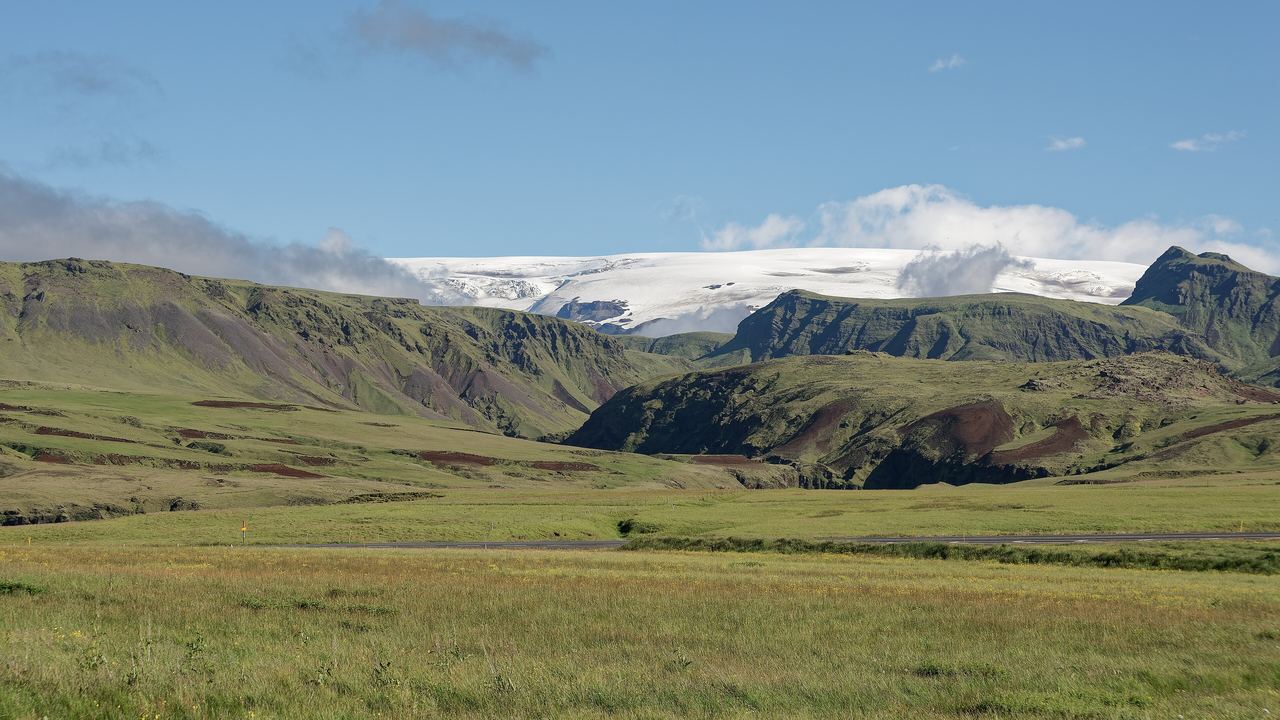
Katla Ice Cave Tours from Vík
Three tours into the ice above an active volcano, from 193.98 EUR. The black bands running through the walls are ash, and this is the only Icelandic ice cave open in August.
The cave is inside Kötlujökull, the southeastern tongue of the Mýrdalsjökull ice cap, which is the ice sitting directly on the Katla caldera. That is the whole reason it looks the way it does. Every time Katla has erupted it has thrown ash onto the glacier above it, the ash has been buried by the next winter's snow, and the ice has carried both downhill in layers. Cutting a cave through that ice cuts through the sequence, so the walls come out striped: clear blue where the ice is clean, black where a year of ash sits inside it.
Operators sell it under nicknames, usually the Dragon Glass cave or the Yeti cave, and the names change more often than the marketing admits because the cave itself does. This page is about that one cave: what is in the walls, why it is open when the others are not, how you get up there, and what the three listings actually differ on. The volcano underneath it, the town below it and the glacier walks next door are covered on the south coast page above.
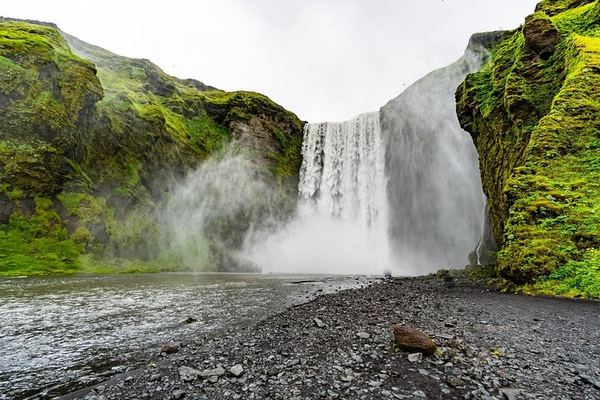
Katla Ice Cave from Reykjavík, with a 40-Minute Off-Road Leg
Seljalandsfoss, Skógafoss and the black sand beach by minibus, then a 40-minute off-road jeep from Vík to the ice cave under Katla. Gear is provided.
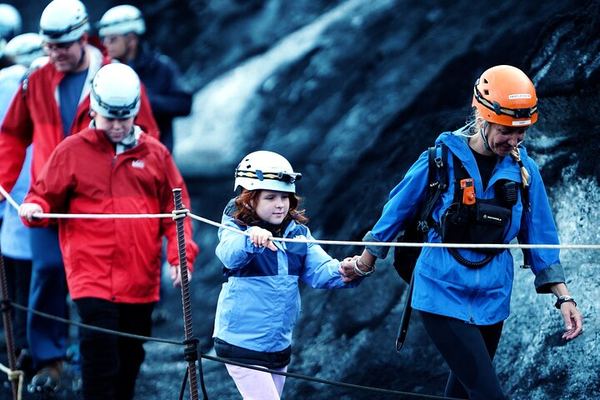
Katla Ice Cave from Vik: the Fastest Ice Cave in Iceland
For trips with no spare day: a short walk to the glacier and 45 to 60 minutes inside the ice. Check-in shares a building with the Black Crust Pizzeria.
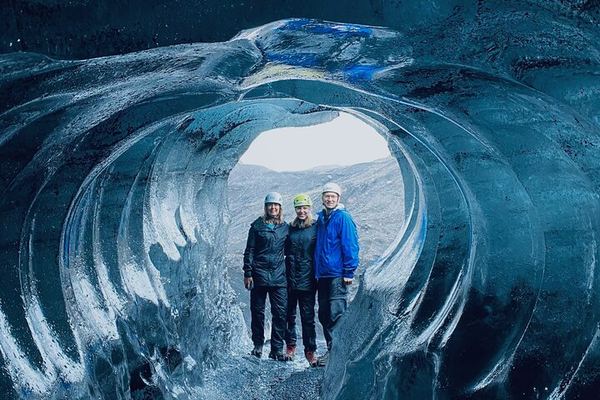
The Dragon Glass Ice Cave Under Katla, by Super Jeep from Vík
The Dragon Glass cave inside Kötlujökull, with black ice beside blue, reached by Super Jeep from Vík. Crampons and a helmet go on before you walk in.
Ratings collected by Viator and Tripadvisor
What the black stripes are
They are tephra: ash and fine pumice thrown out by Katla and dropped onto the ice cap above. A heavy ashfall lands as a dark blanket, the following winter buries it under snow, and the snow compresses into ice over the years that follow. The glacier then carries the whole stack downhill at its own pace. By the time it reaches the snout at Kötlujökull, a couple of centuries of that process is stacked up in the ice like sediment in a cliff.
So the wall of the cave is a record rather than a decoration. The thickest dark bands correspond to Katla's larger events, the 1918 eruption among them, which ran for twenty-four days and put enough material into the air to be recorded across the North Atlantic. Nobody in the cave can point at a band and name a year with certainty, and any guide who does is telling you a story rather than reading the ice. What they can tell you honestly is which direction is older, which is down-glacier, and why the black layers are gritty when you touch them and the clear ones are not.
The ice is also why the cave is dark rather than blue in places. Ash absorbs light. A cave in clean glacier ice glows; this one alternates, and the photographs that circulate are usually taken in the cleanest chamber with a lamp behind the ice.
The only Icelandic ice cave that exists in August
This is the fact worth booking around, and most listings mention it in passing when it deserves to be the headline.
The famous blue ice caves of Iceland are in the Vatnajökull outlet glaciers, three or four hours further east, and they are seasonal in the strictest sense. They are melt features, carved out by water running under and through the glacier in summer, and they are only safe to enter once the meltwater has stopped and the structure has frozen hard. That gives a window of roughly November to March. In April they start to run again, by May they are flooded or collapsed, and every autumn the guiding companies go out and find new ones, because last year's cave usually no longer exists.
Katla's cave is run all year. It still changes: the roof drops, the entrance shifts, the passages narrow, and the route is re-surveyed each season, so the cave you enter in September is not exactly the cave someone photographed in March. But there is always a cave, and that makes it the answer to the most common disappointment in Icelandic tourism, which is arriving in July having seen winter photographs.
If you are travelling between May and October and someone offers you a blue ice cave under Vatnajökull, ask what you are actually entering. In summer the honest answers are an ice tunnel cut by machine, a man-made cave, or this one.
| Leaves from | Price | How long | What else is in it | Rating |
|---|---|---|---|---|
| Vík | 193.98 EUR | About 3 hours | The cave and the jeep ride, nothing else | 4.8 (798) |
| Vík | 239.00 EUR | About 3 hours | The cave, longer on the glacier | 4.7 (1,174) |
| Reykjavík | 265.00 EUR | Full day | South coast waterfalls and beaches, then the cave | 4.8 (138) |
The gap between the two Vík departures is 45 EUR for broadly the same three hours, and the cheaper one is rated slightly higher on eight hundred reviews. The Reykjavík day at 265 EUR is not really an ice cave tour with a longer drive; it is a south coast tour that finishes in the cave, and if you are already staying in Vík you are paying 71 EUR for a minibus you do not need.
Why it has to be a super jeep
The cave is not at the end of a road. From Vík the route runs inland onto Mýrdalssandur and then up the glacial outwash plain on an unsurfaced track that crosses braided meltwater channels, and those channels move. There is no fixed crossing and no bridge, which is why every operator uses modified 4x4s on oversized low-pressure tyres rather than a minibus, and why the drive takes forty minutes to cover a distance that looks like fifteen on a map.
Two consequences. The jeep ride is genuinely part of the experience rather than transport, and several reviews on these listings are about the drive rather than the cave. And this is the one south coast activity that usually still runs when the weather turns, because the vehicles handle conditions that close the beach and the glacier walks. What stops it is not rain or wind but the river: after heavy melt or heavy rain the channels rise, and a cancellation on a clear day is almost always water rather than ice.
Do not attempt the track in a rental car. Standard Icelandic rental insurance excludes water damage entirely, and the crossings look shallower than they are.
What is provided, and what you have to bring
Every operator on this page supplies the technical kit: helmet, headlamp and crampons, fitted at the vehicle before you walk the last stretch to the entrance. None of them supplies clothing or footwear, and that is where people come unstuck.
You need boots that a crampon can grip, which in practice means a stiff sole and an ankle. Trainers are refused at the jeep rather than argued about on the ice, and most companies will rent boots if you ask at the time of booking, which almost nobody does. Layers matter more than thickness: the cave sits around freezing all year, so a July visitor going in wearing a T-shirt has a worse time than a February one in a fleece. Waterproofs earn their place because glacier ice drips constantly and the walk in is often across wet ash.
Minimum ages vary between operators and are set by the crampons and the terrain rather than by the cave, so check the specific listing rather than assuming. Gloves are the item people forget: you will put your hands on the ice, because everybody does.
Questions people actually ask
Is the Katla ice cave open in summer?
Yes, and it is the only one in Iceland that is. The blue ice caves under Vatnajökull are melt features that only exist from about November to March. Katla's cave inside Kötlujökull is run twelve months a year, which is why it appears in itineraries in July when nothing else does.
Why is the ice black?
Because it has volcanic ash in it. Katla has erupted repeatedly through the ice cap above, each eruption dropped tephra onto the glacier, and each subsequent winter buried it. The glacier carries the layers downhill, so a cave cut through the ice near the snout exposes them as dark bands. The grit you feel on the darker ice is genuinely the volcano.
How much does it cost and where should I leave from?
193.98 or 239.00 EUR from Vík for about three hours, or 265.00 EUR from Reykjavík for a full day that includes the south coast on the way. If you are staying in Vík, take the 193.98 EUR option: it is the highest rated of the two short ones and the extra money on the Reykjavík tour buys minibus hours rather than more cave.
Is it the same cave every year?
No. The glacier moves, sections of roof collapse and the entrance migrates, so the route is surveyed again each season and the interior differs noticeably from one year to the next. There is always a cave, but the specific chamber in the photograph you booked from may not be there. Treat the pictures as a genre rather than a promise.
Is it safe with an active volcano underneath?
The volcano is the least of it. Katla is monitored continuously and any unrest would close the glacier long before it closed the road. The real hazards are ordinary: ice underfoot, falling meltwater, and a river crossing that rises with the weather. Operators cancel on the river, not on the volcano.
Can I drive to the cave myself?
No. The approach crosses unbridged glacial meltwater channels that shift position through the season, which is why every listing here uses a modified super jeep on low-pressure tyres. Standard Icelandic rental insurance excludes water damage outright, so an attempt in a hire car is uninsured as well as unwise.
What should I wear?
Boots stiff enough to take a crampon, waterproof outer layers, a warm mid-layer and gloves. The cave is around freezing whatever the month, and the walk to it is usually across wet ash. Helmet, headlamp and crampons are included on all three listings. Footwear is not, though most operators will rent boots if you ask when you book.
Data verified on. Prices, durations and ratings read from the three Katla ice cave products on this site, 12 August 2026. Glacier and eruption detail from the published record for Katla and Mýrdalsjökull.