
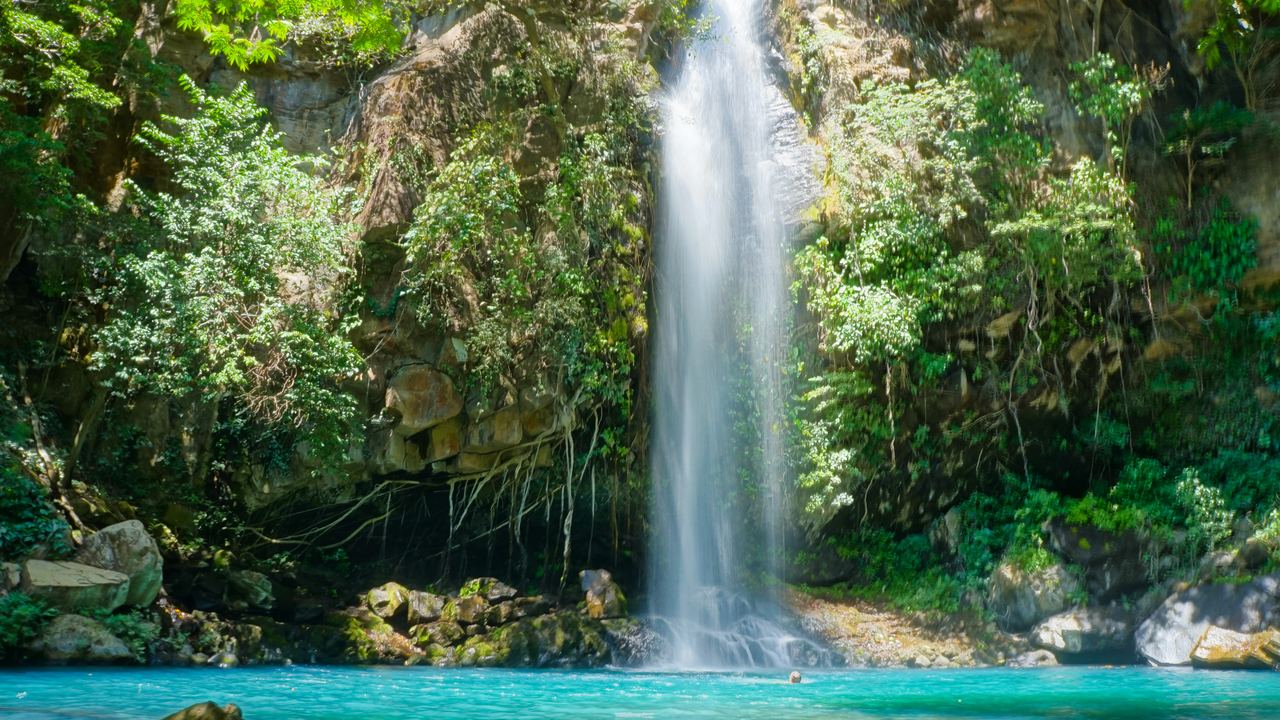
Rincón de la Vieja National Park: Mud Pots and Fumaroles
A 3.5 km loop over ground that boils. The trail to the crater has been closed for years, whatever the tour names suggest.
The best thing in this park is under your feet rather than above you. The Las Pailas loop runs 3.5 kilometres through dry tropical forest and passes, at intervals, holes in the ground where grey mud boils, cracks where steam leaves the earth at pressure, and small geysers that spit and subside. The volcano itself, 1,916 metres up and mostly in cloud, is a backdrop. The pailas de barro that give the sector its name are the reason to come, and you walk right up to them behind a wooden rail.
Three things decide whether this trip works, and none of them appears in a listing. Which day you go, because the sector shuts on Mondays. Which trail is open, because they close without warning and the best-known one has been shut since long before you started planning. And whether you understood that the hot springs are somebody's business rather than part of the park.
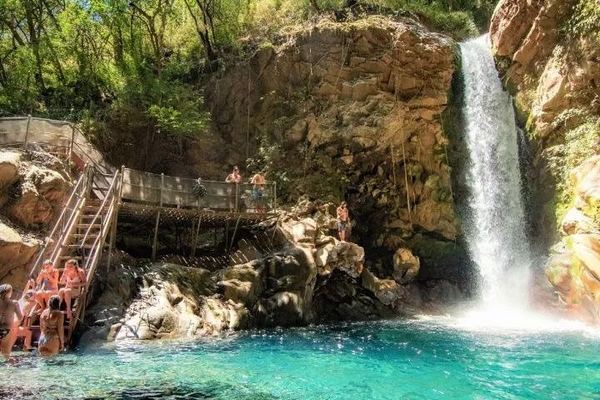
Oropéndola Bridges and the Río Negro Hot Springs, Flat Trails
Both stops are a flat ten minutes from their car parks, with hanging bridges over the waterfall and the hot pools at different temperatures at Río Negro.
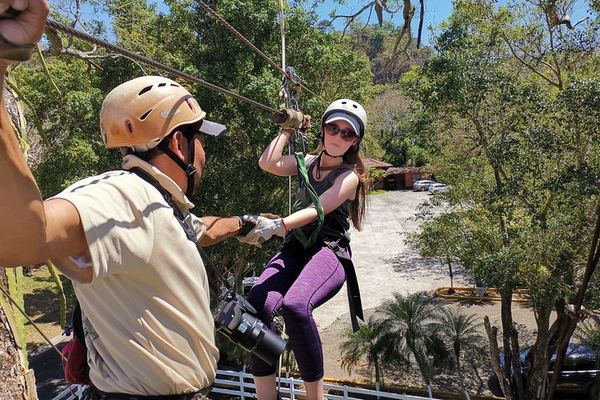
Rincón de la Vieja: 11 Cables, Horses and the Borinquen Steam Sauna
Eleven cables through humid forest, a horseback ride after them, and then the volcanic hot spring, mud baths and steam sauna at Borinquen. Lunch included.
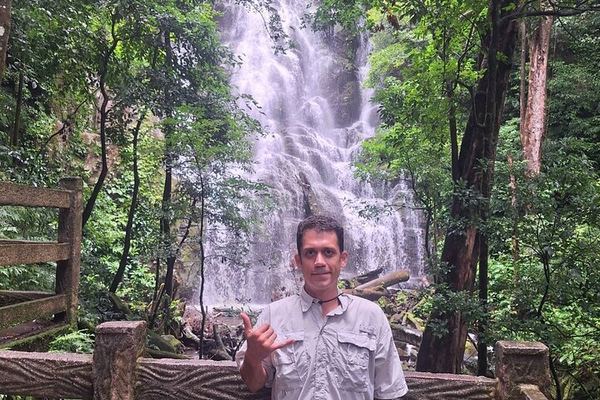
Rincón de la Vieja in a Day: Nine Ziplines, an Ox-Drawn Trapiche and Volcanic Mud
Lunch is a casado at a family-run soda in Curubandé, and the afternoon is Poza Los Coyotes: cliff jumping, river tubing, or a swim in crystal-blue water.
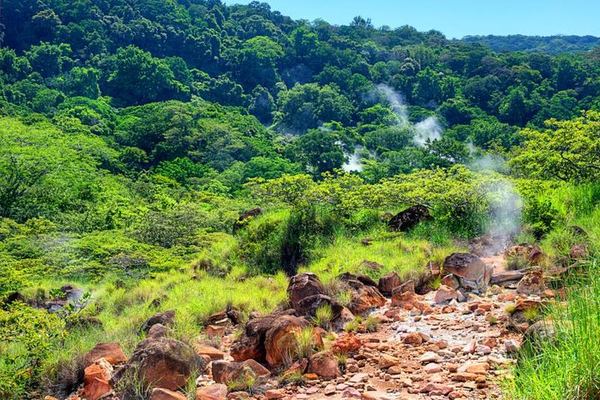
Rincón de la Vieja: Las Pailas, Oropéndola and Ten Hot Pools
The Río Negro springs have ten pools heated by the volcano, and the Las Pailas circuit runs 3.5 km past fumaroles and a mini crater. Some pick-ups cost extra.
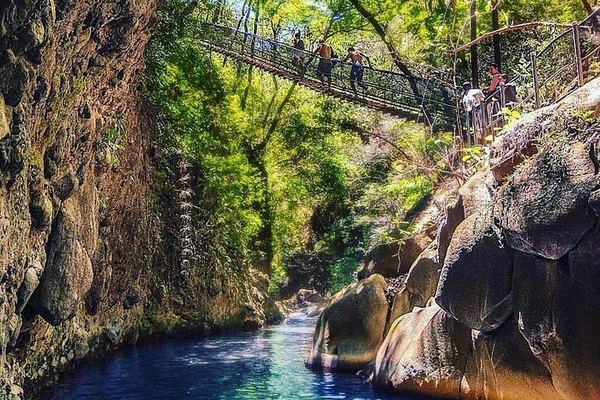
Rincón de la Vieja: the Las Pailas Loop and Oropéndola Waterfall
The Las Pailas loop runs 3.5 km past fumaroles, mini-geysers and boiling mud, and the swim afterwards is under a 25-metre waterfall in the Río Blanco canyon.
Ratings collected by Viator and Tripadvisor
What the Las Pailas loop actually is
Three and a half kilometres, a couple of hours, and almost no climbing. The path is a circuit through dry forest, and the geothermal features are strung along it: mud pots of different sizes and consistencies, a steam vent that sounds like a boiler being bled, a small mud volcano, sulphur staining on the ground, and a set of fumaroles where the smell arrives before the sight does. Operators describe it as needing moderate fitness, and one is explicit that it is not recommended for anyone with poor cardiovascular health, which is more about the heat and the exposure than the gradient.
The wildlife is a genuine part of it rather than a garnish. The park records more than 300 bird species, and the loop passes through habitat for armadillos, collared peccaries, iguanas, white-nosed coatis and three kinds of monkey: white-faced, howler and spider. This is the argument for a guide over a self-drive visit, since almost all of it is invisible to someone walking at their own pace and looking at the mud.
One practical detail that catches people out repeatedly: the Las Pailas sector is closed on Mondays. It is a scheduled closure and it will not be waived, and a Monday booking for a beach transfer plus a park entry is a wasted day.
The trail that is closed, and the tours that sound like it is not
Several listings here are called things like Rincón de la Vieja Volcano Hike. Read them carefully and none of them goes up the volcano, because nobody can. The route to the crater is roughly 8 kilometres each way with about 1,300 metres of ascent, and it has been closed to visitors for years on account of the volcano's behaviour. There is no permit, no guided exception and no operator who can take you.
What the products mean by volcano hike is the Las Pailas loop, on the lower southern flank, with the mountain visible above. That is a perfectly good day and the descriptions are not dishonest once you read past the title. But if you arrived expecting a summit, this is where to adjust, and it is worth doing so before you book rather than at the trailhead.
The volcano's own recent record explains why the closure is not being reviewed. Through the summer of 2026 it produced a long run of steam-driven eruptions, several of which sent lahars down the northern flank, and the alert level was raised in late July. The visitor sectors sit low on the opposite side of the mountain, which is precisely why the park kept selling tickets while the summit stayed off limits.
The question at any Costa Rican volcano is never whether the mountain is active. It is which specific trail is open this week, and here the answer for the crater has been the same one for years.
The other trails, and the one with a deadline
Beyond the mud loop there are two waterfall routes in the park, and one of them runs on a clock. La Cangreja must be entered before midday, because rangers will not let walkers start a long return trip late in the day. Published lengths for it vary widely depending on the source, somewhere between about 6 and 10 kilometres for the round trip, and that disagreement is worth taking seriously rather than averaging: ask at the gate what they are counting, and budget for the longer figure.
The Catarata Escondida, the hidden waterfall, is the other. Both were open alongside Las Pailas when the park was checked in August 2026. Both close at short notice when conditions change, and historically that has happened without any advance announcement.
| Trail | Length | Status | What to know |
|---|---|---|---|
| Las Pailas loop | 3.5 km circuit | Open | The mud pots and fumaroles; closed on Mondays |
| La Cangreja waterfall | About 6 to 10 km return, sources disagree | Open | Entry to the trail closes at midday |
| Catarata Escondida | Waterfall route | Open | Closes at short notice, like the others |
| Crater route | About 8 km, 1,300 m of ascent | Closed, and has been for years | No operator can take you up, whatever the tour is called |
The hot springs are not in the park
Search for this destination and the photographs are mostly of thermal pools and mud baths. None of those are inside the national park. They belong to private operations on the surrounding land, hotels and adventure centres running their own hot springs and their own admissions, and a trip that includes them is buying you two separate tickets.
The same is true of the waterfall most of these tours swim at. Oropendola drops about 25 metres into a turquoise pool in the canyon of the Río Blanco, and it sits outside the park with its own entrance fee: one operator lists the Oropendola entrance and the national park fee as two distinct inclusions. The zip line circuits, the horse riding and the hanging bridges are all private too.
None of this is a complaint. It is how the sector works, and the combination of a geothermal walk in the morning and a hot spring in the afternoon is genuinely the best day out in this part of Guanacaste. It does explain the prices, though. A 110 EUR day includes about 17 dollars of national park; everything above that is transport, guiding and somebody's private waterfall.
Getting there, and what it costs
The Las Pailas entrance is roughly 24 kilometres from Liberia, and the last seven or eight of those are unpaved. In the dry season a small hire car manages it. After heavy rain it is a different proposition, and it is the main reason people who intended to drive themselves end up booking a tour.
Entry is 15 US dollars for a non-resident adult and 5 for children aged 2 to 12, which becomes 16.95 once 13 per cent tax is added. Since August 2023 nothing is sold at the gate, so the ticket has to be booked in advance through the national park reservation system, even on a quiet Tuesday. Tours that quote a park fee as included have done this for you.
Bring more water than feels necessary. This is dry forest at low altitude, the loop has little shade in the middle of the day, and the geothermal ground radiates heat. Closed shoes rather than sandals, because the surface is loose and hot in places. Repellent and sun cream are listed as not included by at least one operator, which tells you something about how often people ask.
On timing across the year, the pattern is the Guanacaste one set out on the page above: dry and reliable from December to April, green and wetter the rest of the year, with the access road as the variable that actually changes.
Questions people actually ask
Can you hike to the crater of Rincón de la Vieja?
No. The crater route, about 8 kilometres with 1,300 metres of ascent, has been closed to visitors for years because of the volcano's activity, and it remained closed through the eruptive sequence of 2026. Several tours are named in a way that suggests otherwise; what they all actually walk is the Las Pailas loop on the lower flank. If an operator offers you the summit, ask them which permit they are working under.
Is the park open with the volcano erupting?
It was on 12 August 2026, and it stayed open through the summer's eruptions. The activity is at the summit and the lahars ran down the northern flank, while the visitor sectors sit low on the southern side. Individual trails do close at short notice and have historically done so without advance notice, so check the reservation system on the day rather than relying on anything written earlier.
Which day should I not go?
Monday. The Las Pailas sector, which is the one with the mud pots and the one every tour uses, is closed on Mondays. This is the single most common wasted journey here, and it catches independent travellers far more often than it catches tours.
How hard is the walk?
Easier than most people expect. The Las Pailas circuit is 3.5 kilometres over roughly two hours with little climbing, on a maintained path. Operators ask for moderate fitness and one advises against it for anyone with poor cardiovascular health, which is about heat and exposure rather than gradient. The waterfall trails are longer and steeper, and La Cangreja will not let you start after midday.
Are the hot springs included?
Only if the listing says so, and they are never part of the park entry. Every thermal pool, mud bath and zip line in this sector is on private land with its own admission. The same goes for the Oropendola waterfall, which sits outside the boundary and charges separately. Read the inclusions rather than the photographs.
Can I do it without a tour?
Yes, and it saves a lot. Book the entry in advance through the national park system, since tickets stopped being sold at gates in August 2023, and be realistic about the last seven or eight kilometres of unpaved road, especially in the wet season. What you give up is the wildlife: more than 300 bird species and several kinds of monkey live along that loop, and almost none of them will be noticed by someone walking without a guide.
How much does it cost?
The park itself is 16.95 US dollars for an adult with tax. Guided days from the beaches and Liberia run from 110 to 258 EUR, and the difference is transport, group size and how many private attractions come attached: a waterfall swim, a hot spring, a zip line circuit, lunch. The 258 EUR listing is a private day with zip lines and horse riding, which is a different product from a walk in a national park.
Data verified on. Prices and inclusions from the five Rincón de la Vieja products on this site. Fees, opening days, trail status and alert level checked on the SINAC reservation system, 12 August 2026.