

Irazú Volcano Tours: Costa Rica's Highest Crater, by Road
3,432 metres, with a car park near the rim. The green lake in the crater is real, and it is only there for part of the year.
Irazú is the volcano you do not have to climb. A paved road runs from Cartago to a car park just below the rim at 3,432 metres, which makes the highest active volcano in Costa Rica also the easiest one in the country to stand on. What waits at the top is a grey plateau of ash and pumice with almost nothing growing on it, and a crater 1,050 metres wide dropping 300 metres to a floor that is sometimes filled with a green lake and sometimes not.
The lack of effort is the selling point and also the reason the trip is never sold alone. Forty-five minutes at a crater does not fill a day, so every listing here bundles the volcano with the old colonial side of the valley below it. What follows is what the volcano is, what it did to San José in living memory, and how to avoid the two mistakes that ruin the visit: arriving late, and booking the wrong sector.
Guayabo, Irazú's Dwarf Forest and the Emptied Town Below Turrialba
Four people maximum, a walk inside an inactive crater, and the half-empty town that recent Turrialba activity left behind. Entrance fees are cash on the day.
Irazú at 3,432 m, Cartago and Orosi: Back in San Jose by 3pm
The largest volcano in Costa Rica at 3,432 m and 500 square kilometres, then Cartago and the Orosi coffee valley, with the hotel reached again by 3pm.
Irazú at 3,432 m, the 800 Species at Lankester and Orosi
More than eleven and a half hours from San José: the green crater lake at 3,432 m, over 800 species at Lankester, lunch, and the Orosi and Ujarrás valleys.
Irazú, Both Oceans on a Clear Day, and Lankester's 800 Orchids
From the summit of the country's highest active volcano both oceans are visible on a clear day, and Lankester protects over 800 orchid and bromeliad species.
Irazú, Playa Negra, Lankester's Japanese Garden and Lunch over Lake Cachí
Lunch sits above an artificial lake built for hydroelectric power, and the volcano stop includes Playa Negra and an optional climb to the highest ground.
Ratings collected by Viator, Tripadvisor and Civitatis
The eruption that greeted a President
On 19 March 1963, Irazú began erupting. John F. Kennedy landed in Costa Rica for a state visit within days of it starting, and the coincidence fixed the eruption in the national memory more firmly than its size alone would have done. It went on for two years.
What that meant on the ground was not lava. It was ash, continuously, over the capital and much of the central highlands. San José spent months under it: roofs collapsing under the weight, water supplies fouled, coffee and dairy land buried, respiratory illness through the winter. The subsequent floods and lahars did more damage than the eruption itself, because the ash had stripped the catchments above Cartago and the rain had nowhere to soak in.
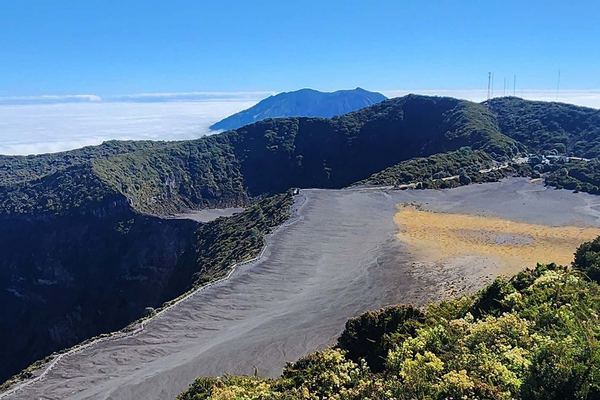
You can still read it from the summit. The bare, lunar ground you walk on up there is that eruption's deposit, and the reason a volcano in a country this wet has a summit with almost no vegetation on it is that sixty years has not been long enough. It is one of the few places where a visitor can see the scale of a historical eruption without being told what to look for.
The grey plateau at the top is not scenery, it is sediment. Everything underfoot arrived between 1963 and 1965, and the capital an hour below spent those two years sweeping it off the roofs.
Both oceans, and what the odds really are
The line in every brochure is that you can see the Pacific and the Caribbean at the same time from the summit of Irazú. It is true. It is also the single most oversold sentence in Costa Rican tourism, because the clear days on which it happens are genuinely rare and the summit is usually inside cloud.
The mechanism is simple and it does not care about your booking. Moist air rises off both coasts through the morning and meets over the cordillera, so the window is early and narrow. Be at the top by nine. February and March give the best odds and still do not promise anything. If two oceans are the reason you are going, go on the clearest morning of your trip rather than the most convenient one, and treat the view as a bonus rather than the product. Plenty of people stand up there in white-out and go home disappointed by a mountain that behaved exactly as it always does.
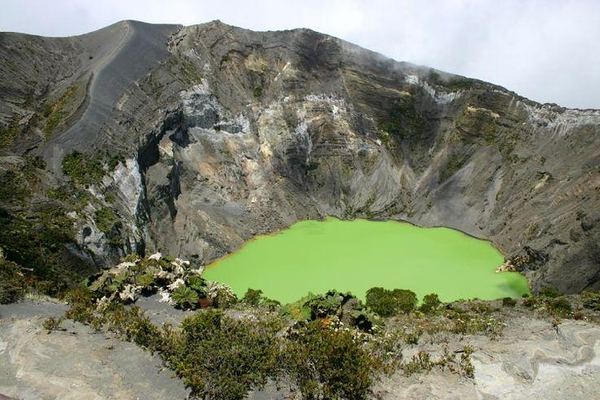
The other thing nobody warns you about is the lake. Photographs of Irazú almost always show a vivid green pool in the main crater, and that pool is seasonal: it collects rainwater through the wet months and can be reduced to a dry grey floor by the end of the dry season. Arriving in February for the clear skies and finding an empty crater is a real and reasonably common outcome, and it is the direct cost of choosing the best weather.
Why nobody sells an Irazú-only day
Look through the five trips on this page and the absence is obvious: none of them is just the volcano. There is a good reason. The walking at the summit amounts to a loop between viewpoints on the main crater and the neighbouring Diego de la Haya, it takes well under an hour, and the cold sends most people back to the vehicle before that. An operator who sold Irazú alone would be selling a two-hour drive for a forty-five minute stop.
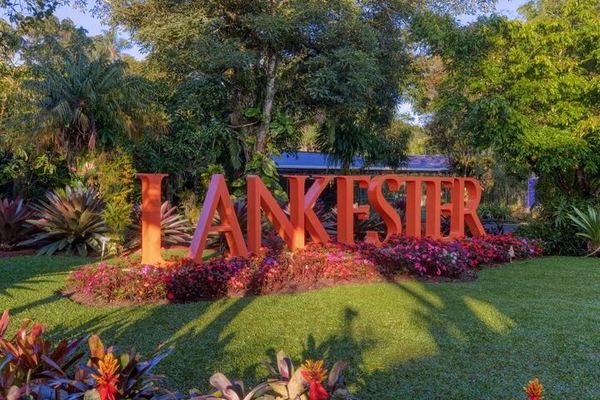
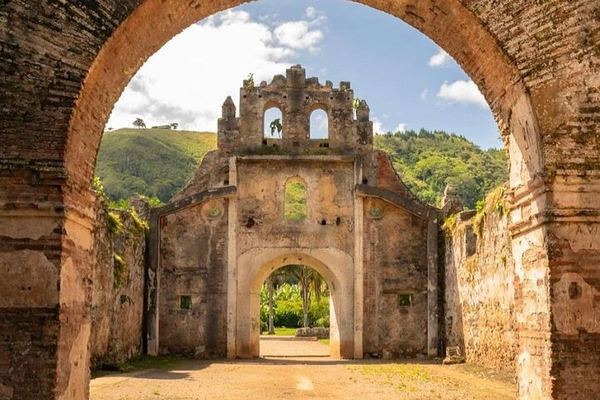
So the volcano gets a valley attached to it, and the valley is genuinely good. Cartago sits below with the basilica of Our Lady of the Angels and the roofless ruins of a parish church that earthquakes destroyed twice. The Orosi valley behind it is the oldest continuously inhabited corner of the country. The Lankester botanical gardens hold one of the more serious orchid collections in Central America. One listing swaps all of that for Guayabo, the pre-Columbian site with stone causeways and aqueducts still running, and charges the most on this page for it.
| What comes with the volcano | Price | How long | Rated |
|---|---|---|---|
| Orosi valley and Lankester gardens | 75 to 121 EUR | 8 to 10 hours | 4.6 |
| Cartago city and the Orosi valley | 131 EUR | 9 hours | 4.6 |
| Orosi, Lankester and Lake Cachí, with lunch | 132 EUR | 10 hours | 4.8 |
| The Guayabo pre-Columbian site | 213 EUR | 10 hours | 4.9 |
The spread is the usual one: 75 EUR buys you a seat on a minibus, 213 buys a small group and a guide who has read something. Ratings climb with the price here, which is not always true and is worth noting. The cheapest option on this page is also the cheapest guided volcano day anywhere in the Central Valley.
The two sectors, and the booking mistake
The national reservation system sells Irazú as two separate entries: sector cráter and sector Prusia. They are not two entrances to the same place. The crater sector is the summit road and the viewpoints. Prusia is a replanted pine and cypress sector lower on the flank, with forest trails and picnic ground, planted after the 1963 eruption to hold the slopes together. It is a pleasant morning's walk and it has no crater in it.
No guide explains the difference and the booking page does not warn you, so it is entirely possible to arrive at the wrong gate with a valid ticket for somewhere else. If you are booking independently, the one you want is the crater sector. If you are on a tour, the operator has already chosen.
Practicalities
The summit is 54 kilometres from San José and takes between an hour and a half and two hours, most of it climbing through farmland above Cartago. Entry is 15 US dollars for a non-resident adult and 5 for a child, which becomes 16.95 once 13 per cent tax is added, and parking is a further 1,100 colones in cash. Since August 2023 nothing is sold at the gate, so book ahead even for a park that never sells out.
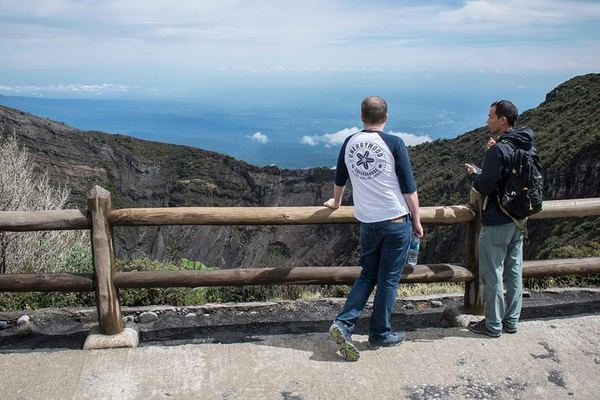
Dress for a mountain. It runs between about 5 and 9 °C at the top, with wind, while San José sits in the mid twenties, and the drive takes ninety minutes, which is not long enough for anyone to believe the forecast. A windproof jacket, long trousers and closed shoes. The ground is loose volcanic grit rather than rock, and it is hard on light footwear. There is a café and there are toilets at the car park, which given the altitude is more infrastructure than most volcanoes offer.
On seasons, the pattern is the one set out on the page above and it pulls in two directions here more than anywhere else in the valley: the dry months give the view and take the lake, and the wet months do the reverse.
Questions people actually ask
Can you really see two oceans from Irazú?
Yes, on a genuinely clear morning, and those are rare. The summit is usually in cloud and the window is early: be at the top by nine, ideally in February or March. Treat it as a thing that sometimes happens rather than a thing you have booked. Most visitors see the crater and a sea of cloud, which is a fine sight in itself and is not what the brochure promised.
Is there a lake in the crater?
Sometimes. The green pool in the main crater is rainwater and it is seasonal: it fills through the wet months and can dry to a grey floor by the end of the dry season in March. Nothing in the listings mentions this, so people book February for the weather and are surprised. If the lake is what you came for, the wetter months are the answer, and you trade the view for it.
How hard is it? Do you have to hike?
Barely at all. The road ends near the rim and the walking is a short, flat loop between the viewpoints over the main crater and Diego de la Haya. It is the most accessible active volcano in Costa Rica and works for people who cannot manage a hike. The real difficulty is the altitude and the cold rather than the terrain: 3,432 metres, exposed, and often below 10 °C.
How cold is it?
Between about 5 and 9 °C at the summit, with wind, on a day when San José is in the mid twenties. This catches out almost everybody who books on impulse from a warm hotel lobby. A windproof layer is the difference between staying for the view and heading back to the vehicle after ten minutes.
Which is better, Irazú or Poás?
Poás has the more dramatic crater, an acid lake steaming 300 metres below a railing, and it is the harder one to actually get into: booked slots, passport numbers, no refunds and a park that has closed repeatedly. Irazú is higher, easier, colder and more reliable, and it is the sensible choice if you have one day, limited mobility, or no appetite for a ticket that cannot be moved. The page above sets the comparison out in full.
What is Prusia and do I want it?
Prusia is the other Irazú sector on the reservation system: a reforested pine and cypress area on the lower flank with walking trails, planted after the 1963 eruption to stabilise the slopes. It is a good place for a walk in the woods and it has no view of a crater. If you are booking your own ticket, make sure you are buying the crater sector.
Is Irazú still active?
Yes, it is classified as an active volcano and it is monitored continuously, but it has done nothing dramatic since the sequence that began in March 1963 and ran to 1965. What you see today is fumarolic rather than eruptive. The visible legacy is the ground itself: the bare grey summit plateau is that eruption's ash, and sixty years of tropical rain has not yet put a forest back on it.
Data verified on. Prices, durations and ratings from the five Irazú products on this site. Fees, sector names and booking status checked on the SINAC reservation system; eruption dates from the published record.