
Vulcano and Lipari: Boat Tours and the Gran Cratere
Five of the seven listings price the whole boat, not the seat. Split six ways, the 590 EUR charter undercuts the 120 EUR shared trip.
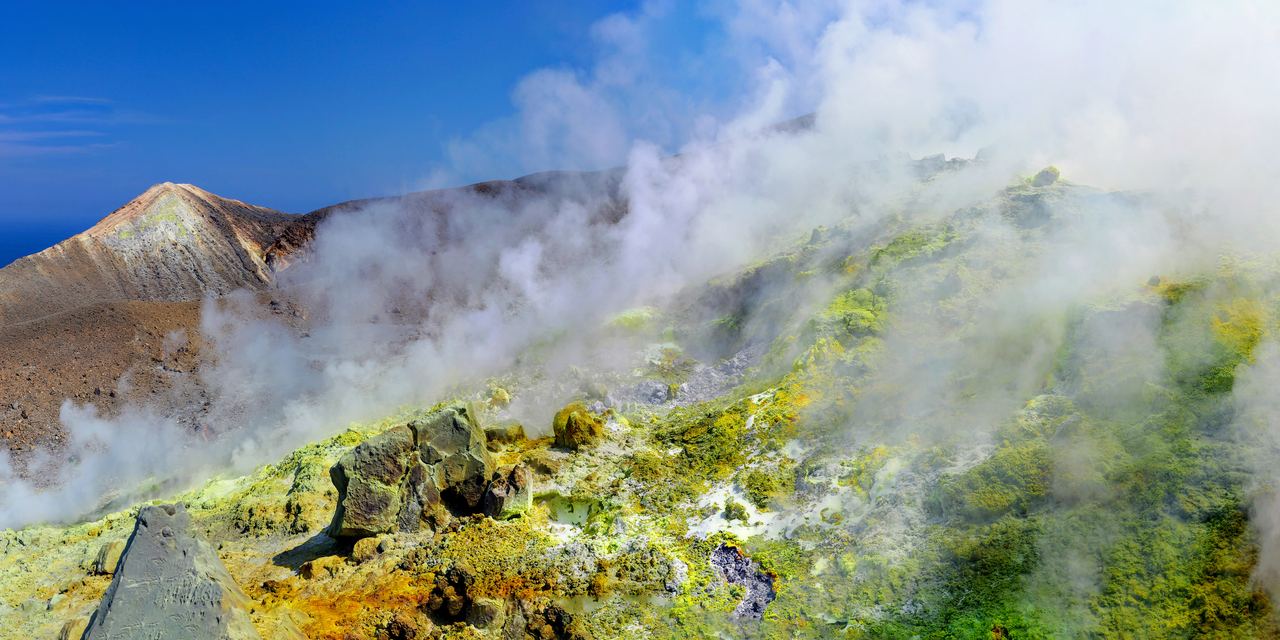
Vulcano gave most European languages their word for a volcano, by way of the Roman god whose forge was supposed to be under it, and it gave volcanology a second one. The eruption that ran from 2 August 1888 to 22 March 1890 was described in detail by Giuseppe Mercalli, and the style of activity he recorded, short violent blasts of ash and blocks rather than flowing lava, has been called vulcanian ever since. Nothing has erupted here since 1890. What the island still does is steam, from a fumarole field on the crater rim and from vents in the shallows at Porto di Levante, and the smell of it reaches you before the boat has tied up.
How the archipelago works as a whole, how you get to it and how Vulcano's rules compare with Stromboli's are on the Aeolian Islands page above. This one is about these two islands and the seven things you can buy on them: why the price list needs decoding before you compare anything, what the crater walk is actually like, what has happened to the mud baths that half the internet is still advertising, and which listing here is quietly the most popular of the lot.
Kayaking into the Lava Tunnels of Vulcano, Three Grades
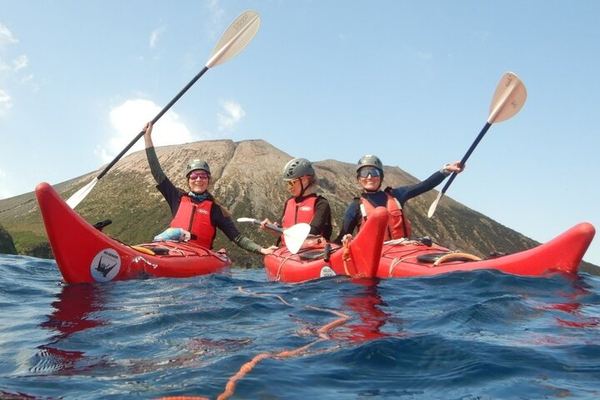
Paddle and swim into caves and tunnels cut in the lava, and into the thermal water that bubbles up in the bays. Three grades, from complete beginner upwards.
Lipari by Mahogany Boat: the Pumice Quarries and Cala Fico
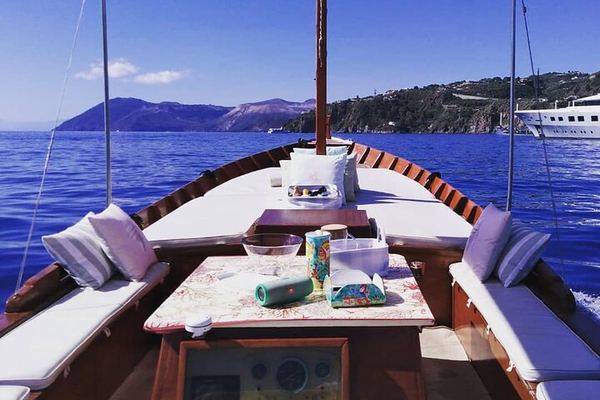
An 8.5-metre mahogany boat with a shaded table aft, and swims at the old pumice quarries, Praia di Vinci and Cala Fico. Fruit, snacks and cold wine aboard.
Lipari by Private Boat, with the Pumice Sea and Two Stops on Salina
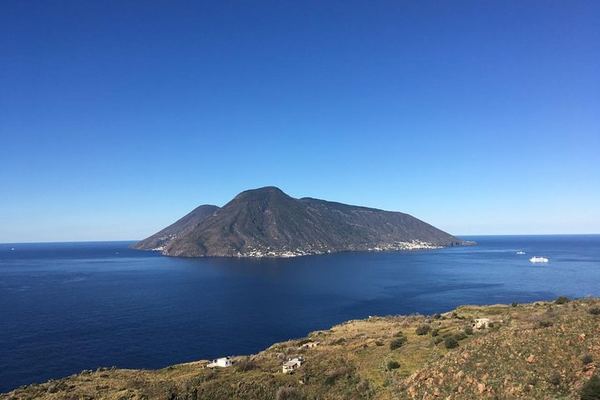
An exclusive boat for one group of up to 15: seven hours past Lipari's coloured volcanic caves and pumice coast, with stops at Santa Marina Salina and Lingua.
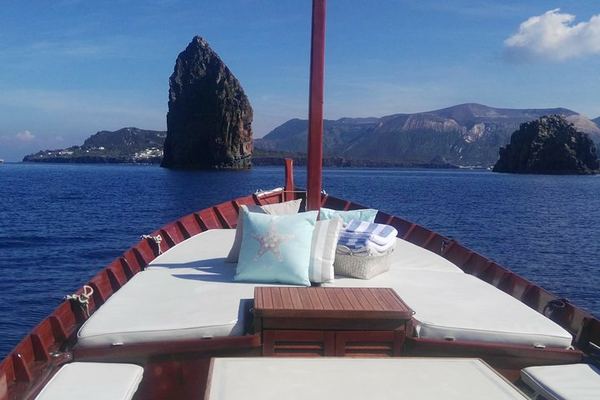
Lipari to Vulcano by Wooden Boat, Right Round with Lunch at Gelso
A private wooden boat for seven hours, right round Vulcano past the Venus Pool and the Horse Cave, with lunch either at Vulcano Porto or down at Gelso.
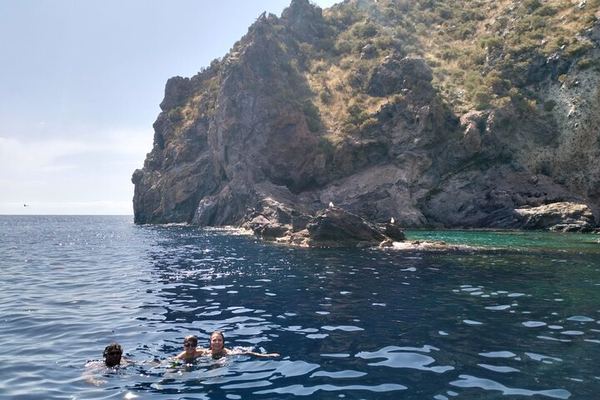
South Lipari by Small Boat, Four People, Six with Children
Four passengers, six with small children, from Marina Corta: Praia di Vinci, the Faraglioni of Lipari and Valle Muria, with snorkelling gear and fruit aboard.
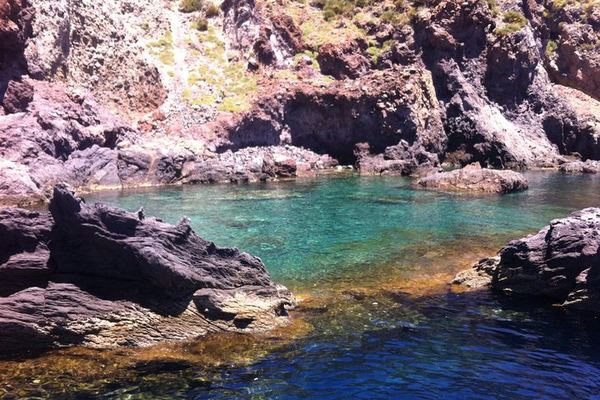
Southwest Lipari and Vulcano by Private Boat with Aeolian Skippers
Aeolian skippers, sea caves and snorkelling round southwest Lipari and Vulcano, sandy beaches on the way and time ashore in the centre of Vulcano. Private.
Vulcano and South Lipari by the Seat, with a Beach Lunch Stop
A per-person seat with Aeolian skippers, swimming stops round Vulcano, the caves that are not on the map, and lunch ashore on a beach with local food.
Ratings collected by Viator and Tripadvisor
Five of these seven prices are for the boat, not for you
This is the thing that makes the Vulcano and Lipari market look absurd until you decode it, and then makes it look rather good.
Two of the seven listings are shared trips sold per head: a day boat around Vulcano and southern Lipari at 90 EUR, and one that runs to Lipari and southern Salina at 120. Everything else on this page is a charter. The number you are looking at is the price of the vessel, and it does not change when you add people to it.
Run the arithmetic and the ranking inverts. The 200 EUR boat is advertised for four to six passengers, which is 33 to 50 EUR each. The 590 EUR seven-hour trip around Lipari and Vulcano, the most expensive thing on the page by a distance, comes to about 98 EUR a head for six, and under 150 for four. Against a shared seat at 120 EUR that is either better value or very close to it, and you get to decide where the boat stops.
So the practical question is not which listing is cheapest. It is how many of you there are. Two people should look hard at the shared trips. Four should look at the 200 EUR boat. Six should look at the charters, because at that point privacy is nearly free.
| What it is | Listed price | Per person | Rating | Notes |
|---|---|---|---|---|
| Vulcano and southern Lipari, shared day boat | 90 EUR | 90 EUR | 4.8 (33) | Per head. Swimming stops, caves, a lunch stop on a beach |
| Lipari and southern Salina, shared day boat | 120 EUR | 120 EUR | 4.8 (25) | Per head. Two stops on Salina, at Lingua and Santa Marina |
| Kayak and coasteering on Vulcano | 150 EUR | Private, small group | 5.0 (343) | Not a boat tour at all, and by review count the most popular thing here |
| Boat from Lipari, 4 to 6 passengers | 200 EUR | 33 to 50 EUR | 4.9 (30) | The best value on the page if there are four or more of you |
| Lipari by boat, private | 390 EUR | 65 to 98 EUR | 5.0 (45) | Mahogany boat, 8.5 m, built for lounging rather than covering ground |
| Vulcano and south-west Lipari, private | 399 EUR | 67 to 100 EUR | 5.0 (49) | The operator's own bestseller: caves, snorkelling, sandy stops |
| Lipari and Vulcano, private, 7 hours | 590 EUR | 98 to 148 EUR | 5.0 (83) | The long one. Includes Praia Vinci, a beach reachable only from the sea |
Walking up the Gran Cratere
It is a straightforward hour, up a track of ash and pumice that switchbacks behind Porto di Levante, gaining a little under 400 metres. There is no ticket, no daily cap and no requirement to take a guide, which makes it one of the easiest active craters in Europe to walk up under your own steam.
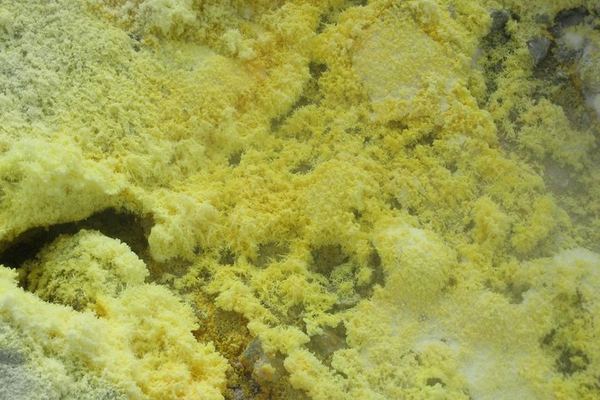
At the top you get a rim path around a bowl of yellow-stained ground, with fumaroles venting along the northern edge, and a view that on a clear morning takes in the whole chain: Lipari and Salina in front, Panarea and Stromboli beyond, Etna smoking away to the south. It is the best single viewpoint in the archipelago and it costs nothing.
Two rules that are not optional. There is an automatic traffic light at the trailhead: red, or switched off entirely, means the path is closed, and it responds to wind direction rather than to weather, because what matters is where the fumaroles are putting their gas. And the ordinance that governs the path prescribes an FFP2 or FFP3 mask, for the same reason. Hydrogen sulphide is the smell you noticed at the harbour; on the rim, with the wind wrong, it is not just a smell.
The hours are the constraint that catches day visitors, and they are set out in full on the Aeolian Islands page: from 1 April to 20 October the path opens 06.30 to 10.30 and again 16.00 to 19.30, and is shut in between. In winter it runs straight through, 07.30 to 16.30.
The mud baths are closed, and much of the internet has not caught up
For decades the pozza dei fanghi at Porto di Levante, a warm sulphurous mud pool a couple of minutes from the quay, was the thing people came to Vulcano to do. It has been closed, on and off, since the beginning of 2020, on health and safety grounds. It reopened briefly in May 2025 and closed again on 12 June 2025.
It is still all over the internet. Blogs, listicles and a fair number of tour descriptions elsewhere continue to promise it, because nobody goes back and edits a page that is already ranking. Not one of the seven listings on this page includes the mud baths, which tells you what the operators who actually work the island know.
There is a substitute and almost nobody points visitors at it. Along the shore at Porto di Levante the seabed vents hot gas into the shallows, the Acque Calde, and you can stand in warm, fizzing water at the edge of the sea, for nothing, all year round. It does the same job as the mud, smells the same, and has the advantage of existing. Take off anything silver first, on the beach or on the crater: hydrogen sulphide tarnishes it in an afternoon and the marks do not always come out.
Not one of the seven operators working this island sells the mud baths. Half the travel internet still does, because a page that already ranks is a page nobody goes back to edit.
What the boats actually do all day
Almost identically the same thing, which is why the ratings are so uniformly high and so uninformative. You leave from Lipari or from Porto di Levante, run down a coast of coloured cliffs and sea caves, stop three or four times to swim, eat somewhere, and come back. The volcanology is scenery rather than subject: you look at the fumarole field from the water, at the pumice and obsidian on Lipari's flanks, at the stacks off the southern coast.
The differences that matter are practical. How many stops, whether lunch is on board or on a beach, whether the boat has shade, and whether the skipper is willing to change the route when the wind turns, which on private trips they generally are and on shared ones they cannot be. One listing here promises Praia Vinci, a beach with no land access, and that is the sort of specific that separates a real itinerary from a stock description.
Weighted across all seven, the rating here is 4.98 from 608 reviews, which is the highest of any category on this site. Read that as a signal about the format rather than about individual operators. A day of swimming off a small boat in clear water is very hard to get wrong, and nobody rates the sea three stars because the volcano was quiet.
The most popular thing here is not a boat tour
By review count the leader on this page is not any of the boats. It is a kayak and coasteering trip around Vulcano at 150 EUR, with 343 reviews and a clean five stars, more reviews than the next two listings combined.
That is worth pausing on. Vulcano's coast is short, sheltered on the eastern side and riddled with caves and arches at exactly the scale a kayak handles and a boat does not. Grades run from easy to genuinely demanding. If you are reasonably fit and the idea of paddling into a sea cave under a volcano appeals more than sitting on a deck, this is the listing the numbers are pointing at, and it is the only one on the page that puts you at water level.
Season, briefly, because the parent page has the month-by-month detail: this is a June to September market. The boats sell swimming stops and the water on this coast is not warm enough to sell them either side of that. The crater walk, by contrast, is better in April and October, when you are not climbing an ash slope in thirty degrees before half past ten in the morning.
Questions people actually ask
Are the mud baths on Vulcano open?
No. The pozza dei fanghi has been closed on and off since early 2020, reopened briefly in May 2025 and closed again on 12 June 2025. None of the seven listings here includes it. If a page elsewhere promises you the mud baths, check the date on it. The warm shallows at Porto di Levante, the Acque Calde, are open, free and do much the same thing.
Why is one tour 90 EUR and another 590?
Because they are not the same unit. Two of the seven listings sell a seat; the other five sell the boat. A 590 EUR charter for six works out at about 98 EUR each, which is cheaper than one of the shared trips. Before comparing prices here, check whether the figure is per person or per vessel, and count your party.
Can you walk up the crater on Vulcano?
Yes, and it is one of the easiest active craters in Europe to do independently: no ticket, no cap, no compulsory guide, about an hour up a track of ash and pumice to a rim just under 400 metres. The constraints are the opening hours, which shut the path from 10.30 to 16.00 between April and October, and the traffic light at the start, which closes it when the wind puts the fumarole gas over the path.
Why do I need a mask?
Because the crater rim is an active fumarole field venting hydrogen sulphide and other gases, and the ordinance governing the path prescribes an FFP2 or FFP3. With the wind in the wrong quarter the concentration on the rim is not trivial. It is also why the traffic light exists, and why red means turn round rather than press on.
When did Vulcano last erupt?
Between 2 August 1888 and 22 March 1890. Giuseppe Mercalli documented it, and the style he described, violent short-lived blasts of ash and blocks rather than flowing lava, is called vulcanian activity after this island. Since then the island has only degassed, although the gas output is monitored closely and has been elevated at times.
Is it worth doing Vulcano as a day trip?
For the sea, yes, easily. For the crater, only if you take the first crossing of the morning, because the path shuts at 10.30 through the whole summer and the day boats put you ashore after that. If the Gran Cratere is the reason you are coming, sleep on the island or on Lipari and walk up at seven.
What is the smell?
Hydrogen sulphide, from the fumaroles on the rim and from vents in the shallows at Porto di Levante. It is strongest near the harbour and people stop noticing it within about an hour. Take off silver jewellery before you swim or climb: sulphide tarnishes it quickly and the marks are not always reversible.
Data verified on. Prices, ratings and counts from the 7 Vulcano and Lipari listings on this site. Crater path hours, traffic light and mask rule from Lipari municipal ordinance no. 17 of 23 April 2023.