

Rinjani Summit Trek, 3 Days and 2 Nights
Out of the tent at two in the morning for 1,100 metres of volcanic sand. Four of the eleven listings filed here are not three-day treks, and one never reaches the top.
The three-day crossing is the full Rinjani: up from Sembalun at about 1,150 metres to a camp on the crater rim at 2,639, out of the tent before three in the morning for the summit at 3,726, then down inside the caldera to the lake and the hot springs, and out through Senaru on the third day. Around 72 hours from start to finish. The summit push is roughly 1,100 metres of ascent on volcanic sand that gives back a third of every step, and it is the reason people who are fit enough for the distance still turn round.
Below: the three days with their altitudes and hours, what the summit morning is actually like, what the porters carry and what they charge, the escape route down the Torean valley that one operator writes into its own itinerary, and how to tell a real three-day summit trek from the four listings here that are something else.
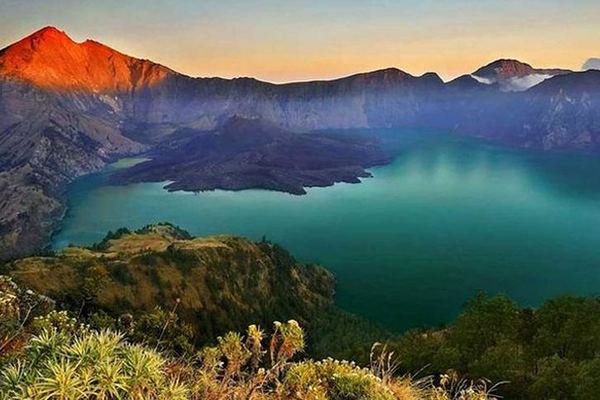
Rinjani 3 Days: Both Crater Rims, the Summit and Segara Anak Lake
The two-day packages make you choose between the summit and the lake. Three days holds the summit, both crater rims and Segara Anak lake in one walk.
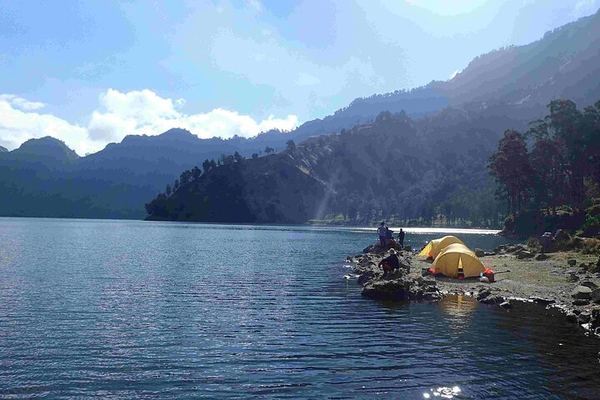
Rinjani 3 Days in Reverse: Up the Cool Senaru Forest, Out Through Sembalun Savanna
Run in the opposite direction to most three-day packages: the shaded forest climb first, then the lake and hot springs, and the summit only after them.
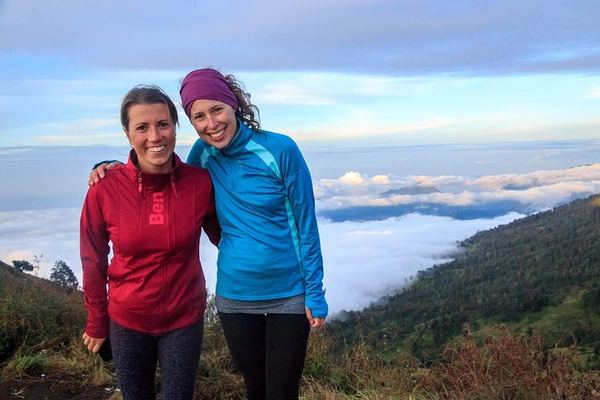
Rinjani 3 Days, Sembalun to Senaru: Summit, Lake and a Second Rim in One Day
The shortest package that still reaches every point, at the price of a middle day holding the summit, the descent to the lake and a second climb to Senaru.
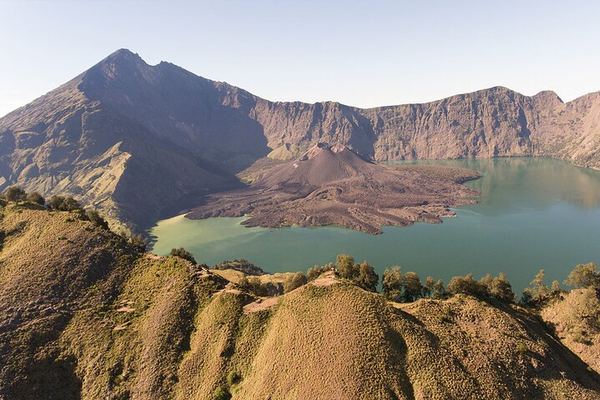
Rinjani 3 Days: Sunrise Over the Wallace Line, Edelweiss on the Ridge Down
Your medical card and trekking pass QR code are handed over at Sembalun, and the descent from the summit follows a ridge of edelweiss back down to camp.
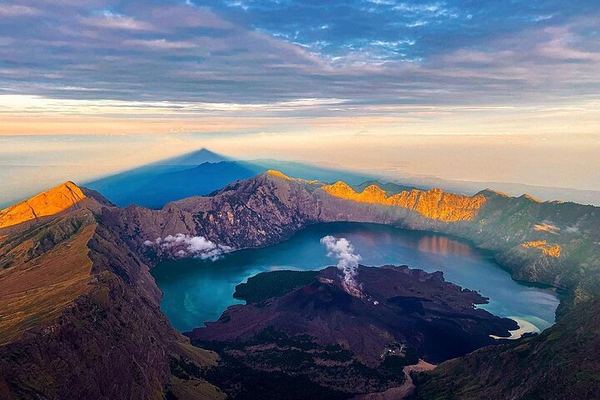
Rinjani 3 Days Through the Grasslands: Summit, Lake and Hot Springs
The first day crosses open grassland rather than forest, and the Sembalun rim camp faces the crater lake, the summit and northern Lombok at sunset.
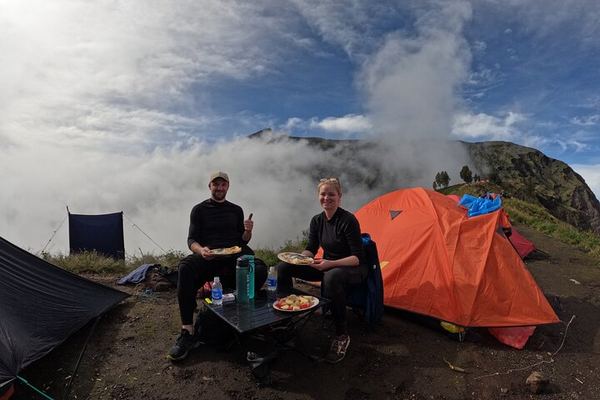
Rinjani 3-Day Summit and Lake, with the Torean Route as a Way Out
If the second night on the Senaru rim falls through, this operator camps at the lake and walks out through Torean instead, keeping the trek at three days.
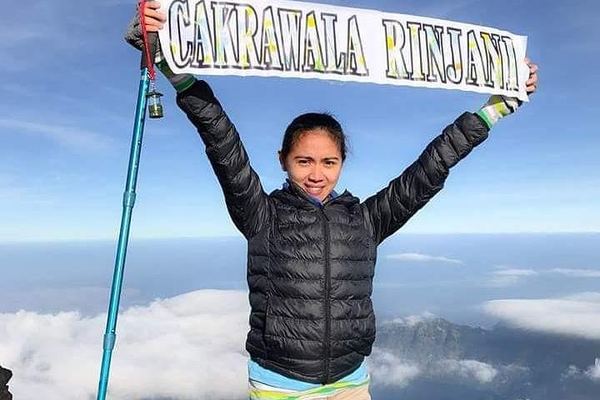
Rinjani 3 Days with Cakrawala: 2 a.m. Summit Start, Black Monkeys on the Way Down
Cakrawala states the requirement outright: eight hours of uphill and downhill walking a day, three days running, with the summit push leaving camp at 2 a.m.
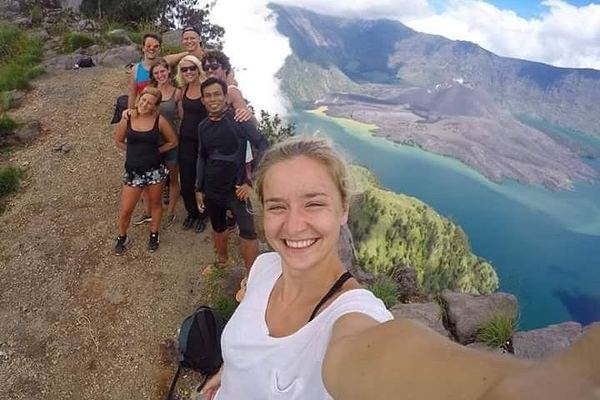
Rinjani's Second Summit: the Senaru Rim Trek This Operator Gives Families
The only Rinjani package this operator puts in front of first-time trekkers and families with children, camping on the Senaru rim for sunset and sunrise.
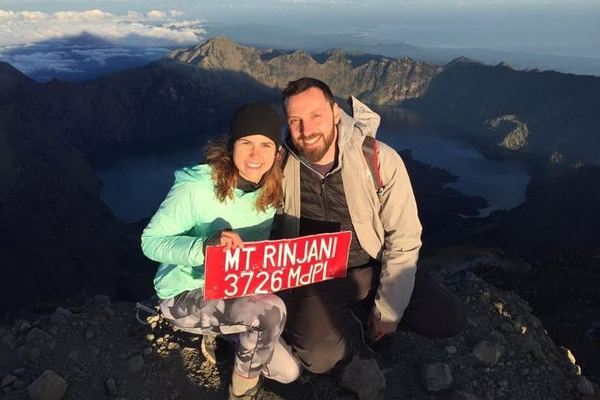
Rinjani Summit 2 Days with Em Adventure, a Sembalun Outfit: Groups of Six
A Sembalun-based outfit running the summit in two days with a maximum of six travellers per group, starting from your hotel and the park office registration.
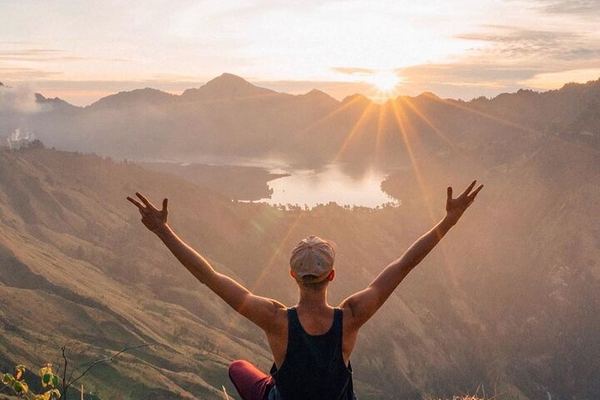
Rinjani Summit from Sembalun in Two Days: 1,156 m to 3,726 m and Back
The Sembalun route in its shortest form: camp on the rim at 2,639 m, summit early the next morning, then descend the full 2,570 metres to the village.
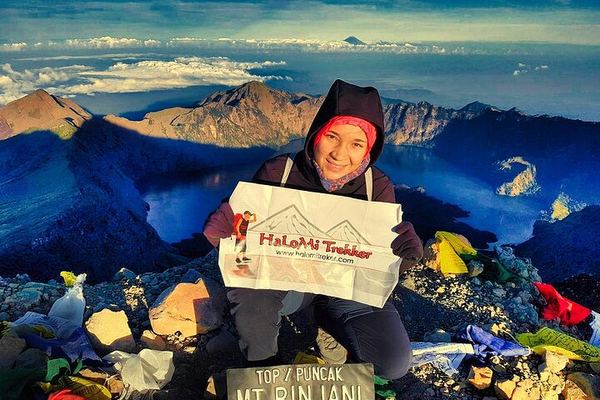
Rinjani Summit in 20 to 21 Hours of Walking: HaLoMi's 2D1N, Night Before Included
HaLoMi publishes the walking time rather than hiding it, and throws in the transfer the day before, so the two-day package actually runs three days.
Ratings collected by Viator and Tripadvisor
The three days
Almost every operator runs it in the same direction, Sembalun to Senaru, and there is a reason. Sembalun is higher to begin with and the first day crosses open savannah grassland rather than rainforest, which gets you to the rim with more left in your legs for the summit the next morning. Going the other way is greener and cooler on day one and leaves you with a longer climb before the summit push.
| Day 1 | Day 2 | Day 3 | |
|---|---|---|---|
| Start | Sembalun village, about 1,150 m | Plawangan Sembalun, 2,639 m | Segara Anak, about 2,000 m |
| High point | Plawangan Sembalun, 2,639 m | The summit, 3,726 m | Senaru crater rim, 2,641 m |
| Finish | Camp on the crater rim | Camp beside the lake | Senaru village |
| Terrain | Open grassland, then a long steep climb to the rim | Volcanic sand and scree, then a 600 m descent into the caldera | Climb out of the caldera, then rainforest down |
| Roughly | 6 to 7 hours | Summit from 02:00, back at camp mid morning, lake by afternoon | 4 to 5 hours down to Senaru |

The summit morning
You are woken between two and half past. It is a few degrees above freezing on the rim and colder on the ridge. The route to the top follows the crest, and after the first hour the ground turns to loose volcanic sand on a gradient where each step slides back. That section is what people remember, and it lasts a long time.
Sunrise is between half past five and six. On a clear morning the summit gives you the whole of Lombok, Mount Agung across the strait on Bali, Sumbawa to the east, and the lake in its hole a kilometre and a half below. Then you go back down the same sand, which is faster and much harder on the knees, and reach camp for a late breakfast before descending into the caldera.
The lake, the hot springs and the way out
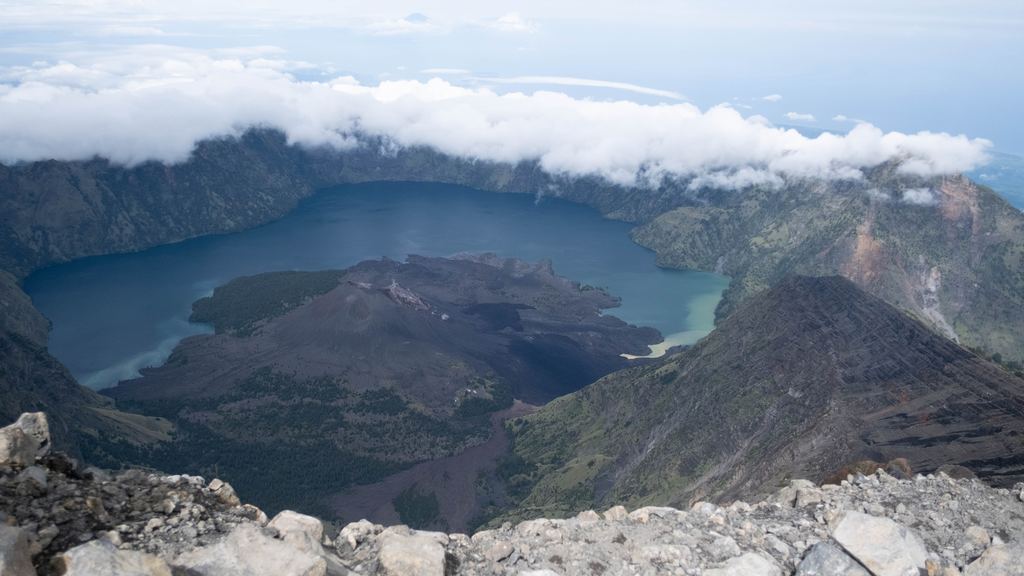
The second night is what separates this trek from the two-day rim walk. From the rim camp the path drops around 600 metres into the caldera to Segara Anak, where you can swim in the lake and then sit in the hot springs that run into it. One operator describes the view from the lakeside camp as the smoke coming out of the hole of the new volcano, which is Barujari, the young cone growing in the middle of the water.
On day three you climb out of the caldera to the Senaru rim and walk down through rainforest to the village. There is an alternative that one operator writes into its own description: if you cannot face the climb back out on the second day, you stay at the lake and descend the Torean valley instead, which follows a river out to the north and passes the Penimbungan waterfall, a hundred-metre cascade. It exists as a bail-out and it is worth asking your operator whether they will run it, because the alternative on a bad second night is a 600 metre climb on tired legs.
What is carried, and what it costs
The camp moves with you and you do not carry it. Porters take the tents, the toilet tent, the sleeping bags, the mattresses, the pillows and, on several operators, folding chairs and a table, along with all the cooking gear and the food, on shoulder poles. They walk the same ground you do in sandals and they arrive first.
What is not carried for you is your own luggage. An extra porter is quoted at 25 US dollars a day in the exclusions of one of the listings here, which over three days is a meaningful sum and still the right call if you have never done a summit push with a full pack. Tips for the guide and porters are also excluded everywhere and are expected.
One operator includes a medical check at 25,000 rupiah per person and a plastic rain coat, and provides the transport from Senaru across to Sembalun to start. Those small inclusions are a decent proxy for how organised an operator is, because they are the things a careless one leaves you to sort out at seven in the morning.
| Item | Typical figure | Notes |
|---|---|---|
| National park permit | IDR 200,000 to 250,000 per person per day | Sources disagree; one operator states 250,000 and invoices separately |
| Compulsory insurance | IDR 290,000 per person per trek | Includes helicopter evacuation, required since 6 March 2026 |
| Extra porter for your own bag | About 25 USD per day | Stated in the exclusions of one listing here |
| Tips for guide and porters | Not fixed | Excluded by every operator, expected by all of them |
| Boots, jacket, gloves, torch | Yours | No operator here provides personal kit |
| Travel insurance | Yours | Separate from the compulsory park insurance |
How to spot the four listings that are not three-day treks
Eleven products sit under this heading and seven of them do what the heading says. Of the other four, three are genuine summit attempts compressed into two days and one is not a summit trek at all.
The two-day summit variant is a real thing and it is brutal. One operator states its own estimated total trekking time as 20 to 21 hours, which is the same mountain with one night instead of two and no lake. It exists for people with a fixed flight, and it is the version most likely to end short of the top, because the summit push comes after a single short night rather than a full day of acclimatisation and rest.
The one that is not a summit trek names itself Second Summit and sells the Senaru crater rim. Its own description opens by explaining that it is a two day one night package to the Senaru crater rim for beginners. Both the title and the description are the operator's. The description is the one telling the truth.
The test takes ten seconds. Open the description and look for the word Sembalun and the number 3,726. A real summit trek names its starting village and its high point, because those are the two things it is selling. A rim trek renamed for search traffic names neither.
Seven of the eleven listings here are three-day summit treks. Three are two-day summit attempts of 20 hours or more on foot. One is a beginners' walk to the rim with the word summit in the title.
Cold, and what it means at 3,726 metres
The temperature range across this trek is the thing people underestimate. You start in Sembalun at around thirty degrees. The rim camp at 2,639 metres drops to single figures overnight, and the summit before sunrise sits between zero and three, with wind. That is a spread of more than thirty degrees inside 36 hours, on a tropical island, and it is why every operator here excludes a jacket and gloves from the inclusions while listing them as required.
None of this needs technical clothing. A warm layer, a windproof shell, gloves, a hat and a head torch cover it. What does not cover it is the assumption that Indonesia is hot, which is the assumption people arrive with and which the summit ridge corrects at four in the morning.
When it runs
The park's calendar governs this route exactly as it governs the two-day one, so there is nothing separate to plan around: closed 1 January to 31 March, reopened 1 April in 2026, and at its best between June and September. The one difference worth noting is that the summit itself is more weather-dependent than the rim. Cloud on the ridge at five in the morning turns the view into nothing, and guides will turn a group round for wind on the sand section in a way they would never do on the walk up from Senaru.
Questions people actually ask
How hard is the summit push?
It is the hardest part of the trek by a distance. Roughly 1,100 metres of ascent starting at two in the morning, the last long section on loose volcanic sand at a gradient where you slide back with each step. It is not technical and no equipment is needed beyond warm clothes and a head torch. It is a matter of persistence in the cold and the dark for three to four hours.
Can I do the summit in two days instead of three?
It is sold, and one operator states the total trekking time as 20 to 21 hours across the two days. You camp on the Sembalun rim, summit the next morning and come straight back down without seeing the lake or the hot springs. It is the version most likely to end short of the top, because the summit push follows one short night rather than a proper rest day. If the summit matters, take three days.
Do I swim in the crater lake?
Yes, if you are on the three-day route. The second night is at Segara Anak at about 2,000 metres, and the hot springs that run into the lake are a few minutes from the camp. The lake itself is cold. This is the main thing the two-day rim trek does not include, and for many people it is the better half of the trip.
Which direction should the trek run?
Sembalun to Senaru, which is how almost every operator here runs it. Sembalun starts higher and crosses open grassland, so you reach the rim camp with more in reserve for the summit the following morning. The reverse direction is cooler and greener on day one but leaves you a longer climb before the summit push.
What if I cannot climb back out of the caldera?
There is a way out down the Torean valley from the lake, which follows a river north and passes the Penimbungan waterfall instead of climbing 600 metres to the Senaru rim. One operator writes it into its own description as the solution if you cannot manage the second climb. Ask whether your operator will run it before you need it, not on the morning you do.
Do I need to hire an extra porter?
The porters in your package carry the camp, the cooking gear, the food and the water. Your own bag is yours unless you pay for a porter, quoted at about 25 US dollars a day in one listing here. Over three days that is a real cost. It is also the difference between enjoying the summit morning and surviving it, if you have not carried a full pack up 1,500 metres before.
How cold does it get?
Between zero and three degrees on the summit before dawn, with wind, and single figures overnight at the rim camp. Sembalun at the start is around thirty. Every operator excludes jackets and gloves from what they provide while requiring you to have them, so bring a warm layer, a windproof shell, gloves, a hat and a head torch.
Data verified on. Altitudes, timings, inclusions, porter and permit costs and the Torean alternative all read from the eleven products sold here. Closure dates and insurance from the Rinjani park authority.