
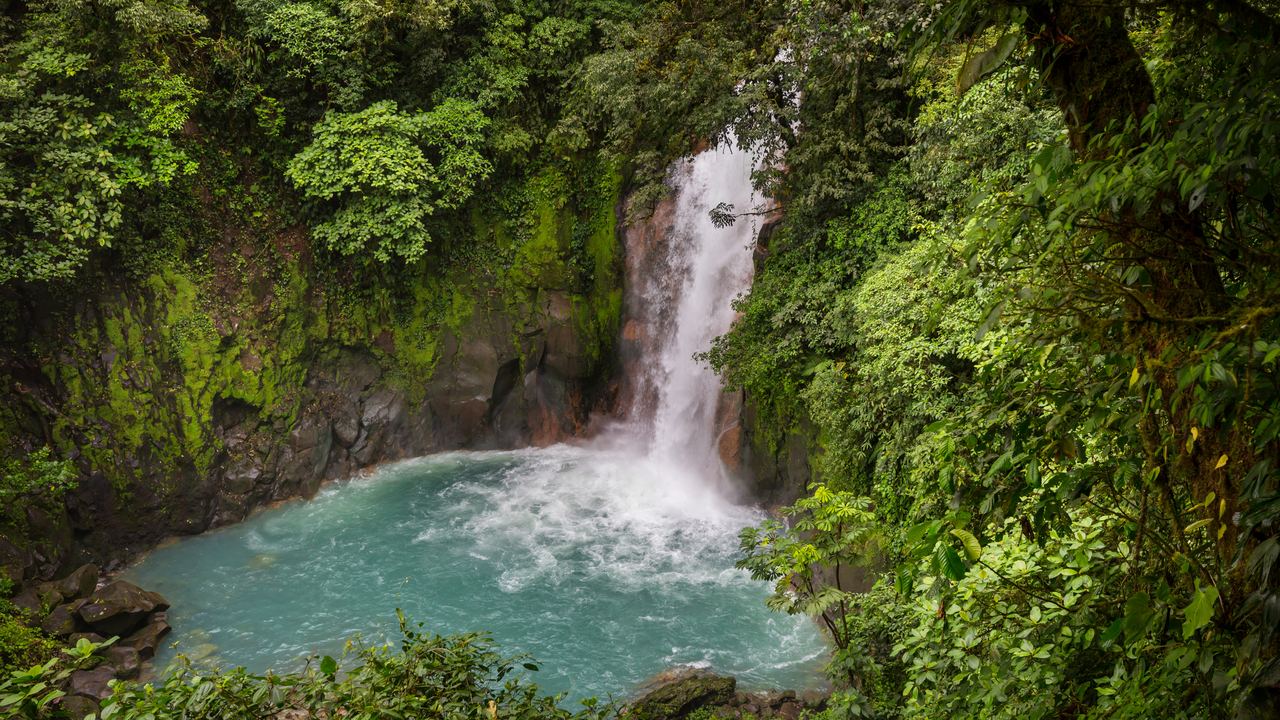
Miravalles: the Volcano That Powers Guanacaste
Mud pots you can get into, and a geothermal field producing around 162 MW. There is no national park here, and that changes how the whole day works.
Miravalles is the volcano in Costa Rica that goes to work. At 2,028 metres it is the highest peak in the Guanacaste cordillera, its last eruption was a small steam explosion in September 1946, and none of that is why it matters to the country. Under its southwestern flank lies a reservoir of superheated water that has been generating electricity since March 1994, and the field above it is the most productive geothermal development Costa Rica has. The visitor attractions are on the same heat, a few kilometres away.
That last point is the one that changes your day. Everywhere else in this region you book a park ticket through a government system and walk on public land with rangers and fixed rules. Here you buy a ticket from a business, and what you are allowed to do is correspondingly different, in ways that are mostly to the visitor's advantage.
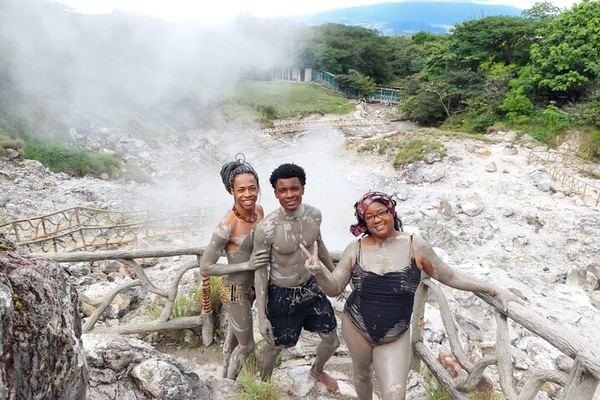
Las Hornillas: a Walk-Through Crater, and a Sauna on a Boiling Pool
The crater at Las Hornillas is one you walk through, the sauna is built over a boiling mineral pool, and the volcanic mud comes out of the same crater.
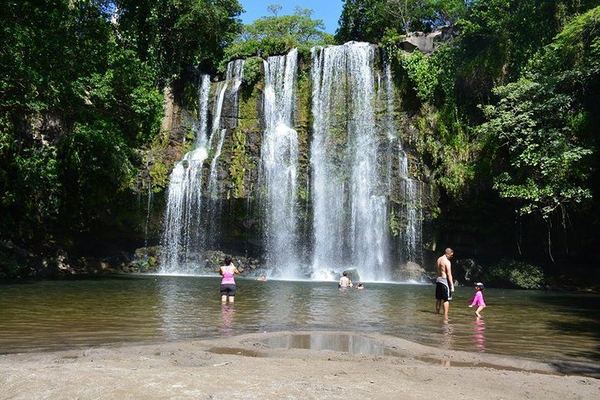
Miravalles: the Only Walkable Crater, and Mud Graded by Colour
The mud is colour-coded by depth, brown at two metres, grey at one, yellow off the surface, and you pick the one you want to bathe in. Cash for the waterfall.
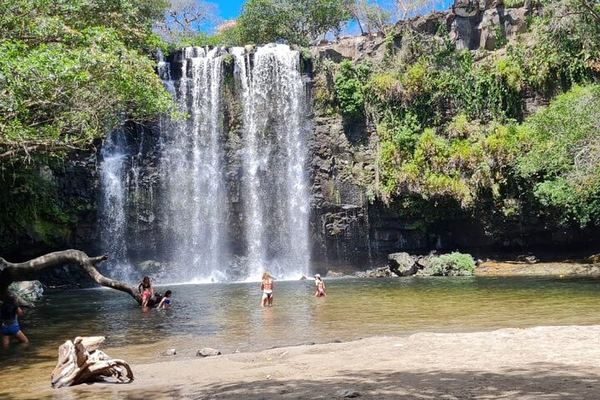
Miravalles with the Hot Springs Before the Hike, Not After
The crater, the thermal pools and the mud bath all happen before lunch, and the guided hike over the hanging bridges and three waterfalls comes afterwards.
Ratings collected by Viator and Tripadvisor
The volcano with a day job
Exploratory drilling on the southwestern flank in 1979 and 1980 found what geologists call a liquid-dominated reservoir: an area of roughly 15 square kilometres where water held under pressure sits hot enough to flash into steam when it is brought up a pipe. Generation began in March 1994. The field now runs on the order of 61 wells and has an installed capacity of about 162 megawatts, which makes it the most developed geothermal resource in the country. It has also reached the ceiling of what it can be asked to produce.
The reason this matters to Costa Rica specifically is dry-season arithmetic. The national grid runs overwhelmingly on renewables, and the largest single share is hydroelectric, which weakens exactly when the rains stop. Geothermal does not care about the weather or the time of day. It is the part of the system that holds steady in February when the reservoirs are low, and Miravalles is the biggest piece of it.
You will not tour the plant. What you will see, driving in, is the infrastructure of it: pipework crossing the fields on trestles, wellheads, and plumes of white vapour standing over the sugarcane. Most visitors mistake the steam for volcanic activity. It is not. It is a power station, and the distinction between the volcano's own fumaroles and the cooling towers of the plant is the single most useful thing a guide can point out on the way up.
| Detail | |
|---|---|
| Reservoir found | Exploratory wells, 1979 to 1980 |
| Generating since | March 1994 |
| Installed capacity | About 162 MW |
| Wells | Roughly 61 |
| Reservoir area | About 15 km², under the southwestern flank |
| Operator | The national electricity institute, ICE |
| Status | The country's most productive geothermal field, at its extraction ceiling |
Miravalles or Rincón: the mud pots are not the same product
Both destinations sell boiling mud, they are an hour apart, and most people booking one has never been told how they differ. The difference is not geological. It is legal, and it decides what you are permitted to do when you get there.
| Miravalles | Rincón de la Vieja | |
|---|---|---|
| Land | Private, several separate operators | National park |
| Booked through | The operator directly, or a tour | The national reservation system, in advance |
| Entry cost | No park fee; private admissions instead | 15 USD plus 13% tax |
| How close you get | Close, and you can bathe in the mud | Behind a rail on a marked loop |
| The walk | Short, and most of the day is water | 3.5 km loop, about 2 hours |
| Hot springs | The point of the visit | Outside the park, sold separately |
| Closed days | None fixed | Mondays, in the Las Pailas sector |
| Wildlife | Incidental | 300-plus bird species, three kinds of monkey |
Put plainly: Rincón is the better walk and the better wildlife, and it keeps you at arm's length from everything. Miravalles is the better soak. If the appeal of a geothermal area is getting into it rather than looking at it, this is the one, and it is the reason all three listings here are built around thermal pools and a mud bath rather than a trail.
At Rincón de la Vieja you photograph the boiling mud from behind a wooden rail. At Miravalles you are handed a bucket of it.
What "the only walkable crater in the country" actually means
One listing here describes this as a rare chance to explore the only walkable volcanic crater in Costa Rica. That is a stretch and it is worth unpicking, because it is the kind of line that sets an expectation the day cannot meet.
You are not walking into the summit crater of Miravalles at 2,028 metres. What the tours visit is the geothermal ground on the lower flank, in the sector generally known as Las Hornillas, where secondary vents, mud pots and fumaroles sit in an area you can move around on foot. The ground temperatures quoted by one operator run from about 40 to 100 °C, which is accurate and is also the reason there are boardwalks and boundaries even on private land.
It is a genuinely good couple of hours and it is more intimate than anything the national parks allow. It is simply not a summit crater, and Irazú, an hour from San José, has a rim you can drive to and walk along. Read the claim as marketing for the secondary vents rather than a description of the mountain.
No national park, and what that changes
Miravalles is protected, but not as a national park. It sits in a protected zone, and that classification carries a different set of rules: there is no park gate, no ranger station selling entry, and no listing on the national reservation system that every other volcano in this guide depends on. When the system was checked on 12 August 2026, Miravalles did not appear on it, and that is not a closure. It is a category.
Three practical consequences. You cannot turn up and buy a national park ticket, because there is not one to buy; you book with whichever hot spring, mud bath or adventure centre you intend to visit. Prices are set by those businesses rather than by a fee schedule, which is why the three listings here cluster tightly between 157 and 168 EUR while nearby destinations range from 44 to 309. And the opening hours, safety rules and what you may touch are the operator's, so they vary from one property to the next in a way that park rules do not.
On seasons, the short version is that this destination is the least weather-dependent in Guanacaste, because the attractions are hot water and hot water is indifferent to the forecast. The road in is easier in the dry months. That is the whole of it, and the regional pattern is set out on the page above.
The three trips
All three run roughly six hours, all three leave from Liberia or the Pacific beaches at Playa Flamingo and Playa Hermosa, and all three combine the same elements in a slightly different order: the geothermal ground, a mud bath, thermal pools, a sauna, waterfalls and in two cases hanging bridges over the forest. Prices run 157, 163 and 168 EUR, and the ratings sit at 4.8, 4.8 and 4.9. There is no cheap option here, and there is no bad one.
What separates them is mostly the walking. One is built around a hike to a secondary crater and back through jungle hot springs. Another is explicitly described as suitable for all fitness levels and warns only against travellers with spinal injuries, which tells you the mud bath and the pools are the main event. If mobility is a consideration, that distinction is the one to read the listing for, and it is stated clearly in all three.
The wider point about this corner of Guanacaste is that it is quiet. Rincón de la Vieja carries a national park's traffic and Río Celeste carries twelve tour operators; Miravalles carries three, and one of them describes itself, fairly, as off the beaten path. That is a real difference on the ground and it is most of the reason to choose it.
Questions people actually ask
Is Miravalles a national park?
No. It is a protected zone, which is a different classification, and it does not appear on the national park reservation system. There is no park gate and no government entry fee. Everything a visitor does at Miravalles happens on private land, booked directly with a hot spring, mud bath or adventure centre, or through a tour that has done that for you.
Can you climb Miravalles?
Not in the sense of reaching the 2,028 metre summit on a commercial tour. What the trips here walk is the geothermal ground on the lower flank, where secondary vents, mud pots and fumaroles sit in an area you can move around in on foot. One listing calls this the only walkable volcanic crater in the country, which overstates it: Irazú, near San José, has a rim you can drive to.
How is it different from Rincón de la Vieja?
Rincón is a national park with a 3.5 kilometre loop, serious wildlife and boiling mud you view from behind a rail, for 15 US dollars plus tax. Miravalles is private land where you get much closer, bathe in the mud and spend most of the day in thermal water, at prices set by the operator. Rincón is the better walk; Miravalles is the better soak, and it is far quieter.
When did Miravalles last erupt?
September 1946, and it was a small steam explosion on the southwestern flank rather than anything dramatic. There is no eruptive activity to see. The heat is all in the hydrothermal system underneath, which is what feeds both the mud pots and the power station.
What is the geothermal plant and can I visit it?
It is the country's largest geothermal development, run by the national electricity institute: generating since March 1994, roughly 61 wells, and about 162 megawatts of installed capacity drawn from a reservoir of some 15 square kilometres under the flank. It is an industrial site and is not part of the tourist circuit. You will see its pipework and its steam plumes from the road, and it is worth knowing that those plumes are a power station rather than the volcano.
How much does it cost and where do the tours start?
Between 157 and 168 EUR for a day of about six hours, leaving from Liberia, Playa Flamingo or Playa Hermosa. All three include the geothermal ground, thermal pools and a mud bath, with waterfalls and hanging bridges added in various combinations. The narrow price band is a consequence of there being no park fee to vary: you are buying an operator's package rather than an entry ticket plus transport.
Is it suitable if I do not want to hike?
Yes, and this is where Miravalles beats every other volcano in the region. One of the three listings is described as suitable for all physical fitness levels, with a caution only for travellers with spinal injuries, and most of the day is spent in water. If you want the geothermal experience without a national park's walking, this is the destination that answers it.
Data verified on. Prices, durations and inclusions from the three Miravalles products on this site. Geothermal figures from the published record; protected-area status checked against the SINAC reservation system.